DIEGO F PARRA · CREATOR OF THE MASTERESTAURANT® METHODOLOGY
HOSPITALITY GROUPS EXPERTWho does leadership in Ecuador call when the group grows and the standard falls behind?
What worked with three sites in Ecuador collapses at twenty. The difference is not the team's talent: it is that nobody wrote the standard down, and without one every opening starts from zero.
In Ecuador, a hospitality group is organized around one principle: measure first, standardize next, and only then expand. That is the rule of the MASTERESTAURANT methodology and its TOOLKIT, applied across 8,400+ restaurants in 43 countries, from a single unit to portfolios with dozens of brands.
Measuring means putting each brand's and each unit's economics on the table before anything is decided: which brands to back, which to restructure and which site is carrying which. Standardizing means manuals, processes and operational control so site fifty delivers what site one delivers. Expansion comes last, once there is a documented standard and a profitable unit to replicate. The method adapts to the size of the group, its stage and its market.
How does consulting for hospitality groups work in Ecuador?
It begins by putting the group's portfolio in Ecuador on the table, brand by brand and site by site, with the numbers behind each one. Measurement comes first, standardization second and expansion last.
An owned site, a license and a franchise are three different risks, and the group chooses between them once the standard is documented and the team is mature. The plan covers portfolio strategy and capital deployment, multi-site standardization with operational control and consistent quality, financial governance with dashboards the board can decide on, talent and structure, and entry into new markets. Leadership is supported through implementation, the group's information stays confidential, and the work runs on site or virtually, in English or Spanish, sized to the group's complexity. As context for a group in Ecuador, this page cites four verified figures, local or industry-wide, from sources such as INEC and CoStar.
What do the numbers tell a hospitality group in Ecuador?
88,654 jobs in accommodation and food services (2021), +5.3% in 2022 — national employment in the accommodation and food services sector, according to INEC.
A market figure puts a portfolio in context, but it does not say which brand or site deserves the next investment. For a hospitality group, the numbers guide capital allocation. Other reference points cited on this page: +7.8% (Middle East hotel RevPAR, YTD through August 2025 — CoStar); US$ 5.4T (domestic tourism spending reached US$ 5.4 trillion in 2024, the sector's largest demand source — the World Travel & Tourism Council); 5.4% (average monthly staff separations rate in US accommodation and food services, 2024 — the U.S. Bureau of Labor Statistics). The question is which brand has room to grow in Ecuador, whether the documented standard can travel to a new site and whether Prime Cost holds at group level. The figures inform the bet; the group's own unit economics decide it.
Data
Reference figures for hospitality groups in Ecuador
The figures cited on this page, local or industry-wide, with what each one measures and its source.
Figure
What it measures
Source
US$ 5.4T
Domestic tourism spending reached US$ 5.4 trillion in 2024, the sector's largest demand source
World Travel & Tourism Council (WTTC)
+7.8%
Middle East hotel RevPAR (YTD through August 2025)
CoStar (STR)
88,654 jobs in accommodation and food services (2021), +5.3% in 2022
National employment in the accommodation and food services sector
INEC - Registro Estadístico de Empresas (REEM) 2022
5.4%
Average monthly staff separations rate in US accommodation and food services (2024)
U.S. Bureau of Labor Statistics
Each figure links to its source in the data cards on this page.
The local market
How a hospitality group competes in Ecuador
Expanding a hospitality group—whether a hotel chain, restaurant holding, or multi-brand food and beverage operation—multiplies operational complexity exponentially. Growing from three to twenty units is not a threefold increase; it transforms the entire structure of costs, process standardization, financial governance, and management retention. Without that redesign, what worked with a handful of locations collapses. Most groups expand by commercial impulse—a real estate opportunity, an interested franchisee, a market that seems promising—without strategic portfolio architecture, without replicable operational manuals, without per-unit profitability metrics, without decision structures for capital allocation across brands. As a result, profitability erodes: each new opening absorbs operational talent from existing units, standards degrade, margins compress. Specialized consulting for hospitality groups fills exactly that gap: it transforms growth by impulse into governed expansion.
The transformation delivered by this consulting is building a gastronomy-based enterprise operated by systems, not by heroes. Diagnosis begins at the portfolio level: which brands generate real profitability, which ones drain capital, where is replication potential. From there, unit strategy is designed: location selection, cost architecture, Prime Cost governed at group level (not in isolation per unit), protected operating margins. Then comes multi-site standardization: process manuals, inventory control systems, replicable talent structures, centralized financial governance. The MASTERESTAURANT toolkit—integrating diagnosis, strategy, standardization, and dashboards—adapts entirely to the group's operation: its numbers are known, market structure understood, local constraints mapped. The result is not theory: it is a group that opens new locations knowing precisely what operating margin it will replicate, in what timeline, and with what talent structure. The board makes decisions on data, not intuition.
Diego F. Parra has worked building and scaling hospitality operations across 43 countries. The MASTERESTAURANT methodology is implemented in over 8,400 restaurants and groups. As a C-Suite consultant, he has signed payrolls, negotiated leases, structured partnerships, and closed expansions in operations worth hundreds of millions of dollars. That global experience is not imported as dogma: it translates into structured questions about local market, consumer profile, talent availability, cost structure, and regulators. A hospitality group incorporating this consulting accesses twenty years of contrasted operational learning across multiple markets, currencies, regulations, and economic cycles. This reduces expansion risk—not because it guarantees success, expansion always carries risk—but because it converts decisions that would otherwise be speculative into decisions informed by systematic experience. For the board, that means confidence to scale.
The return for the group is measurable across four dimensions. First: per-unit profitability replicated. Each new opening meeting the group's operating margin model, without surprises from standard degradation. Second: portfolio decisions based on data. Which brands to strengthen, which to restructure, where to allocate capital, when to divest. Third: an operation that does not depend on the founder or heroic operators. Systems, manuals, and organizational structure make replicable what once depended on key individuals. Fourth: company valuation. A gastronomy group governed by systems, with a track record of consistent profitability, replicable units, and clear chain of command, is exponentially more attractive to investors: private equity, strategic buyers, franchisors. It is not an intangible return; it is architecture that transforms business value.
Market data
The hospitality group market in Ecuador in figures
US$ 5.4T
Domestic tourism spending reached US$ 5.4 trillion in 2024, the sector's largest demand source
Ecuador's hospitality ecosystem concentrates in Quito, Guayaquil, and Cuenca, with emerging niches in tourism zones (coastal regions, Amazon, Galápagos). In Quito, Mariscal, Cumbayá, and the north zone host mid-to-high level hotel groups, multi-brand food and beverage operations, and chains focused on corporate and international tourism. Guayaquil concentrates the highest food and beverage activity, with groups operating from dark kitchens to complex full-service establishments. Nature tourism (Galápagos, Amazon) generates seasonal but consistent demand for lodging and F&B services. Market structure differentiates between family-owned operators (viewing hospitality as a dispersed portfolio of businesses), small chains (3-8 units), and nascent holdings (10-20 units). Managerial talent is limited: operational executives with proven multi-site experience are scarce, making retention and scalability constant pressure points. The consumer, especially in Quito and Guayaquil, has grown more sophisticated, quality-demanding, and price-sensitive.
Expansion opportunity is real: international tourism markets grow, domestic F&B consumption advances in cities, and there is demand for professional operations. However, profitability erosion risks are concrete. Each new opening consumes operational talent: a proven manager in one location relocates to another, and the original unit is left with a substitute. Standards degrade because there are no transferable manuals or control systems that function without the founder's direct oversight. Lease costs in premium commercial zones (Mariscal in Quito, Samborondón in Guayaquil) compress margins, and competition from regional brands and international franchises intensifies. A group scaling from few to many units without structural redesign typically sees EBITDA per unit fall significantly. Additionally, regulatory volatility and inflation make models that worked in 2022 unviable by 2024. Consulting for hospitality groups does not eliminate those risks, but makes them predictable and manageable through systems.
RESOURCES
MASTERESTAURANT studies, guides & tools
Before your next move in Ecuador, these MASTERESTAURANT resources give real operating and profitability context:
The judgment behind this hospitality group consulting
Diego F Parra is an engineer and C-Suite consultant, and his trade for the last twenty years has been walking into restaurants, franchises, dark kitchens and HORECA groups across four continents to create them, rescue them or expand them. Along the way he signed payrolls, negotiated leases, structured partnerships and closed expansions in operations worth hundreds of millions of dollars.
The MASTERESTAURANT® methodology came out of that, and is used today by 8,400+ restaurants across 43 countries, with its TOOLKIT: MTIE, Gastronomic Radar, Standard Recipe Generator, Tech Sheets and KPI Dashboard. For an owner that means every decision is made on his own numbers and on tested processes, not on a hunch from the last good weekend.
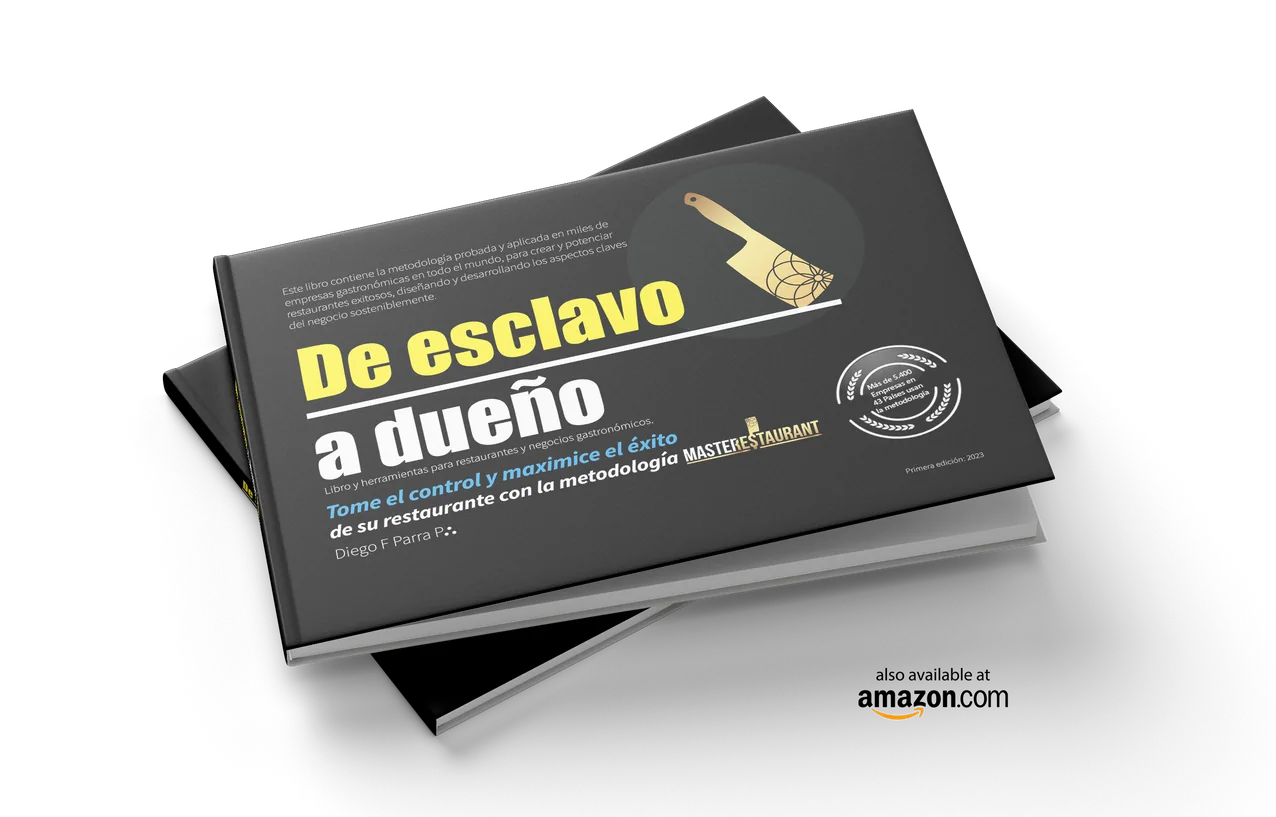
His published work backs it: Author of 3 ISBN-registered books, including «De esclavo a dueño», creator of the industry's leading podcast and of the largest bilingual community of owners, chefs and operations directors in the region (65M+ views per year as @masterestaurant), recognized among the top Latino restaurant operations experts globally. See Diego F Parra's professional profile.
Hospitality group consulting with its own doctrine, not generic frameworks
Consulting for hospitality groups is not solved with management theory, but with a method of its own. Every engagement is built on the Restaurant Model Canvas and real industry data—profitability, Prime Cost, cost structure, multi-site standardization and expansion—applied to the specific business model of a hotel or restaurant group, a chain or a holding. The goal is not to add brands or openings, but to build a business system that replicates per-unit profitability, governs the portfolio and sustains operations without depending on founders or operational heroes. That is why the work leaves Prime Cost governed at group level, EBITDA per unit and indicator dashboards the board decides on without commissioning a report.
For groups already trading that need order before growth
A specialized, personalized 1-on-1 service for new and existing restaurants of:
Before the next opening
The cheapest moment to standardize: replicating a tidy model costs the same as replicating a messy one and returns twice as much.
Mid-restructuring
When it is time to decide what to close, what to convert and what to hold, on judgement rather than seniority.
Before franchising
Without manuals, quality control and a profitable unit, a franchise multiplies reputational risk instead of margin.
Ahead of incoming capital
Funds and family offices that need a legible, defensible operation before they sign.
What's included
What the engagement with leadership includes
These are the MASTERESTAURANT methodology modules your tailor-made programme is built from:
The numbers of every unit before any plan
EBITDA per site and per brand
Prime Cost with a single definition group-wide
Manuals and processes that travel to every site
A shared indicator dashboard for leadership
Organizational structure and trained managers
Menu engineering consistent across the network
Criteria to back, restructure or close
A staged expansion plan
Investment: from USD $50K to USD $500K+ - tailor-made hospitality programs, priced to the group's size and complexity - spots LIMITED worldwide.
Corporate programs
Tailor-made hospitality consulting programs for groups and chains
Every hospitality program is 100% personalized and tailor-made to the group, and it starts with a strategic portfolio diagnosis, brand by brand and unit by unit. From there it works through the key elements of the business model in the MASTERESTAURANT Restaurant Canvas: portfolio strategy and capital allocation, multi-site standardization, financial governance and decision dashboards, talent and structure, and expansion, franchise or new markets, with support for leadership during implementation. It is priced to the size and complexity of the group (from USD $50K to USD $500K+), with limited spots worldwide to ensure dedicated attention and discretion for each client.
Diego F Parra is the consultant that business groups, chains, holdings and family offices choose to grow, standardize and expand their restaurant portfolio with profitability and governance.
An engineer and C-Suite consultant, he is the author of 3 ISBN-registered books and the creator of the MASTERESTAURANT methodology and its technology suite (MTIE, Gastronomic Radar and KPI Dashboard), applied by 8,400+ restaurants across 43 countries. His method comes from two decades of creating, rescuing and expanding restaurants, franchises, dark kitchens and HORECA groups across four continents. That is why he comes to the board with tools proven in real operations and reviews each brand and each site before recommending an opening, a restructuring or a franchise.
The book that changed how restaurants are managed: practical strategies and tools based on more than 20 years of experience, for traditional restaurants, dark kitchens, foodtech and HORECA businesses.
Triunfar o Morir en el Intento
Practical tools and key strategies to design and operate restaurants and food businesses efficiently.
Podcast: Masterestaurant — Mistakes for Restaurants
The public autopsy of the mistakes that bankrupt restaurants: owners and managers listen on Spotify to avoid repeating them. Condensed operating doctrine, open to everyone.
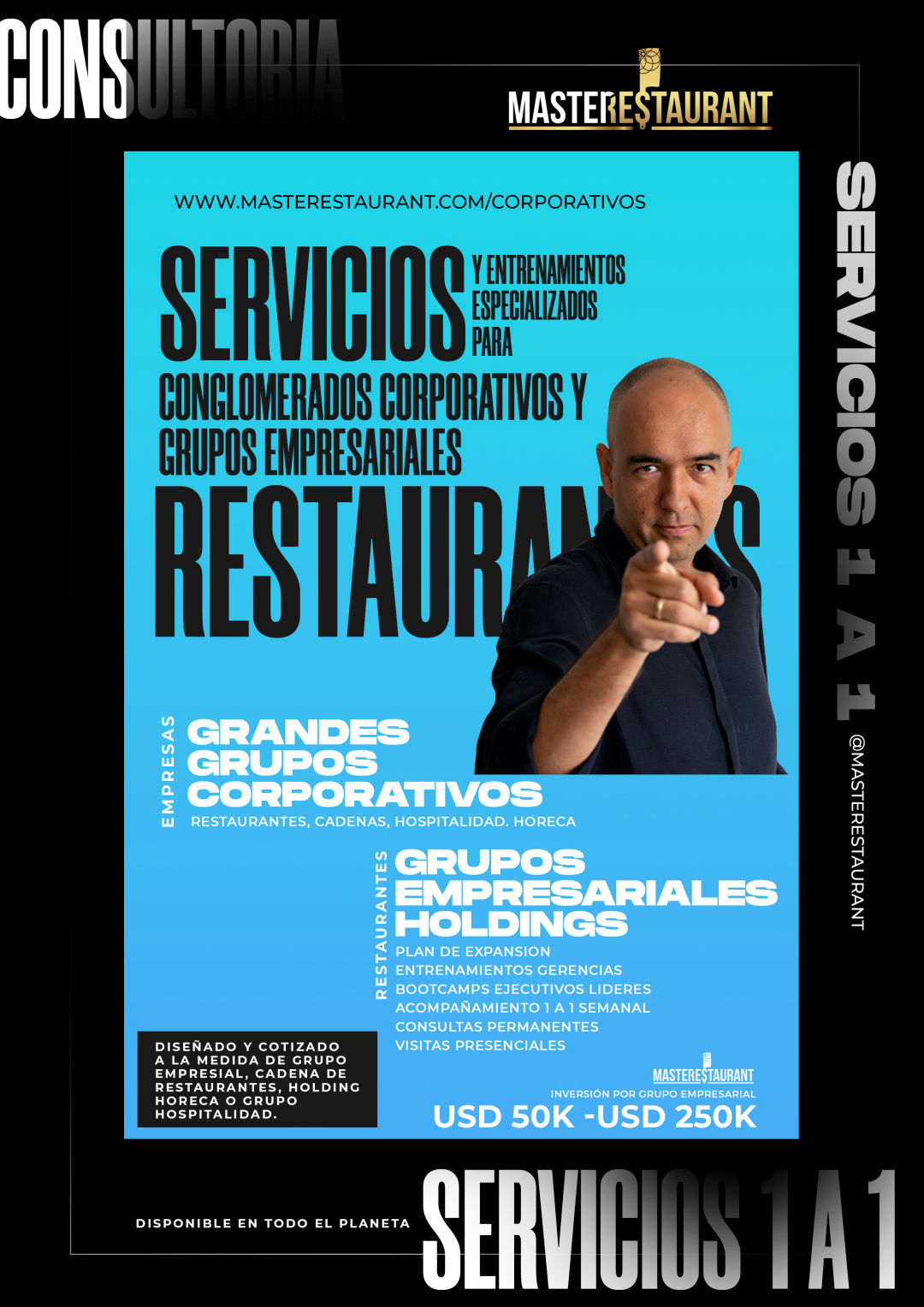
The complete corporate intervention catalog: consulting, executive bootcamps, advisory and specialized services, with scopes and formats. The document to decide with your board.
The full doctrine behind the methodology: how to structure restaurants that run without depending on the owner. Ideal pre-reading before your group's diagnosis.
Beyond hospitality group consulting, Diego F Parra and his team offer keynotes, mentoring, training, programs and a membership, all built on the same method and the same tools. In a hospitality group that means the work can be split by level: keynotes for the board and managers, training for each site's leaders and mentoring for whoever runs a brand, all on the same indicators. If what you need goes beyond consulting, the full ecosystem is available:
Get a quote for hospitality consulting for your group in Ecuador
Your message goes straight to Diego's team: group or chain, number of sites, stage and what you need to achieve in Ecuador.
“A hospitality group grows or dilutes because of its business system, never because of its opening pace. I've seen groups open twenty locations in two years and collapse in margin; others double size in four years and protect profitability. The difference is not founder capacity: it is operational architecture. In any market, that architecture is what enables you to scale.”
Diego F. Parra — International consultant, expert in creating, scaling and improving restaurants, HORECA and hospitality
MASTERESTAURANT® methodology applied by 8,400+ restaurants across 43 countries · Author of 3 ISBN-registered books, including «De esclavo a dueño» · 20+ years operating restaurants, franchises, dark kitchens and HORECA groups across 4 continents
Restaurant groups: territories, services and ecosystem resources
Useful links for boards and leadership teams weighing hospitality group consulting before deciding: nearby territories where the same service is available, sister services in the MASTERESTAURANT ecosystem, Diego F Parra's professional profile and management tools.
How is the per-unit profitability model exactly structured? What assurance is there that margins will replicate if we double our number of locations?
The model begins by diagnosing real Prime Cost of each existing unit: merchandise cost plus direct payroll plus rent, disaggregated by business line. Operating margin target is built using market benchmarks and the group's cost structure. For each new opening, expected Prime Cost is projected using location data, unit type, and comparative experience. The model is validated in real-time with performance dashboards. There is no absolute guarantee (markets are volatile), but predictability: if the model says 28% Prime Cost, you will execute between 26-30%, not surprises of 35-40%.
We operate with a founder who makes all major operational decisions. How do we transition to portfolio governance without losing that 'iron hand'?
The transition is structural, not cultural. You define who decides what: the board decides capital allocation across brands; the C-Suite decides standard operations via indicators; the founder focuses on long-term strategy and key relationships. Manuals, dashboards, and decision chains distribute the 'iron hand,' not eliminate it. In fact, the founder gains: time is freed from micromanagement and refocused on what only he can do.
What is the most expensive mistake in a group that is expanding?
Opening before standardizing. The new site copies the good and the bad of the previous ones, and past a certain number nobody can say which version of the standard each location is running.
We turn over more and earn less. What is happening?
Almost always structure: group fixed costs that grew with the openings and a Prime Cost nobody governs corporately. It shows the moment you look at EBITDA per unit.
What part does talent play in this?
A decisive one, which is why the engagement includes organizational structure and leadership development. A written standard without trained managers to hold it lasts until the first high season.
Do you help funds and family offices?
Yes: operational due diligence, value thesis and support to management, to enter or grow in hospitality with industry judgement.
What is the investment for a hospitality program?
Hospitality programs range from USD $50K to USD $500K+ and are priced to the size and complexity of the group, the number of sites and the scope of the engagement. They are quoted to fit after the diagnosis.
Community
Join our MASTERESTAURANT Community for FREE
Restaurant owners and teams from 43 countries sharing knowledge, tools and applied AI — straight to your WhatsApp.
 MASTERESTAURANT®