 MASTERESTAURANT®
CBRE forecasts U.S. hotel RevPAR growth of 1.3% for 2025
CBRE Hotels 2025
Multi-site standardization · Kawasaki

DIEGO F PARRA · CREATOR OF THE MASTERESTAURANT® METHODOLOGY
HOSPITALITY GROUPS ADVISORY Who can say in Kawasaki which brand in the portfolio is carrying which, with numbers rather than instinct?
What worked with three sites in Kawasaki collapses at twenty. The difference is not the team's talent: it is that nobody wrote the standard down, and without one every opening starts from zero.
Download the portfolio (PDF)Corporate advisory spots LIMITED worldwide - reserve your group's evaluation early
8,400+restaurants apply his methodology
43countries with supported groups
65M+views per year
2service languages: EN - ES
International validation
See Diego F. Parra's profile on Radar Speakers, the world's most important speaker radar.
See profile on Radar Speakers →
1.3%
45,000+
more than 1.53 million inhabitants
4%

@masterestaurant
Per-unit profitability, not just group turnover
In Kawasaki, a hospitality group is organized around one principle: measure first, standardize next, and only then expand. That is the rule of the MASTERESTAURANT methodology and its TOOLKIT, applied across 8,400+ restaurants in 43 countries, from a single unit to portfolios with dozens of brands.
Measuring means putting each brand's and each unit's economics on the table before anything is decided: which brands to back, which to restructure and which site is carrying which. Standardizing means manuals, processes and operational control so site fifty delivers what site one delivers. Expansion comes last, once there is a documented standard and a profitable unit to replicate. The method adapts to the size of the group, its stage and its market.
How does consulting for hospitality groups work in Kawasaki?
It starts with a strategic diagnosis of the group in Kawasaki, brand by brand and site by site, with each one's unit economics on the table. The sequence is fixed: measure, standardize, and only then expand.
MASTERESTAURANT's hospitality consulting works with hotels, restaurant chains, F&B operations and holdings that have to decide where to put the next round of capital and which brands or sites have earned it. The diagnosis becomes the plan: portfolio strategy and capital allocation, multi-site standardization, Prime Cost control across the group with decision dashboards for the board, talent and leadership structure, and readiness for franchise, license or new markets. Leadership is supported through implementation, under confidentiality agreements, on site or virtually, in English or Spanish. As context for a group in Kawasaki, this page cites four verified figures, local or industry-wide, from sources such as Kawasaki City Government and CBRE Hotels 2025.
What do the numbers tell a hospitality group in Kawasaki?
more than 1.53 million inhabitants — population of Kawasaki City in 2025, an all-time record high, driven by growth in single-person households, according to Kawasaki City Government.
A market figure puts a portfolio in context, but it does not say which brand or site deserves the next investment. For a hospitality group, the numbers guide capital allocation. Other reference points cited on this page: 1.3% (CBRE forecasts U.S. hotel RevPAR growth of 1.3% for 2025 — CBRE Hotels 2025); 45,000+ (Saudi Arabia holds 67% of GCC hotel rooms under construction, over 45,000 keys — CoStar); 4% (global foodservice market growth in 2025 — Euromonitor International). The question is which brand has room to grow in Kawasaki, whether the documented standard can travel to a new site and whether Prime Cost holds at group level. The figures inform the bet; the group's own unit economics decide it.
Data
Reference figures for hospitality groups in Kawasaki
The figures cited on this page, local or industry-wide, with what each one measures and its source.
| Figure | What it measures | Source |
|---|---|---|
| 1.3% | CBRE forecasts U.S. hotel RevPAR growth of 1.3% for 2025 | CBRE Hotels 2025 |
| 45,000+ | Saudi Arabia holds 67% of GCC hotel rooms under construction, over 45,000 keys | CoStar / STR 2025 |
| more than 1.53 million inhabitants | Population of Kawasaki City in 2025, an all-time record high, driven by growth in single-person households | Kawasaki City Government |
| 4% | Global foodservice market growth in 2025 | Euromonitor International |
Each figure links to its source in the data cards on this page.
The local market
How a hospitality group competes in Kawasaki
A hospitality group—hotel chain, resort, restaurant holding, multibrand F&B operation—faces an operational reality that doesn't scale linearly: moving from three to twenty units is not opening five times faster, but multiplying fixed costs, regulatory complexity, service-delivery standards that diverge across locations, and management talent stretched thin across territories. In Kawasaki, where commercial corridors demand high-velocity capital deployment and competition for administrative talent is fierce relative to regional alternatives, growth without systematic design inevitably erodes per-unit profitability: each new opening requires replicable operational management systems, financial control per unit, and portfolio governance frameworks that most groups construct *only after* diluting their original margins irreversibly. Specialized hospitality group consulting addresses that structural gap: it's not accelerating store openings, it's architecting the *system* that binds each unit to corporate standards before expansion begins.
This hospitality group consulting service converts growth driven by commercial impulse into a governed gastronomic and hotel enterprise. The diagnostic phase maps each portfolio unit—cost structure, true operating margin, deviations from corporate standard—; strategy defines which brands to accelerate, which to restructure, and how to allocate capital between them. Execution follows: multi-unit standardization (process manuals, group-level vendor contracts, indicator dashboards tracking unit economics and Prime Cost governance), scalable organizational structure, and explicit expansion rules (franchising, partnerships, new openings). All integrated into the MASTERESTAURANT methodology: not generic consulting recommendations, but a proprietary toolkit—Restaurant Model Canvas, MTIE (Masterestaurant Territory Engine), Radar Gastronomico—and executive coaching that the board governs from data, not intuition or founder instinct.
Diego F. Parra's authority as a C-Suite consultant specialized in hospitality groups substantively reduces expansion risk: 43 countries, 8,400+ restaurants operating under his methodology, real C-level experience signing payrolls and negotiating leases in multi-hundred-million-dollar operations, and a proprietary technology suite (Restaurant Model Canvas, Radar Gastronomico, Technical Sheets, Indicator Dashboards) that has demonstrated predictive power in assessing unit viability before capital deployment. This is not academic consulting: it's the experience of an operator who has structured corporate entities, closed expansion deals, and guided board decisions on portfolio strategy across markets as diverse as Latin America, Europe, and Asia. That demonstrable track record gives shareholders confidence that your expansion plan in Kawasaki rests on battle-tested systems, not generic frameworks or commercial hunches.
Return on investment is operationally and financially measurable: each new unit replicates profitability from predecessors because it inherits standardized processes and governed metrics; margin per unit is protected because costs are granular and controlled at group level; the board makes portfolio decisions from data—which units to accelerate, which to redirect, how to allocate marketing spend and growth capital—instead of reacting to operational crises; operations cease to depend on the founder or isolated 'hero' operators, becoming a replicable system that attracts capital because it's auditable, predictable, and valuable. For a hospitality group in Kawasaki with ambitions to scale to new prefectures or F&B models, that independence from key individuals and that portfolio governance are competitive differentiators that also increase enterprise valuation in the market.
Market data
What the market data says in Kawasaki
Saudi Arabia holds 67% of GCC hotel rooms under construction, over 45,000 keys
CoStar / STR 2025Population of Kawasaki City in 2025, an all-time record high, driven by growth in single-person households
Kawasaki City GovernmentGlobal foodservice market growth in 2025
Euromonitor InternationalKawasaki as a market
Trade fairs, congresses and season in Kawasaki
Kawasaki's hospitality ecosystem is structured around its geographic position (30–45 minutes from Tokyo, primary rail hub) and its transition from industrial city to business and leisure destination. The Kawasaki Station and Kasao districts concentrate mid-range restaurant chains (casual dining, ramen, regional izakaya), business hotels targeting corporate travelers and nearby tourism, and ghost kitchens serving Tokyo consumers via delivery platforms. Administrative talent is competent but constrained—high cost of living, competition for director-level roles with Yokohama and Tokyo proper—and commercial rents are more predictable than central Tokyo but subject to seasonal occupancy margin pressure. Foodtech and multibrand operations are growing but fragmented: most groups operate 2–7 units without transversal standardization or portfolio margin governance, vulnerable to costly operational turnover and inconsistent unit economics. That market structure creates both demand for portfolio discipline and risk of failed execution without external expertise.
Expansion of a hospitality group in Kawasaki encounters genuine market opportunity and systematic operational risk. Local demand is robust—corporate tourism, metropolitan-area population of 1.5+ million, growing night-life and gastronomic experience consumption—and the market tolerates new brand entries. Risks, however, are structural and costly: each new unit multiplies administrative costs (manager salaries, audits, insurance), weak standardization leads to recipe and service drift that damages chain reputation, annual operational staff turnover runs high regionally (expensive to replace and train), and margin governance is fragile—what was profitable with a few units collapses with more absent shared dashboards and centralized vendor contracts. Many local groups discover by year five that they scaled revenue but lost per-unit profitability, converting themselves into operations vulnerable to cash-flow crisis or market shifts. The 'growth without system' pattern is nearly universal in Kawasaki's mid-market hospitality segment.
RESOURCES
MASTERESTAURANT studies, guides & tools
Before your next move in Kawasaki, these MASTERESTAURANT resources give real operating and profitability context:
- AI PROMPTHospitality Service Script Builder for Restaurants
- STUDYMarket Study for Gastrobar: Myth vs Reality in 2026
- WHITEPAPERMenu Engineering: Mathematical Models to Restructure Your Offering by Popularity and Marginal Profitability
- ARTICLERestaurante fisico vs dark kitchen alternativas
- CHECKLISTOwner Leadership in Restaurants: Traditional Waiter
- LISTRestaurant ticket average pricing: mistakes vs right · List
- COMPARISONRestaurant Social Media Content 2026: Mistakes vs the Right
The corporate consultant
The authority behind every profitable restaurant
Behind MASTERESTAURANT's hospitality group consulting is Diego F Parra: engineer and C-Suite consultant with two decades creating, rescuing and expanding restaurants, franchises, dark kitchens and HORECA and hospitality groups across four continents. He doesn't arrive with theory: he arrives with the experience of having signed payrolls, negotiated leases, structured partnerships and closed expansions in operations worth hundreds of millions of dollars.
He is the creator of the MASTERESTAURANT® methodology — applied by 8,400+ restaurants across 43 countries — and its TOOLKIT of tools (MTIE, Gastronomic Radar, Standard Recipe Generator, Tech Sheets and KPI Dashboard). For a brand, a group or an investor that means one thing: every decision is made on proven data and systems, not on intuition.
Author of 3 ISBN-registered books, including «De esclavo a dueño», creator of the industry's leading podcast and of the largest bilingual community of owners, chefs and operations directors in the region (65M+ views per year as @masterestaurant), and recognized among the top Latino restaurant operations experts globally. See his full track record in Diego F Parra's professional profile.
Hospitality group consulting with its own doctrine, not generic frameworks
Consulting for hospitality groups is not solved with management theory, but with a method of its own. Every engagement is built on the Restaurant Model Canvas and real industry data—profitability, Prime Cost, cost structure, multi-site standardization and expansion—applied to the specific business model of a hotel or restaurant group, a chain or a holding. The goal is not to add brands or openings, but to build a business system that replicates per-unit profitability, governs the portfolio and sustains operations without depending on founders or operational heroes. That is why the work leaves Prime Cost governed at group level, EBITDA per unit and indicator dashboards the board decides on without commissioning a report.
Corporate consulting from start to finish
Advisory that covers the full restaurant-group lifecycle
Diagnosis and portfolio strategy
Corporate diagnosis brand by brand and unit by unit, with each one's unit economics on the table before anything is decided.
Quote the diagnosisStandardization and multi-site control
Manuals, processes and operational control so site fifty delivers what site one delivers.
Quote the standardizationProfitability and financial governance
Prime Cost governed at group level, EBITDA per unit and indicator dashboards the board decides on without commissioning a report.
Quote the financial governanceExpansion, franchise and new markets
Owned site, licence or franchise are three different risks. The choice depends on the documented standard and the maturity of the team.
See the services portfolio (PDF)The methodology
Discover the MASTERESTAURANT methodology
A portfolio that grows profitably is governed by a system, not by gut feel: tools, processes and models you can audit.
Who is it for?
The portfolios where this work pays off most
A specialized, personalized 1-on-1 service for new and existing restaurants of:
Groups that grew fast
Openings quicker than the manuals: every site runs its own way and nobody can compare one with another.
Consolidated chains
Years of trading, layers of accumulated decisions and a per-unit margin that has been sliding without anyone knowing where.
Hotel groups with F&B
Restaurants, breakfast and events inside the hotel, with their own unit economics rather than diluted into the rooms account.
Multi-brand portfolios
Several brands under one house, each with its own margin, and a board that needs to compare them on the same terms.
What's included
The scope of work with the group, point by point
Every engagement is built tailor-made from these modules of the MASTERESTAURANT methodology:
- Corporate diagnosis and portfolio strategy
- Multi-site standardization and manuals
- Per-unit profitability and financial governance
- Menu engineering consistent across the network
- Organizational structure and leadership
- Indicator dashboards for the board
- Readiness for franchising and licensing
- Expansion into new markets
- Training for the leadership team
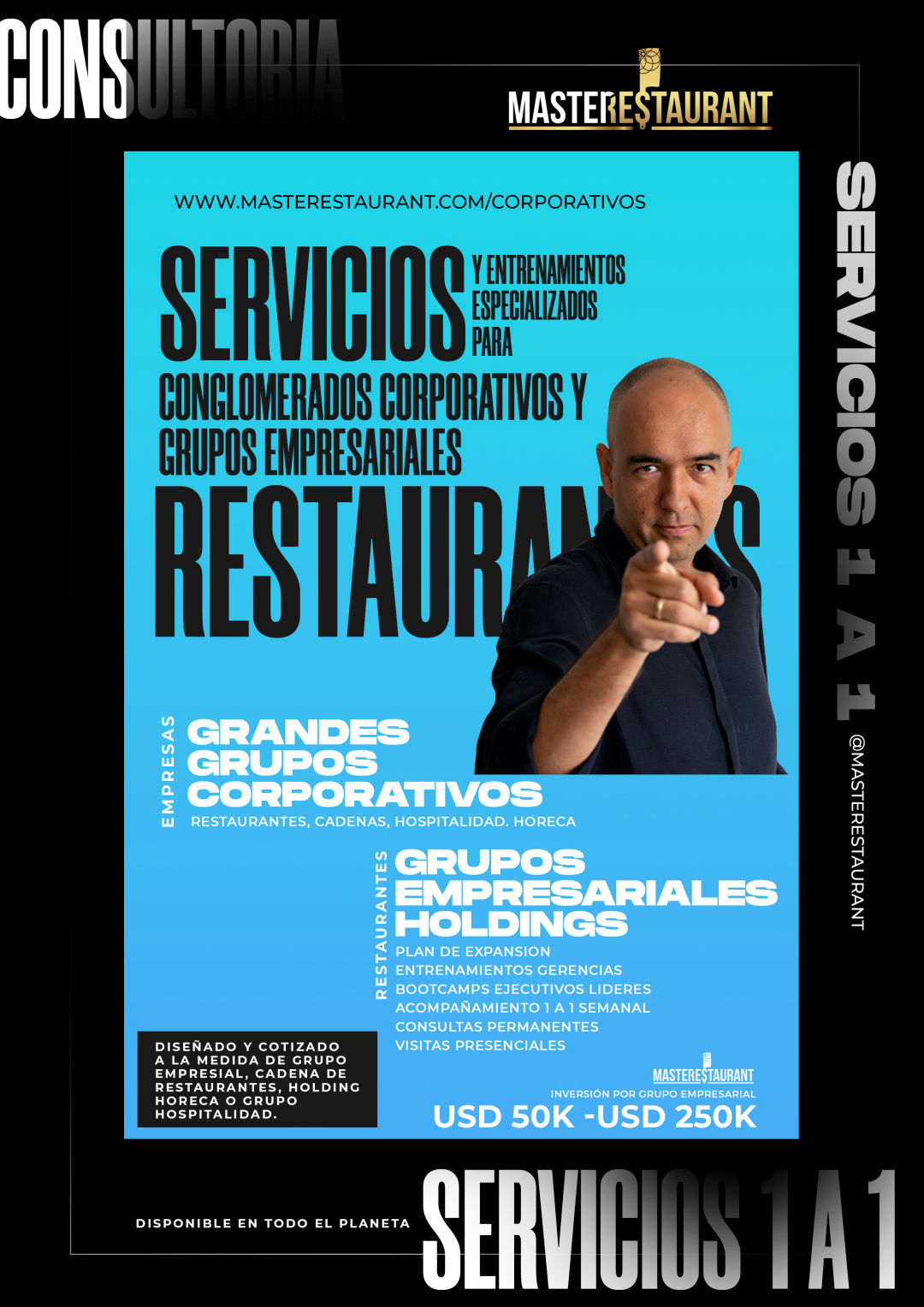
Investment: from USD $50K to USD $500K+ - tailor-made hospitality programs, priced to the group's size and complexity - spots LIMITED worldwide.
Corporate programs
Tailor-made hospitality consulting programs for groups and chains
Every hospitality program is 100% personalized and tailor-made to the group, and it starts with a strategic portfolio diagnosis, brand by brand and unit by unit. From there it works through the key elements of the business model in the MASTERESTAURANT Restaurant Canvas: portfolio strategy and capital allocation, multi-site standardization, financial governance and decision dashboards, talent and structure, and expansion, franchise or new markets, with support for leadership during implementation. It is priced to the size and complexity of the group (from USD $50K to USD $500K+), with limited spots worldwide to ensure dedicated attention and discretion for each client.
Corporate coverage
We also work with groups near Kawasaki
Explore consulting for hospitality groups in other territories, or go back to the worldwide index on the hospitality consulting worldwide page:
Hotel group consulting across JapanHospitality groups consulting in JapanHORECA hospitality consulting in KyotoAdvisory for hospitality holdings in OsakaHospitality group consultant in TokyoHORECA hospitality consulting in YokohamaHORECA hospitality consulting across BrazilHotel group consulting in AustriaHospitality group expansion in IsraelHORECA hospitality consulting in South AfricaHospitality group expansion in AjmanHospitality group consultant in Al AinHospitality group consultant across QatarAdvisory for hospitality holdings across Saudi ArabiaHotel group consulting across the United Arab EmiratesHospitality group expansion in AustraliaHospitality group expansion in BangkokHORECA hospitality consulting in BeijingHospitality group expansion in ChinaHospitality groups consulting in DammamHospitality group consultant in Hong KongHospitality groups consulting in IndiaHotel group consulting in IndonesiaHospitality group expansion in JakartaMore countries →More cities →
We do serve — and every city on the planet
Available there too: on-site or virtual, in English and Spanish.
Who is Diego F Parra?
Diego F Parra is the consultant that business groups, chains, holdings and family offices choose to grow, standardize and expand their restaurant portfolio with profitability and governance.
An engineer and C-Suite consultant, he is the author of 3 ISBN-registered books and the creator of the MASTERESTAURANT methodology and its technology suite (MTIE, Gastronomic Radar and KPI Dashboard), applied by 8,400+ restaurants across 43 countries. His method comes from two decades of creating, rescuing and expanding restaurants, franchises, dark kitchens and HORECA groups across four continents. That is why he comes to the board with tools proven in real operations and reviews each brand and each site before recommending an opening, a restructuring or a franchise.
HORECA · Chains · Holdings · Foodtech
Private programs for boards and family offices
Consulting, executive bootcamps, events and private advisory for boards, C-Suite and family offices.
Starting at USD $50K, tailored to each organization; limited spots worldwide.
Published doctrine
The books that changed restaurant management
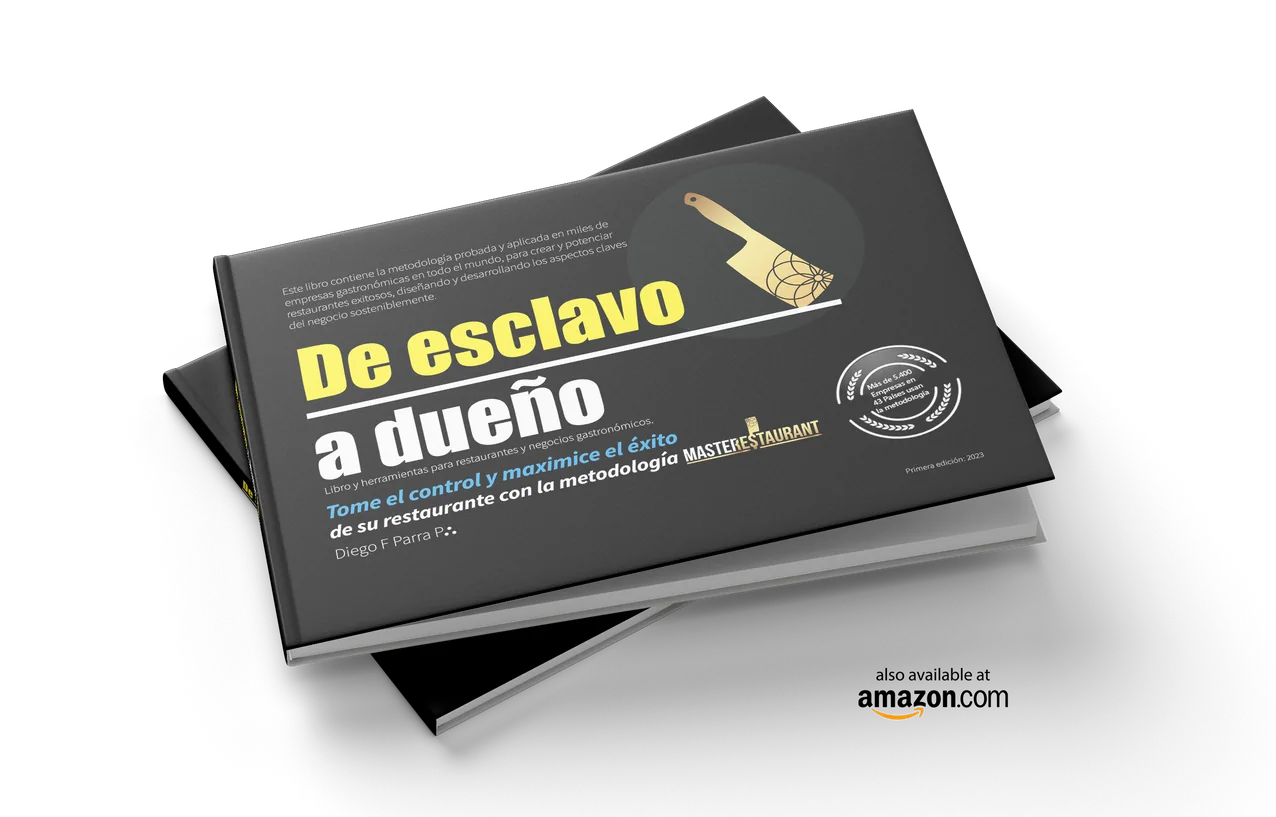
De Esclavo a Dueño
The book that changed how restaurants are managed: practical strategies and tools based on more than 20 years of experience, for traditional restaurants, dark kitchens, foodtech and HORECA businesses.
Triunfar o Morir en el Intento
Practical tools and key strategies to design and operate restaurants and food businesses efficiently.
Podcast: Masterestaurant — Mistakes for Restaurants
The public autopsy of the mistakes that bankrupt restaurants: owners and managers listen on Spotify to avoid repeating them. Condensed operating doctrine, open to everyone.
Listen on SpotifyDownloads
The documents your board will ask for
MASTERESTAURANT services portfolio
The complete corporate intervention catalog: consulting, executive bootcamps, advisory and specialized services, with scopes and formats. The document to decide with your board.
Download PDFBook: From Slave to Owner
The full doctrine behind the methodology: how to structure restaurants that run without depending on the owner. Ideal pre-reading before your group's diagnosis.
View on AmazonPortfolio
More services by Diego F Parra and his team
Beyond hospitality group consulting, Diego F Parra and his team offer keynotes, mentoring, training, programs and a membership, all built on the same method and the same tools. In a hospitality group that means the work can be split by level: keynotes for the board and managers, training for each site's leaders and mentoring for whoever runs a brand, all on the same indicators. If what you need goes beyond consulting, the full ecosystem is available:
International keynote speakerOne-on-one consulting and advisoryPersonalized mentoring for owners (limited spots)Corporate groups and holdings consultingCelebrity Restaurants consultingThemed restaurant advisorySpecialized training programs52-Week membershipPitch deck and restaurant investment readinessExponential Program0.1 Program — Elevate Your RestaurantInteractive training kit
Direct contact
Get a quote for hospitality consulting for your group in Kawasaki
Your message goes straight to Diego's team: group or chain, number of sites, stage and what you need to achieve in Kawasaki.
“A hospitality group doesn't dilute because it opens slowly: it dilutes because its systems don't scale. I've worked with dozens of operations in Kawasaki and across Asia that had higher revenue in year five of expansion but lower profit, because each new unit inherited weak processes, non-standardized talent, and zero margin governance. The model that works is inverted: first I architect the system—diagnostics, standards, dashboards, structure—then expansion happens naturally because each unit replicates the profitability of its predecessor. That's the work.”
Diego F. Parra — International consultant, expert in creating, scaling and improving restaurants, HORECA and hospitality
MASTERESTAURANT® methodology applied by 8,400+ restaurants across 43 countries · Author of 3 ISBN-registered books, including «De esclavo a dueño» · 20+ years operating restaurants, franchises, dark kitchens and HORECA groups across 4 continents
Full profile →Start with the corporate diagnosis, in Kawasaki
Tell us how many sites and brands your group has and what decision is on the table.
Explore more
Restaurant groups: territories, services and ecosystem resources
Useful links for boards and leadership teams weighing hospitality group consulting before deciding: nearby territories where the same service is available, sister services in the MASTERESTAURANT ecosystem, Diego F Parra's professional profile and management tools.
World's best restaurant keynote speakerWorld's best restaurant consultantC-Suite restaurant consultant for chains & groupsDiego F Parra — professional profileKeynote speaker serviceCorporate groups & holdings consultingCelebrity restaurant consultingInternational themed restaurant advisoryHotel group consulting across JapanHospitality groups consulting in JapanHORECA hospitality consulting in KyotoAdvisory for hospitality holdings in OsakaHospitality group consultant in TokyoHORECA hospitality consulting in Yokohama
FAQ
Frequently asked questions
How do we know that standardization won't freeze our ability to innovate or adapt to local differences across our units?
The standardization we design doesn't freeze innovation: it defines the non-negotiable core (recipe base, service standards, cost management, safety) that protects brand integrity, and releases space for local variation (complementary menu items, décor, local activations). Each unit reports metrics on shared dashboards, allowing the board to spot which local innovations perform and scale them across the portfolio. Most growth in successful groups comes from reusing playbooks that worked, not reinventing at every opening.
We're under pressure to scale our Kawasaki operation within 2–3 years to remain competitive. What's a realistic timeline for a consulting program to deliver operational and financial results that justify the investment?
Diagnostics and strategy take 6–8 weeks; first results—better margin visibility, more informed portfolio decisions, clear organizational structure—appear by month 3–4. Structured expansion (new units, franchising) runs in parallel, accelerating growth without sacrificing per-unit profitability. Groups that implement in year one typically execute 3–5 new openings with protected margins, compared to chaotic expansion that adds volume but erodes profitability across the portfolio.
How is this different from a generalist consultancy?
It knows the kitchen and the floor. A generalist consultancy draws the org chart; here the costing, the technical sheet and the shift get worked too, and that is where margin is won or lost.
What if the group already has an operations director?
All the better. Nobody gets replaced: they get method, single definitions and comparable indicators so their judgement reaches every site the same way.
Can the diagnosis be hired on its own?
Yes. Many groups start there and decide afterwards how far to take implementation.
What is asked of the group during the engagement?
Access to the real numbers of every unit and timely decisions from leadership. A diagnosis on dressed-up data corrects nothing.
What is the investment for a hospitality program?
Hospitality programs range from USD $50K to USD $500K+ and are priced to the size and complexity of the group, the number of sites and the scope of the engagement. They are quoted to fit after the diagnosis.
