 MASTERESTAURANT®
The spa economy reached US$ 157 billion in revenues in 2024
Global Wellness Institute
Portfolio governance · San Diego California

DIEGO F PARRA · CREATOR OF THE MASTERESTAURANT® METHODOLOGY
HOSPITALITY GROUPS CONSULTING Who puts a hospitality group in San Diego California in order before expansion outruns it?
Diego F. Parra has worked across 8,400+ restaurants in 43 countries, from independent operations to groups with dozens of sites. In San Diego California he applies that judgement to the whole portfolio.
Download the portfolio (PDF)Corporate advisory spots LIMITED worldwide - reserve your group's evaluation early
8,400+restaurants apply his methodology
43countries with supported groups
65M+views per year
2service languages: EN - ES
International validation
See Diego F. Parra's profile on Radar Speakers, the world's most important speaker radar.
See profile on Radar Speakers →
US$ 157B
80%
1 million+
70%

@masterestaurant
Per-unit profitability, not just group turnover
In San Diego California, a hospitality group is organized around one principle: measure first, standardize next, and only then expand. That is the rule of the MASTERESTAURANT methodology and its TOOLKIT, applied across 8,400+ restaurants in 43 countries, from a single unit to portfolios with dozens of brands.
Measuring means putting each brand's and each unit's economics on the table before anything is decided: which brands to back, which to restructure and which site is carrying which. Standardizing means manuals, processes and operational control so site fifty delivers what site one delivers. Expansion comes last, once there is a documented standard and a profitable unit to replicate. The method adapts to the size of the group, its stage and its market.
How does consulting for hospitality groups work in San Diego California?
It begins by putting the group's portfolio in San Diego California on the table, brand by brand and site by site, with the numbers behind each one. Measurement comes first, standardization second and expansion last.
An owned site, a license and a franchise are three different risks, and the group chooses between them once the standard is documented and the team is mature. The plan covers portfolio strategy and capital deployment, multi-site standardization with operational control and consistent quality, financial governance with dashboards the board can decide on, talent and structure, and entry into new markets. Leadership is supported through implementation, the group's information stays confidential, and the work runs on site or virtually, in English or Spanish, sized to the group's complexity. As context for a group in San Diego California, this page cites four verified figures, local or industry-wide, from sources such as Hospitality Technology and Global Wellness Institute.
What do the numbers tell a hospitality group in San Diego California?
80% — 80% of hotels prioritize driving guest loyalty as a key technology objective, according to Hospitality Technology. A market figure puts a portfolio in context, but it does not say which brand or site deserves the next investment.
For a hospitality group, the numbers guide capital allocation. Other reference points cited on this page: US$ 157B (the spa economy reached US$ 157 billion in revenues in 2024 — Global Wellness Institute); 1 million+ (restaurant and foodservice establishments, 2025 — the National Restaurant Association); 70% (Prime-cost overspend in 70% of restaurants — Masterestaurant). The question is which brand has room to grow in San Diego California, whether the documented standard can travel to a new site and whether Prime Cost holds at group level. The figures inform the bet; the group's own unit economics decide it.
Data
Reference figures for hospitality groups in San Diego California
The figures cited on this page, local or industry-wide, with what each one measures and its source.
| Figure | What it measures | Source |
|---|---|---|
| US$ 157B | The spa economy reached US$ 157 billion in revenues in 2024 | Global Wellness Institute |
| 80% | 80% of hotels prioritize driving guest loyalty as a key technology objective | Hospitality Technology (2024 Lodging Technology Study) |
| 1 million+ | restaurant and foodservice establishments (2025) | National Restaurant Association |
| 70% | Prime-cost overspend in 70% of restaurants | Masterestaurant - Índice de Prime Cost 2026 |
Each figure links to its source in the data cards on this page.
The local market
The hospitality group market in San Diego California: the context your portfolio must master
San Diego California is a highly competitive hospitality market with dozens of independent restaurant chains, regional hotel groups, and multibrand F&B holdings. When a group scales from 3–5 units to 15–20, systems that worked in early phases collapse: operating costs multiply without control, process standardization doesn't exist, each general manager improvises by personal criterion, operating margins erode with each new opening, and working capital management becomes chaotic. Most groups expand by commercial impulse—a leasing opportunity here, a trending concept there—without strategic portfolio diagnosis or multi-unit standardization. The result is an enterprise operating as a portfolio of independent businesses, not a replicable system. Specialized consulting for hospitality groups fills this gap: it's not about opening "one more restaurant" with better marketing, but transforming the group's operational structure to govern each unit with data, consistent systems, and metrics. Without strategic intervention, a group dilates rather than scales.
The service transforms an impulse-driven group into a governed gastronomy company using MASTERESTAURANT methodology: it begins with deep portfolio diagnosis (current state of each brand, unit-level profitability, structural inefficiencies), defines brand and portfolio strategy (which to strengthen, which to restructure, decision matrix for new openings), implements multi-unit standardization (operation manuals, process control, structured training, operational audit), governs unit economics at group level (Prime Cost disaggregated by unit, EBITDA margins, market-type sensitivity analysis), designs scalable organizational structure (roles, responsibilities, decision authority), systematizes expansion and franchise (market criteria, replication playbooks, brand control), and deploys executive dashboards for the board. Each component is calibrated to the group's operational and financial reality, not a generic package. The outcome is an operation that doesn't depend on founder or operational heroes, but on proven systems that scale.
Diego F. Parra is an internationally recognized consultant 100% specialized in restaurants and hospitality, with MASTERESTAURANT® methodology applied by 8,400+ units across 43 countries, proven C-Suite consulting experience in portfolio structures worth hundreds of millions of dollars, and bestselling author on Amazon. His digital community exceeds 65 million annual views. He is not a generic operations consultant or academic; he is an operator who has signed payrolls, negotiated leases, restructured chains with dozens of units, and advised boards on expansion and capital allocation decisions. That track record reduces expansion risk: the board isn't trusting local market intuition or theoretical methodology, but global-scale experience applied to local reality. Every decision on where to open, when to restructure, how to prepare new units comes from patterns proven across markets equivalent to local conditions in 42 other countries.
A hospitality group implementing the corporate program achieves measurable return: replicated unit-level profitability (operating margins stabilized and increasing even with new openings), protected expansion margins (each new unit is not an experiment but a controlled replica of proven model), data-driven portfolio decisions (board and C-Suite know which brands to strengthen, which to close or restructure, how to allocate capital between new openings and upgrades), founder-independent operations (documented systems, manuals, and structures allow new managers to enter a clear framework without ad-hoc mentorship), and higher-value group (an enterprise with scalable systems, consistent margins, and ordered growth is more attractive to investors, funds, or potential partners). For a hospitality group in California, that means the difference between being a collection of successful units and being a gastronomy company competing at regional and national scale.
Market data
Sector figures in San Diego California
80% of hotels prioritize driving guest loyalty as a key technology objective
Hospitality Technology (2024 Lodging Technology Study)restaurant and foodservice establishments (2025)
National Restaurant AssociationPrime-cost overspend in 70% of restaurants
Masterestaurant - Prime Cost Index 2026San Diego California as a market
The sector calendar and stages in San Diego California
San Diego California has a fragmented yet dynamic hospitality ecosystem: it includes regional hotel chains in Gaslamp Quarter, Del Mar, and the La Jolla corridor; luxury resorts in Coronado; independent restaurant groups concentrated in Little Italy and Hillcrest; multibrand F&B operations in Mission Valley and Pacific Beach shopping corridors; and emerging foodtech and dark kitchens in midtown. The annual tourism market generates stable demand for accommodations and dining experiences, yet also fierce competition for market share. Local executive talent exists—hospitality schools such as San Diego State University produce graduates—but there is scarcity of operators with experience in multi-site governance and standardization. Lease costs vary dramatically by zone (Gaslamp versus periphery is nearly double), and labor cost structure reflects the California market (high wages, strict wage-and-hours regulations, benefit mandates). Groups that understand this economic and demographic geography and replicate a robust unit-level profitability model have access to regional venture capital and potential expansion toward Southwest markets.
A hospitality group in California faces clear opportunity: stable tourism market, purchasing power in premium zones (La Jolla, Coronado), and ability to test models before expanding to Phoenix, Las Vegas, or Los Angeles. However, real risks exist: replication costs (opening a second unit in premium zone is not significantly cheaper; often considerably more expensive per square meter and per labor unit), operational fragmentation (each GM develops own standards, procurement becomes uncoordinated, inventory leaks), local consumer sophistication (money exists, but experience must be consistent and high-quality, not mediocre copies), talent scarcity (finding a general manager who replicates model with operational integrity is harder than opening the physical unit), capital constraints (each new opening competes internally for funds). Groups expanding without system collapse within 2–3 years when coordination costs exceed economies of scale. Those with clear structure, metrics, and replication playbooks not only survive: they generate rising margins.
RESOURCES
MASTERESTAURANT studies, guides & tools
What a team in San Diego California can review to size the impact: sector studies, tools and cases:
- AI PROMPTHospitality Service Script Builder for Restaurants
- STUDYInconsistency between locations: 2026 benchmarks with excellent, acceptable and critical ranges
- CASE STUDYArtificial intelligence applied to business model in restaurants: myth vs reality 2026
- CASE STUDYComo montar una pizzeria caso estudio
- CHECKLISTChef partnership: traditional method vs Masterestaurant
- DATARestaurant Transfer: Traditional Method vs Masterestaurant
- COMPARISONRestaurant Inventory Control
The corporate consultant
Twenty years of real operations, not theory
There are consultants who have read about restaurants and consultants who have stood inside one at nine on a Friday night. Diego F Parra is the second kind: engineer and C-Suite consultant with two decades creating, rescuing and expanding restaurants, franchises, dark kitchens and HORECA and hospitality groups across four continents, with payrolls signed, leases negotiated and expansions closed in operations worth hundreds of millions of dollars.
That experience was distilled into the MASTERESTAURANT® methodology, applied today by 8,400+ restaurants across 43 countries, and into its TOOLKIT: MTIE, Gastronomic Radar, Standard Recipe Generator, Tech Sheets and KPI Dashboard. Tools, not slides.
The picture is completed by 3 ISBN-registered books, including «De esclavo a dueño», the industry's leading podcast, the largest bilingual community of owners, chefs and operations directors in the region (65M+ views per year as @masterestaurant) and a place among the top Latino restaurant operations experts globally. Full detail in Diego F Parra's professional profile.
Hospitality group consulting with its own doctrine, not generic frameworks
Consulting for hospitality groups is not solved with management theory, but with a method of its own. Every engagement is built on the Restaurant Model Canvas and real industry data—profitability, Prime Cost, cost structure, multi-site standardization and expansion—applied to the specific business model of a hotel or restaurant group, a chain or a holding. The goal is not to add brands or openings, but to build a business system that replicates per-unit profitability, governs the portfolio and sustains operations without depending on founders or operational heroes. That is why the work leaves Prime Cost governed at group level, EBITDA per unit and indicator dashboards the board decides on without commissioning a report.
Corporate consulting from start to finish
Advisory that covers the full restaurant-group lifecycle
Growing is not turning over more
A group can raise sales and lower margin. What gets governed is EBITDA per unit, not the portfolio total.
Quote the diagnosisThe standard is an asset
Written, measured and held by trained managers. Without it, the group's value depends on who happens to be on shift.
Quote the standardizationTalent holds the system up
Organizational structure and leadership development as part of the engagement, not as an optional extra.
Quote the financial governanceExpansion gets prepared
New markets, licences and franchises with the model validated and the team ready, not when the opportunity appears.
See the services portfolio (PDF)The methodology
Discover the MASTERESTAURANT methodology
A portfolio that grows profitably is governed by a system, not by gut feel: tools, processes and models you can audit.
Who is it for?
Built for those who lead and expand hospitality groups
1-on-1 consulting, no templates, for restaurants in any of these situations:
The board
Whoever decides capital and portfolio, and needs to know which unit carries which before approving the next opening.
Operations leadership
Whoever has to make the standard reach every site identically, through processes rather than phone calls.
Finance leadership
Whoever needs single definitions for every indicator so EBITDA per unit means the same thing across the network.
Expansion leadership
Whoever chooses between owned site, licence or franchise, and needs the standard documented before signing.
What's included
The scope of work with the group, point by point
Every engagement is built tailor-made from these modules of the MASTERESTAURANT methodology:
- Corporate diagnosis of the group and its portfolio of brands and units
- Strategic growth and expansion planning with the board and the C-Suite
- Business model and unit economics per brand and per unit
- Multi-site standardization: manuals, processes and operational control
- Cost structure and Prime Cost governed at group level
- KPI dashboards and financial governance of the portfolio
- Menu engineering and consistent experience across all sites
- Organizational structure, talent and leadership
- Readiness for franchising, licensing and new markets
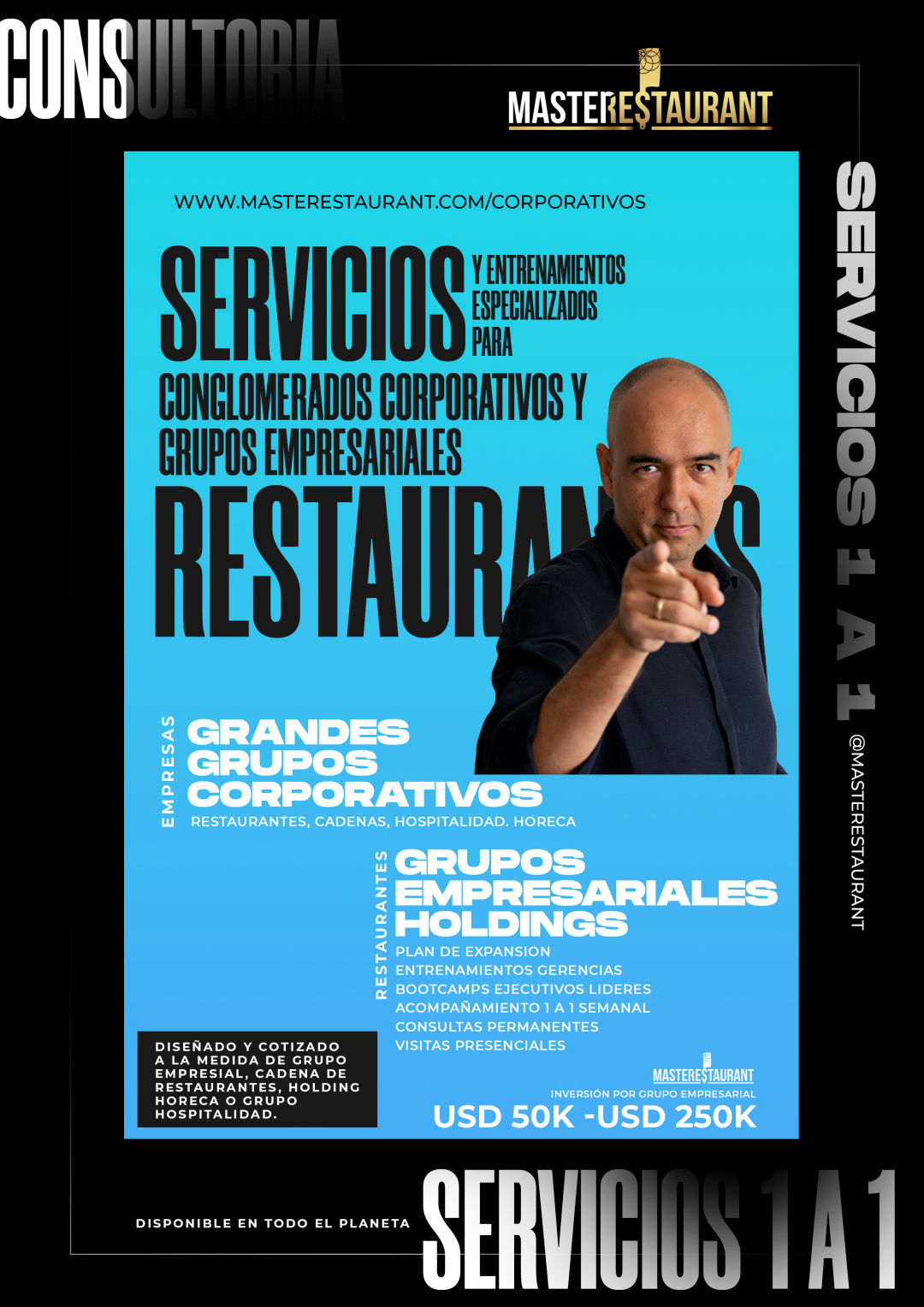
Investment: from USD $50K to USD $500K+ - tailor-made hospitality programs, priced to the group's size and complexity - spots LIMITED worldwide.
Corporate programs
Tailor-made hospitality consulting programs for groups and chains
Every hospitality program is 100% personalized and tailor-made to the group, and it starts with a strategic portfolio diagnosis, brand by brand and unit by unit. From there it works through the key elements of the business model in the MASTERESTAURANT Restaurant Canvas: portfolio strategy and capital allocation, multi-site standardization, financial governance and decision dashboards, talent and structure, and expansion, franchise or new markets, with support for leadership during implementation. It is priced to the size and complexity of the group (from USD $50K to USD $500K+), with limited spots worldwide to ensure dedicated attention and discretion for each client.
Corporate coverage
Consulting for hospitality groups near San Diego California
Explore consulting for hospitality groups in other territories, or go back to the worldwide index on the hospitality consulting worldwide page:
HORECA hospitality consulting in AnaheimHospitality group consultant in ArlingtonHORECA hospitality consulting in AtlantaHospitality groups consulting in Atlantic City, New JerseyHORECA hospitality consulting in Augusta GeorgiaHospitality groups consulting in Aurora IllinoisHotel group consulting in AustinHospitality groups consulting in Baltimore MarylandHospitality group expansion in Baton Rouge, LouisianaAdvisory for hospitality holdings in Beverly HillsHORECA hospitality consulting in Boca Raton FloridaHospitality group expansion in BostonAdvisory for hospitality holdings in Brookhaven, New YorkHospitality group expansion in Carson City NevadaHospitality group expansion in Charlotte, North CarolinaHotel group consulting in ChicagoHotel group consulting in Columbia MarylandHospitality group expansion in Coral Gables FloridaHospitality group expansion in Corpus ChristiHORECA hospitality consulting in Cupertino CaliforniaAdvisory for hospitality holdings in DallasHospitality group consultant in Delray Beach FloridaAdvisory for hospitality holdings in El PasoHotel group consulting in State of ArizonaMore countries →More cities →
We do serve — and every city on the planet
Available there too: on-site or virtual, in English and Spanish.
Who is Diego F Parra?
Diego F Parra is the consultant that business groups, chains, holdings and family offices choose to grow, standardize and expand their restaurant portfolio with profitability and governance.
An engineer and C-Suite consultant, he is the author of 3 ISBN-registered books and the creator of the MASTERESTAURANT methodology and its technology suite (MTIE, Gastronomic Radar and KPI Dashboard), applied by 8,400+ restaurants across 43 countries. His method comes from two decades of creating, rescuing and expanding restaurants, franchises, dark kitchens and HORECA groups across four continents. That is why he comes to the board with tools proven in real operations and reviews each brand and each site before recommending an opening, a restructuring or a franchise.
HORECA · Chains · Holdings · Foodtech
Private programs for boards and family offices
Consulting, executive bootcamps, events and private advisory for boards, C-Suite and family offices.
Starting at USD $50K, tailored to each organization; limited spots worldwide.
Published doctrine
The books that changed restaurant management
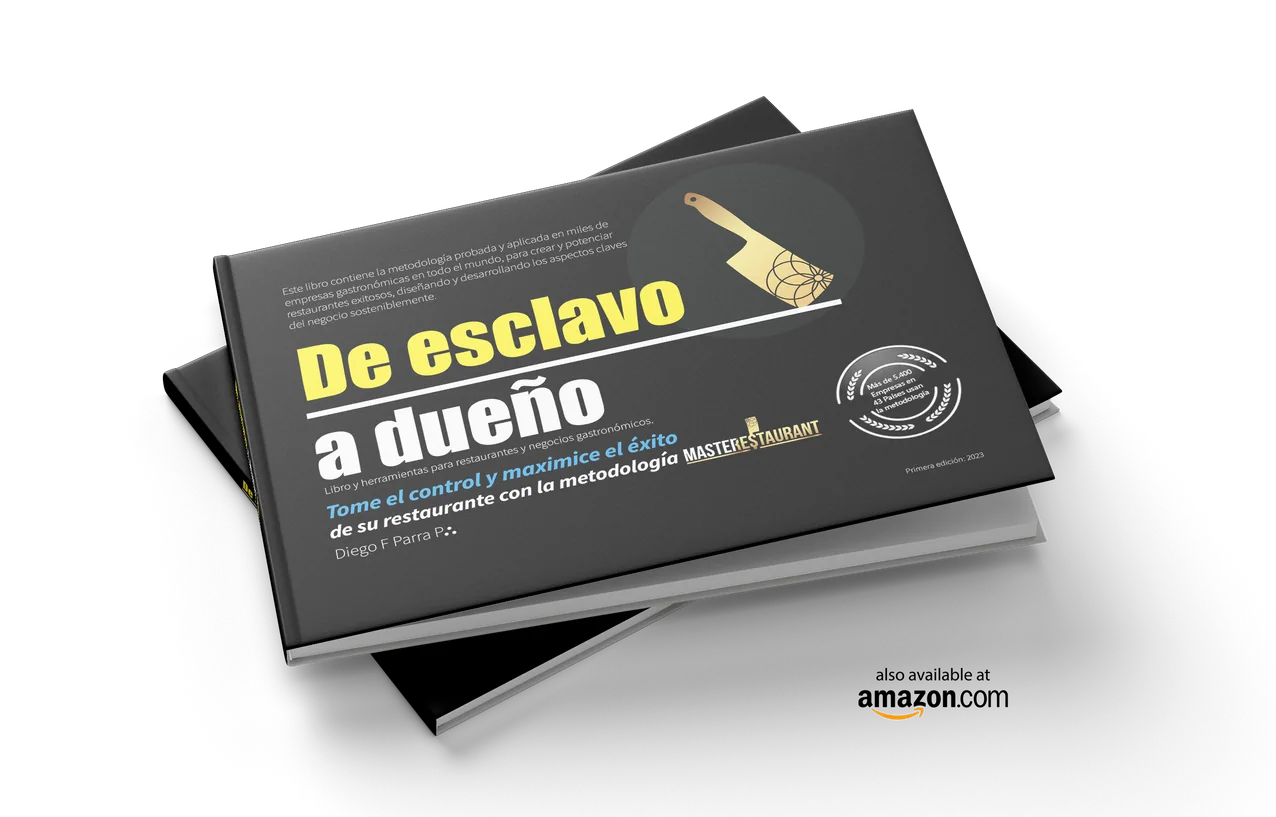
De Esclavo a Dueño
The book that changed how restaurants are managed: practical strategies and tools based on more than 20 years of experience, for traditional restaurants, dark kitchens, foodtech and HORECA businesses.
Triunfar o Morir en el Intento
Practical tools and key strategies to design and operate restaurants and food businesses efficiently.
Podcast: Masterestaurant — Mistakes for Restaurants
The public autopsy of the mistakes that bankrupt restaurants: owners and managers listen on Spotify to avoid repeating them. Condensed operating doctrine, open to everyone.
Listen on SpotifyDownloads
The documents your board will ask for
MASTERESTAURANT services portfolio
The complete corporate intervention catalog: consulting, executive bootcamps, advisory and specialized services, with scopes and formats. The document to decide with your board.
Download PDFBook: From Slave to Owner
The full doctrine behind the methodology: how to structure restaurants that run without depending on the owner. Ideal pre-reading before your group's diagnosis.
View on AmazonPortfolio
More services by Diego F Parra and his team
Beyond hospitality group consulting, Diego F Parra and his team offer keynotes, mentoring, training, programs and a membership, all built on the same method and the same tools. In a hospitality group that means the work can be split by level: keynotes for the board and managers, training for each site's leaders and mentoring for whoever runs a brand, all on the same indicators. If what you need goes beyond consulting, the full ecosystem is available:
International keynote speakerOne-on-one consulting and advisoryPersonalized mentoring for owners (limited spots)Corporate groups and holdings consultingCelebrity Restaurants consultingThemed restaurant advisorySpecialized training programs52-Week membershipPitch deck and restaurant investment readinessExponential Program0.1 Program — Elevate Your RestaurantInteractive training kit
Direct contact
Get a quote for hospitality consulting for your group in San Diego California
Your message goes straight to Diego's team: group or chain, number of sites, stage and what you need to achieve in San Diego California.
“A hospitality group scales or dilates by its business system, not by its opening pace. I've seen chains grow from 3 to 30 units in four years and fail because each manager operated in a silo; and I've seen groups scale from 5 to 35 units in the same period with rising margins because they had a system. The difference isn't the market—it's whether the group built a company or just accumulated businesses.”
Diego F. Parra — International consultant, expert in creating, scaling and improving restaurants, HORECA and hospitality
MASTERESTAURANT® methodology applied by 8,400+ restaurants across 43 countries · Author of 3 ISBN-registered books, including «De esclavo a dueño» · 20+ years operating restaurants, franchises, dark kitchens and HORECA groups across 4 continents
Full profile →Before the next opening in San Diego California
Tell us how many sites and brands your group has and what decision is on the table.
Explore more
Restaurant groups: territories, services and ecosystem resources
Useful links for boards and leadership teams weighing hospitality group consulting before deciding: nearby territories where the same service is available, sister services in the MASTERESTAURANT ecosystem, Diego F Parra's professional profile and management tools.
World's best restaurant keynote speakerWorld's best restaurant consultantC-Suite restaurant consultant for chains & groupsDiego F Parra — professional profileKeynote speaker serviceCorporate groups & holdings consultingCelebrity restaurant consultingInternational themed restaurant advisoryHORECA hospitality consulting in AnaheimHospitality group consultant in ArlingtonHORECA hospitality consulting in AtlantaHospitality groups consulting in Atlantic City, New JerseyHORECA hospitality consulting in Augusta GeorgiaHospitality groups consulting in Aurora Illinois
FAQ
Frequently asked questions
How do you ensure multi-unit standardization doesn't stifle local brand identity and each restaurant's character?
Standardization is not uniformity; it is replication of what generates profitability with local autonomy in design, regional suppliers, and menu adaptation to zone preferences. MASTERESTAURANT defines "non-negotiable standards" (max prime cost, talent turnover, cleanliness, service) and "margins for local innovation" (suppliers, design, seasonal offers). Each GM knows what can change and what cannot. Result: each restaurant retains identity and feels ownership of the model, but the board has margin and experience consistency guarantees.
What is the difference between this program and simply hiring a corporate CFO or COO?
A CFO brings financial governance; a COO brings operational processes. The program integrates both plus: portfolio strategy (which brands to strengthen, which to close, how to expand without diluting capital), unit economics engineering (not annual budgeting, but line-item cost disaggregation by unit, sensitivity analysis, peer benchmarking), implementation engagement (not reporting, but execution alongside teams, behavior change, training), and proven methodology across 8,400+ restaurants. A hospitality-inexperienced CFO/COO often introduces controls that work in manufacturing but asphyxiate F&B margins.
What is the most expensive mistake in a group that is expanding?
Opening before standardizing. The new site copies the good and the bad of the previous ones, and past a certain number nobody can say which version of the standard each location is running.
We turn over more and earn less. What is happening?
Almost always structure: group fixed costs that grew with the openings and a Prime Cost nobody governs corporately. It shows the moment you look at EBITDA per unit.
What part does talent play in this?
A decisive one, which is why the engagement includes organizational structure and leadership development. A written standard without trained managers to hold it lasts until the first high season.
Do you help funds and family offices?
Yes: operational due diligence, value thesis and support to management, to enter or grow in hospitality with industry judgement.
What is the investment for a hospitality program?
Hospitality programs range from USD $50K to USD $500K+ and are priced to the size and complexity of the group, the number of sites and the scope of the engagement. They are quoted to fit after the diagnosis.
