 MASTERESTAURANT®
Growth in Colombia tourism foreign exchange (Jan-Sep 2024)
Portafolio (Banco de la República)
Hotels, chains and holdings · South Africa

DIEGO F PARRA · CREATOR OF THE MASTERESTAURANT® METHODOLOGY
HOSPITALITY GROUPS ADVISORY Who puts a hospitality group in South Africa in order before expansion outruns it?
What worked with three sites in South Africa collapses at twenty. The difference is not the team's talent: it is that nobody wrote the standard down, and without one every opening starts from zero.
Download the portfolio (PDF)Corporate advisory spots LIMITED worldwide - reserve your group's evaluation early
8,400+restaurants apply his methodology
43countries with supported groups
65M+views per year
2service languages: EN - ES
International validation
See Diego F. Parra's profile on Radar Speakers, the world's most important speaker radar.
See profile on Radar Speakers →
+14%
4.33 trillion USD
+4.1%
5-25x

@masterestaurant
Portfolio consulting for groups in South Africa
In South Africa, a hospitality group is organized around one principle: measure first, standardize next, and only then expand. That is the rule of the MASTERESTAURANT methodology and its TOOLKIT, applied across 8,400+ restaurants in 43 countries, from a single unit to portfolios with dozens of brands.
Measuring means putting each brand's and each unit's economics on the table before anything is decided: which brands to back, which to restructure and which site is carrying which. Standardizing means manuals, processes and operational control so site fifty delivers what site one delivers. Expansion comes last, once there is a documented standard and a profitable unit to replicate. The method adapts to the size of the group, its stage and its market.
How does consulting for hospitality groups work in South Africa?
It begins by putting the group's portfolio in South Africa on the table, brand by brand and site by site, with the numbers behind each one. Measurement comes first, standardization second and expansion last.
An owned site, a license and a franchise are three different risks, and the group chooses between them once the standard is documented and the team is mature. The plan covers portfolio strategy and capital deployment, multi-site standardization with operational control and consistent quality, financial governance with dashboards the board can decide on, talent and structure, and entry into new markets. Leadership is supported through implementation, the group's information stays confidential, and the work runs on site or virtually, in English or Spanish, sized to the group's complexity. As context for a group in South Africa, this page cites four verified figures, local or industry-wide, from sources such as Portafolio and ResearchAndMarkets.com.
What do the numbers tell a hospitality group in South Africa?
+14% — growth in Colombia tourism foreign exchange (Jan-Sep 2024), according to Portafolio. A market figure puts a portfolio in context, but it does not say which brand or site deserves the next investment.
For a hospitality group, the numbers guide capital allocation. Other reference points cited on this page: 4.33 trillion USD (global foodservice market size in 2023 — ResearchAndMarkets.com); +4.1% (Year-on-year real income growth of the food and beverages sector in September — Stats SA); 5-25x (cost of acquiring a new customer vs. retaining an existing one — Harvard Business Review). The question is which brand has room to grow in South Africa, whether the documented standard can travel to a new site and whether Prime Cost holds at group level. The figures inform the bet; the group's own unit economics decide it.
Data
Reference figures for hospitality groups in South Africa
The figures cited on this page, local or industry-wide, with what each one measures and its source.
| Figure | What it measures | Source |
|---|---|---|
| +14% | Growth in Colombia tourism foreign exchange (Jan-Sep 2024) | Portafolio (Banco de la República) |
| 4.33 trillion USD | Global foodservice market size in 2023 | ResearchAndMarkets.com |
| +4.1% | Year-on-year real income growth of the food and beverages sector in September | Stats SA |
| 5-25x | Cost of acquiring a new customer vs. retaining an existing one | Harvard Business Review |
Each figure links to its source in the data cards on this page.
The local market
What to know about South Africa before the next site opens
A hospitality group—restaurant chain, hotel holding, or multibrand F&B operation—scaling from three or four locations to twenty multiplies complexity exponentially: each new site adds fixed costs, operational standards, local teams, and administrative dependencies that inherited systems cannot support. Most expanding groups follow pure commercial impulse (open where there is demand) without a business architecture that sustains profitability per unit. The result is predictable: margin erosion with each opening, dilution of brand standards, talent turnover due to unclear processes, expansion decisions made without real economic viability data. A group that grew with the founder deciding everything breaks down when there are ten sites. Facing this void, conventional alternatives—generic management consulting or point-cost audits—miss the root cause: the absence of a replicable gastronomic business system. Diego offers the opposite: not a process repair, but redesign of the gastronomic enterprise as a governed portfolio.
The transformation the program delivers is structural: converting a group that expands on impulse into a gastronomic enterprise governed by data and systems. This includes portfolio diagnostics (which current units are truly profitable, which drain resources, which can replicate); strategy for brands and units (where each brand grows, how they differentiate, how to absorb new markets); real multi-site standardization (operational manuals that replicate food, service, and cost-control standards in every kitchen); unit economics management (profitability calculation per unit, identification of variables most affecting margin, expansion viability projection); Prime Cost governance at group level (centralized control of food, payroll, and operational costs, consolidated purchasing negotiation); dashboards that tell the board and C-Suite exactly where profitability and risk sit; scalable organizational structure (from founder-hero to teams that function without heroes); and expansion strategy validated by data, not optimism. All this is rooted in the MASTERESTAURANT methodology, already applied by +8,400 restaurants across 43 countries.
Diego's global authority reduces expansion risk at board level. Diego is not an academic consultant or generic process manager: he is an operator who has signed payrolls, negotiated leases, and structured deals in operations worth hundreds of millions of dollars, specialized 100% in restaurants and hospitality. He has advised C-Suites of hotel groups, multibrand chains, and F&B holdings in markets as diverse as Madrid, Miami, Mexico, and Southeast Asia. He is author of «From Slave to Owner», creator of gastronomic engineering tools like the Restaurant Model Canvas, MTIE (Masterestaurant Territory Engine), and the Gastronomy Radar. His global community accumulates +65M annual views. When the board asks «how do I know I can replicate profitability?», the answer is not theoretical: he has 43 verified cases of groups that succeeded.
The concrete return for the group is operational and financial. Operationally: profitability replicated per unit (each new site opens with a model that already proved margin), protected margins because there is standardization in kitchen, food, and costs, and a group that functions without depending on the founder or a star general manager (vulnerability that disappears). Financially: expansion and portfolio decisions backed by real data (which brand to grow, which to restructure, how to allocate capital across new sites), centralized Prime Cost control (purchasing negotiation that reduces costs significantly), reliable profitability projections for investors. At valuation level: a group more valuable to capital funds, banks, or potential buyers, because it stops being «a business that depends on the founder» to become an enterprise with replicable systems and proven data.
Market data
The numbers a board decides on in South Africa
Global foodservice market size in 2023
ResearchAndMarkets.comYear-on-year real income growth of the food and beverages sector in September
Stats SACost of acquiring a new customer vs. retaining an existing one
Harvard Business ReviewSouth Africa as a market
Why South Africa is a market for hospitality groups
South Africa's hospitality ecosystem combines consolidated urban markets (Johannesburg, Cape Town, Pretoria, Durban) with luxury and tourism niches (resorts, hotel chains, restaurant operations in commercial corridors, convention centers). The group landscape includes regional hotel chains, branded restaurant operations, multibrand F&B holdings, and dark kitchen and foodtech ventures in accelerated expansion. Managerial talent is available but concentrated in major cities; real estate costs vary significantly between premium districts (Sandton, V&A Waterfront) and secondary corridors; consumers are service-standard-sensitive but fragmented by zone (urban consumer, international tourist, local market). Market structure favors groups that can standardize operations across multiple sites because it reduces costs and expands margins. Risks are predictable: groups growing without operational systems replicate the global pattern, but with additional friction from inter-city distances, logistics costs, and talent scarcity in secondary sites.
Expansion opportunity is real for groups that know how to monetize each site. Tier-1 cities (Johannesburg, Cape Town) offer density of consumers with purchasing power; commercial corridors concentrate traffic sufficient for multiple brands; business and leisure tourism flows toward chains with reputation for consistent standards; and local consumers reward brand loyalty when experience is predictable. But expansion risks without system are severe: opening sites without cost standardization leads to margin dilution (variable food quality, wasted payroll at each location, unconsolidated purchasing, brand identity loss); talent turnover in operations lacking role clarity drains founder energy; and lack of centralized financial governance makes it impossible to decide which markets merit continued investment. Many groups grow in a straight line until margin falls and founders discover they have ten operations but none profitable at the level of their first two.
RESOURCES
MASTERESTAURANT studies, guides & tools
MASTERESTAURANT original research, tools and analysis you can apply to operations in South Africa:
- AI PROMPTHospitality Service Script Builder for Restaurants
- DATARestaurant Business Model: Myth vs Reality in 2026
- CONCEPTRestaurant Business Plan: Before vs After with Masterestaurant
- CASE STUDYComo abrir un food truck caso estudio
- CHECKLISTAbrir segundo local checklist
- COMPARISONRestaurant Inventory Control
- COMPARISONCocina oculta comparativa restaurantecercademi
The corporate consultant
From the kitchen to the boardroom, in the same language
Few consultants move as easily through a kitchen on a full service as through a board meeting reviewing EBITDA per unit. Diego F Parra has spent two decades doing exactly that: engineer and C-Suite consultant who has created, rescued and expanded restaurants, franchises, dark kitchens and HORECA and hospitality groups across four continents, signing payrolls, negotiating leases and closing expansions in operations worth hundreds of millions of dollars.
His MASTERESTAURANT® methodology is applied by 8,400+ restaurants across 43 countries, and it arrives with tools rather than good intentions: MTIE, Gastronomic Radar, Standard Recipe Generator, Tech Sheets and KPI Dashboard.
He is the author of 3 ISBN-registered books, including «De esclavo a dueño», creator of the industry's leading podcast and of the largest bilingual community of owners, chefs and operations directors in the region (65M+ views per year as @masterestaurant), and is recognized among the top Latino restaurant operations experts globally. The full track record is in Diego F Parra's professional profile.
Hospitality group consulting with its own doctrine, not generic frameworks
Consulting for hospitality groups is not solved with management theory, but with a method of its own. Every engagement is built on the Restaurant Model Canvas and real industry data—profitability, Prime Cost, cost structure, multi-site standardization and expansion—applied to the specific business model of a hotel or restaurant group, a chain or a holding. The goal is not to add brands or openings, but to build a business system that replicates per-unit profitability, governs the portfolio and sustains operations without depending on founders or operational heroes. That is why the work leaves Prime Cost governed at group level, EBITDA per unit and indicator dashboards the board decides on without commissioning a report.
Corporate consulting from start to finish
Advisory that covers the full restaurant-group lifecycle
What the board decides
Which brands to back, which to restructure and how to allocate capital, on EBITDA per unit rather than seniority or affection.
Quote the diagnosisWhat operations holds up
Manuals, quality control and trained managers. A standard with nobody to hold it lasts until the first high season.
Quote the standardizationWhat protects the margin
Prime Cost with a single definition, group fixed costs reviewed and waste measured the same way across the network.
Quote the financial governanceWhat makes growth possible
A model proven per unit, a documented standard and a staged plan before the next opening is signed.
See the services portfolio (PDF)The methodology
Discover the MASTERESTAURANT methodology
A portfolio that grows profitably is governed by a system, not by gut feel: tools, processes and models you can audit.
Who is it for?
Who this corporate consulting is for
Private, made-to-measure support, for whoever is creating and for whoever is correcting:
Enterprise groups and conglomerates
A hospitality portfolio governed with method: financial control, standardization and decision dashboards for the board and the C-Suite.
Restaurant chains
Profitable replication per unit: standards, Prime Cost and operations that deliver the same result at site one and at site fifty.
Hospitality holdings
Portfolio strategy: which brands to back, which to restructure and how to allocate capital to maximize group return.
Dark kitchens and foodtechs scaling up
Scaling without burning cash: unit economics, multi-node operations and expansion on data rather than growth instinct.
Family offices and funds
Operational due diligence, value thesis and support to management: enter or grow in hospitality with the MASTERESTAURANT methodology.
What's included
What the corporate engagement covers
No two engagements are alike: they are assembled from these MASTERESTAURANT methodology modules:
- Corporate diagnosis and portfolio strategy
- Multi-site standardization and manuals
- Per-unit profitability and financial governance
- Menu engineering consistent across the network
- Organizational structure and leadership
- Indicator dashboards for the board
- Readiness for franchising and licensing
- Expansion into new markets
- Training for the leadership team
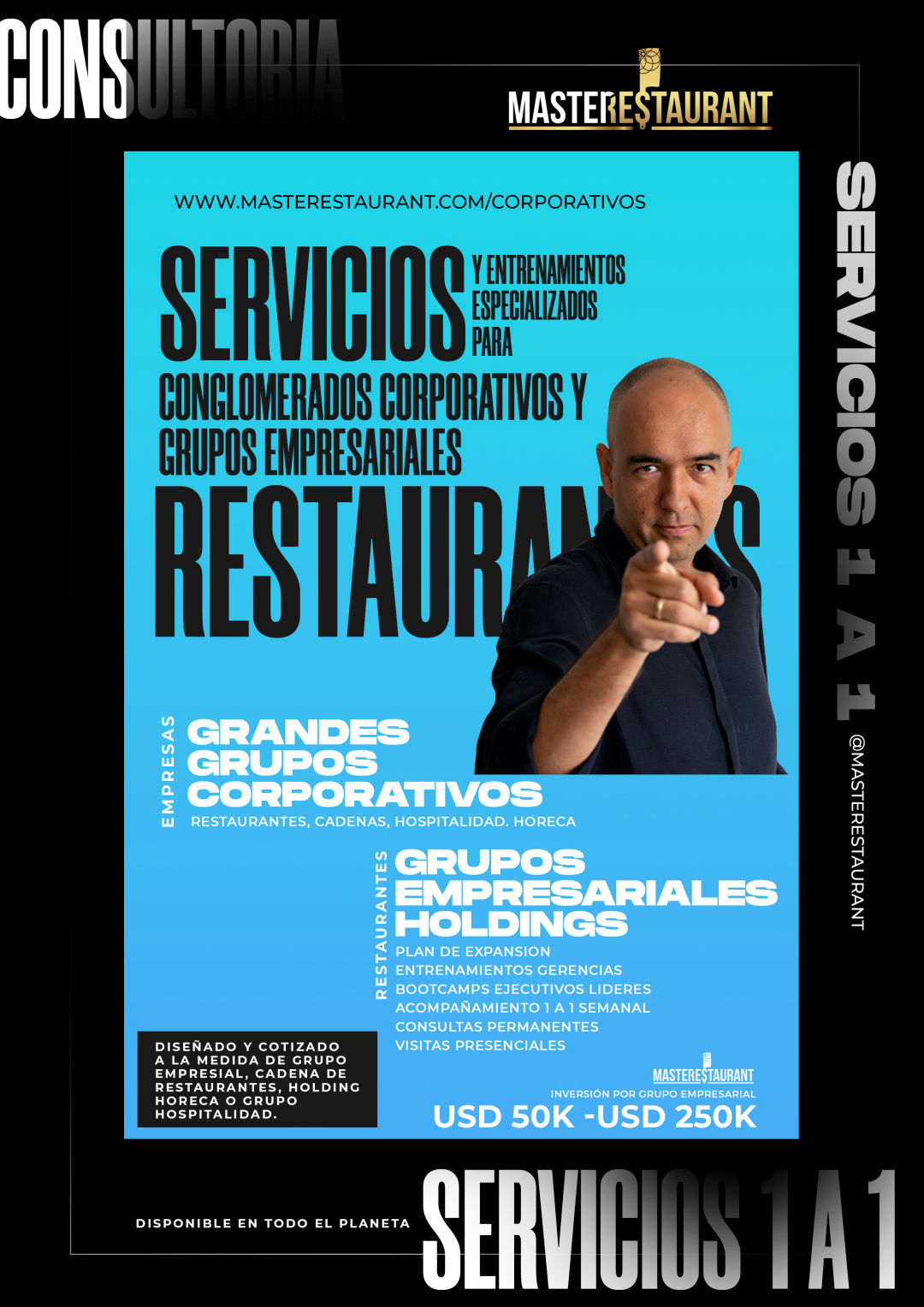
Investment: from USD $50K to USD $500K+ - tailor-made hospitality programs, priced to the group's size and complexity - spots LIMITED worldwide.
Corporate programs
Tailor-made hospitality consulting programs for groups and chains
Every hospitality program is 100% personalized and tailor-made to the group, and it starts with a strategic portfolio diagnosis, brand by brand and unit by unit. From there it works through the key elements of the business model in the MASTERESTAURANT Restaurant Canvas: portfolio strategy and capital allocation, multi-site standardization, financial governance and decision dashboards, talent and structure, and expansion, franchise or new markets, with support for leadership during implementation. It is priced to the size and complexity of the group (from USD $50K to USD $500K+), with limited spots worldwide to ensure dedicated attention and discretion for each client.
Corporate coverage
Consulting for hospitality groups near South Africa
Explore consulting for hospitality groups in other territories, or go back to the worldwide index on the hospitality consulting worldwide page:
Hospitality group expansion in JohannesburgHORECA hospitality consulting across BrazilHospitality group expansion in AustraliaHotel group consulting in AustriaHospitality group expansion in IsraelHospitality group expansion across CanadaHospitality group consultant across CubaHORECA hospitality consulting across El SalvadorHORECA hospitality consulting across HondurasAdvisory for hospitality holdings across NicaraguaHospitality group consultant across ParaguayHospitality group consultant across UruguayHORECA hospitality consulting across VenezuelaHospitality groups consulting in Antigua and BarbudaAdvisory for hospitality holdings in ArgentinaHospitality group consultant in the BahamasHORECA hospitality consulting in BelgiumHospitality group consultant in BelizeHospitality group consultant in BoliviaHospitality group consultant in BrazilAdvisory for hospitality holdings in CanadaHotel group consulting in ChileHospitality group expansion in ChinaHospitality group consultant in ColombiaMore countries →More cities →
We do serve — and every city on the planet
Available there too: on-site or virtual, in English and Spanish.
Who is Diego F Parra?
Diego F Parra is the consultant that business groups, chains, holdings and family offices choose to grow, standardize and expand their restaurant portfolio with profitability and governance.
An engineer and C-Suite consultant, he is the author of 3 ISBN-registered books and the creator of the MASTERESTAURANT methodology and its technology suite (MTIE, Gastronomic Radar and KPI Dashboard), applied by 8,400+ restaurants across 43 countries. His method comes from two decades of creating, rescuing and expanding restaurants, franchises, dark kitchens and HORECA groups across four continents. That is why he comes to the board with tools proven in real operations and reviews each brand and each site before recommending an opening, a restructuring or a franchise.
HORECA · Chains · Holdings · Foodtech
Private programs for boards and family offices
Consulting, executive bootcamps, events and private advisory for boards, C-Suite and family offices.
Starting at USD $50K, tailored to each organization; limited spots worldwide.
Published doctrine
The books that changed restaurant management
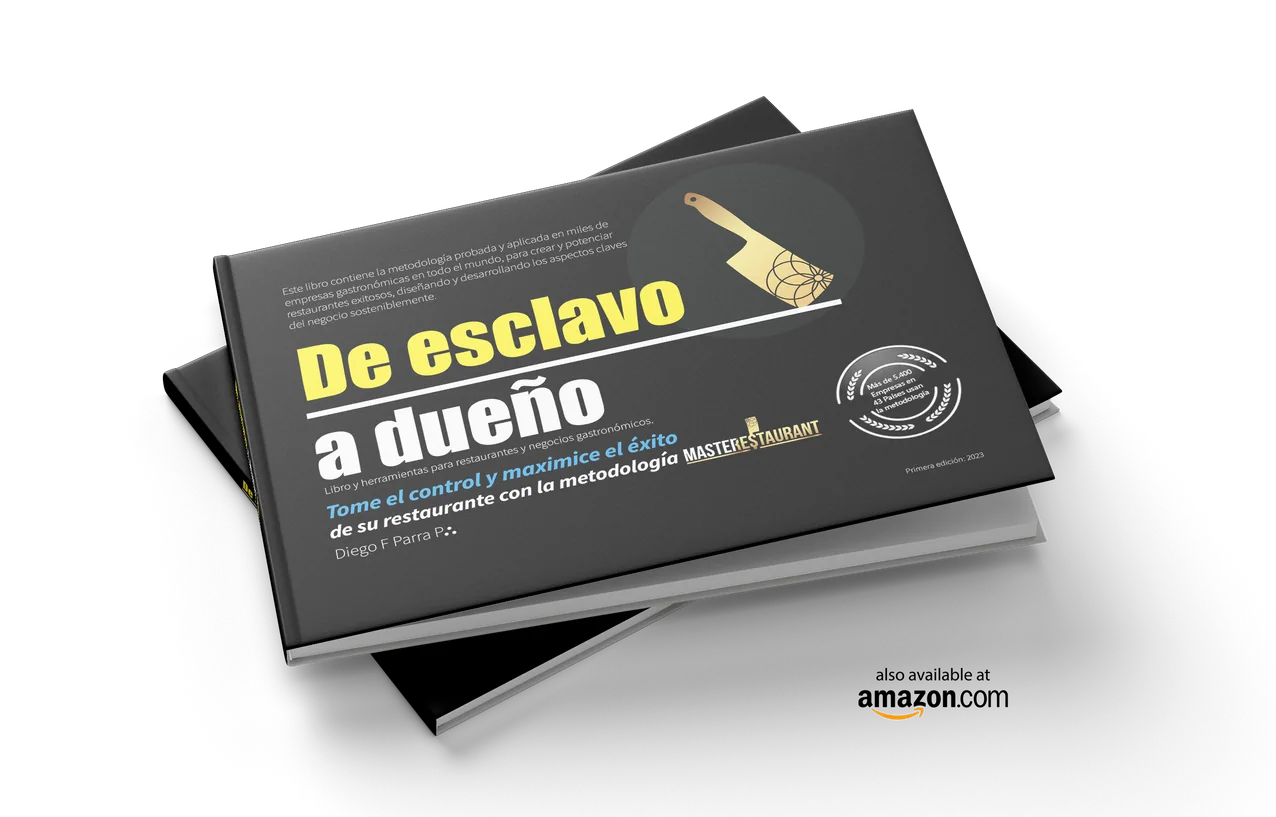
De Esclavo a Dueño
The book that changed how restaurants are managed: practical strategies and tools based on more than 20 years of experience, for traditional restaurants, dark kitchens, foodtech and HORECA businesses.
Triunfar o Morir en el Intento
Practical tools and key strategies to design and operate restaurants and food businesses efficiently.
Podcast: Masterestaurant — Mistakes for Restaurants
The public autopsy of the mistakes that bankrupt restaurants: owners and managers listen on Spotify to avoid repeating them. Condensed operating doctrine, open to everyone.
Listen on SpotifyDownloads
The documents your board will ask for
MASTERESTAURANT services portfolio
The complete corporate intervention catalog: consulting, executive bootcamps, advisory and specialized services, with scopes and formats. The document to decide with your board.
Download PDFBook: From Slave to Owner
The full doctrine behind the methodology: how to structure restaurants that run without depending on the owner. Ideal pre-reading before your group's diagnosis.
View on AmazonPortfolio
More services by Diego F Parra and his team
Beyond hospitality group consulting, Diego F Parra and his team offer keynotes, mentoring, training, programs and a membership, all built on the same method and the same tools. In a hospitality group that means the work can be split by level: keynotes for the board and managers, training for each site's leaders and mentoring for whoever runs a brand, all on the same indicators. If what you need goes beyond consulting, the full ecosystem is available:
International keynote speakerOne-on-one consulting and advisoryPersonalized mentoring for owners (limited spots)Corporate groups and holdings consultingCelebrity Restaurants consultingThemed restaurant advisorySpecialized training programs52-Week membershipPitch deck and restaurant investment readinessExponential Program0.1 Program — Elevate Your RestaurantInteractive training kit
Direct contact
Get a quote for hospitality consulting for your group in South Africa
Your message goes straight to Diego's team: group or chain, number of sites, stage and what you need to achieve in South Africa.
“A group scales or dilutes based on its business system, not its pace of openings. I have seen chains that open twenty sites in three years end up weaker than when they started, because each opening was a bet, not a process. The difference is simple: you must know exactly why one unit makes money, replicate that logic in the next one, and measure in real time whether the system works.”
Diego F. Parra — International consultant, expert in creating, scaling and improving restaurants, HORECA and hospitality
MASTERESTAURANT® methodology applied by 8,400+ restaurants across 43 countries · Author of 3 ISBN-registered books, including «De esclavo a dueño» · 20+ years operating restaurants, franchises, dark kitchens and HORECA groups across 4 continents
Full profile →Shall we talk about your portfolio in South Africa?
Tell us how many sites and brands your group has and what decision is on the table.
Explore more
Restaurant groups: territories, services and ecosystem resources
Useful links for boards and leadership teams weighing hospitality group consulting before deciding: nearby territories where the same service is available, sister services in the MASTERESTAURANT ecosystem, Diego F Parra's professional profile and management tools.
World's best restaurant keynote speakerWorld's best restaurant consultantC-Suite restaurant consultant for chains & groupsDiego F Parra — professional profileKeynote speaker serviceCorporate groups & holdings consultingCelebrity restaurant consultingInternational themed restaurant advisoryHospitality group expansion in JohannesburgServices portfolio for hospitality groupsOne-on-one consulting for hospitality groupsMentoring for hospitality groupsMTIE — Territory Engine for hospitality groupsGastronomic Radar for hospitality groups
FAQ
Frequently asked questions
How do we ensure that standardizing processes in Johannesburg will replicate the profitability we have in our historic Cape Town locations?
Replicability is verified in two stages: first, detailed diagnostics of why the historic site is profitable (food recipe, payroll, rent, customer mix, actual operating margin); second, adaptation of that recipe to Johannesburg (adjustment for local costs, demand, available talent). It is piloted at the new site for 60–90 days under supervision, real results are measured, and only then is the system replicated to subsequent openings. Risk is never zero, but this converts openings from bets into data-backed processes.
Our group has five locations with very different margins. How do we know which to restructure or close, and which to grow?
Real unit economics analysis: each site is modeled separately (revenue, COGS, payroll, rent, other operating), net EBITDA margin is calculated, and compared against industry benchmark and your portfolio's best case. Sites with low margin but potential (e.g., poor location but strong brand) are flagged for restructuring; those burning cash with no clear improvement path are closed; those that are margin machines are replicated. That analysis avoids political decisions and forces data conversation at board level.
What is the most expensive mistake in a group that is expanding?
Opening before standardizing. The new site copies the good and the bad of the previous ones, and past a certain number nobody can say which version of the standard each location is running.
We turn over more and earn less. What is happening?
Almost always structure: group fixed costs that grew with the openings and a Prime Cost nobody governs corporately. It shows the moment you look at EBITDA per unit.
What part does talent play in this?
A decisive one, which is why the engagement includes organizational structure and leadership development. A written standard without trained managers to hold it lasts until the first high season.
Do you help funds and family offices?
Yes: operational due diligence, value thesis and support to management, to enter or grow in hospitality with industry judgement.
What is the investment for a hospitality program?
Hospitality programs range from USD $50K to USD $500K+ and are priced to the size and complexity of the group, the number of sites and the scope of the engagement. They are quoted to fit after the diagnosis.
