 MASTERESTAURANT®
Bahamas' first Applebee's restaurant announced in October 2024 the hiring of 150 Bahamian workers.
Tribune242
Restaurant holdings · Bahamas

DIEGO F PARRA · CREATOR OF THE MASTERESTAURANT® METHODOLOGY
HOSPITALITY GROUP CONSULTANT Who replaces the founder's judgement in the Bahamas with a system, without losing what made the group grow?
For boards and leadership in the Bahamas choosing between opening, converting or closing: the corporate diagnosis puts those three options against every unit with the same yardstick.
Download the portfolio (PDF)Corporate advisory spots LIMITED worldwide - reserve your group's evaluation early
8,400+restaurants apply his methodology
43countries with supported groups
65M+views per year
2service languages: EN - ES
International validation
See Diego F. Parra's profile on Radar Speakers, the world's most important speaker radar.
See profile on Radar Speakers →
150 contrataciones
+8% room revenue
4.5% growth
2,000 additional rooms

@masterestaurant
Site one and site fifty, in the Bahamas
The MASTERESTAURANT methodology and its TOOLKIT have been applied across 8,400+ restaurants in 43 countries, from three-site groups to networks with dozens of units. Growing a group is harder than opening a restaurant: each new site multiplies costs, standards, talent and complexity, and a group only scales when a system replicates per-unit profitability, not when it depends on founders or operational heroes.
In the Bahamas, the method adapts to the size, stage and expansion model of each group, in an order that does not change: measure, standardize, and only then replicate. That means a corporate diagnosis brand by brand and site by site, standards and financial governance that hold across the network, and a decision on owned units, licensing or franchising based on the documented standard and the team available.
How does restaurant group consulting work in the Bahamas?
It starts with a corporate diagnosis of every unit in the Bahamas measured with the same yardstick: EBITDA per unit, Prime Cost, standards and the team that runs each site. From there the board decides what to open, convert or close.
MASTERESTAURANT's corporate consulting works on four fronts at once: portfolio strategy, multi-site standardization, financial governance and expansion. The diagnosis compares units on the same indicators, so the board sees which sites carry the group and which dilute it. Then come the systems that make growth repeatable: documented recipes and processes, a KPI dashboard reviewed on a fixed cadence and a leadership structure that does not depend on the founders. The work uses the group's own numbers, in person or remotely, in English or Spanish, and the scope is tailored to the number of units and the stage of the business. This page cites four verified figures for the Bahamas, from sources such as Tribune242 and Bahamas Hotel and Tourism Association.
What do the numbers say about running a restaurant group in the Bahamas?
150 contrataciones — Bahamas' first Applebee's restaurant announced in October 2024 the hiring of 150 Bahamian workers, according to Tribune242. A figure like this sizes the opportunity; it does not say whether each new unit will earn money.
For a group, the useful reading is the unit economics behind each opening: Prime Cost under control, a theoretical food cost close to the real one and EBITDA measured site by site. That is what decides whether a new location in the Bahamas multiplies profit or only multiplies complexity. Other reference points cited on this page: +8% room revenue (Bahamas hotel room revenue grew 8% mid-2024, also driving food and beverage spending, Tribune242); 2,000 additional rooms (The Bahamas Hotel and Tourism Association noted in 2024 that the destination needs 2,000 additional hotel rooms to maintain a solid growth foundation, Bahamas Hotel and Tourism Association); 4.5% growth (The Bahamian tourism sector projected 4.5% growth for 2025 despite facing critical capacity challenges, Tribune242).
Data
Market figures for restaurant groups in the Bahamas
The figures cited on this page, with what each one measures and its source.
| Figure | What it measures | Source |
|---|---|---|
| 150 contrataciones | Bahamas' first Applebee's restaurant announced in October 2024 the hiring of 150 Bahamian workers | Tribune242 |
| +8% room revenue | Bahamas hotel room revenue grew 8% mid-2024, also driving food and beverage spending | Tribune242 |
| 4.5% growth | The Bahamian tourism sector projected 4.5% growth for 2025 despite facing critical capacity challenges | Tribune242 |
| 2,000 additional rooms | The Bahamas Hotel and Tourism Association noted in 2024 that the destination needs 2,000 additional hotel rooms to maintain a solid growth foundation | Bahamas Hotel and Tourism Association (BHTA) |
Each figure links to its source in the data cards on this page.
The local market
What to know about Bahamas before the next unit opens
A restaurant group in this market facing growth from 2–3 units to 5–8 confronts an operational reality many underestimate: each new opening is not a replica of the original model, but a new unit of complexity. Fixed costs multiply (rents at different locations, multiple kitchen equipment sets, disconnected POS systems), standards erode because what worked through the founder's personal relationships does not scale without documentation, and management talent is scarce in a market where multi-unit group hospitality experience is limited. Most groups growing by commercial impulse discover too late that unit-level profitability drops sharply when scaling: lower kitchen margins due to lack of procurement standardization, higher distribution costs, manager turnover because no clear career path exists, and portfolio decisions made by gut feel rather than data. A specialized corporate consulting program fills that gap: it transforms growth from 'open faster' into 'grow governed and profitable.'
The transformation delivered by Diego's corporate consulting begins with a deep portfolio diagnosis: which units are truly profitable, which bleed margin, what hidden gaps exist between properties that appear identical. Then it structures brand and unit strategy (which brand to scale into franchise, which to hold corporate, which to restructure), designs operations manuals that actually work multi-unit (not consultant fiction, but processes validated across 43 countries), establishes unit economics and Prime Cost governed at group level (not in isolation), implements indicator dashboards the board and C-suite use weekly to decide (where to allocate capital, which unit needs intervention, when it's safe to open property 9), builds organizational structure that functions without the founder (specialist teams, not operational heroes), and designs expansion and franchising as a predictable engine. All through MASTERESTAURANT methodology proven across restaurants and hospitality groups in 43 countries, adapted to local market specifics: labor market dynamics, local cost structure, consumer profile, tax and regulatory environment.
Diego's authority reduces risk for the board and C-suite: he is an international consultant 100% specialized in restaurants and hospitality (not a generalist), creator of MASTERESTAURANT methodology applied by 8,400+ restaurant groups across 43 countries, boardroom consultant with real experience signing payroll, negotiating leases, structuring entities, and closing multi-hundred-million-dollar expansion deals. Author of 'From Slave to Owner', architect of proprietary technology suite (Restaurant Model Canvas, MTIE—Masterestaurant Territory Engine, Restaurant Radar, Technical Specs, Indicator Dashboard) with verified community reach of 65+ million views annually. This global experience means Diego does not discover 'best practices' as the project unfolds: he brings them already validated, adapted, ready to implement. For a board here, that means scaling on proven systems and data from similar contexts, not on intuition or costly experimentation.
The concrete return for the group is measurable and tied to operations: unit profitability replicated (each new opening holds designed margin, does not degrade it), margin protected in each expansion because procurement systems, fixed costs, and operational control are standardized and monitored, portfolio decisions backed by data (the board sees in the dashboard which brands to push capital toward, which to restructure or close, how to allocate resources), operations independent of the founder or key managers (the system works, people are interchangeable because process owns the outcome), and a more valuable group attractive to investors, banks, and potential acquirers because the business model is replicable and governed. A program of this scale typically lifts portfolio EBITDA (from cost control and efficient capital allocation), cuts director-level turnover (because career paths and standards are clear), and accelerates new-unit payback.
Market data
Bahamas in numbers: groups, chains and franchises
Bahamas hotel room revenue grew 8% mid-2024, also driving food and beverage spending.
Tribune242The Bahamian tourism sector projected 4.5% growth for 2025 despite facing critical capacity challenges.
Tribune242The Bahamas Hotel and Tourism Association noted in 2024 that the destination needs 2,000 additional hotel rooms to maintain a solid growth foundation.
Bahamas Hotel and Tourism Association (BHTA)Bahamas as a market
The sector calendar and stages in the Bahamas
The region's corporate hospitality ecosystem is concentrated yet sophisticated: it groups hotel operators with multi-unit F&B (casinos, restaurants, bars), casual dining chains in Nassau and Freeport, all-inclusive resort operators with large-scale culinary complexes, hospitality family offices (owners who inherited or built small groups seeking structure), and investors in dark kitchens and delivery targeting tourists and high-net-worth residents. Key corridors are: Paradise Island and Cable Beach (concentrated tourism), Downtown Nassau (corporate and local dining), Freeport commercial center (multi-unit consumer base), and resort hotels across sister islands. Available management talent is limited in multi-unit experience (many in hotel sectors, some with Caribbean rotation, few in group standardization), rents are high due to tourism competition, and purchasing power is significant but concentrated: cruise tourists and resort guests, Nassau executives and professionals, and a small local entrepreneurial class. The market does not tolerate mediocrity in guest experience (competitors are international resorts and Caribbean chains), forcing any growing group to maintain high standards or lose identity quickly.
The opportunity to scale a group or chain here is real but risky without structure: proven demand exists for differentiated food-service concepts in tourism and corporate corridors, potential margins are high because consumers are high-spending, and room exists for 2–3 new units per concept within 3–5 years. Yet margin erosion at scale is especially acute here: labor costs are high (wages and retention in a small market), supply chain is limited and expensive (dependence on imports for premium ingredients), multi-unit coordination is complicated because management remains personal, and competition is fierce (world-class hotels, international chains, entrepreneurs with access to capital). A group opening a second or third unit without standardization typically loses margin quickly because it repeats errors per-location, lacks consolidated purchasing power, and each manager improvises standards. The local and visiting consumer expects consistency: they demand the same experience at any unit and quickly dilute reputation if they feel incoherence in service, quality, or pricing. Reputation in Nassau is built in months and destroyed in weeks.
RESOURCES
MASTERESTAURANT studies, guides & tools
Before your next move in the Bahamas, these MASTERESTAURANT resources give real operating and profitability context:
- STUDYBuying a running restaurant: traditional method vs Masterestaurant method
- WHITEPAPERCentralized Production Kitchens: Financial and Operational Viability Analysis of the Commissary Model
- CONCEPTGastronomic business idea: mistakes vs. right method
- LIST7 signs your staff turnover is out of control · List
- CANVASRestaurant Business Model Canvas | Free Download
- GUIDERestaurant hiring 2026: traditional method · Guide
The corporate consultant
Why his judgment matters in this decision
When an owner hires corporate restaurant consulting, what he is really buying is judgment: someone who has already watched the same plan fail three times and knows where it breaks. Diego F Parra has two decades of that material — engineer and C-Suite consultant, restaurants, franchises, dark kitchens and HORECA groups created, rescued and expanded across four continents, with payrolls signed, leases negotiated and expansions closed in operations worth hundreds of millions of dollars.
That judgment is written into the MASTERESTAURANT® methodology, used by 8,400+ restaurants across 43 countries, and into its TOOLKIT: MTIE, Gastronomic Radar, Standard Recipe Generator, Tech Sheets and KPI Dashboard. The goal is not for you to depend on the consultant, but on the system.
Author of 3 ISBN-registered books, including «De esclavo a dueño», creator of the industry's leading podcast and of the largest bilingual community of owners, chefs and operations directors in the region (65M+ views per year as @masterestaurant), recognized among the top Latino restaurant operations experts globally. More in Diego F Parra's professional profile.
Corporate consulting with its own doctrine, not generic frameworks
Consulting for restaurant groups is not solved with management theory. Every engagement is built on the Restaurant Model Canvas and real industry data—profitability, Prime Cost, cost structure, multi-site standardization and expansion—applied to the specific business model of a group, a chain or a holding. The goal is not to open more restaurants, but to build a business system that replicates per-unit profitability, governs the portfolio and sustains operations on clear rules rather than indispensable people. Every board decision rests on the group's own indicators, measured at each site.
Corporate consulting from start to finish
Advisory that covers the full restaurant-group lifecycle
The test is the worst location
A chain is not judged by its best site. If the gap between best and worst is explained by who is on shift, there is no standard.
Get a quoteDocument before replicating
Every opening copies whichever version of the standard existed that month. Writing it once is cheaper than correcting twenty copies.
Quote standardizationOne yardstick for the network
One definition per indicator, the same for every brand and site. Comparing on different criteria is not comparing.
Quote expansionFranchising means selling a system
Manuals, quality control and a demonstrably profitable unit. Without them, what gets handed over is an expectation.
See the services portfolio (PDF)The methodology
Discover the MASTERESTAURANT methodology
Behind every group that scales profitably there is a system, not luck: tools, processes and models that turn impulse growth into governed expansion.
Who is it for?
The networks where this work pays off most
A tailor-made 1-on-1 service, built for those opening and for those already operating:
Those who want to open better
Not faster: better. With the model proven per unit before replicating it in the next market.
Those who want margin back
Networks that trade and do not earn: Prime Cost governed, fixed costs reviewed and sites compared on the same yardstick.
Those who want to franchise
Manuals, quality control and a demonstrably profitable unit before the first franchisee signs.
Those selling or raising capital
A group with written processes and comparable indicators negotiates better and holds up in due diligence.
What's included
What gets diagnosed, what gets standardized and what gets governed
Depending on the diagnosis, the engagement draws on some of these MASTERESTAURANT modules:
- Which site earns and which is being carried
- Where the network's margin is going
- Which processes exist only in somebody's head
- Which indicators mean different things at each location
- What has to be documented before the next opening
- Which managers are needed to hold the standard
- Which expansion model fits this group
- What gets measured again at the end
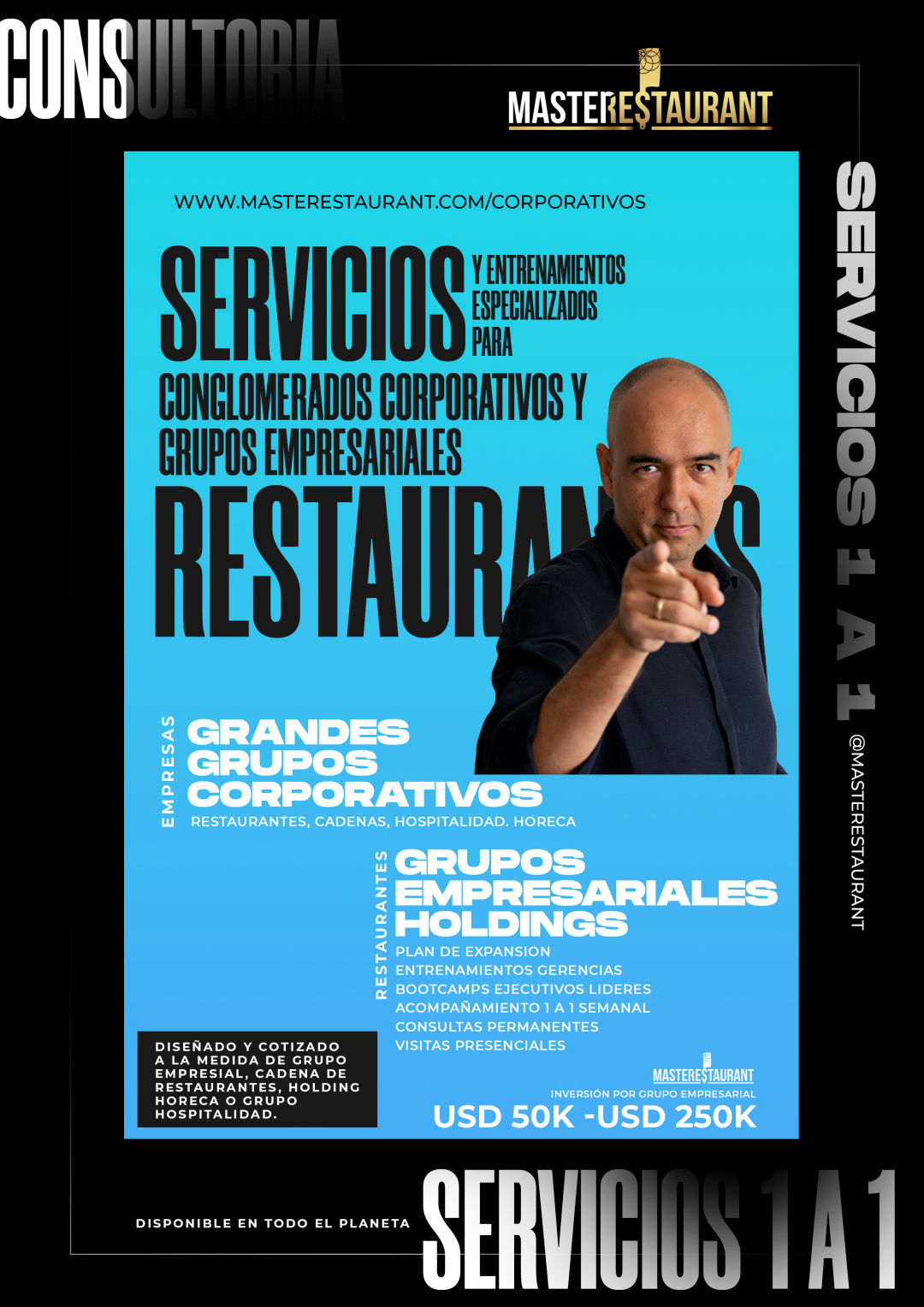
Investment: from USD $50K to USD $500K+ - tailor-made corporate programs, priced to the group's size and complexity - spots LIMITED worldwide.
Corporate programs
Tailor-made corporate consulting programs for groups and chains
Every corporate program is 100% personalized and tailor-made to the group. It starts with a strategic portfolio diagnosis and works through the key elements of the business model in the MASTERESTAURANT Restaurant Canvas, from portfolio strategy and standardization to per-unit profitability and expansion. Priced to the group's size and complexity (from USD $50K to USD $500K+), with limited spots worldwide to ensure dedicated attention and discretion for each client. The diagnosis sets the scope and the phases (strategic planning, standardization and implementation, and support through operations and expansion), working from the group's own numbers, on site or remote, in English or Spanish.
Corporate coverage
Where else we support restaurant groups near Bahamas
Explore other territories or the worldwide index:
Restaurant chain expansion in FreeportRestaurant group consultant in NassauRestaurant chain consulting in AustraliaRestaurant chain expansion in AustriaRestaurant chain consulting in IsraelRestaurant chain consulting in South AfricaCorporate hospitality consulting in AlajuelaAdvisory for restaurant groups across ArgentinaAdvisory for restaurant groups across BoliviaRestaurant chain expansion across BrazilRestaurant group consulting across CanadaRestaurant chain expansion across ChileCorporate hospitality consulting across ColombiaCorporate hospitality consulting across Costa RicaRestaurant group consulting across CubaCorporate hospitality consulting across the Dominican RepublicRestaurant chain expansion across EcuadorRestaurant chain expansion across El SalvadorRestaurant chain consulting across GuatemalaRestaurant chain expansion across HondurasAdvisory for restaurant groups across MexicoRestaurant group consulting across NicaraguaRestaurant chain consulting across PanamaRestaurant group consultant across ParaguayMore countries →More cities →
We do serve — and every city on the planet
Served on site or virtually, in English and Spanish.
Who is Diego F Parra?
Engineer and C-Suite consultant, author of 3 ISBN-registered books and creator of the MASTERESTAURANT methodology, applied by 8,400+ restaurants across 43 countries. The method comes with its own technology suite: MTIE, Gastronomic Radar and KPI Dashboard.
He is the consultant that business groups, chains, holdings and family offices choose to grow, standardize and expand their restaurant portfolio with profitability and governance. His method comes from two decades operating, rescuing and expanding restaurants, franchises, dark kitchens and HORECA groups across four continents, and it arrives with instruments proven in real operations, not generic templates. He works in English or Spanish, on site or remote.
HORECA · Chains · Holdings · Foodtech
Private programs for boards and family offices
Consulting, bootcamps and private advisory for boards and family offices.
From USD $50K, priced to the group; limited spots worldwide.
Published doctrine
The books that changed restaurant management
De Esclavo a Dueño
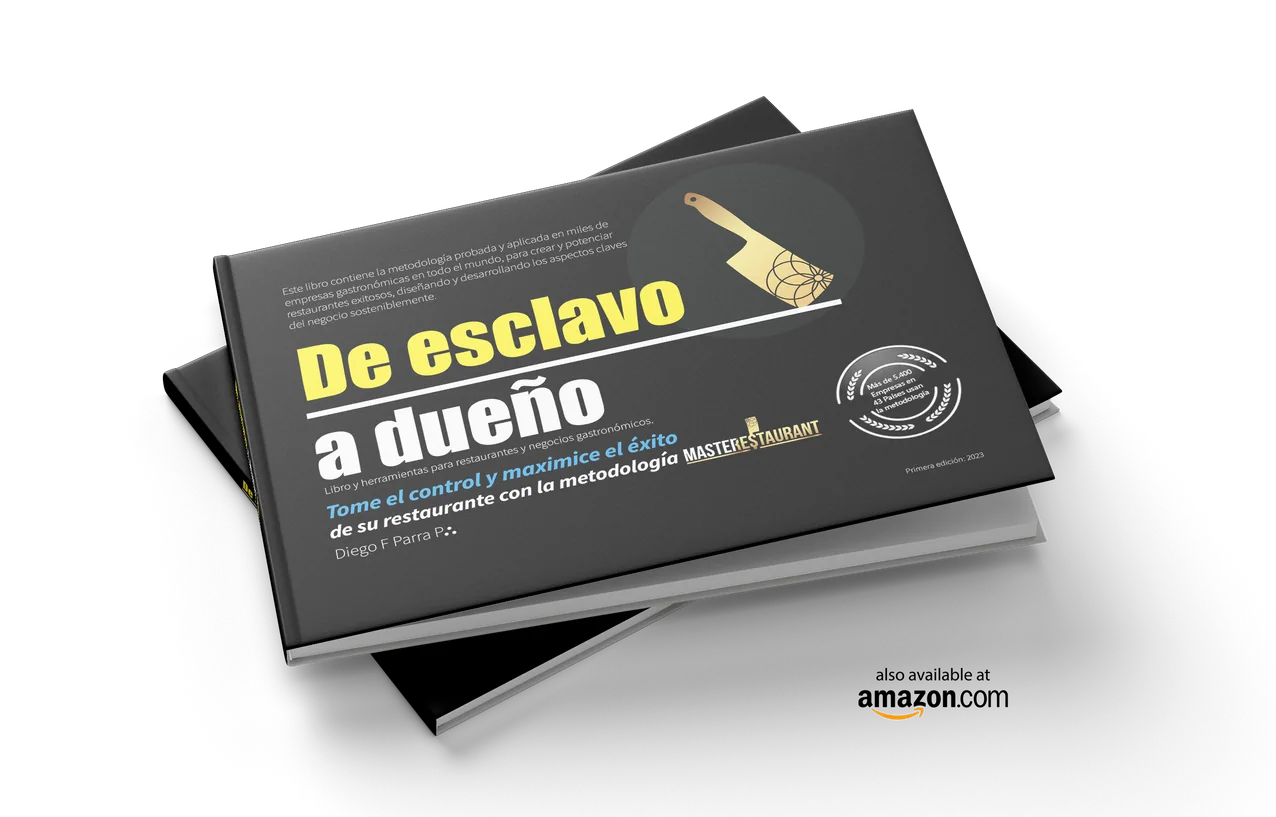
The book that changed how restaurants are managed: practical strategies and tools based on more than 20 years of experience, for traditional restaurants, dark kitchens, foodtech and HORECA businesses.
Triunfar o Morir en el Intento
Practical tools and key strategies to design and operate restaurants and food businesses efficiently.
Podcast: Masterestaurant — Mistakes for Restaurants
The public autopsy of the mistakes that bankrupt restaurants: thousands of owners and managers listen on Spotify to avoid repeating them.
Listen on SpotifyDownloads
The documents your board will ask for
MASTERESTAURANT services portfolio
The complete corporate intervention catalog: consulting, executive bootcamps, advisory and specialized services, with scopes and formats. The document to decide with your board.
Download PDFBook: From Slave to Owner
The full doctrine behind the methodology: how to structure restaurants that run without depending on the owner. Ideal pre-reading before your group's diagnosis.
View on AmazonPortfolio
More services by Diego F Parra and his team
As the group grows, every new site needs managers trained to the same standard. That is why the ecosystem's services start from the same method and tools as the corporate consulting: training and courses for managers in each market, the membership to keep learning going and the Pitch Deck and investment service when expansion needs capital. The full ecosystem is available:
International keynote speakerOne-on-one consulting and advisoryPersonalized mentoring for owners (limited spots)Corporate groups and holdings consultingCelebrity Restaurants consultingThemed restaurant advisorySpecialized training programs52-Week membershipPitch deck and restaurant investment readinessExponential Program0.1 Program — Elevate Your RestaurantInteractive training kit
Direct contact
Get a quote for corporate consulting for your group in the Bahamas
Your message goes straight to Diego's team: group or chain, number of sites, stage and what you need to achieve in the Bahamas.
“Restaurant groups grow by two routes: the impulse path, which opens units because today's market demands it, and the design path, which builds a system that replicates profitability at every location. This market proves this quickly—small, international competition, margins that erode without standardization. What I've seen across 43 countries is that groups that scale without diluting brand are those treating expansion as an operations-engineering problem, not a speed-to-market race.”
Diego F. Parra — International consultant, expert in creating, scaling and improving restaurants, HORECA and hospitality
MASTERESTAURANT® methodology applied by 8,400+ restaurants across 43 countries · Author of 3 ISBN-registered books, including «De esclavo a dueño» · 20+ years operating restaurants, franchises, dark kitchens and HORECA groups across 4 continents
Full profile →Shall we talk about your network in the Bahamas?
Tell us how many units the network runs and which decision the board has to make.
Explore more
Restaurant groups: territories, services and ecosystem resources
Related links for boards, C-Suite and teams evaluating Diego F Parra's corporate consulting for restaurant groups and chains: nearby territories, sister services in the MASTERESTAURANT ecosystem and management tools, all built on the same method.
World's best restaurant keynote speakerWorld's best restaurant consultantC-Suite restaurant consultant for chains & groupsDiego F Parra — professional profileKeynote speaker serviceCorporate groups & holdings consultingCelebrity restaurant consultingInternational themed restaurant advisoryRestaurant chain expansion in FreeportRestaurant group consultant in NassauCorporate hospitality consulting in AlajuelaAdvisory for restaurant groups across ArgentinaAdvisory for restaurant groups across BoliviaRestaurant chain expansion across Brazil
FAQ
Frequently asked questions
When we open a second or third unit, we always lose margin even though we try to replicate the original model. How does this system diagnose where margin goes and stop that bleed?
The diagnosis starts in data: we extract Prime Cost, COGS, labor cost, and operating expenses per unit, mapping where they diverge across locations. In regional groups, margin loss typically stems from three sources: unconsolidated procurement (each manager negotiates with their own suppliers, no group leverage), weak kitchen and bar cost control (no portioning standards or waste tracking), and improvised management (no manual, each leader runs their own operation). MASTERESTAURANT closes that in 60 days: centralizes procurement, documents kitchen and bar processes with cost standards per dish, structures management by specialty (not multi-role chaos), and deploys weekly dashboards that alert before margin drops. Result: margin recovery is fast and predictable.
How do we decide whether to franchise a brand or keep it corporate? And if we franchise, how do we prevent the franchisee from destroying the guest experience?
The decision is strategic and data-driven: franchise brands with robust operating systems, verified demand, and margin that withstands decentralization. In this market, this typically means replicable casual dining (not highly personalized founder concepts). Before offering franchise, the system demands operations documentation (manuals, processes, staff training), economics that sustain margin for both franchisee and corporate, and a real-time KPI dashboard corporate monitors monthly. The franchisee operates under non-negotiable standards (quality, service, pricing) verified through monthly audits. That prevents brand dilution while enabling capital-light growth.
How does corporate consulting for restaurant groups and chains work?
It starts with a strategic diagnosis of the group and its portfolio of brands and units. Based on it, the growth plan is designed —portfolio strategy, multi-site standardization, per-unit profitability and expansion—and leadership is supported through implementation.
Is the confidentiality of the group's information protected?
Yes. The whole process operates under confidentiality agreements (NDA). The group's financial, operational and strategic information is and remains the client's. Limited spots worldwide exist to guarantee dedication and focus on each organization.
How long does it take and what are the phases of the corporate engagement?
It depends on the group's size and complexity: diagnosis, strategic planning, standardization and implementation, and support during operation and expansion. Scaling a group profitably is a process with method, not an event.
What is the investment for a corporate program?
Corporate programs range from USD $50K to USD $500K+ and are priced to the group's size and complexity, number of sites and scope of the engagement. They are quoted tailor-made after the diagnosis.
Do you work with growing groups and also with consolidated chains?
Both: expanding groups that need to standardize and get in order before growing, and consolidated chains looking to recover per-unit profitability, restructure the portfolio or prepare franchising and new markets.
