 MASTERESTAURANT®
Jobs created by bars and restaurants in Brazil in 2024, a record high for the sector.
ABRASEL
Corporate governance · Brazil

DIEGO F PARRA · CREATOR OF THE MASTERESTAURANT® METHODOLOGY
RESTAURANT GROUP ADVISORY Who does a chain in Brazil call when it opens faster than it documents?
Diego F. Parra has worked across 8,400+ restaurants in 43 countries. In Brazil he applies that judgement to the whole network, not to a pilot site.
Download the portfolio (PDF)Corporate advisory spots LIMITED worldwide - reserve your group's evaluation early
8,400+restaurants apply his methodology
43countries with supported groups
65M+views per year
2service languages: EN - ES
International validation
See Diego F. Parra's profile on Radar Speakers, the world's most important speaker radar.
See profile on Radar Speakers →
230,000 jobs
70%
230,000
4%

@masterestaurant
The system behind a chain in Brazil
The MASTERESTAURANT methodology and its TOOLKIT have been applied across 8,400+ restaurants in 43 countries, from three-site groups to networks with dozens of units. Growing a group is harder than opening a restaurant: each new site multiplies costs, standards, talent and complexity, and a group only scales when a system replicates per-unit profitability, not when it depends on founders or operational heroes.
In Brazil, the method adapts to the size, stage and expansion model of each group, in an order that does not change: measure, standardize, and only then replicate. That means a corporate diagnosis brand by brand and site by site, standards and financial governance that hold across the network, and a decision on owned units, licensing or franchising based on the documented standard and the team available.
How does restaurant group consulting work in Brazil?
It begins by measuring each unit in Brazil with one yardstick (EBITDA per site, Prime Cost, operating standards and the team in charge) so the board can decide what to open, convert or close on evidence.
The diagnosis turns into four workstreams: portfolio, multi-site standards, financial governance and expansion. The aim is a group that can grow without the founders in every decision: documented recipes and processes, a KPI dashboard with a fixed review cadence and managers who own their numbers. The engagement uses the group's own data, runs in person or remotely, in English or Spanish, and is sized to the number of units and the stage of the business. This page cites four verified figures for Brazil, from sources such as ABRASEL and Masterestaurant.
What do the numbers say about running a restaurant group in Brazil?
230,000 jobs — jobs created by bars and restaurants in Brazil in 2024, a record high for the sector, according to ABRASEL. A figure like this sizes the opportunity; it does not say whether each new unit will earn money.
Other reference points cited on this page: 230,000 (new job openings in bars and restaurants, 2024, record, ABRASEL); 70% (Prime-cost overspend in 70% of restaurants, Masterestaurant); 4% (global foodservice market growth in 2025, Euromonitor International). For a group, the useful reading is the unit economics behind each opening: Prime Cost under control, a theoretical food cost close to the real one and EBITDA measured site by site. That is what decides whether a new location in Brazil multiplies profit or only multiplies complexity.
Data
Market figures for restaurant groups in Brazil
The figures cited on this page, with what each one measures and its source.
| Figure | What it measures | Source |
|---|---|---|
| 230,000 jobs | Jobs created by bars and restaurants in Brazil in 2024, a record high for the sector, per ABRASEL | ABRASEL |
| 70% | Prime-cost overspend in 70% of restaurants | Masterestaurant - Índice de Prime Cost 2026 |
| 230,000 | new job openings in bars and restaurants (2024, record) | ABRASEL / IBGE |
| 4% | Global foodservice market growth in 2025 | Euromonitor International |
Each figure links to its source in the data cards on this page.
The local market
How a restaurant chain competes in Brazil
A restaurant group or chain in Brazil that scales from two or three locations to ten or twenty faces exponential complexity that cannot be managed through commercial impulse alone. Each new opening replicates fixed costs (rent, management payroll, systems, fiscal compliance), demands new operational processes (centralized purchasing, team training, quality oversight), and introduces points of failure (the casual dining manager who works in Pinheiros does not necessarily scale to Vila Mariana; prime cost that closes in one zone may be unviable in another due to consumer differences, local ingredient availability, and occupancy expense variance). Most Brazilian groups grow because they find a format that sells, not because they engineered a system that replicates profitability. The result: eroded margins as locations multiply, operations hostage to founders or a few operational heroes, and boards with no visibility into unit economics to make portfolio decisions. Corporate consulting specialized in restaurants and hospitality closes that gap, transforming growth impulse into governed business architecture.
The transformation this service delivers is specific: converting a group that grows without design into a GOVERNED RESTAURANT COMPANY. That means deep portfolio diagnosis (unit performance, brand analysis, identification of cash-draining vs. cash-generating businesses), growth strategy aligned to group operational capacity (which brands to expand, in which geographies, at what pace), multi-location standardization (operation manuals, critical processes, control systems), portfolio financial governance (unit economics by concept, Prime Cost and EBITDA managed at group level, monthly indicator dashboards for board review), organizational structure that does not depend on heroism (clear roles, authority lines, talent development for local leadership), expansion and franchise strategy when appropriate (replicable model, brand control, recurring revenue streams). All built on the MASTERESTAURANT methodology, fully adapted to Brazil's operational and fiscal reality.
Diego F. Parra's global authority in restaurants and hospitality significantly reduces scale risk in Brazil. A consultant specialized exclusively in gastronomy with real C-Suite experience across 43 countries and over 8,400 restaurants and groups; executive who has signed payroll, negotiated leases, structured corporations, and closed expansion deals in operations worth hundreds of millions of dollars; author of 3 ISBN-registered books with «De Esclavo a Dueño»; creator of MASTERESTAURANT, a framework proven across multiple geographies and ownership structures (from entrepreneurs to family offices and hospitality investment funds). That accumulated experience, translated into diagnosis and custom systems for each group, eliminates improvisation and anchors portfolio decisions in data and process, not intuition or founder mythology.
Return for the group is measurable. First: replicated unit profitability. When standardization works, each new opening reaches profitability in predictable timeframe with protected margins. Second: portfolio decisions backed by data. The board knows which concepts to expand, which to restructure, how to allocate capital for expansion, which geographic zones offer real opportunity vs. saturation. Third: an operation that is not hostage to the founder or three key executives. When manual, process, dashboard, and training exist, talent turnover does not collapse the business. Fourth: a more valuable group. A portfolio managed with financial, operational, and strategic visibility is more attractive to investors, franchisors, eventual partners, or buyers. Diego's corporate consulting converts growth by impulse into sustainable value.
Market data
The restaurant-group and chain market in Brazil in figures
Prime-cost overspend in 70% of restaurants
Masterestaurant - Prime Cost Index 2026new job openings in bars and restaurants (2024, record)
ABRASEL / IBGEGlobal foodservice market growth in 2025
Euromonitor InternationalBrazil as a market
What drives chains in Brazil
Brazil's restaurant corporate ecosystem is dynamic and segmented: casual dining groups with multiple locations in malls and main avenues (rapid occupancy model, high customer turnover, margins compressed by volume); fine dining chains concentrated in São Paulo, Rio de Janeiro, and Belo Horizonte (competition for culinary and service talent, sensitivity to economic cycles, higher-ticket customer base); dark kitchens and foodtech in expansion (capital-light model, platform dependency, margins absorbed by commissions); family offices and investment funds with hospitality portfolios (return focus, demand for corporate governance, pressure to scale or consolidate). Supply of senior management talent is concentrated: gastronomy executives compete between groups, pressuring compensation and retention. Rent in strategic districts (Pinheiros, Itaim, Vila Mariana in São Paulo; Leblon, Ipanema in Rio) remains a cost pressure. Consumer by zone is heterogeneous: average ticket, frequency, format preference vary between districts and cities.
Expansion opportunity in Brazil is genuine: middle-class growth, mall expansion in peripheries (São Paulo, Curitiba, Brasilia), demand for gastronomy across segments. However, risks that erode profitability as scale increases are Brazil-specific: replicated fixed costs across multiple locations without real economies of scale (management payroll, supervision, duplicate systems in locations not yet reaching volume); lack of operational standard across units (each local manager improvises processes, generating quality variance and cost variation); high operational talent turnover, pressuring constant training and service impact; weak portfolio governance (boards without visibility into margin by concept or zone, expansion or closure decisions based on «it's working here» vs. data). Brazilian consumer is cyclical: economic cycles impact ticket and frequency, new format competition displaces traditional casual dining volume. A custom corporate program including portfolio diagnosis, selective operational standardization, prime cost governance by zone and brand, and direct decision dashboards for the board is what allows a group to protect margins while scaling.
RESOURCES
MASTERESTAURANT studies, guides & tools
Reading and downloads we bring to operators in Brazil: proprietary data, cases and working templates:
- STUDYThe Service Economy: Turning Operating Costs into Brand Value
- STUDYAutomating restaurant permits and licenses: the mistakes that cost a fortune vs. the right method (2026)
- GUIDERestaurant memberships: MR method vs traditional · Guide
- ARTICLEMyth vs Reality: Process standardization in restaurants
- CASE STUDYStandardize Before Scaling: Real 2026 Case Study
- CONCEPTWaiter Training: Before vs After · Definition
The corporate consultant
The authority behind every profitable restaurant
Behind MASTERESTAURANT's corporate restaurant consulting is Diego F Parra: engineer and C-Suite consultant with two decades creating, rescuing and expanding restaurants, franchises, dark kitchens and HORECA and hospitality groups across four continents. He doesn't arrive with theory: he arrives with the experience of having signed payrolls, negotiated leases, structured partnerships and closed expansions in operations worth hundreds of millions of dollars.
He is the creator of the MASTERESTAURANT® methodology — applied by 8,400+ restaurants across 43 countries — and its TOOLKIT of tools (MTIE, Gastronomic Radar, Standard Recipe Generator, Tech Sheets and KPI Dashboard). For a brand, a group or an investor that means one thing: every decision is made on proven data and systems, not on intuition.
Author of 3 ISBN-registered books, including «De esclavo a dueño», creator of the industry's leading podcast and of the largest bilingual community of owners, chefs and operations directors in the region (65M+ views per year as @masterestaurant), and recognized among the top Latino restaurant operations experts globally. See his full track record in Diego F Parra's professional profile.
Corporate consulting with its own doctrine, not generic frameworks
Consulting for restaurant groups is not solved with management theory. Every engagement is built on the Restaurant Model Canvas and real industry data—profitability, Prime Cost, cost structure, multi-site standardization and expansion—applied to the specific business model of a group, a chain or a holding. The goal is not to open more restaurants, but to build a business system that replicates per-unit profitability, governs the portfolio and sustains operations on clear rules rather than indispensable people. Every board decision rests on the group's own indicators, measured at each site.
Corporate consulting from start to finish
Advisory that covers the full restaurant-group lifecycle
What the board decides
Where next year's capital goes, on EBITDA per unit and strategic fit, not on whichever brand argues hardest in the meeting.
Get a quoteWhat holds the network up
Trained managers, quality control and written processes. A standard needs somebody to hold it or it degrades on its own.
Quote standardizationWhat protects the margin
Prime Cost governed, group fixed costs reviewed and waste measured identically across every site.
Quote expansionWhat makes growth possible
A model proven per unit and a staged plan, before the next opening or the first franchise contract is signed.
See the services portfolio (PDF)The methodology
Discover the MASTERESTAURANT methodology
Behind every group that scales profitably there is a system, not luck: tools, processes and models that turn impulse growth into governed expansion.
Who is it for?
Who this corporate consulting is for
A tailor-made 1-on-1 service, built for those opening and for those already operating:
From three to ten sites
The stretch where the founder's judgement stops reaching and no structure has replaced it yet.
From ten to fifty
Where the network needs governance: single definitions, quality control and trained managers in every market.
Consolidated networks
Years of trading and a per-unit margin sliding slowly, with nobody able to point at where.
Groups in generational transition
When what lived in the founder's head has to become a system others can run.
What's included
What the network engagement covers
No two engagements are alike: they are assembled from these MASTERESTAURANT methodology modules:
- Executive bootcamps for the leadership team
- Working sessions with the board
- A full corporate diagnosis
- Unit economics per brand and per unit
- Multi-site manuals and operational control
- Prime Cost governed corporately
- KPI dashboards for leadership
- Readiness for franchising and new markets
- Support through implementation
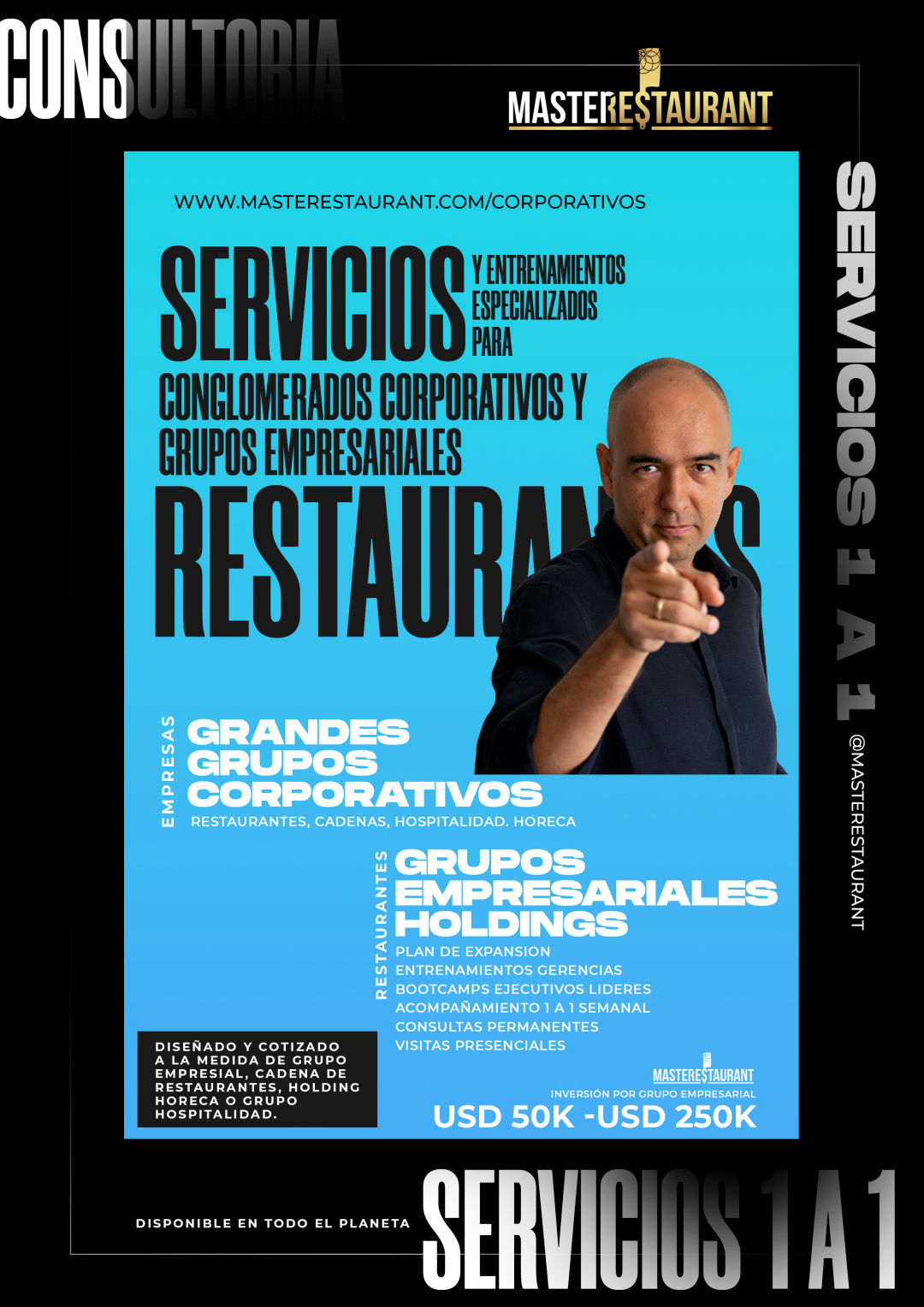
Investment: from USD $50K to USD $500K+ - tailor-made corporate programs, priced to the group's size and complexity - spots LIMITED worldwide.
Corporate programs
Tailor-made corporate consulting programs for groups and chains
Every corporate program is 100% personalized and tailor-made to the group. It starts with a strategic portfolio diagnosis and works through the key elements of the business model in the MASTERESTAURANT Restaurant Canvas, from portfolio strategy and standardization to per-unit profitability and expansion. Priced to the group's size and complexity (from USD $50K to USD $500K+), with limited spots worldwide to ensure dedicated attention and discretion for each client. The diagnosis sets the scope and the phases (strategic planning, standardization and implementation, and support through operations and expansion), working from the group's own numbers, on site or remote, in English or Spanish.
Corporate coverage
Chain engagements available near Brazil
Explore other territories or the worldwide index:
Restaurant chain expansion across BrazilRestaurant group consultant in BrasíliaCorporate hospitality consulting in CuritibaRestaurant group consulting in Rio de JaneiroCorporate hospitality consulting in São PauloRestaurant chain consulting in AustraliaRestaurant chain expansion in AustriaRestaurant chain consulting in IsraelRestaurant chain consulting in South AfricaCorporate hospitality consulting in AlajuelaAdvisory for restaurant groups across ArgentinaAdvisory for restaurant groups across BoliviaRestaurant group consulting across CanadaRestaurant chain expansion across ChileCorporate hospitality consulting across ColombiaCorporate hospitality consulting across Costa RicaRestaurant group consulting across CubaCorporate hospitality consulting across the Dominican RepublicRestaurant chain expansion across EcuadorRestaurant chain expansion across El SalvadorRestaurant chain consulting across GuatemalaRestaurant chain expansion across HondurasAdvisory for restaurant groups across MexicoRestaurant group consulting across NicaraguaMore countries →More cities →
We do serve — and every city on the planet
Served on site or virtually, in English and Spanish.
Who is Diego F Parra?
Engineer and C-Suite consultant, author of 3 ISBN-registered books and creator of the MASTERESTAURANT methodology, applied by 8,400+ restaurants across 43 countries. The method comes with its own technology suite: MTIE, Gastronomic Radar and KPI Dashboard.
He is the consultant that business groups, chains, holdings and family offices choose to grow, standardize and expand their restaurant portfolio with profitability and governance. His method comes from two decades operating, rescuing and expanding restaurants, franchises, dark kitchens and HORECA groups across four continents, and it arrives with instruments proven in real operations, not generic templates. He works in English or Spanish, on site or remote.
HORECA · Chains · Holdings · Foodtech
Private programs for boards and family offices
Consulting, bootcamps and private advisory for boards and family offices.
From USD $50K, priced to the group; limited spots worldwide.
Published doctrine
The books that changed restaurant management
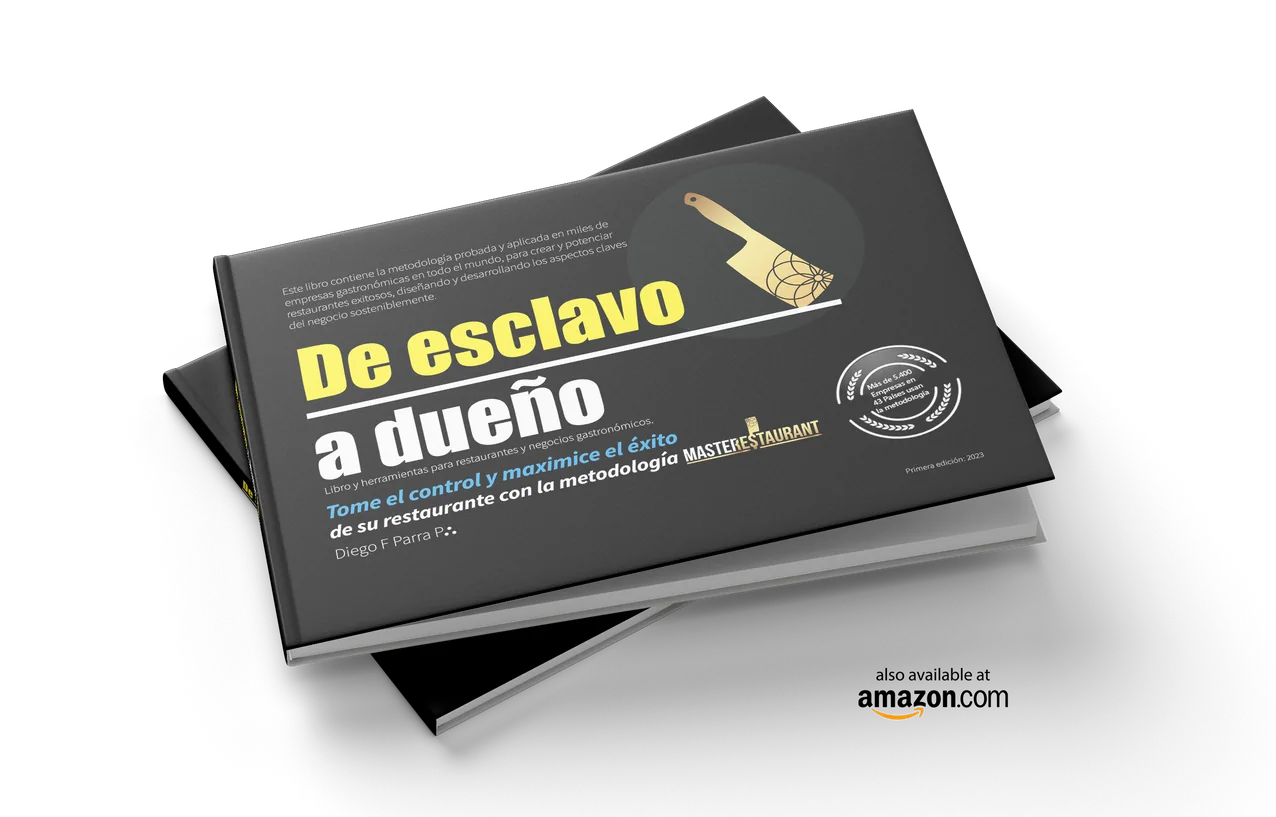
De Esclavo a Dueño
The book that changed how restaurants are managed: practical strategies and tools based on more than 20 years of experience, for traditional restaurants, dark kitchens, foodtech and HORECA businesses.
Triunfar o Morir en el Intento
Practical tools and key strategies to design and operate restaurants and food businesses efficiently.
Podcast: Masterestaurant — Mistakes for Restaurants
The public autopsy of the mistakes that bankrupt restaurants: thousands of owners and managers listen on Spotify to avoid repeating them.
Listen on SpotifyDownloads
The documents your board will ask for
MASTERESTAURANT services portfolio
The complete corporate intervention catalog: consulting, executive bootcamps, advisory and specialized services, with scopes and formats. The document to decide with your board.
Download PDFBook: From Slave to Owner
The full doctrine behind the methodology: how to structure restaurants that run without depending on the owner. Ideal pre-reading before your group's diagnosis.
View on AmazonPortfolio
More services by Diego F Parra and his team
As the group grows, every new site needs managers trained to the same standard. That is why the ecosystem's services start from the same method and tools as the corporate consulting: training and courses for managers in each market, the membership to keep learning going and the Pitch Deck and investment service when expansion needs capital. The full ecosystem is available:
International keynote speakerOne-on-one consulting and advisoryPersonalized mentoring for owners (limited spots)Corporate groups and holdings consultingCelebrity Restaurants consultingThemed restaurant advisorySpecialized training programs52-Week membershipPitch deck and restaurant investment readinessExponential Program0.1 Program — Elevate Your RestaurantInteractive training kit
Direct contact
Get a quote for corporate consulting for your group in Brazil
Your message goes straight to Diego's team: group or chain, number of sites, stage and what you need to achieve in Brazil.
“In three decades watching groups fail I learned they don't fracture from opening slowly—they collapse from scaling without system. Each new location is opportunity to improve profitability if you have diagnosis, standardization, and dashboard; or it's opportunity to dilute margins if you grow by impulse. The difference between a group that scales and one that disintegrates is that the first knows where every dollar exits each location, and the second hopes the manager figures it out. A board that sees numbers by concept and geography sleeps well.”
Diego F. Parra — International consultant, expert in creating, scaling and improving restaurants, HORECA and hospitality
MASTERESTAURANT® methodology applied by 8,400+ restaurants across 43 countries · Author of 3 ISBN-registered books, including «De esclavo a dueño» · 20+ years operating restaurants, franchises, dark kitchens and HORECA groups across 4 continents
Full profile →Shall we talk about your network in Brazil?
Tell us how many units the network runs and which decision the board has to make.
Explore more
Restaurant groups: territories, services and ecosystem resources
Related links for boards, C-Suite and teams evaluating Diego F Parra's corporate consulting for restaurant groups and chains: nearby territories, sister services in the MASTERESTAURANT ecosystem and management tools, all built on the same method.
World's best restaurant keynote speakerWorld's best restaurant consultantC-Suite restaurant consultant for chains & groupsDiego F Parra — professional profileKeynote speaker serviceCorporate groups & holdings consultingCelebrity restaurant consultingInternational themed restaurant advisoryRestaurant chain expansion across BrazilRestaurant group consultant in BrasíliaCorporate hospitality consulting in CuritibaRestaurant group consulting in Rio de JaneiroCorporate hospitality consulting in São PauloCorporate hospitality consulting in Alajuela
FAQ
Frequently asked questions
Our group has 8 profitable locations individually, but when we review consolidated portfolio margin we realize growth is not translating to results. How does Masterestaurant identify where the money goes?
First phase is granular financial diagnosis: unit economics per location (revenue, COGS, labor, rent, other operating costs, EBITDA), identification of hidden drains (decentralized purchasing without volume, management payroll not assigned to location, replicated fixed costs with no margin effect). Then: margin comparison by concept and geography vs. benchmark of similar groups. That lets the board see where the leak is, which concepts to expand vs. restructure, and what capital allocation maximizes portfolio return.
We want to expand to 15 locations in two years, but if we replicate our current team structure our payroll will explode and we'll lose operational control. How does Masterestaurant manage expansion without blowing up the structure?
We design organizational structure in layers: corporate C-level (finance, operations, brand, talent), cluster supervisors by geography, and local managers specialized in daily execution. Parallel: standardization of critical processes (purchasing, training, daily close, quality oversight) and systems that unbundle operation from people. ROI of restructure typically shows at location 12-15: before is net investment, after is exponential effect. The board sees real payback timeline.
How does corporate consulting for restaurant groups and chains work?
It starts with a strategic diagnosis of the group and its portfolio of brands and units. Based on it, the growth plan is designed —portfolio strategy, multi-site standardization, per-unit profitability and expansion—and leadership is supported through implementation.
Is the confidentiality of the group's information protected?
Yes. The whole process operates under confidentiality agreements (NDA). The group's financial, operational and strategic information is and remains the client's. Limited spots worldwide exist to guarantee dedication and focus on each organization.
How long does it take and what are the phases of the corporate engagement?
It depends on the group's size and complexity: diagnosis, strategic planning, standardization and implementation, and support during operation and expansion. Scaling a group profitably is a process with method, not an event.
What is the investment for a corporate program?
Corporate programs range from USD $50K to USD $500K+ and are priced to the group's size and complexity, number of sites and scope of the engagement. They are quoted tailor-made after the diagnosis.
Do you work with growing groups and also with consolidated chains?
Both: expanding groups that need to standardize and get in order before growing, and consolidated chains looking to recover per-unit profitability, restructure the portfolio or prepare franchising and new markets.
