DIEGO F PARRA · CREATOR OF THE MASTERESTAURANT® METHODOLOGY
RESTAURANT CHAIN EXPERTWho replaces the founder's judgement in Denmark with a system, without losing what made the group grow?
A chain in Denmark does not break by opening: it breaks by opening without having written down how it operates. Past a certain number of sites, the team's memory stops being a system.
The MASTERESTAURANT methodology and its TOOLKIT have been applied across 8,400+ restaurants in 43 countries, from three-site groups to networks with dozens of units. Growing a group is harder than opening a restaurant: each new site multiplies costs, standards, talent and complexity, and a group only scales when a system replicates per-unit profitability, not when it depends on founders or operational heroes.
In Denmark, the method adapts to the size, stage and expansion model of each group, in an order that does not change: measure, standardize, and only then replicate. That means a corporate diagnosis brand by brand and site by site, standards and financial governance that hold across the network, and a decision on owned units, licensing or franchising based on the documented standard and the team available.
How does restaurant group consulting work in Denmark?
It starts with a corporate diagnosis of every unit in Denmark measured with the same yardstick: EBITDA per unit, Prime Cost, standards and the team that runs each site. From there the board decides what to open, convert or close.
MASTERESTAURANT's corporate consulting works on four fronts at once: portfolio strategy, multi-site standardization, financial governance and expansion. The diagnosis compares units on the same indicators, so the board sees which sites carry the group and which dilute it. Then come the systems that make growth repeatable: documented recipes and processes, a KPI dashboard reviewed on a fixed cadence and a leadership structure that does not depend on the founders. The work uses the group's own numbers, in person or remotely, in English or Spanish, and the scope is tailored to the number of units and the stage of the business. This page cites four verified figures for Denmark, from sources such as Harvard Business Review and the U.S. Bureau of Labor Statistics.
What do the numbers say about running a restaurant group in Denmark?
5-25x — cost of acquiring a new customer vs. retaining an existing one, according to Harvard Business Review. A figure like this sizes the opportunity; it does not say whether each new unit will earn money.
Other reference points cited on this page: 5.4% (average monthly staff separations rate in US accommodation and food services, 2024, the U.S. Bureau of Labor Statistics); 4-10% (food waste and spoilage over purchases, LeanPath); 70% (Prime-cost overspend in 70% of restaurants, Masterestaurant). For a group, the useful reading is the unit economics behind each opening: Prime Cost under control, a theoretical food cost close to the real one and EBITDA measured site by site. That is what decides whether a new location in Denmark multiplies profit or only multiplies complexity.
Data
Market figures for restaurant groups in Denmark
The figures cited on this page, with what each one measures and its source.
Figure
What it measures
Source
5-25x
Cost of acquiring a new customer vs. retaining an existing one
Harvard Business Review
5.4%
Average monthly staff separations rate in US accommodation and food services (2024)
U.S. Bureau of Labor Statistics
4-10%
Food waste and spoilage over purchases
LeanPath / U.S. EPA
70%
Prime-cost overspend in 70% of restaurants
Masterestaurant - Indice de Prime Cost 2026
Each figure links to its source in the data cards on this page.
The local market
Why opening fast in Denmark does not guarantee earning more
A restaurant group that operated profitably with two or three locations faces operational breakdown when scaling to ten, twenty, or fifty units. Each new site multiplies variables: centralized purchasing complexity, process standardization that doesn't exist in written form, talent management across multiple shifts and locations, Prime Cost control without real visibility, procedures that fail to replicate across kitchens, and portfolio decisions based on intuition rather than data. Consulting for restaurant groups is specialized because unplanned growth erodes margins at every opening: the fourth restaurant already yields less than the first, not due to market but due to system failures. Most groups expand by commercial impulse—spotting an attractive lease, opening—rather than through strategic design or financial governance of the portfolio. What separates a restaurant chain that scales without dilution from one that opens more units but loses profitability is the business system, not the expansion pace.
Diego F Parra's corporate consulting service transforms an operational group into a governed gastronomic enterprise. It begins with a real portfolio diagnosis: analysis of profitability per unit, margins, fixed and variable costs, labor structure, and comparisons between locations. From there emerges brand strategy—which units to strengthen, which to restructure, where to open new ones. Next comes multi-location standardization: kitchen and dining room protocols, Prime Cost controls at the group level, centralized purchasing systems, management indicators. A scalable organizational structure is designed with clear roles and financial governance—indicator dashboards the board reviews monthly, not quarterly. The MASTERESTAURANT methodology incorporates proprietary tools (unit economics, EBITDA governance, territorial expansion model, technical sheets for each unit) and adapts fully to local fiscal, commercial, and cultural reality. The result is a profitable, predictable, replicable portfolio ready for franchise or investment.
Diego F Parra has designed and executed consulting for restaurant groups in 43 countries, reaching over 8,400 restaurants and gastronomic holdings. He is not academic: he has signed payrolls as an operational partner, negotiated leases across multiple markets, structured partnerships, and closed expansions worth hundreds of millions of dollars. He is author of 'From Slave to Owner, and generates over 65 million views annually in his community. That track record doesn't eliminate the risk of expanding in a new market—each territory has its own fiscal and labor structure—but the board gains access to proven experience: he knows what fails in most groups during expansion, why margins erode, how to avoid it. Diagnosis and strategy are not hypothetical or based on generic models, but on patterns replicated across varied contexts. That confidence in proven data and systems is what differentiates ordered expansion from speculation.
The return on well-executed corporate consulting for a restaurant group is tangible and measurable. First, replicable profitability per unit: each new location opens with protected margins, not as an experiment. Second, data-driven portfolio decisions: the board knows which brands to invest capital in, which to consolidate in a single larger location, which to restructure or close. Third, an operational team that doesn't depend on founder intuition or operational heroes who leave: management is systemic, documented, transferable. Fourth, an operation that attracts investment because it is predictable and valued—investors buy enterprises, not isolated restaurants. Fifth, controlled franchise expansion: once the model is replicable, it licenses in other markets with low risk. A group that invests in specialized corporate consulting doesn't just open more locations; it builds a system that makes them profitable.
Market data
Chain figures in Denmark
5-25x
Cost of acquiring a new customer vs. retaining an existing one
The market for restaurant groups and chains is sophisticated, competitive, and highly segmented. Major cities concentrate most chain operations—casual dining (lunch bars and cafés), fine dining (luxury market with high margins but few units), cloud kitchens (delivery-focused), and gastronomic holdings. Tier-two cities have more fragmented local markets, with regional groups of 3–8 units dominating. Operating costs are among Europe's highest: retail or high-street rents frequently exceed €800–1,200 m²/month, managerial salaries reach €5,000–7,000 monthly, and payroll taxes are progressive. Management talent is available but highly competitive; turnover in chef and maître positions is significant. The Nordic consumer is demanding, values quality over volume, and expects transparency in ingredient sourcing, sustainability, and uniform service standards across locations. Most groups reaching ten units begin to fragment without multi-location standardization.
Expansion opportunity for a restaurant chain is real: gastronomic tourism is robust (major Nordic cities attract substantial flows of international visitors annually interested in experiential dining), the corporate lunch market is captive, and growth corridors exist in shopping centers and secondary districts where rent is more manageable. However, expansion risks are severe. Most common: fixed costs that don't scale linearly (accounting, insurance, legal services remain high even with few units), erosion of operational quality due to lack of standardization (a kitchen without documented protocols fails during replication), and the gap between expected and actual profitability from underestimating regional costs or losing key talent. Premium zones offer visibility but command premium rents; secondary locations have better margins but lower foot traffic. The local consumer tolerates isolated failures but is intolerant of inconsistency between locations. That standard is what most groups in accelerated growth lack.
RESOURCES
MASTERESTAURANT studies, guides & tools
Before your next move in Denmark, these MASTERESTAURANT resources give real operating and profitability context:
From the kitchen to the boardroom, in the same language
Few consultants move as easily through a kitchen on a full service as through a board meeting reviewing EBITDA per unit. Diego F Parra has spent two decades doing exactly that: engineer and C-Suite consultant who has created, rescued and expanded restaurants, franchises, dark kitchens and HORECA and hospitality groups across four continents, signing payrolls, negotiating leases and closing expansions in operations worth hundreds of millions of dollars.
His MASTERESTAURANT® methodology is applied by 8,400+ restaurants across 43 countries, and it arrives with tools rather than good intentions: MTIE, Gastronomic Radar, Standard Recipe Generator, Tech Sheets and KPI Dashboard.
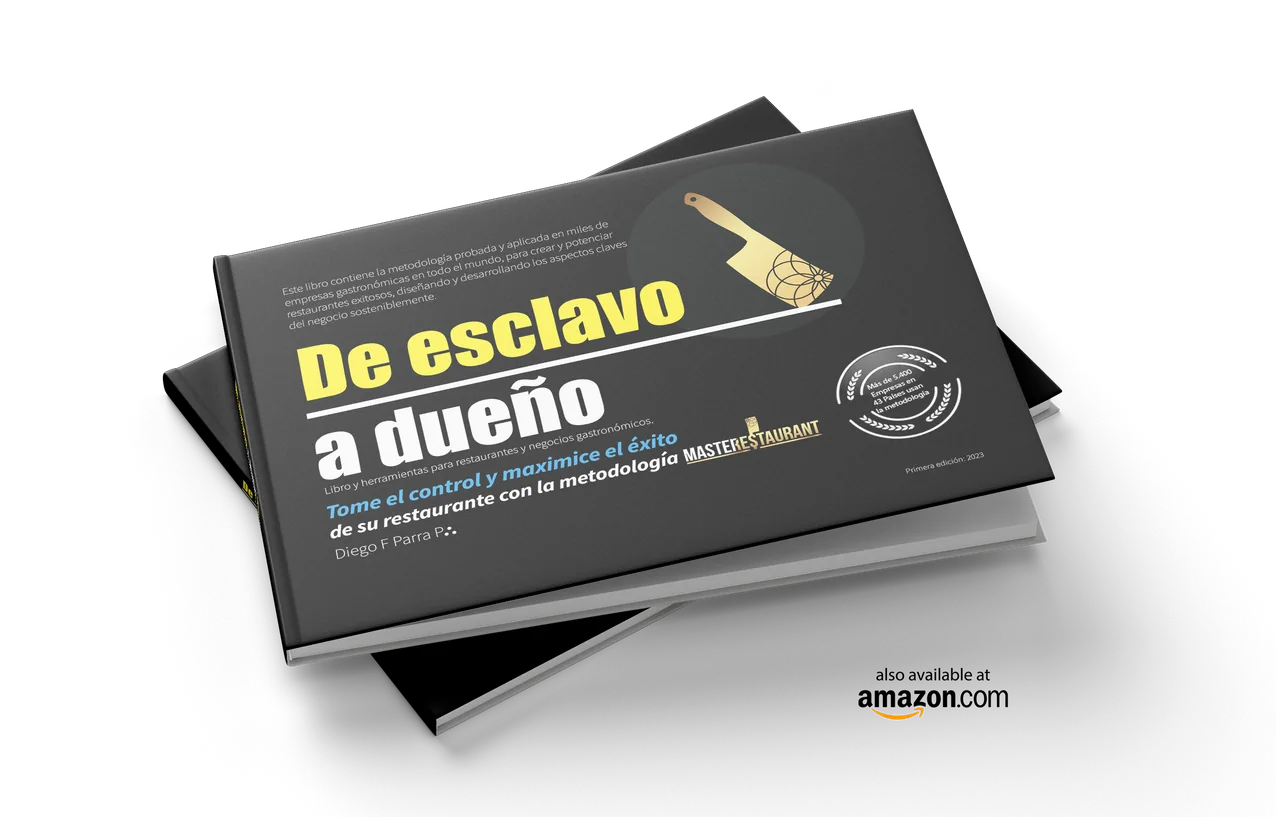
He is the author of 3 ISBN-registered books, including «De esclavo a dueño», creator of the industry's leading podcast and of the largest bilingual community of owners, chefs and operations directors in the region (65M+ views per year as @masterestaurant), and is recognized among the top Latino restaurant operations experts globally. The full track record is in Diego F Parra's professional profile.
Corporate consulting with its own doctrine, not generic frameworks
Consulting for restaurant groups is not solved with management theory. Every engagement is built on the Restaurant Model Canvas and real industry data—profitability, Prime Cost, cost structure, multi-site standardization and expansion—applied to the specific business model of a group, a chain or a holding. The goal is not to open more restaurants, but to build a business system that replicates per-unit profitability, governs the portfolio and sustains operations on clear rules rather than indispensable people. Every board decision rests on the group's own indicators, measured at each site.
Built for those who lead and expand restaurant groups
Private, made-to-measure support, for whoever is creating and for whoever is correcting:
Those who want to open better
Not faster: better. With the model proven per unit before replicating it in the next market.
Those who want margin back
Networks that trade and do not earn: Prime Cost governed, fixed costs reviewed and sites compared on the same yardstick.
Those who want to franchise
Manuals, quality control and a demonstrably profitable unit before the first franchisee signs.
Those selling or raising capital
A group with written processes and comparable indicators negotiates better and holds up in due diligence.
What's included
What gets diagnosed, what gets standardized and what gets governed
The scope is defined with you; these are the MASTERESTAURANT methodology modules available:
Executive bootcamps for the leadership team
Working sessions with the board
A full corporate diagnosis
Unit economics per brand and per unit
Multi-site manuals and operational control
Prime Cost governed corporately
KPI dashboards for leadership
Readiness for franchising and new markets
Support through implementation
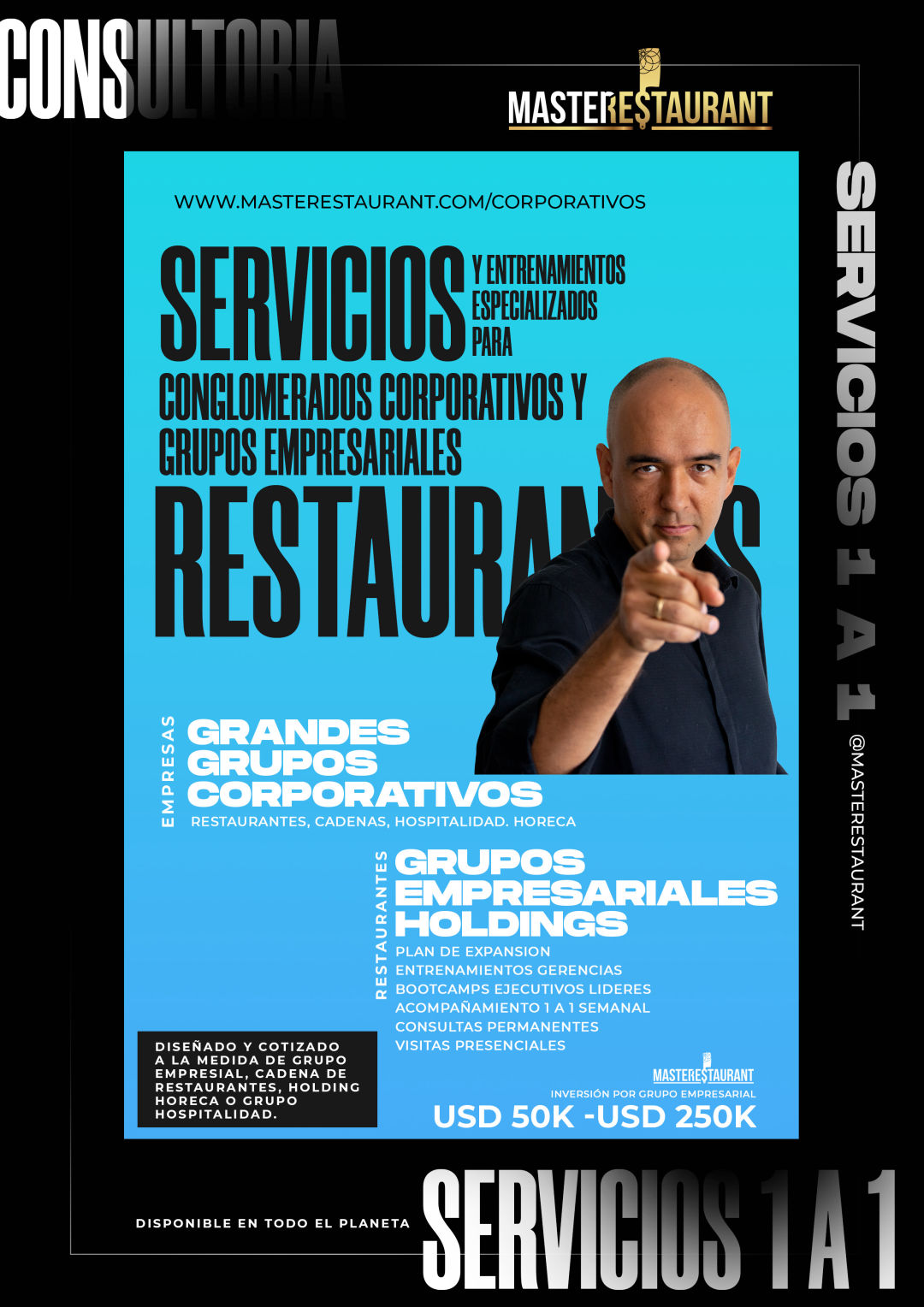
Investment: from USD $50K to USD $500K+ - tailor-made corporate programs, priced to the group's size and complexity - spots LIMITED worldwide.
Corporate programs
Tailor-made corporate consulting programs for groups and chains
Every corporate program is 100% personalized and tailor-made to the group. It starts with a strategic portfolio diagnosis and works through the key elements of the business model in the MASTERESTAURANT Restaurant Canvas, from portfolio strategy and standardization to per-unit profitability and expansion. Priced to the group's size and complexity (from USD $50K to USD $500K+), with limited spots worldwide to ensure dedicated attention and discretion for each client. The diagnosis sets the scope and the phases (strategic planning, standardization and implementation, and support through operations and expansion), working from the group's own numbers, on site or remote, in English or Spanish.
Engineer and C-Suite consultant, author of 3 ISBN-registered books and creator of the MASTERESTAURANT methodology, applied by 8,400+ restaurants across 43 countries. The method comes with its own technology suite: MTIE, Gastronomic Radar and KPI Dashboard.
He is the consultant that business groups, chains, holdings and family offices choose to grow, standardize and expand their restaurant portfolio with profitability and governance. His method comes from two decades operating, rescuing and expanding restaurants, franchises, dark kitchens and HORECA groups across four continents, and it arrives with instruments proven in real operations, not generic templates. He works in English or Spanish, on site or remote.
The book that changed how restaurants are managed: practical strategies and tools based on more than 20 years of experience, for traditional restaurants, dark kitchens, foodtech and HORECA businesses.
Triunfar o Morir en el Intento
Practical tools and key strategies to design and operate restaurants and food businesses efficiently.
The complete corporate intervention catalog: consulting, executive bootcamps, advisory and specialized services, with scopes and formats. The document to decide with your board.
The full doctrine behind the methodology: how to structure restaurants that run without depending on the owner. Ideal pre-reading before your group's diagnosis.
As the group grows, every new site needs managers trained to the same standard. That is why the ecosystem's services start from the same method and tools as the corporate consulting: training and courses for managers in each market, the membership to keep learning going and the Pitch Deck and investment service when expansion needs capital. The full ecosystem is available:
Get a quote for corporate consulting for your group in Denmark
Your message goes straight to Diego's team: group or chain, number of sites, stage and what you need to achieve in Denmark.
“A restaurant group scales or dilutes because of its business system, never because of opening pace. I've seen chains grow 40% in one year and collapse because each new unit cost more than the last. And I've seen others that opened one per quarter and endured because they replicated the model. The difference isn't luck; it's design.”
Diego F. Parra — International consultant, expert in creating, scaling and improving restaurants, HORECA and hospitality
MASTERESTAURANT® methodology applied by 8,400+ restaurants across 43 countries · Author of 3 ISBN-registered books, including «De esclavo a dueño» · 20+ years operating restaurants, franchises, dark kitchens and HORECA groups across 4 continents
Restaurant groups: territories, services and ecosystem resources
Related links for boards, C-Suite and teams evaluating Diego F Parra's corporate consulting for restaurant groups and chains: nearby territories, sister services in the MASTERESTAURANT ecosystem and management tools, all built on the same method.
How do we ensure a new location maintains profitability similar to the original after expansion, without compromising operational margins or quality?
The new location opens with a unit economics model replicated from the portfolio, not as an experiment. Prior diagnosis identifies realistic margins for each zone. Purchasing costs, labor, and operating procedures are standardized. During the first 3–6 months, key indicators are monitored weekly: Prime Cost, EBITDA, talent turnover. If they diverge, adjustment happens immediately. The difference is you don't wait for failure; you monitor in real time.
What if the group grows but the founder remains the operational bottleneck? How do we remove that dependency without losing strategic vision?
A scalable organization is structured: an operations director (not founder) has authority over processes, standardization, and location teams. The founder steps back to board-level and portfolio strategy decisions. Every decision is documented (operation manuals, location sheets, management indicators). Within 6–9 months, the group operates without the founder's signature on daily decisions. That increases company value and attracts investment.
What is the corporate diagnosis?
An X-ray of the group on real data: portfolio of brands and units, unit economics of each, cost structure, processes, talent and governance. It does not come from interviews, it comes from the numbers.
How long before results show?
Cost engineering shows within weeks. Multi-site standardization and habit change are measured in quarters. The plan says what to expect and when.
What is left in writing?
Multi-site manuals and processes, single definitions for every indicator, a structure of roles and the staged expansion plan. What is not written does not survive the first change of manager.
On site or remote?
Virtual, on site or hybrid depending on scope and the network's geography. The logistics change, the method and the deliverables do not.
What is the investment for a corporate program?
Corporate programs range from USD $50K to USD $500K+ and are priced to the group's size and complexity, number of sites and scope of the engagement. They are quoted tailor-made after the diagnosis.
Community
Join our MASTERESTAURANT Community for FREE
Restaurant owners and teams from 43 countries sharing knowledge, tools and applied AI — straight to your WhatsApp.
 MASTERESTAURANT®