 MASTERESTAURANT®
New monthly minimum wage for trade and services after the increase
elsalvador.com · accessed Sep 28, 2026Restaurant Groups & Chains · El Salvador
Diego F. Parra · CREATOR OF THE MASTERESTAURANT® METHODOLOGY
RESTAURANT GROUP CONSULTINGWho prepares a chain in El Salvador to franchise without handing out an unsolved problem?
Diego F. Parra has worked across 8,400+ restaurants in 43 countries. In El Salvador he applies that judgement to the whole network, not to a pilot site.
Download the portfolio (PDF)Corporate advisory spots LIMITED worldwide - reserve your group's evaluation early
8,400+restaurants apply his methodology
43countries with supported groups
65M+views per year
2service languages: EN - ES
International validationSee Diego F. Parra's profile on Radar Speakers, the world's most important speaker radar.See profile on Radar Speakers →
US$ 408.80 US$ 3.6 billion US$ 386 million 6,000
@masterestaurant
Site one and site fifty, in El Salvador
The MASTERESTAURANT methodology and its TOOLKIT have been applied across 8,400+ restaurants in 43 countries, from three-site groups to networks with dozens of units. Growing a group is harder than opening a restaurant: each new site multiplies costs, standards, talent and complexity, and a group only scales when a system replicates per-unit profitability, not when it depends on founders or operational heroes.
In El Salvador, the method adapts to the size, stage and expansion model of each group, in an order that does not change: measure, standardize, and only then replicate. That means a corporate diagnosis brand by brand and site by site, standards and financial governance that hold across the network, and a decision on owned units, licensing or franchising based on the documented standard and the team available.
How does restaurant group consulting work in El Salvador?
It begins by measuring each unit in El Salvador with one yardstick (EBITDA per site, Prime Cost, operating standards and the team in charge) so the board can decide what to open, convert or close on evidence.
The diagnosis turns into four workstreams: portfolio, multi-site standards, financial governance and expansion. The aim is a group that can grow without the founders in every decision: documented recipes and processes, a KPI dashboard with a fixed review cadence and managers who own their numbers. The engagement uses the group's own data, runs in person or remotely, in English or Spanish, and is sized to the number of units and the stage of the business. This page cites four verified figures for El Salvador, from sources such as elsalvador.com and Diario El Mundo.
What do the numbers say about running a restaurant group in El Salvador?
US$ 408.80 — New monthly minimum wage for trade and services after the increase, according to elsalvador.com. A figure like this sizes the opportunity; it does not say whether each new unit will earn money.
For a group, the useful reading is the unit economics behind each opening: Prime Cost under control, a theoretical food cost close to the real one and EBITDA measured site by site. That is what decides whether a new location in El Salvador multiplies profit or only multiplies complexity.
Other reference points cited on this page: US$ 3.6 billion (revenue that international tourism brought to the Salvadoran economy, Diario El Mundo); US$ 386 million (investment in building the Pacific Airport in the eastern region, Bloomberg Línea); 6,000 (additional hotel rooms the country needs to meet tourism demand, Diario El Mundo).
Data
Market figures for restaurant groups in El Salvador
The figures cited on this page, with what each one measures and its source.
| Figure | What it measures | Source |
|---|---|---|
| US$ 408.80 | New monthly minimum wage for trade and services after the increase | elsalvador.com |
| US$ 3.6 billion | Revenue that international tourism brought to the Salvadoran economy | Diario El Mundo / MITUR |
| US$ 386 million | Investment in building the Pacific Airport in the eastern region | Bloomberg Línea |
| 6,000 | Additional hotel rooms the country needs to meet tourism demand | Diario El Mundo |
Each figure links to its source in the data cards on this page.
The local market
How a restaurant chain competes in El Salvador
A restaurant group or hospitality chain in El Salvador grows according to commercial opportunity, not strategic design. Each new unit multiplies operational complexity: more personnel to train, service standards that diverge by location and leadership, costs that don't replicate (rent, utilities, regional wages), supply chains that fragment. What worked with two or three locations—where the founder could be everywhere—collapses with five, ten, or twenty units.
Most groups that expanded without governance experienced profitability erosion per unit in their first growth years, a pattern documented across regional multi-format portfolios. A group that opens without a tested business model ends up depending on operational heroes (the star manager, the founder working extreme hours) instead of replicable systems. Consulting for restaurant groups exists precisely to fill that gap: converting commercial impulse into governed expansion.
The program transforms a group growing by impulse into a governed hospitality enterprise. It begins with comprehensive portfolio diagnostics: each operating unit (brand, territory, format) analyzed for unit economics, Prime Cost, EBITDA, talent retention, and net profitability. Then, brand and unit strategy: which to accelerate, which to restructure, how to allocate capital by return. Third, multi-unit standardization: operational manuals, centralized procurement processes, quality control, training protocols, and per-unit metrics that speak one language.
Fourth, corporate financial governance: Prime Cost governed at group level (not by impulse), executive dashboards that boards read in 30-minute meetings, clear organizational structure (who decides what). Fifth, expansion playbook for restaurant chains: criteria for new units (location, format, investment, expected payback), franchising if applicable, and integration protocols. All through MASTERESTAURANT methodology, consulting for restaurant chains 100% customized to the Salvadoran market.
Diego F. Parra has advised restaurant groups in 43 countries, working directly with boards and C-Suite teams in operations worth hundreds of millions of dollars. Creator of the MASTERESTAURANT methodology, now applied by over 8,400 restaurants and hospitality groups worldwide. Bestselling author of 'From Slave to Owner', a consultant who has closed expansions, negotiated leases, managed payroll, and structured multi-jurisdictional partnerships in complex contexts.
His proprietary technology suite includes the Restaurant Model Canvas (for operational diagnostics), MTIE (Masterestaurant Territory Engine, for local market analysis), Gastronomic Radar (competitive intelligence), and Feasibility Technical Sheets. When a board engages Diego, it isn't hiring a theoretical consultant—it's accessing verified experience in portfolio expansion within similar structures, similar markets, similar constraints. That eliminates the risk of decisions based on intuition or incomplete local data.
The return is measurable. First, replicated profitability per unit: the group knows precisely what Prime Cost target applies to each unit type (outlet, casual, premium), what gross margin should be, what EBITDA. Second, protected margins on each new opening: no unit launches without modeled viability and protocols ensuring it hits targets by year two. Third, portfolio decisions with data: the board knows which brand replicates, which needs restructuring, which is profitable only in one location.
Fourth, operations independent of individuals: if the general manager leaves, the system continues; if the founder falls ill, the company doesn't collapse. Fifth, corporate valuation: a group with governed portfolio, clear unit economics, and expansion playbook is 1.5x to 2x more valuable to investors, lenders, and potential acquirers than one where 'everything depends on owner energy.' The program pays for itself in the first expansion cycle.
Market data
The numbers leadership decides on in El Salvador
Revenue that international tourism brought to the Salvadoran economy
Diario El Mundo / MITURInvestment in building the Pacific Airport in the eastern region
Bloomberg LíneaAdditional hotel rooms the country needs to meet tourism demand
Diario El MundoEl Salvador as a market
Trade fairs, congresses and season in El Salvador
El Salvador's restaurant and hospitality ecosystem clusters around strategic commercial corridors: Rosa/Escalante zone in San Salvador (premium gastronomy hub, high-net-worth consumers, executive tourism), Santa Tecla (accelerating hotel and restaurant expansion, middle-to-upscale segment), Santa Ana (colonial heritage, cultural and gastronomic tourism), Sonsonate (local gastronomy corridor), and coastal areas (Libertad, La Paz—weekend tourism, seasonal peaks).
Existing groups typically operate 3 to 15 units, mixing formats: casual dining (comedores, pupuserías), casual-premium (seafood, steakhouse), and select outlets or food courts in shopping centers. Executive talent (general managers, chefs, operations supervisors) concentrates in San Salvador; turnover averages 12-18 months in key positions. Lease costs vary sharply by zone and format (modest in secondary zones to premium in Escalante). Supply splits between local producers (meat, dairy, produce) and wholesale distributors; margins squeezed by competition and currency fluctuations.
Domestic and international tourism is seasonal (December-April peak; August-September low). Most groups grew opportunistically (family legacy, available lease, chef connection) without coherent expansion plan.
Opportunity is clear: gastronomic consumption in El Salvador grows with rising middle class, corporate tourism, and nightlife. But expanding without systems is a classic trap. Costs don't scale: a casual outlet in a prime location generates strong margins—but five units won't all perform identically. The fifth in a secondary zone generates lower revenue, and Prime Cost deteriorates due to fragmented procurement and dispersed management.
Lack of operational standard: each manager implements his 'version' of the concept (staff talks, local menu tweaks, variable hours); customers perceive inconsistency, brand erodes. Talent turnover: without transparent salary structure and clear career path, groups lose managers every 12 months; each new unit restarts the learning curve. Weak governance: the board doesn't truly know which unit is profitable and which is a 'founder project.' Local consumers are price-sensitive but loyal to consistent brand.
A tailor-made program allows expansion design where margins replicate, standards lock, talent retention improves via structural clarity. That's what separates a scaling group from a diluting one.
RESOURCES
MASTERESTAURANT studies, guides & tools
Reading and downloads we bring to operators in El Salvador: proprietary data, cases and working templates:
- COMPARISONMultiple locations without standards vs restaurant group with system: the difference that defines the future
- COMPARISONBefore vs After: opening a new restaurant with Masterestaurant
- ARTICLERestaurant Memberships and Subscriptions 2026: Before
- CHECKLISTDelivery Commissions That Kill Restaurant Margins: Myth vs
- CASE STUDYCustomer Loyalty in Restaurants: Myth vs Reality · Case study
- ARTICLEExpert AI Consultant for Restaurants in El Salvador
The corporate consultant
The judgment behind this corporate restaurant consulting
Diego F. Parra is an engineer and C-Suite consultant, and his trade for the last twenty years has been walking into restaurants, franchises, dark kitchens and HORECA groups across four continents to create them, rescue them or expand them. Along the way he signed payrolls, negotiated leases, structured partnerships and closed expansions in operations worth hundreds of millions of dollars.
The MASTERESTAURANT® methodology came out of that, and is used today by 8,400+ restaurants across 43 countries, with its TOOLKIT: MTIE, Gastronomic Radar, Standard Recipe Generator, Tech Sheets and KPI Dashboard. For an owner that means every decision is made on his own numbers and on tested processes, not on a hunch from the last good weekend.
His published work backs it: Author of 3 ISBN-registered books, including «De esclavo a dueño», creator of the industry's leading podcast and of the largest bilingual community of owners, chefs and operations directors in the region (65M+ views per year as @masterestaurant), recognized among the top Latino restaurant operations experts globally. See Diego F. Parra's professional profile.
Corporate consulting with its own doctrine, not generic frameworks
Consulting for restaurant groups is not solved with management theory. Every engagement is built on the Restaurant Model Canvas and real industry data—profitability, Prime Cost, cost structure, multi-site standardization and expansion—applied to the specific business model of a group, a chain or a holding. The goal is not to open more restaurants, but to build a business system that replicates per-unit profitability, governs the portfolio and sustains operations on clear rules rather than indispensable people. Every board decision rests on the group's own indicators, measured at each site.
Corporate consulting from start to finish
Advisory that covers the full restaurant-group lifecycle
What gets measured first
Unit economics per brand and per unit. Everything that follows rests on it.
Get a quoteWhat gets fixed first
Whatever returns margin in weeks: Prime Cost, waste and group fixed costs. The structural work comes next, and in writing.
Quote standardizationWhat gets written down
Manuals, indicator definitions and a structure of roles, which is what survives changes of team.
Quote expansionWhat gets measured again
The same figures from the diagnosis, at the close. That is the contract with leadership and what separates this from a report.
See the services portfolio (PDF)The methodology
Discover the MASTERESTAURANT methodology
Behind every group that scales profitably there is a system, not luck: tools, processes and models that turn impulse growth into governed expansion.
Who is it for?
Who sits at the table in a network engagement
1-on-1 consulting, no templates, for restaurants in any of these situations:
From three to ten sites
The stretch where the founder's judgement stops reaching and no structure has replaced it yet.
From ten to fifty
Where the network needs governance: single definitions, quality control and trained managers in every market.
Consolidated networks
Years of trading and a per-unit margin sliding slowly, with nobody able to point at where.
Groups in generational transition
When what lived in the founder's head has to become a system others can run.
What's included
What the work with leadership includes
Every engagement is built tailor-made from these modules of the MASTERESTAURANT methodology:
- The real numbers of every site, before any plan
- EBITDA per unit and per brand
- Prime Cost with a single definition across the network
- Manuals and processes that travel to every opening
- Quality control and standard compliance
- A shared indicator dashboard for leadership
- A structure of roles and trained managers
- Criteria to open, convert or close
- A staged expansion plan
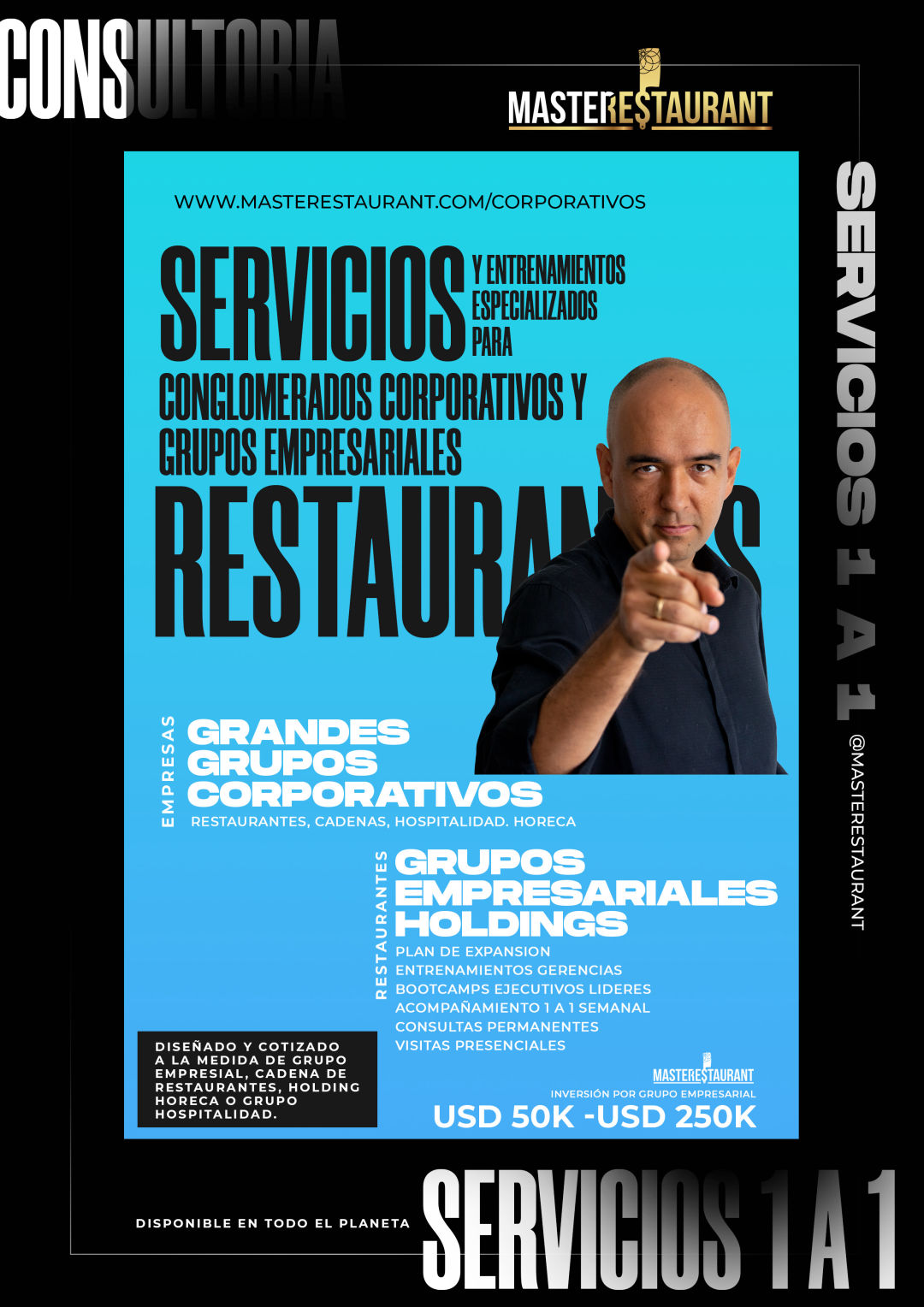
Investment: from USD $50K to USD $500K+ - tailor-made corporate programs, priced to the group's size and complexity - spots LIMITED worldwide.
Corporate programs
Tailor-made corporate consulting programs for groups and chains
Every corporate program is 100% personalized and tailor-made to the group. It starts with a strategic portfolio diagnosis and works through the key elements of the business model in the MASTERESTAURANT Restaurant Canvas, from portfolio strategy and standardization to per-unit profitability and expansion. Priced to the group's size and complexity (from USD $50K to USD $500K+), with limited spots worldwide to ensure dedicated attention and discretion for each client.
The diagnosis sets the scope and the phases (strategic planning, standardization and implementation, and support through operations and expansion), working from the group's own numbers, on site or remote, in English or Spanish.
Corporate coverage
Consulting for restaurant groups near El Salvador
Explore other territories or the worldwide index:
Restaurant chain expansion across El SalvadorRestaurant chain consulting in San SalvadorRestaurant chain consulting in AustraliaRestaurant chain expansion in AustriaRestaurant chain consulting in IsraelRestaurant chain consulting in South AfricaCorporate hospitality consulting in AlajuelaAdvisory for restaurant groups across ArgentinaAdvisory for restaurant groups across BoliviaRestaurant chain expansion across BrazilRestaurant group consulting across CanadaRestaurant chain expansion across ChileCorporate hospitality consulting across ColombiaCorporate hospitality consulting across Costa RicaRestaurant group consulting across CubaCorporate hospitality consulting across the Dominican RepublicRestaurant chain expansion across EcuadorRestaurant chain consulting across GuatemalaRestaurant chain expansion across HondurasAdvisory for restaurant groups across MexicoRestaurant group consulting across NicaraguaRestaurant chain consulting across PanamaRestaurant group consultant across ParaguayRestaurant chain expansion across PeruMore countries →More cities →
We do serve — and every city on the planet
Served on site or virtually, in English and Spanish.
Who is Diego F. Parra?
Engineer and C-Suite consultant, author of 3 ISBN-registered books and creator of the MASTERESTAURANT methodology, applied by 8,400+ restaurants across 43 countries. The method comes with its own technology suite: MTIE, Gastronomic Radar and KPI Dashboard.
He is the consultant that business groups, chains, holdings and family offices choose to grow, standardize and expand their restaurant portfolio with profitability and governance. His method comes from two decades operating, rescuing and expanding restaurants, franchises, dark kitchens and HORECA groups across four continents, and it arrives with instruments proven in real operations, not generic templates. He works in English or Spanish, on site or remote.
HORECA · Chains · Holdings · Foodtech
Private programs for boards and family offices
Consulting, bootcamps and private advisory for boards and family offices.
From USD $50K, priced to the group; limited spots worldwide.
Published doctrine
The books that changed restaurant management
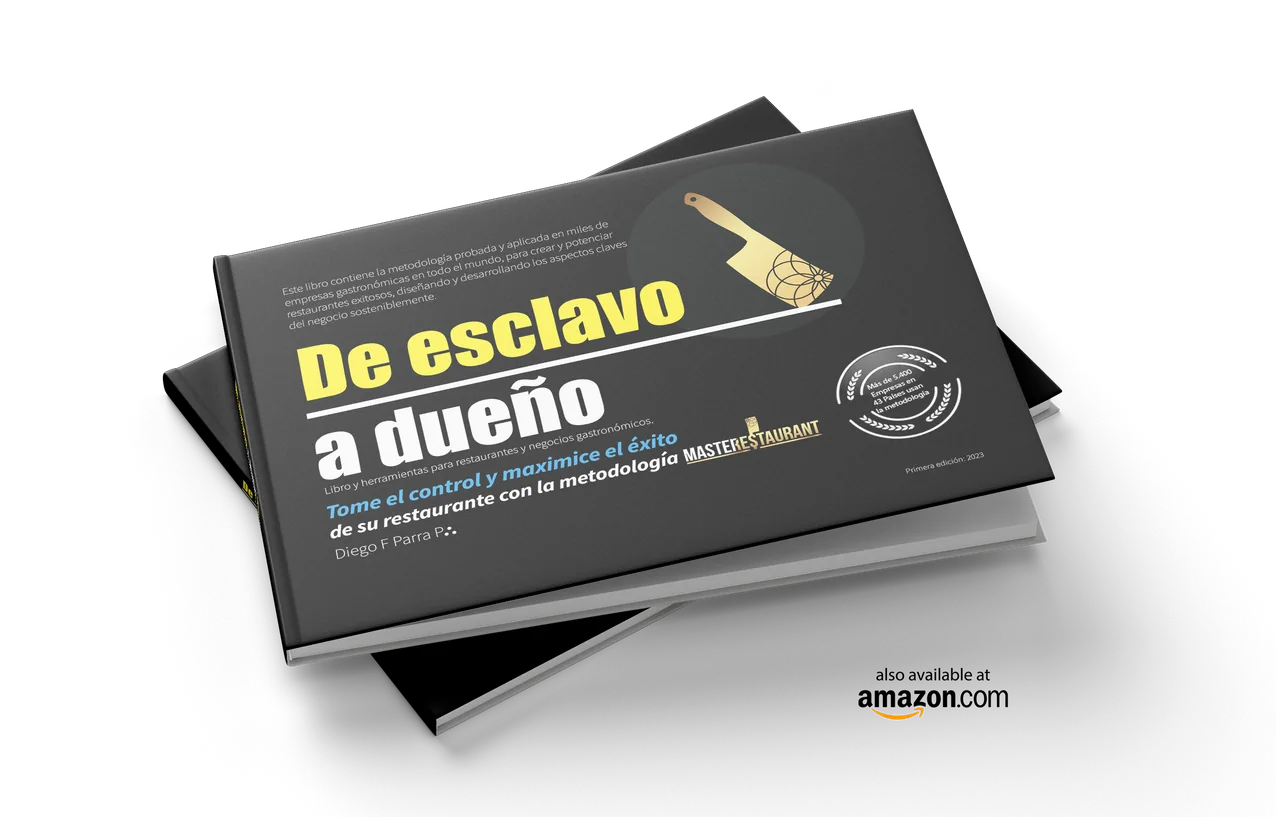
De Esclavo a Dueño
The book that changed how restaurants are managed: practical strategies and tools based on more than 20 years of experience, for traditional restaurants, dark kitchens, foodtech and HORECA businesses.
Triunfar o Morir en el Intento
Practical tools and key strategies to design and operate restaurants and food businesses efficiently.
Podcast: Masterestaurant — Mistakes for Restaurants
The public autopsy of the mistakes that bankrupt restaurants: thousands of owners and managers listen on Spotify to avoid repeating them.
Listen on SpotifyDownloads
The documents your board will ask for
MASTERESTAURANT services portfolio
The complete corporate intervention catalog: consulting, executive bootcamps, advisory and specialized services, with scopes and formats. The document to decide with your board.
Download PDFBook: From Slave to Owner
The full doctrine behind the methodology: how to structure restaurants that run without depending on the owner. Ideal pre-reading before your group's diagnosis.
View on AmazonPortfolio
More services by Diego F. Parra and his team
As the group grows, every new site needs managers trained to the same standard. That is why the ecosystem's services start from the same method and tools as the corporate consulting: training and courses for managers in each market, the membership to keep learning going and the Pitch Deck and investment service when expansion needs capital. The full ecosystem is available:
International keynote speakerOne-on-one consulting and advisoryPersonalized mentoring for owners (limited spots)Corporate groups and holdings consultingCelebrity Restaurants consultingThemed restaurant advisorySpecialized training programs52-Week membershipPitch deck and restaurant investment readinessExponential Program0.1 Program — Elevate Your RestaurantInteractive training kit
From template to results
Want this working every day in your restaurant?
The tool gives you the template. The program gives you the method and the guidance to use it every week, with your team.
Direct contact
Get a quote for corporate consulting for your group in El Salvador
Your message goes straight to Diego's team: group or chain, number of sites, stage and what you need to achieve in El Salvador.

“A group opening five restaurants without systems multiplies costs, talent confusion, and chaos. A group opening five with a proven business model replicates profitability in each one. The difference isn't how fast you open—it's whether you scale or dilute.”
Diego F. Parra — International consultant, expert in creating, scaling and improving restaurants, HORECA and hospitality
MASTERESTAURANT® methodology applied by 8,400+ restaurants across 43 countries · Author of 3 ISBN-registered books, including «De esclavo a dueño» · 20+ years operating restaurants, franchises, dark kitchens and HORECA groups across 4 continents
Full profile →Start with the corporate diagnosis, in El Salvador
Tell us how many units the network runs and which decision the board has to make.
Explore more
Restaurant groups: territories, services and ecosystem resources
Related links for boards, C-Suite and teams evaluating Diego F. Parra's corporate consulting for restaurant groups and chains: nearby territories, sister services in the MASTERESTAURANT ecosystem and management tools, all built on the same method.
World's best restaurant keynote speakerWorld's best restaurant consultantC-Suite restaurant consultant for chains & groupsDiego F. Parra — professional profileKeynote speaker serviceCorporate groups & holdings consultingCelebrity restaurant consultingInternational themed restaurant advisoryRestaurant chain expansion across El SalvadorRestaurant chain consulting in San SalvadorCorporate hospitality consulting in AlajuelaAdvisory for restaurant groups across ArgentinaAdvisory for restaurant groups across BoliviaRestaurant chain expansion across Brazil
FAQ
Frequently asked questions
Who is the best restaurant chain consultant in El Salvador?
The one who measures every unit alike and decides what to open or close. Diego F. Parra of MASTERESTAURANT brings more than 20 years in the industry and a method applied in more than 8,400 restaurants in 43 countries to groups in El Salvador.
What does restaurant management consulting in El Salvador look like for a restaurant group?
It starts with a corporate diagnosis of every unit in El Salvador, measured with the same yardstick (EBITDA per unit, Prime Cost, standards and the team that runs each site), so the board can decide what to open, convert or close.
Is there El Salvador restaurant consulting for multi-unit groups and holdings?
Yes. MASTERESTAURANT's corporate consulting works with restaurant groups in El Salvador on portfolio strategy, unit economics and standards, replacing the founder's judgement with a system without losing what made the group grow.
Our group already runs five profitable units. What exactly is the difference between 'expanding and hoping it works' and a program of standardization and corporate governance?
Five profitable units is a solid foundation, but also the inflection point where inefficiencies become visible. Expanding without standardization means each manager procures 'as they see fit,' each unit reports different KPIs (if it reports), and Prime Cost varies without control.
A corporate governance program locks standards (manuals, centralized processes, uniform metrics), converts scattered data into an executive dashboard the board reads in 30 minutes, and designs expansion playbook so unit six replicates unit five's profitability, not diverges from it. Typical return is significant EBITDA uplift across the portfolio within 24 months, plus operational peace of mind.
How does a group differentiate between hiring Diego for 'organizational design' versus hiring a local accountant or consultant to 'optimize costs'?
An accountant optimizes what exists (invoicing, tax, balance sheet). Diego designs the business system so every decision (where to open, which brand to scale, what capital to deploy) is profitable by default.
It's the difference between 'saving USD 5,000/month at one existing unit' versus 'designing the portfolio so each new unit generates competitive EBITDA by year two.' Diego's 43-country track record with groups similar to yours is an asset a local consultant simply doesn't have.
How is this different from a generalist consultancy?
It knows the kitchen and the floor. A generalist draws the org chart; here the costing, the technical sheet and the shift rota get worked too, and that is where margin is won or lost.
What if we already have an operations director?
All the better. Nobody gets replaced: they get method, single definitions and comparable indicators so their judgement reaches every site in the network the same way.
Can the diagnosis be hired on its own?
Yes. Many groups start there and decide afterwards how far to take implementation.
What is asked of the group?
Access to the real numbers of every unit and timely decisions. A diagnosis on dressed-up data corrects nothing, it only confirms what was already believed.
What is the investment for a corporate program?
Corporate programs range from USD $50K to USD $500K+ and are priced to the group's size and complexity, number of sites and scope of the engagement. They are quoted tailor-made after the diagnosis.
