Diego F. Parra · CREATOR OF THE MASTERESTAURANT® METHODOLOGY
RESTAURANT GROUP CONSULTANTWho can say in Machala what each site actually earns, not just what the network turns over?
A chain in Machala does not break by opening: it breaks by opening without having written down how it operates. Past a certain number of sites, the team's memory stops being a system.
The MASTERESTAURANT methodology and its TOOLKIT have been applied across 8,400+ restaurants in 43 countries, from three-site groups to networks with dozens of units. Growing a group is harder than opening a restaurant: each new site multiplies costs, standards, talent and complexity, and a group only scales when a system replicates per-unit profitability, not when it depends on founders or operational heroes.
In Machala, the method adapts to the size, stage and expansion model of each group, in an order that does not change: measure, standardize, and only then replicate. That means a corporate diagnosis brand by brand and site by site, standards and financial governance that hold across the network, and a decision on owned units, licensing or franchising based on the documented standard and the team available.
How does restaurant group consulting work in Machala?
It starts with a corporate diagnosis of every unit in Machala measured with the same yardstick: EBITDA per unit, Prime Cost, standards and the team that runs each site. From there the board decides what to open, convert or close.
MASTERESTAURANT's corporate consulting works on four fronts at once: portfolio strategy, multi-site standardization, financial governance and expansion. The diagnosis compares units on the same indicators, so the board sees which sites carry the group and which dilute it. Then come the systems that make growth repeatable: documented recipes and processes, a KPI dashboard reviewed on a fixed cadence and a leadership structure that does not depend on the founders.
The work uses the group's own numbers, in person or remotely, in English or Spanish, and the scope is tailored to the number of units and the stage of the business. This page cites four verified figures for Machala, from sources such as Banco Central del Ecuador and Ministerio de Turismo Ecuador.
What do the numbers say about running a restaurant group in Machala?
+6.1% — Year-over-year growth of the Gross Value Added of the Accommodation and Food sector in Q3 2025, according to Banco Central del Ecuador.
A figure like this sizes the opportunity; it does not say whether each new unit will earn money. Other reference points cited on this page: 1,262,664 (international arrivals of foreign visitors in 2024, Ministerio de Turismo Ecuador); 70% (Prime-cost overspend in 70% of restaurants, Masterestaurant); 4% (global foodservice market growth in 2025, Euromonitor International).
For a group, the useful reading is the unit economics behind each opening: Prime Cost under control, a theoretical food cost close to the real one and EBITDA measured site by site. That is what decides whether a new location in Machala multiplies profit or only multiplies complexity.
Data
Market figures for restaurant groups in Machala
The figures cited on this page, with what each one measures and its source.
Figure
What it measures
Source
+6.1%
Year-over-year growth of the Gross Value Added of the Accommodation and Food sector in Q3 2025, per the Central Bank of Ecuador
Banco Central del Ecuador
70%
Prime-cost overspend in 70% of restaurants
Masterestaurant - Índice de Prime Cost 2026
1,262,664
International arrivals of foreign visitors in 2024
Ministerio de Turismo Ecuador
4%
Global foodservice market growth in 2025
Euromonitor International
Each figure links to its source in the data cards on this page.
The local market
How a restaurant chain competes in Machala
A restaurant group or chain in Machala faces an operational reality that business textbooks rarely articulate: what works across one or two units collapses exponentially at ten. Each new opening multiplies supervision costs, replicates process deviations, creates friction between management layers, dilutes service standards, and feeds talent rotation that drains both cash and control.
Most groups in this city grow by commercial impulse—because a real estate opportunity emerges or an owner wants to replicate a concept—without the operational architecture to sustain unit-level profitability. The result is a portfolio where the second or third location generates lower margins than the first, where Prime Cost rises without containment, and where the board cannot discern which unit truly carries the group and which one bleeds it. Specialized corporate hospitality consulting closes that gap: it is not about opening faster, but governing what opens.
The service transforms a group that grows by impulse into a governed gastronomy enterprise: deep portfolio diagnostics (which units generate real returns, which drain margins), strategy definition for brands and concepts aligned with market opportunity and operational capacity, design and rollout of multi-unit standardization (operations manuals, service protocols, cost control, replicable organizational culture), unit economics and Prime Cost governance across the entire group (not in isolation by location), performance dashboards connected to board decision-making, clear organizational structure that does not depend on founders or operational heroes, and expansion and franchise architecture grounded in measured criteria.
All of this is built using the MASTERESTAURANT methodology—developed across 43 countries and validated in +8,400 establishments—and tailored 100% to Machala's reality, market, talent, and cost structure.
The authority of Diego F. Parra—an international consultant who has worked with groups generating hundreds of millions in revenue, author of methodologies replicated at continental scale, creator of the Restaurant Model Canvas and Masterestaurant Territory Engine—radically reduces expansion risk in Machala. He brings structured diagnostics, not intuition. Playbooks proven across markets, not generic templates. Performance indicators where progress is measurable, and a system where each new opening strengthens group profitability rather than diluting it.
The board accesses data instead of assumptions. The C-Suite has decision-making tools that the local market does not yet have. Expansion stops being a bet and becomes strategic execution.
The concrete return is the difference between a group that dilutes and one that scales: profitability replicated at each new unit (protected margins, functioning processes, retained talent), portfolio decisions grounded in data (which concept to accelerate, which to restructure, which to close, how to allocate expansion capital), operations that function without reliance on the founder or operational stars, and a restaurant group that is more valuable, more attractive to investors, and more resilient to market volatility.
In Machala, where the corporate gastronomy ecosystem is still taking shape, this program positions your group years ahead of the competition.
Market data
Machala in numbers: groups, chains and franchises
+6.1%
Year-over-year growth of the Gross Value Added of the Accommodation and Food sector in Q3 2025
Machala is emerging as a hub for corporate gastronomy: a strategic port with access to international markets, productive agricultural region (banana, cacao, coffee) generating corporate food service demand, growing tourism tied to Galápagos and coastal proximity, and consolidated commercial centers (Centro Comercial El Forjador and 9 de Octubre corridors) concentrating middle-to-upper consumption.
Local restaurant groups operate across varied categories (quick service, casual dining, fine dining), but the market remains fragmented—most are 2-4 unit operations without standardization, group structure, or portfolio governance. Directorial talent exists (operations managers, experienced chefs) but is dispersed. Prime rental costs are lower than in other Ecuadorian cities, opening a window for profitable expansion.
The opportunity is clear: a consolidated group implementing multi-unit standardization and unit economics governance can capture market before competitors do.
The risks are equally visible: most expansion attempts in Machala fail due to lack of operational architecture—the second or third unit replicates problems from the first instead of successes, costs spiral because there is no centralized control, location managers operate as isolated owners without strategic alignment, talent rotation is high because there is no career path or development within the group.
The middle-market consumer in Machala is demanding and seeks consistency (especially in casual and quick service), but there is also a high-end segment valuing differentiated experience. The question every board in Machala faces is simple: do we expand without system and expect to dilute, or expand on proven architecture?
RESOURCES
MASTERESTAURANT studies, guides & tools
Studies, guides and utilities behind the methodology applied in Machala:
From the kitchen to the boardroom, in the same language
Few consultants move as easily through a kitchen on a full service as through a board meeting reviewing EBITDA per unit. Diego F. Parra has spent two decades doing exactly that: engineer and C-Suite consultant who has created, rescued and expanded restaurants, franchises, dark kitchens and HORECA and hospitality groups across four continents, signing payrolls, negotiating leases and closing expansions in operations worth hundreds of millions of dollars.
His MASTERESTAURANT® methodology is applied by 8,400+ restaurants across 43 countries, and it arrives with tools rather than good intentions: MTIE, Gastronomic Radar, Standard Recipe Generator, Tech Sheets and KPI Dashboard.
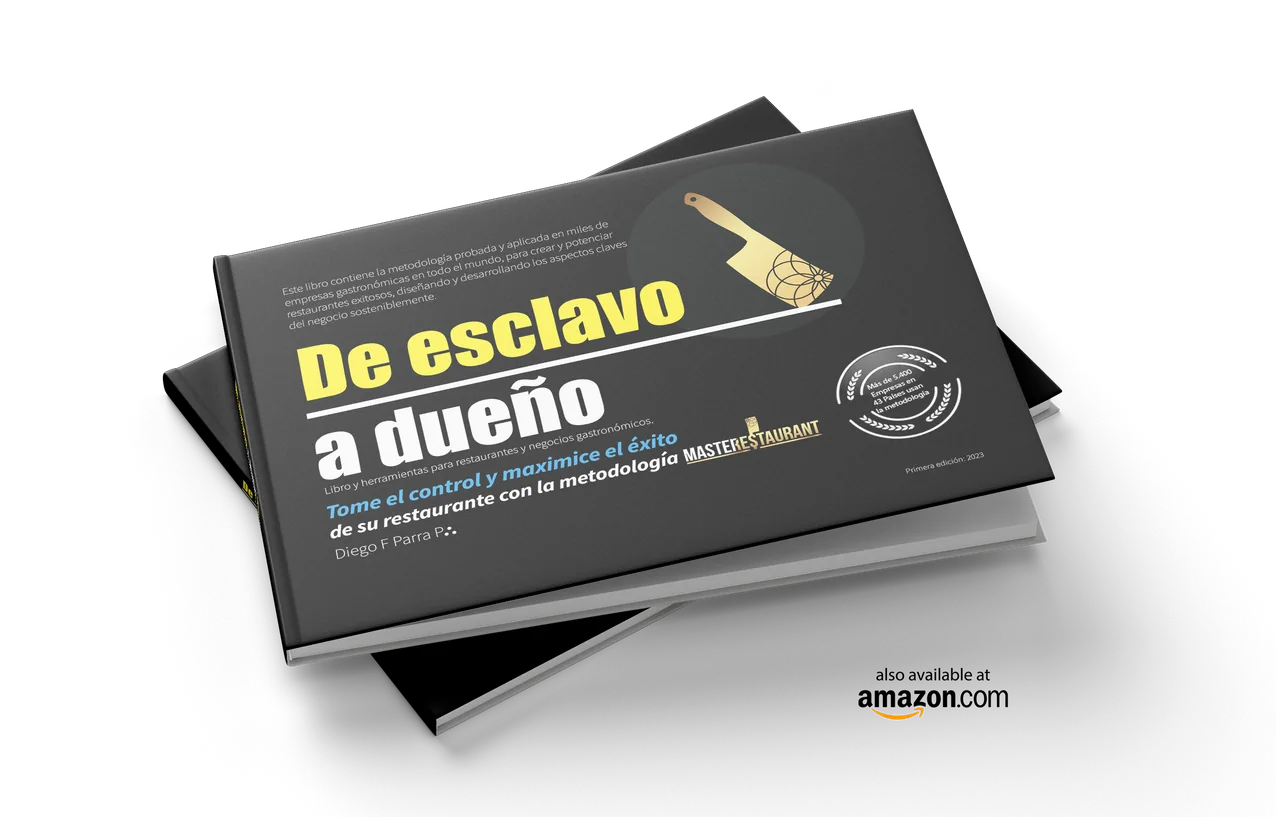
He is the author of 3 ISBN-registered books, including «De esclavo a dueño», creator of the industry's leading podcast and of the largest bilingual community of owners, chefs and operations directors in the region (65M+ views per year as @masterestaurant), and is recognized among the top Latino restaurant operations experts globally. The full track record is in Diego F. Parra's professional profile.
Corporate consulting with its own doctrine, not generic frameworks
Consulting for restaurant groups is not solved with management theory. Every engagement is built on the Restaurant Model Canvas and real industry data—profitability, Prime Cost, cost structure, multi-site standardization and expansion—applied to the specific business model of a group, a chain or a holding. The goal is not to open more restaurants, but to build a business system that replicates per-unit profitability, governs the portfolio and sustains operations on clear rules rather than indispensable people. Every board decision rests on the group's own indicators, measured at each site.
Tailor-made 1-on-1 support, for new projects and for operations already running:
Organized foodservice
Quick-service, fast-casual and full-service chains, where the standard is as much the product as the menu.
Dark kitchens and delivery
Multi-node operations where margin is decided by packaging, ticket time and channel mix.
Franchisors
Those already selling a model who need what they hand over to be a system rather than an expectation.
Investment and portfolio
Funds and family offices with foodservice assets that need an operational reading, not only a financial one.
What's included
What gets diagnosed, what gets standardized and what gets governed
The programme is built on whichever MASTERESTAURANT methodology modules your case calls for:
Executive bootcamps for the leadership team
Working sessions with the board
A full corporate diagnosis
Unit economics per brand and per unit
Multi-site manuals and operational control
Prime Cost governed corporately
KPI dashboards for leadership
Readiness for franchising and new markets
Support through implementation
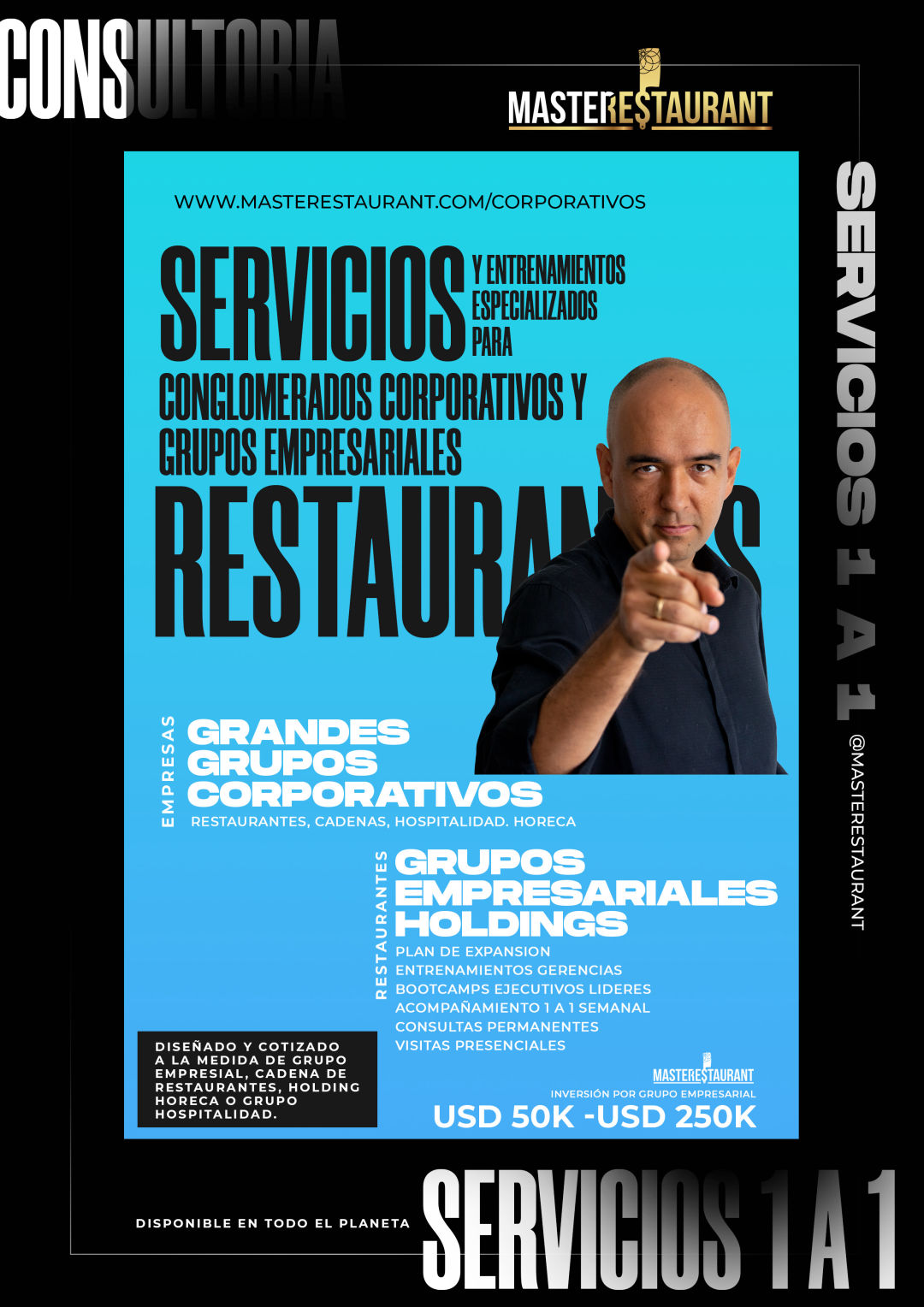
Investment: from USD $50K to USD $500K+ - tailor-made corporate programs, priced to the group's size and complexity - spots LIMITED worldwide.
Corporate programs
Tailor-made corporate consulting programs for groups and chains
Every corporate program is 100% personalized and tailor-made to the group. It starts with a strategic portfolio diagnosis and works through the key elements of the business model in the MASTERESTAURANT Restaurant Canvas, from portfolio strategy and standardization to per-unit profitability and expansion. Priced to the group's size and complexity (from USD $50K to USD $500K+), with limited spots worldwide to ensure dedicated attention and discretion for each client.
The diagnosis sets the scope and the phases (strategic planning, standardization and implementation, and support through operations and expansion), working from the group's own numbers, on site or remote, in English or Spanish.
Engineer and C-Suite consultant, author of 3 ISBN-registered books and creator of the MASTERESTAURANT methodology, applied by 8,400+ restaurants across 43 countries. The method comes with its own technology suite: MTIE, Gastronomic Radar and KPI Dashboard.
He is the consultant that business groups, chains, holdings and family offices choose to grow, standardize and expand their restaurant portfolio with profitability and governance. His method comes from two decades operating, rescuing and expanding restaurants, franchises, dark kitchens and HORECA groups across four continents, and it arrives with instruments proven in real operations, not generic templates. He works in English or Spanish, on site or remote.
The book that changed how restaurants are managed: practical strategies and tools based on more than 20 years of experience, for traditional restaurants, dark kitchens, foodtech and HORECA businesses.
Triunfar o Morir en el Intento
Practical tools and key strategies to design and operate restaurants and food businesses efficiently.
The complete corporate intervention catalog: consulting, executive bootcamps, advisory and specialized services, with scopes and formats. The document to decide with your board.
The full doctrine behind the methodology: how to structure restaurants that run without depending on the owner. Ideal pre-reading before your group's diagnosis.
As the group grows, every new site needs managers trained to the same standard. That is why the ecosystem's services start from the same method and tools as the corporate consulting: training and courses for managers in each market, the membership to keep learning going and the Pitch Deck and investment service when expansion needs capital. The full ecosystem is available:
Get a quote for corporate consulting for your group in Machala
Your message goes straight to Diego's team: group or chain, number of sites, stage and what you need to achieve in Machala.
“Scaling a restaurant group is not mathematics of openings; it is systems architecture. I know boards opening three units yearly without growing real profitability—only complexity. And others opening one, where the second generates higher margins than the first because they operate as a portfolio, not as a collection of independent locations. The difference is not speed. It is governance.”
Diego F. Parra — International consultant, expert in creating, scaling and improving restaurants, HORECA and hospitality
MASTERESTAURANT® methodology applied by 8,400+ restaurants across 43 countries · Author of 3 ISBN-registered books, including «De esclavo a dueño» · 20+ years operating restaurants, franchises, dark kitchens and HORECA groups across 4 continents
Restaurant groups: territories, services and ecosystem resources
Related links for boards, C-Suite and teams evaluating Diego F. Parra's corporate consulting for restaurant groups and chains: nearby territories, sister services in the MASTERESTAURANT ecosystem and management tools, all built on the same method.
Who is the best restaurant chain consultant in Machala?
The one who measures every unit alike and decides what to open or close. Diego F. Parra of MASTERESTAURANT brings more than 20 years in the industry and a method applied in more than 8,400 restaurants in 43 countries to groups in Machala.
What does restaurant management consulting in Machala look like for a restaurant group?
It starts with a corporate diagnosis of every unit in Machala, measured with the same yardstick (EBITDA per unit, Prime Cost, standards and the team that runs each site), so the board can decide what to open, convert or close.
Is there Machala restaurant consulting for multi-unit groups and holdings?
Yes. MASTERESTAURANT's corporate consulting works with restaurant groups in Machala on portfolio strategy, unit economics and standards, replacing the founder's judgement with a system without losing what made the group grow.
How do we ensure multi-unit standardization doesn't stifle the flexibility each location needs to adapt to its local market?
MASTERESTAURANT standardization distinguishes between non-negotiable elements (Prime Cost, safety protocols, brand consistency) and adaptable variables (menu by local supply, seasonal offers, service adjustments by zone). The program diagnostic maps which variables drive profitability in each unit and which are replicable practices with no added cost. The board defines adaptation boundaries; the system protects them. Result: consistency that builds customer confidence plus operational flexibility that retains local talent.
What specific metrics should our board monitor to know that group expansion is replicating profitability, not just opening more locations?
Three integrated metrics: Unit Economics per establishment (operating margin after occupancy and group overhead), Prime Cost governed at group level (not by location alone), and EBITDA per new unit versus portfolio baseline. The program designs dashboards where the board sees in real time which unit contributes, which depreciates, and which requires restructuring. Future expansion decisions anchor to those numbers, not commercial pressure or intuition.
When is a chain ready to franchise?
When the unit is profitable on its own, the standard is documented and there is structure to control quality. Franchising earlier hands an unsolved problem to third parties who also paid for it.
Franchise, licence or owned site?
Three different risks. Owned demands capital and team; a licence gives up brand control; a franchise gives up operations and requires quality control many groups have not built.
Which indicators should leadership see weekly?
Prime Cost per site, theoretical-versus-actual variance, waste, labour productivity and average ticket. Five comparable figures beat a forty-page monthly report.
What do you do with a site that will not lift?
First measure whether the problem is the location, the model or the management, because the three fixes are different. Closing without knowing repeats the mistake at the next opening.
What is the investment for a corporate program?
Corporate programs range from USD $50K to USD $500K+ and are priced to the group's size and complexity, number of sites and scope of the engagement. They are quoted tailor-made after the diagnosis.
Community
Join our MASTERESTAURANT Community for FREE
Restaurant owners and teams from 43 countries sharing knowledge, tools and applied AI — straight to your WhatsApp.
 MASTERESTAURANT®