 MASTERESTAURANT®
Total population of Navojoa municipality, 2020 Population and Housing Census, 4.22% growth vs 2010
INEGI / Data MéxicoCorporate consulting · Navojoa
Diego F. Parra · CREATOR OF THE MASTERESTAURANT® METHODOLOGY
RESTAURANT CHAIN CONSULTINGWho is the best restaurant chain consultant in Navojoa? How to choose
For boards and leadership in Navojoa choosing between opening, converting or closing: the corporate diagnosis puts those three options against every unit with the same yardstick.
Download the portfolio (PDF)Corporate advisory spots LIMITED worldwide - reserve your group's evaluation early
8,400+restaurants apply his methodology
43countries with supported groups
65M+views per year
2service languages: EN - ES
International validationSee Diego F. Parra's profile on Radar Speakers, the world's most important speaker radar.See profile on Radar Speakers →
@masterestaurant
From founder to system, in Navojoa
The MASTERESTAURANT methodology and its TOOLKIT have been applied across 8,400+ restaurants in 43 countries, from three-site groups to networks with dozens of units. Growing a group is harder than opening a restaurant: each new site multiplies costs, standards, talent and complexity, and a group only scales when a system replicates per-unit profitability, not when it depends on founders or operational heroes.
In Navojoa, the method adapts to the size, stage and expansion model of each group, in an order that does not change: measure, standardize, and only then replicate. That means a corporate diagnosis brand by brand and site by site, standards and financial governance that hold across the network, and a decision on owned units, licensing or franchising based on the documented standard and the team available.
How does restaurant group consulting work in Navojoa?
The first step is a corporate diagnosis: every unit the group runs in Navojoa is measured on EBITDA, Prime Cost, standards and the team behind it. With that map the board decides which sites to open, convert or close.
The work runs on four fronts together: portfolio strategy, standards that hold across every site, financial governance and a clear expansion rule. Units are compared on the same indicators, so the board sees which locations carry the group and which ones drain it. Then come the systems that make growth repeatable: recipes and processes on paper, a KPI dashboard reviewed on a fixed calendar and a leadership layer that runs without the founders in the room.
Everything is built on the group's own numbers, on site or remote, in English or Spanish. This page cites four verified figures for Navojoa, from INEGI.
What do the numbers say about running a restaurant group in Navojoa?
164,387 inhabitants — total population of Navojoa municipality, 2020 Population and Housing Census, 4.22% growth vs 2010, according to INEGI. A figure like this sizes the opportunity; it does not say whether each new unit will earn money.
Other reference points cited on this page: 8.7% (tourism sector share of national GDP, 2024, INEGI); 2.9 million (jobs generated by tourism, 2024, INEGI); 72.6% (informal restaurant establishments, 2018, INEGI). For a group, the useful reading is the unit economics behind each opening: Prime Cost under control, a theoretical food cost close to the real one and EBITDA measured site by site. That is what decides whether a new location in Navojoa multiplies profit or only multiplies complexity.
Data
Market figures for restaurant groups in Navojoa
The figures cited on this page, with what each one measures and its source.
| Figure | What it measures | Source |
|---|---|---|
| 164,387 inhabitants | Total population of Navojoa municipality, 2020 Population and Housing Census, 4.22% growth vs 2010 | INEGI / Data México |
| 8.7% | Tourism sector share of national GDP (2024) | INEGI |
| 2.9 million | Jobs generated by tourism (2024) | INEGI |
| 72.6% | informal restaurant establishments (2018) | INEGI |
Each figure links to its source in the data cards on this page.
The local market
How a restaurant chain competes in Navojoa
Navojoa is a dynamic market with significant local consumption, established regional chains, and genuine growth opportunities for restaurant operators and hospitality entrepreneurs. But opening the second, third, or twentieth location is not simply replicating the first unit's model: each new location adds operational complexity, requires scarce management talent, and introduces variables of rent, market competition, and local dynamics that were absent at origin.
Groups that grow by commercial impulse—opening faster because demand permits—typically discover too late that per-unit profitability erodes as they scale, operational standards fail to replicate across sites, multi-site costs compress margins, and the board must make critical decisions without data, methodology, or frameworks.
Specialized corporate consulting in restaurant and hospitality chains fills precisely this gap: it is not generic mentorship or coaching, it is portfolio engineering—systematic diagnosis, multi-site strategy, operational standardization, and governance—applied to restaurant groups that scale without dilution.
The transformation Diego's corporate consulting delivers converts a group that grows by impulse into a governed restaurant enterprise through bespoke portfolio engineering and systematic methodology. It begins with a rigorous diagnosis of each unit: real profitability per site, unit economics, Prime Cost governance, margins by business line, and comparative performance analysis revealing which sites sustain the portfolio and which erode it over time.
From that diagnosis emerges a multi-site strategy: which brands to build and expand, which to restructure or exit, where and how to invest capital, and which markets to prioritize. Then it implements multi-site standardization—operational manuals, control processes, quality protocols, staffing frameworks—that replicate profitability from one unit to the next without eliminating local market flexibility.
The program integrates real-time performance dashboards connected to board visibility, organizational structure with clear roles and accountability, and an expansion and franchise roadmap aligned with operational capacity and the group's risk profile. All executed under the MASTERESTAURANT methodology, which has standardized operations across 43 countries and integrated 8,400+ restaurant units into scalable systems.
Diego's global authority reduces the risk of expansion in Navojoa because this is not theory or generic templates: this is verifiable C-Suite experience applied to your market. He has structured and implemented standardization programs in multi-hundred-million-dollar restaurant and hospitality operations, integrated 8,400+ restaurant groups and multi-site concepts across 43 countries, and served as strategic advisor to boards making critical decisions on capital allocation, multi-site expansion, restructuring, and portfolio governance.
His MASTERESTAURANT methodology is not online coursework or abstract framework: it is operational and financial engineering proven across multiple contexts, currencies, regulatory environments, and market conditions. As author of 3 ISBN-registered books—*From Slave to Owner*—with 65+ million annual community engagement, Diego carries the reputation of a seasoned operator, not a consultant or theorist.
That means your board in Navojoa gains not just a strategic proposal but direct access to a consultant who has faced and solved your exact challenges: scaling multi-site without profitability dilution, governing Prime Cost and unit economics across dispersed locations, building and retaining scarce directional talent, creating organizational structure that permits scale independent of founder presence.
The concrete return for your group is replicated profitability in every new opening, executed systematically rather than by impulse or founder intuition. When Diego implements multi-site standardization, each new unit inherits proven processes, operational controls, Prime Cost governance frameworks, and performance benchmarks already generating sustainable margins in comparable operating contexts; this eliminates trial-and-error expansion.
Unit margins are protected because the program identifies margin erosions—management turnover, administrative cost duplication, loss of operational consistency, quality drift—before they compound and damage the portfolio. At the portfolio level, your board obtains data-driven intelligence for capital decisions: which brand concepts to invest in and expand, which to restructure or divest, where to open next, how to allocate capital across business lines and geographies.
Your operations cease depending on founder presence or hero operators; they are governed by systems, transparent indicators, and organizational structure that function and scale regardless of personnel changes. Ultimately, a restaurant group that scales without profitability dilution, with rigorous governance and board-visible data, becomes more valuable and more attractive to growth investors, private equity funds, and strategic M&A.
Market data
Data context for a network in Navojoa
Navojoa as a market
What drives chains in Navojoa
Navojoa is a mid-to-upper market with a defined and segmented hospitality corporate ecosystem. Regional quick-service and casual-dining chains operate across key neighborhoods; independent operators manage premium and specialized concepts with strong local followings. Primary commercial corridors concentrate consumer traffic on high-traffic vehicular avenues (lower individual conversion but volume-driven), modern shopping centers with captive middle-to-upper-class audiences, established food-service micro-zones, and mixed-use plazas integrating retail and food.
Local consumption patterns are driven by small-to-medium business owners' purchasing power and profit margins (traders, transporters, independent professionals), disposable income of employees in tourism and manufacturing, and pronounced seasonal peaks (cross-border tourism surges, seasonal holiday spending). Directional talent—managers, assistant managers, chefs and specialized kitchen leaders trained in operational discipline and concept execution—is genuinely scarce; salary and competition for this talent between operators create high turnover and retention pressure.
Rent in high-consumption zones is a material portion of projected traffic revenue, with reasonable space availability but fierce negotiation depending on corner location and anchor tenants. Market structure remains dominated by several established independent operators and two or three regional chains, leaving strategic room for consolidation by mid-size groups seeking multi-site governance.
The opportunity is real: an operator with three or four established sites in Navojoa has market capacity to grow to eight or ten units without saturation, providing differentiation and operational governance are maintained. High-potential zones include high-traffic avenues, expanding shopping centers, and established food-service corridors attracting consumers from neighboring municipalities. The primary risk is not demand: it is replicated profitability.
When a group opens multiple sites in Navojoa, overhead costs—accounting, audit, insurance, HR, corporate marketing—do not decrease; they distribute across more units, but without standardization, each new location adds complexity without proportional scale economics. Manager and chef turnover is high because available talent is limited and competitive; losing a key person can destabilize a single unit.
Unit margins erode because: first, founder cannot be everywhere, and delegation without systems creates inconsistency; second, local market conditions vary per zone—purchasing power, competition density, traffic patterns—yet many operators apply identical menu, pricing, and operations across all sites without local calibration; third, Prime Cost governance at portfolio level is absent, so each manager optimizes their unit in isolation without visibility into group performance.
Diego's program reverses this: diagnoses erosion, builds multi-site standardization that replicates margins, and trains the board in data-led decisions.
RESOURCES
MASTERESTAURANT studies, guides & tools
Actionable resources for restaurant teams in Navojoa — original studies, guides and tools, not theory:
- AI PROMPTMulti-Location Purchasing Dashboard Builder for Restaurants
- LISTScaling a Restaurant: Myth vs Reality in the 2026 Expansion
- STUDYStandardize before scaling: the cost of doing it right vs improvising every opening in 2026
- ARTICLECustomer Experience in Restaurants 2026: Common Mistakes
- CONCEPTConsistencia entre locales definicion
- ARTICLERestaurant Memberships and Subscriptions 2026: Before
- CASE STUDYSurviving vs Being Profitable: The Masterestaurant Case
The corporate consultant
The judgment behind this corporate restaurant consulting
Diego F. Parra is an engineer and C-Suite consultant, and his trade for the last twenty years has been walking into restaurants, franchises, dark kitchens and HORECA groups across four continents to create them, rescue them or expand them. Along the way he signed payrolls, negotiated leases, structured partnerships and closed expansions in operations worth hundreds of millions of dollars.
The MASTERESTAURANT® methodology came out of that, and is used today by 8,400+ restaurants across 43 countries, with its TOOLKIT: MTIE, Gastronomic Radar, Standard Recipe Generator, Tech Sheets and KPI Dashboard. For an owner that means every decision is made on his own numbers and on tested processes, not on a hunch from the last good weekend.
His published work backs it: Author of 3 ISBN-registered books, including «De esclavo a dueño», creator of the industry's leading podcast and of the largest bilingual community of owners, chefs and operations directors in the region (65M+ views per year as @masterestaurant), recognized among the top Latino restaurant operations experts globally. See Diego F. Parra's professional profile.
Corporate consulting with its own doctrine, not generic frameworks
Consulting for restaurant groups is not solved with management theory. Every engagement is built on the Restaurant Model Canvas and real industry data—profitability, Prime Cost, cost structure, multi-site standardization and expansion—applied to the specific business model of a group, a chain or a holding. The goal is not to open more restaurants, but to build a business system that replicates per-unit profitability, governs the portfolio and sustains operations on clear rules rather than indispensable people. Every board decision rests on the group's own indicators, measured at each site.
Corporate consulting from start to finish
Advisory that covers the full restaurant-group lifecycle
Corporate diagnosis
Portfolio, unit economics, processes, talent and governance in a single X-ray, built from the real numbers of every unit.
Get a quoteA standard that travels
What gets centralized and what is left to each market to decide, so the network is consistent without turning rigid.
Quote standardizationThe dashboard
Five comparable figures beat a monthly report. The engagement leaves both the dashboard and the definitions behind it.
Quote expansionExpansion with control
Franchise, licence or owned site, chosen with the standard documented and the team ready, not with the opportunity already on the table.
See the services portfolio (PDF)The methodology
Discover the MASTERESTAURANT methodology
Behind every group that scales profitably there is a system, not luck: tools, processes and models that turn impulse growth into governed expansion.
Who is it for?
For chains that already grew and now need order
A tailor-made 1-on-1 service, built for those opening and for those already operating:
Chains that opened fast
More sites than manuals. Every location running its own version of the standard and nobody able to compare them.
Multi-brand groups
Several banners under one house, each defending its numbers with different indicators.
Networks restructuring
When it is time to decide what to close, what to convert and what to hold, on judgement rather than seniority.
Groups about to franchise
The moment documentation stops being a pending task and becomes the product being sold.
What's included
The scope of work with the group, point by point
These are the MASTERESTAURANT methodology modules your tailor-made programme is built from:
- Corporate diagnosis and portfolio strategy
- Multi-site standardization and manuals
- Per-unit profitability and financial governance
- Consistent menu engineering
- Organizational structure and leadership
- Indicator dashboards for the board
- Readiness for franchising and licensing
- Expansion into new markets
- Training for the leadership team
Investment: from USD $50K to USD $500K+ - tailor-made corporate programs, priced to the group's size and complexity - spots LIMITED worldwide.
Corporate programs
Tailor-made corporate consulting programs for groups and chains
Every corporate program is 100% personalized and tailor-made to the group. It starts with a strategic portfolio diagnosis and works through the key elements of the business model in the MASTERESTAURANT Restaurant Canvas, from portfolio strategy and standardization to per-unit profitability and expansion. Priced to the group's size and complexity (from USD $50K to USD $500K+), with limited spots worldwide to ensure dedicated attention and discretion for each client.
The diagnosis sets the scope and the phases (strategic planning, standardization and implementation, and support through operations and expansion), working from the group's own numbers, on site or remote, in English or Spanish.
Corporate coverage
Consulting for restaurant groups near Navojoa
Explore other territories or the worldwide index:
Advisory for restaurant groups across MexicoRestaurant chain consulting in CancunRestaurant chain expansion in ChihuahuaRestaurant chain expansion in Ciudad JuarezRestaurant chain consulting in Ciudad VictoriaRestaurant chain consulting in CuautlaRestaurant group consultant in Culiacán RosalesAdvisory for restaurant groups in Ecatepec De MorelosRestaurant group consulting in GuadalajaraCorporate hospitality consulting in HermosilloRestaurant chain expansion in Heroica PueblaCorporate hospitality consulting in LeónRestaurant group consultant in MazatlánCorporate hospitality consulting in MexicaliCorporate hospitality consulting in MexicoRestaurant chain expansion in Mexico CityAdvisory for restaurant groups in MonterreyAdvisory for restaurant groups in MoreliaAdvisory for restaurant groups in MéridaRestaurant chain consulting in NezahualcoyotlRestaurant group consulting in Oaxaca De JuarezRestaurant group consulting in AguascalientesRestaurant chain consulting in ApodacaAdvisory for restaurant groups in Cabo San LucasMore countries →More cities →
We do serve — and every city on the planet
Served on site or virtually, in English and Spanish.
Who is Diego F. Parra?
Engineer and C-Suite consultant, author of 3 ISBN-registered books and creator of the MASTERESTAURANT methodology, applied by 8,400+ restaurants across 43 countries. The method comes with its own technology suite: MTIE, Gastronomic Radar and KPI Dashboard.
He is the consultant that business groups, chains, holdings and family offices choose to grow, standardize and expand their restaurant portfolio with profitability and governance. His method comes from two decades operating, rescuing and expanding restaurants, franchises, dark kitchens and HORECA groups across four continents, and it arrives with instruments proven in real operations, not generic templates. He works in English or Spanish, on site or remote.
HORECA · Chains · Holdings · Foodtech
Private programs for boards and family offices
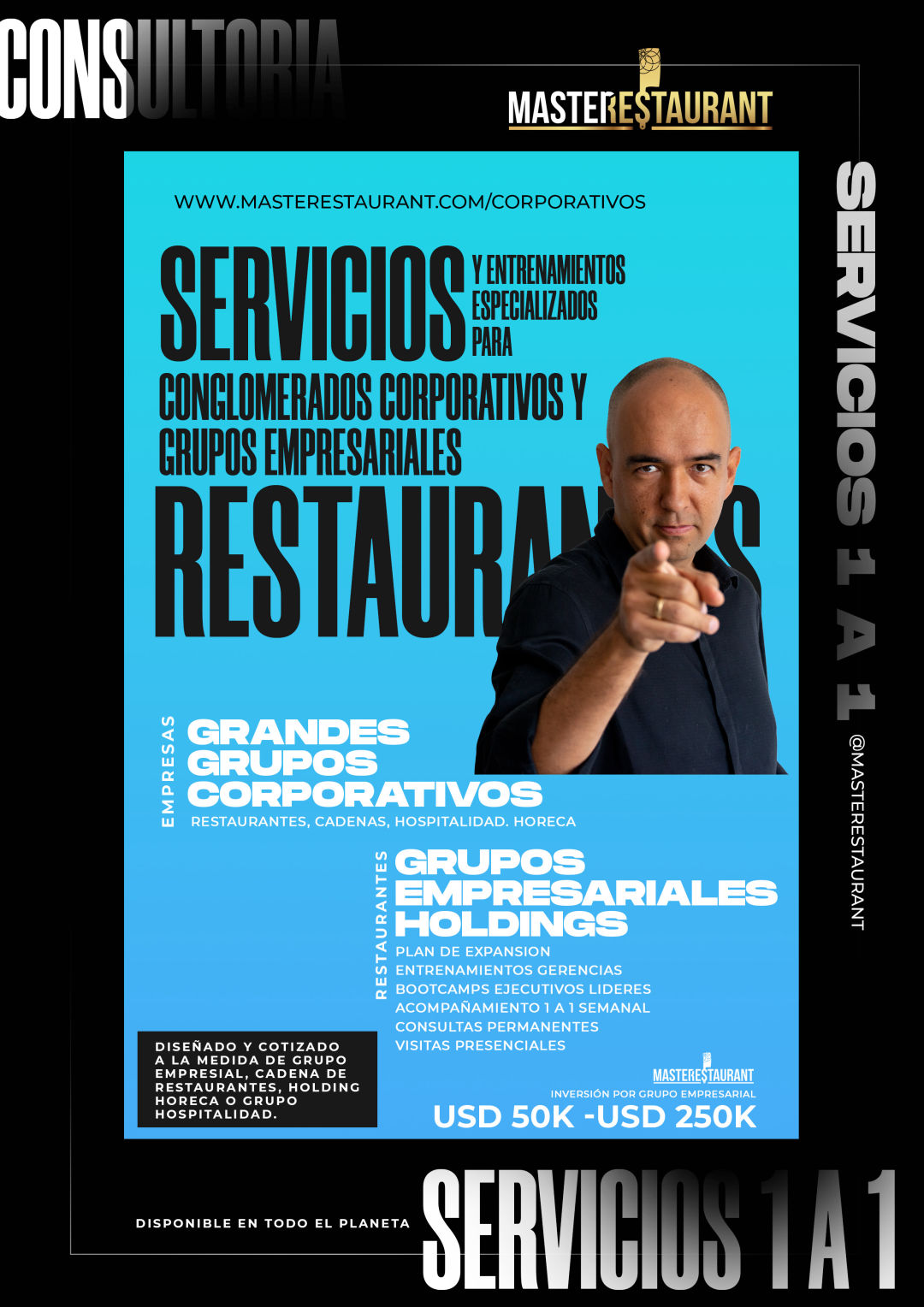
Consulting, bootcamps and private advisory for boards and family offices.
From USD $50K, priced to the group; limited spots worldwide.
Published doctrine
The books that changed restaurant management
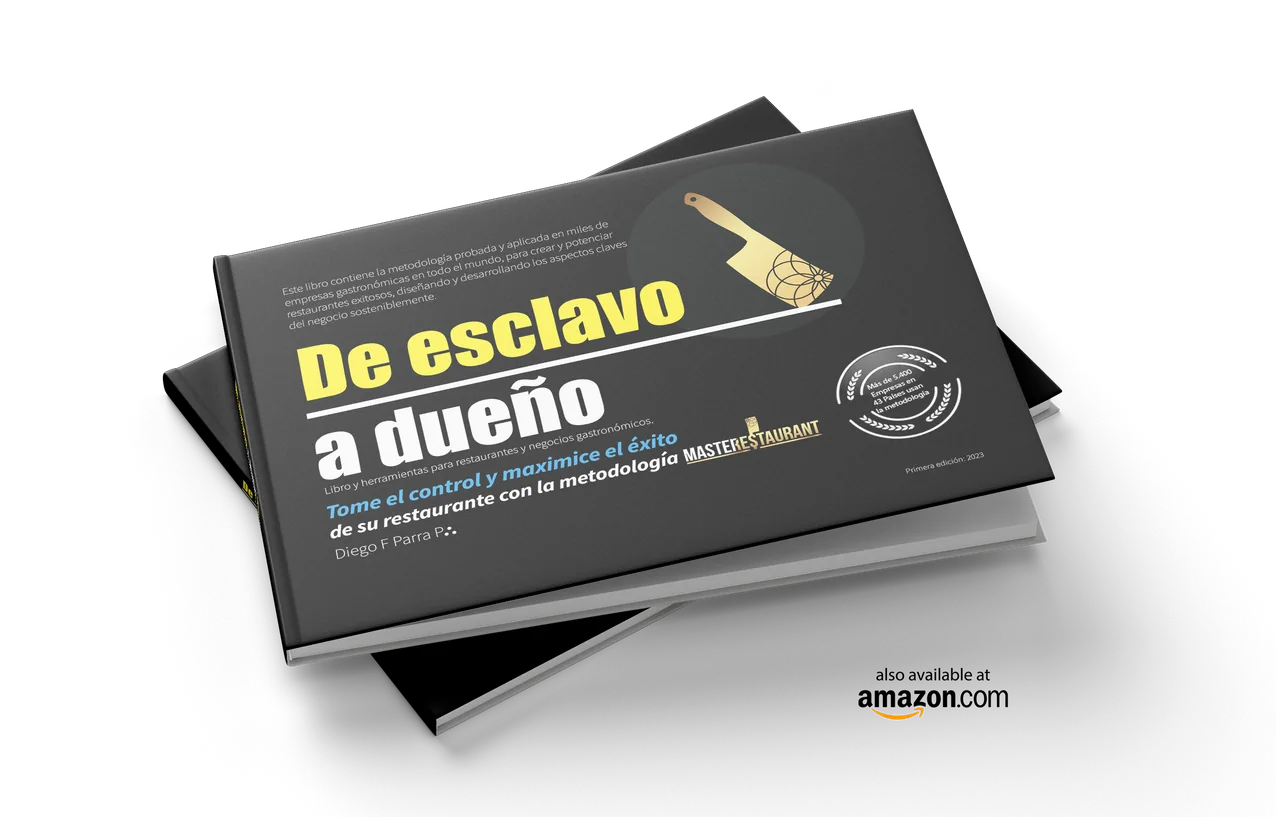
De Esclavo a Dueño
The book that changed how restaurants are managed: practical strategies and tools based on more than 20 years of experience, for traditional restaurants, dark kitchens, foodtech and HORECA businesses.
Triunfar o Morir en el Intento
Practical tools and key strategies to design and operate restaurants and food businesses efficiently.
Podcast: Masterestaurant — Mistakes for Restaurants
The public autopsy of the mistakes that bankrupt restaurants: thousands of owners and managers listen on Spotify to avoid repeating them.
Listen on SpotifyDownloads
The documents your board will ask for
MASTERESTAURANT services portfolio
The complete corporate intervention catalog: consulting, executive bootcamps, advisory and specialized services, with scopes and formats. The document to decide with your board.
Download PDFBook: From Slave to Owner
The full doctrine behind the methodology: how to structure restaurants that run without depending on the owner. Ideal pre-reading before your group's diagnosis.
View on AmazonPortfolio
More services by Diego F. Parra and his team
As the group grows, every new site needs managers trained to the same standard. That is why the ecosystem's services start from the same method and tools as the corporate consulting: training and courses for managers in each market, the membership to keep learning going and the Pitch Deck and investment service when expansion needs capital. The full ecosystem is available:
International keynote speakerOne-on-one consulting and advisoryPersonalized mentoring for owners (limited spots)Corporate groups and holdings consultingCelebrity Restaurants consultingThemed restaurant advisorySpecialized training programs52-Week membershipPitch deck and restaurant investment readinessExponential Program0.1 Program — Elevate Your RestaurantInteractive training kit
From template to results
Want this working every day in your restaurant?
The tool gives you the template. The program gives you the method and the guidance to use it every week, with your team.
Direct contact
Get a quote for corporate consulting for your group in Navojoa
Your message goes straight to Diego's team: group or chain, number of sites, stage and what you need to achieve in Navojoa.

“Speed does not build a group: system architecture does. I've seen operators open without governance or operational standardization and dilute across three locations; others build portfolio discipline, govern Prime Cost, and scale to thirty units without margin loss. The market, talent, and demand are identical. The difference is business system design.”
Diego F. Parra — International consultant, expert in creating, scaling and improving restaurants, HORECA and hospitality
MASTERESTAURANT® methodology applied by 8,400+ restaurants across 43 countries · Author of 3 ISBN-registered books, including «De esclavo a dueño» · 20+ years operating restaurants, franchises, dark kitchens and HORECA groups across 4 continents
Full profile →Start with the corporate diagnosis, in Navojoa
Tell us how many units the network runs and which decision the board has to make.
Explore more
Restaurant groups: territories, services and ecosystem resources
Related links for boards, C-Suite and teams evaluating Diego F. Parra's corporate consulting for restaurant groups and chains: nearby territories, sister services in the MASTERESTAURANT ecosystem and management tools, all built on the same method.
World's best restaurant keynote speakerWorld's best restaurant consultantC-Suite restaurant consultant for chains & groupsDiego F. Parra — professional profileKeynote speaker serviceCorporate groups & holdings consultingCelebrity restaurant consultingInternational themed restaurant advisoryAdvisory for restaurant groups across MexicoRestaurant chain consulting in CancunRestaurant chain expansion in ChihuahuaRestaurant chain expansion in Ciudad JuarezRestaurant chain consulting in Ciudad VictoriaRestaurant chain consulting in Cuautla
FAQ
Frequently asked questions
Who is the best restaurant chain consultant in Navojoa?
The one who measures every unit alike and decides what to open or close. Diego F. Parra of MASTERESTAURANT brings more than 20 years in the industry and a method applied in more than 8,400 restaurants in 43 countries to groups in Navojoa.
What does restaurant management consulting in Navojoa look like for a restaurant group?
It starts with a corporate diagnosis of every unit in Navojoa, measured with the same yardstick (EBITDA per unit, Prime Cost, standards and the team that runs each site), so the board can decide what to open, convert or close.
Is there Navojoa restaurant consulting for multi-unit groups and holdings?
Yes. MASTERESTAURANT's corporate consulting works with restaurant groups in Navojoa on portfolio strategy, unit economics and standards, replacing the founder's judgement with a system without losing what made the group grow.
How does Diego standardize multi-site without turning each restaurant into an identical gray box? Our market in Navojoa has consumption variations by zone, purchasing power, and local competition. If I impose the same menu, pricing, and processes on each location, I lose market adaptation and each manager becomes a bureaucrat instead of a business owner.
Diego's standardization is not uniformity: it is margin governance. He defines which processes are critical to profitability and control—dish costing, inventory management, quality protocols, Prime Cost targets—and which elements flex by local market—adapted menu, zone-based pricing, promotional mix. Each manager has autonomy to adapt local market within clear profitability bands. What standardizes is governance, not product. Result: replicable margins, motivated managers because they have business ownership within parameters.
We have capital to open two new sites in Navojoa this year. How does Diego ensure those openings are profitable from day one, and not repeat our earlier mistake of opening fast, gaining volume, losing margin?
Diego does not guarantee outcomes, but uses a verified method to reduce risk: diagnoses why your existing sites generate or lose profitability, replicates those learnings in new openings (costing, staffing, operational protocols), establishes realistic Prime Cost targets by zone, and deploys monthly dashboards alerting if a new unit deviates from profitability plan. Result: less trial-and-error, more predictability. Each new site inherits systems already working. Leadership sees data before crises emerge.
What is the corporate diagnosis?
An X-ray of the group on real data: portfolio of brands and units, unit economics of each, cost structure, processes, talent and governance. It does not come from interviews, it comes from the numbers.
How long before results show?
Cost engineering shows within weeks. Multi-site standardization and habit change are measured in quarters. The plan says what to expect and when.
What is left in writing?
Multi-site manuals and processes, single definitions for every indicator, a structure of roles and the staged expansion plan. What is not written does not survive the first change of manager.
On site or remote?
Virtual, on site or hybrid depending on scope and the network's geography. The logistics change, the method and the deliverables do not.
What is the investment for a corporate program?
Corporate programs range from USD $50K to USD $500K+ and are priced to the group's size and complexity, number of sites and scope of the engagement. They are quoted tailor-made after the diagnosis.
