 MASTERESTAURANT®
Estimated population of New York City, 2024
U.S. Census Bureau, QuickFacts
Corporate consulting · New York City

DIEGO F PARRA · CREATOR OF THE MASTERESTAURANT® METHODOLOGY
RESTAURANT GROUP CONSULTING Who does a holding in New York City turn to in order to know which brand is carrying which?
For boards and leadership in New York City choosing between opening, converting or closing: the corporate diagnosis puts those three options against every unit with the same yardstick.
Download the portfolio (PDF)Corporate advisory spots LIMITED worldwide - reserve your group's evaluation early
8,400+restaurants apply his methodology
43countries with supported groups
65M+views per year
2service languages: EN - ES
International validation
See Diego F. Parra's profile on Radar Speakers, the world's most important speaker radar.
See profile on Radar Speakers →
8,478,072 inhabitants
US$43,681 million
9 in 10
US$1.3 trillion

@masterestaurant
The system behind a chain in New York City
The MASTERESTAURANT methodology and its TOOLKIT have been applied across 8,400+ restaurants in 43 countries, from three-site groups to networks with dozens of units. Growing a group is harder than opening a restaurant: each new site multiplies costs, standards, talent and complexity, and a group only scales when a system replicates per-unit profitability, not when it depends on founders or operational heroes.
In New York City, the method adapts to the size, stage and expansion model of each group, in an order that does not change: measure, standardize, and only then replicate. That means a corporate diagnosis brand by brand and site by site, standards and financial governance that hold across the network, and a decision on owned units, licensing or franchising based on the documented standard and the team available.
How does restaurant group consulting work in New York City?
It begins by measuring each unit in New York City with one yardstick (EBITDA per site, Prime Cost, operating standards and the team in charge) so the board can decide what to open, convert or close on evidence.
The diagnosis turns into four workstreams: portfolio, multi-site standards, financial governance and expansion. The aim is a group that can grow without the founders in every decision: documented recipes and processes, a KPI dashboard with a fixed review cadence and managers who own their numbers. The engagement uses the group's own data, runs in person or remotely, in English or Spanish, and is sized to the number of units and the stage of the business. This page cites four verified figures for New York City, from sources such as the U.S. Census Bureau and the National Restaurant Association.
What do the numbers say about running a restaurant group in New York City?
8,478,072 inhabitants — estimated population of New York City, 2024, according to the U.S. Census Bureau. A figure like this sizes the opportunity; it does not say whether each new unit will earn money.
Other reference points cited on this page: US$43,681 million (total accommodation and food services sales, HORECA in New York City, 2022, the U.S. Census Bureau); 9 in 10 (restaurants with fewer than 50 employees, the National Restaurant Association); US$1.3 trillion (direct travel spending in 2024, the U.S. Travel Association). For a group, the useful reading is the unit economics behind each opening: Prime Cost under control, a theoretical food cost close to the real one and EBITDA measured site by site. That is what decides whether a new location in New York City multiplies profit or only multiplies complexity.
Data
Market figures for restaurant groups in New York City
The figures cited on this page, with what each one measures and its source.
| Figure | What it measures | Source |
|---|---|---|
| 8,478,072 inhabitants | Estimated population of New York City, 2024 | U.S. Census Bureau, QuickFacts |
| US$43,681 million | Total accommodation and food services sales (HORECA) in New York City, 2022 | U.S. Census Bureau (Economic Census / QuickFacts) |
| 9 in 10 | Restaurants with fewer than 50 employees | National Restaurant Association |
| US$1.3 trillion | direct travel spending in 2024 | U.S. Travel Association |
Each figure links to its source in the data cards on this page.
The local market
How a restaurant chain competes in New York City
The decision to scale from three to twenty locations rarely reads as obvious in the balance sheet: each new location multiplies operational complexity, labor management, regulatory compliance, and financial risk. What works in a manageable three-unit model—founder-driven decisions, personalized operations, defensible margins—collapses under the weight of multi-unit operations without systems, standardization, or governance. Many restaurant groups advance by commercial impulse—a profitable area generates revenue, another location opens—without corporate architecture that replicates unit profitability location by location. The result is predictable: higher aggregate revenue, compressed margins, operations dependent on heroic individual executives rather than systems, and a board unable to trust expansion numbers because it lacks real visibility into Prime Cost, occupancy, and profitability by brand and location. Corporate consulting specialized in restaurant groups and chains does not accelerate openings: it disciplines growth, protects margins, and gives the C-Suite confidence that each new unit will replicate profitability, not become a speculative bet.
The MASTERESTAURANT corporate program transforms an impulse-driven group into a governed restaurant enterprise. It begins with deep portfolio diagnostics: actual performance of each brand and location (not projections), identification of anchor versus drag units, Prime Cost and operating margin distribution by line of business, and relative efficiency against hospitality benchmarks. From there, portfolio strategy: which brands to accelerate, which to restructure or exit, where to expand with data instead of instinct. Next, multi-unit standardization: operational manuals (procurement, kitchen, service, cleaning, human resources), cost-control processes (inventory, waste, spoilage), information systems that surface profitability, not just revenue. The program integrates Prime Cost and EBITDA governance at portfolio level, performance dashboards for board and operations, organizational structure that separates brands, corporate support layers, and talent planning. It closes with expansion and franchise blueprints, executive support in lease negotiations, and design of future operations. Every component is bespoke: no generic templates.
Diego F. Parra has structured expansion and standardization for more than 8,400 restaurant companies and hospitality groups across 43 countries, in markets from Western Europe and Latin America to Asia and the Middle East. His authority stems not from theory but from real board-level consulting experience in expansions worth hundreds of millions: he has managed payroll, negotiated corporate leases, structured shareholder agreements, and implemented financial governance in multi-unit operations with dozens of locations. He authored "From Slave to Owner", and his digital community generates over 65 million annual views on hospitality corporate governance, unit economics, and expansion. He has designed proprietary tools (Restaurant Model Canvas, MTIE—Masterestaurant Territory Engine, Gastronomic Radar, Performance Dashboards) that are standard among groups that scale with discipline. When a board engages Diego, it is not hiring a consultant: it is acquiring the business system and methodology that has replicated profitability across dozens of regulatory contexts, labor markets, and demand profiles. That materially reduces the existential risk of scaling poorly.
The return from the program is tangible and measurable. First, unit profitability replication: each new opening achieves projected margins, not eroded by loose controls or weak standards. Second, margin protection: a corporate architecture of Prime Cost governance at group level (where every procurement line, service model, and labor cost is standardized and monitored) prevents the margin drift that typically erodes profitability in year two and three of multi-unit operations. Third, portfolio decisions grounded in data: the board no longer depends on CEO instinct or founder judgment to decide which brands to grow, which units to divest, or where to expand next. Fourth, operations independent of founder or heroic executives: systems and documentation allow talent turnover without operational collapse, and the group is less vulnerable to unexpected departures of key executives. Finally, a group more valuable to investors: a transparent, governed operation with proven systems for profitable, scalable growth attracts strategic and financial capital at higher valuations than the alternative (an opaque, impulse-driven group). For a board, this is the difference between a group that dilutes capital as it scales and one that replicates it.
Market data
Chain figures in New York City
Total accommodation and food services sales (HORECA) in New York City, 2022
U.S. Census Bureau (Economic Census / QuickFacts)Restaurants with fewer than 50 employees
National Restaurant Associationdirect travel spending in 2024
U.S. Travel AssociationNew York City as a market
Trade fairs, congresses and season in New York City
The corporate restaurant group and chain market in competitive urban contexts is complex and fragmented. There is a segment of casual-dining chains (operators that replicate formats across multiple neighborhoods), quick-service chains that grow in transit hubs and food courts, ghost kitchens and delivery-first models that exploit urban density, and clusters of independent premium restaurants (owners of three to twelve locations) that typically expand organically. High-growth commercial corridors attract both consolidated operators and emerging chains. The managerial labor market is fierce: general managers, executive chefs, and operations controllers have multiple job offers, which pressures corporate compensation. Real estate costs oscillate dramatically by neighborhood, with vastly different customer demand profiles. Local regulations on liquor licensing, operating hours, waste, and staffing are dense and specific. Tourism sustains margins in high-traffic zones but creates seasonal volatility and risky operator dependencies on this flow. That context creates clear opportunities: a group that standardizes operations and enters multiple markets with cost and talent discipline will gain share over competitors that advance by commercial impulse.
The opportunity for a restaurant group scaling in competitive metropolitan markets is market size and diversity: there is sufficient demand in each zone for multiple brands and formats, from casual dining to premium à la carte. The risk is operational complexity that spikes as scale increases: while managing three locations allows the founder to oversee procurement, hiring, and physical audits, eighteen locations spread across multiple districts require information systems, automated processes, specialized controllers, and clear brand architecture. Most groups that plateau in growth fail for the same reason: they opened locations based on lucrative zones without resolving whether the operating model scales, without standardizing kitchen and service processes, without centralized procurement systems to leverage volume, without talent retention planning, and without a profitability-by-location dashboard. The result is Prime Cost out of control, two-year executive tenure, compressing margins, and a board unable to see the replicated profitability that justifies additional capital. Consumer expectations vary sharply by geography and format. A program that aligns offering, operations, and cost with that segmentation turns risk into competitive advantage.
RESOURCES
MASTERESTAURANT studies, guides & tools
Actionable resources for restaurant teams in New York City — original studies, guides and tools, not theory:
- STUDYOpening a Restaurant from Scratch: Myth vs Reality (2026)
- STUDYOpening a Second Location: Before vs After with Masterestaurant
- PODCASTHow to raise prices without losing guests | MR Podcast
- COMPARISONAI for Restaurants 2026: Traditional Method
- LISTRestaurant ticket average pricing: mistakes vs right · List
- TEMPLATERestaurant market research template 2026
The corporate consultant
The authority behind every profitable restaurant
Behind MASTERESTAURANT's corporate restaurant consulting is Diego F Parra: engineer and C-Suite consultant with two decades creating, rescuing and expanding restaurants, franchises, dark kitchens and HORECA and hospitality groups across four continents. He doesn't arrive with theory: he arrives with the experience of having signed payrolls, negotiated leases, structured partnerships and closed expansions in operations worth hundreds of millions of dollars.
He is the creator of the MASTERESTAURANT® methodology — applied by 8,400+ restaurants across 43 countries — and its TOOLKIT of tools (MTIE, Gastronomic Radar, Standard Recipe Generator, Tech Sheets and KPI Dashboard). For a brand, a group or an investor that means one thing: every decision is made on proven data and systems, not on intuition.
Author of 3 ISBN-registered books, including «De esclavo a dueño», creator of the industry's leading podcast and of the largest bilingual community of owners, chefs and operations directors in the region (65M+ views per year as @masterestaurant), and recognized among the top Latino restaurant operations experts globally. See his full track record in Diego F Parra's professional profile.
Corporate consulting with its own doctrine, not generic frameworks
Consulting for restaurant groups is not solved with management theory. Every engagement is built on the Restaurant Model Canvas and real industry data—profitability, Prime Cost, cost structure, multi-site standardization and expansion—applied to the specific business model of a group, a chain or a holding. The goal is not to open more restaurants, but to build a business system that replicates per-unit profitability, governs the portfolio and sustains operations on clear rules rather than indispensable people. Every board decision rests on the group's own indicators, measured at each site.
Corporate consulting from start to finish
Advisory that covers the full restaurant-group lifecycle
What the board decides
Where next year's capital goes, on EBITDA per unit and strategic fit, not on whichever brand argues hardest in the meeting.
Get a quoteWhat holds the network up
Trained managers, quality control and written processes. A standard needs somebody to hold it or it degrades on its own.
Quote standardizationWhat protects the margin
Prime Cost governed, group fixed costs reviewed and waste measured identically across every site.
Quote expansionWhat makes growth possible
A model proven per unit and a staged plan, before the next opening or the first franchise contract is signed.
See the services portfolio (PDF)The methodology
Discover the MASTERESTAURANT methodology
Behind every group that scales profitably there is a system, not luck: tools, processes and models that turn impulse growth into governed expansion.
Who is it for?
Built for those who lead and expand restaurant groups
A tailor-made 1-on-1 service, built for those opening and for those already operating:
From three to ten sites
The stretch where the founder's judgement stops reaching and no structure has replaced it yet.
From ten to fifty
Where the network needs governance: single definitions, quality control and trained managers in every market.
Consolidated networks
Years of trading and a per-unit margin sliding slowly, with nobody able to point at where.
Groups in generational transition
When what lived in the founder's head has to become a system others can run.
What's included
What the network engagement covers
No two engagements are alike: they are assembled from these MASTERESTAURANT methodology modules:
- The real numbers of every site, before any plan
- EBITDA per unit and per brand
- Prime Cost with a single definition across the network
- Manuals and processes that travel to every opening
- Quality control and standard compliance
- A shared indicator dashboard for leadership
- A structure of roles and trained managers
- Criteria to open, convert or close
- A staged expansion plan
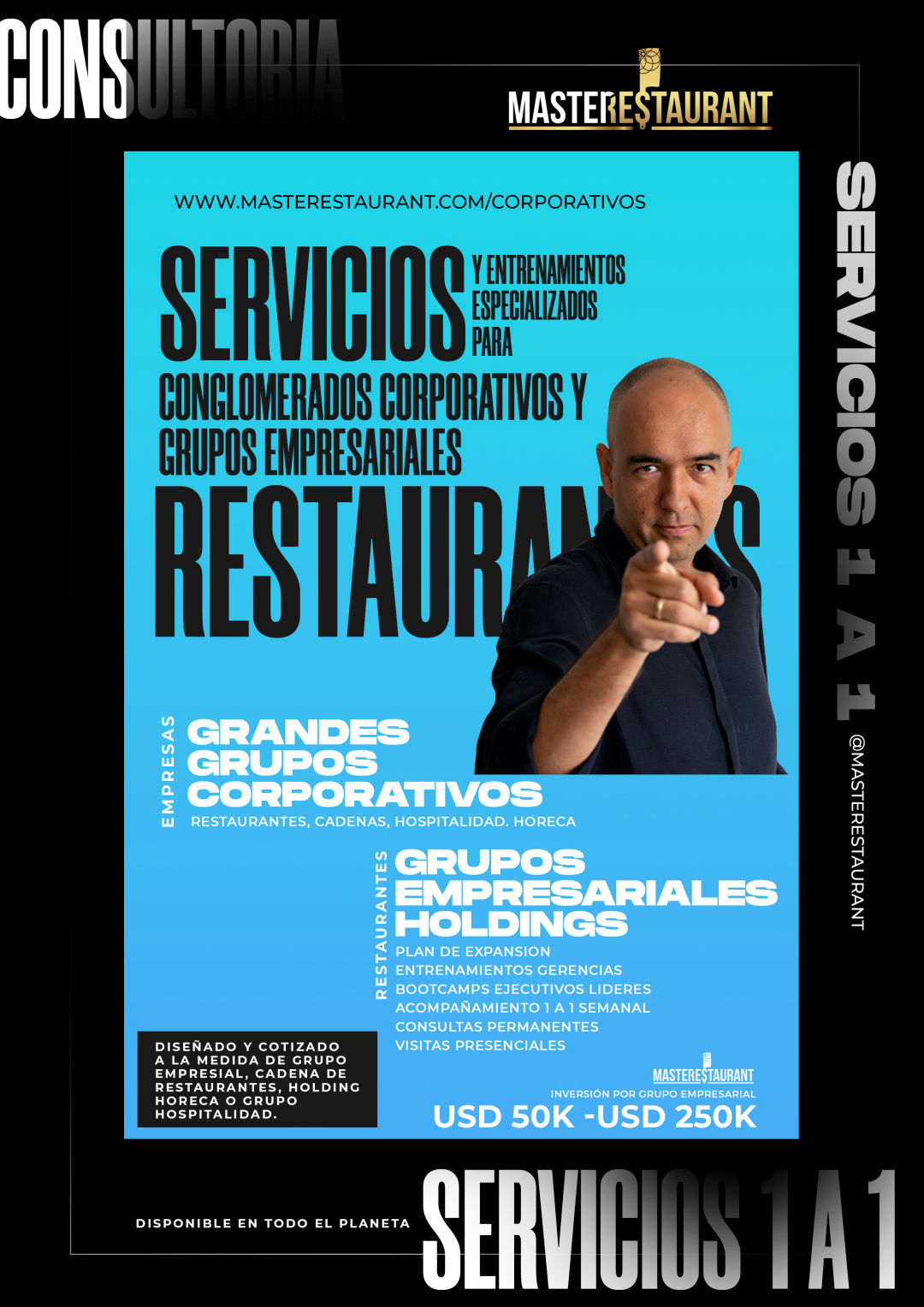
Investment: from USD $50K to USD $500K+ - tailor-made corporate programs, priced to the group's size and complexity - spots LIMITED worldwide.
Corporate programs
Tailor-made corporate consulting programs for groups and chains
Every corporate program is 100% personalized and tailor-made to the group. It starts with a strategic portfolio diagnosis and works through the key elements of the business model in the MASTERESTAURANT Restaurant Canvas, from portfolio strategy and standardization to per-unit profitability and expansion. Priced to the group's size and complexity (from USD $50K to USD $500K+), with limited spots worldwide to ensure dedicated attention and discretion for each client. The diagnosis sets the scope and the phases (strategic planning, standardization and implementation, and support through operations and expansion), working from the group's own numbers, on site or remote, in English or Spanish.
Corporate coverage
Where else we support restaurant groups near New York City
Explore other territories or the worldwide index:
Restaurant chain expansion in AnaheimCorporate hospitality consulting in ArlingtonRestaurant group consultant in AtlantaRestaurant chain expansion in Atlantic City, New JerseyCorporate hospitality consulting in Augusta GeorgiaCorporate hospitality consulting in Aurora IllinoisRestaurant chain expansion in AustinRestaurant chain expansion in Baltimore MarylandRestaurant group consultant in Baton Rouge, LouisianaCorporate hospitality consulting in Beverly HillsRestaurant group consulting in Boca Raton FloridaRestaurant chain consulting in BostonRestaurant group consulting in Brookhaven, New YorkRestaurant group consultant in Carson City NevadaRestaurant group consultant in Charlotte, North CarolinaCorporate hospitality consulting in ChicagoCorporate hospitality consulting in Columbia MarylandRestaurant group consultant in Coral Gables FloridaRestaurant group consulting in Corpus ChristiAdvisory for restaurant groups in Cupertino CaliforniaAdvisory for restaurant groups in DallasRestaurant group consulting in Delray Beach FloridaRestaurant group consulting in El PasoRestaurant chain expansion in State of ArizonaMore countries →More cities →
We do serve — and every city on the planet
Served on site or virtually, in English and Spanish.
Who is Diego F Parra?
Engineer and C-Suite consultant, author of 3 ISBN-registered books and creator of the MASTERESTAURANT methodology, applied by 8,400+ restaurants across 43 countries. The method comes with its own technology suite: MTIE, Gastronomic Radar and KPI Dashboard.
He is the consultant that business groups, chains, holdings and family offices choose to grow, standardize and expand their restaurant portfolio with profitability and governance. His method comes from two decades operating, rescuing and expanding restaurants, franchises, dark kitchens and HORECA groups across four continents, and it arrives with instruments proven in real operations, not generic templates. He works in English or Spanish, on site or remote.
HORECA · Chains · Holdings · Foodtech
Private programs for boards and family offices
Consulting, bootcamps and private advisory for boards and family offices.
From USD $50K, priced to the group; limited spots worldwide.
Published doctrine
The books that changed restaurant management
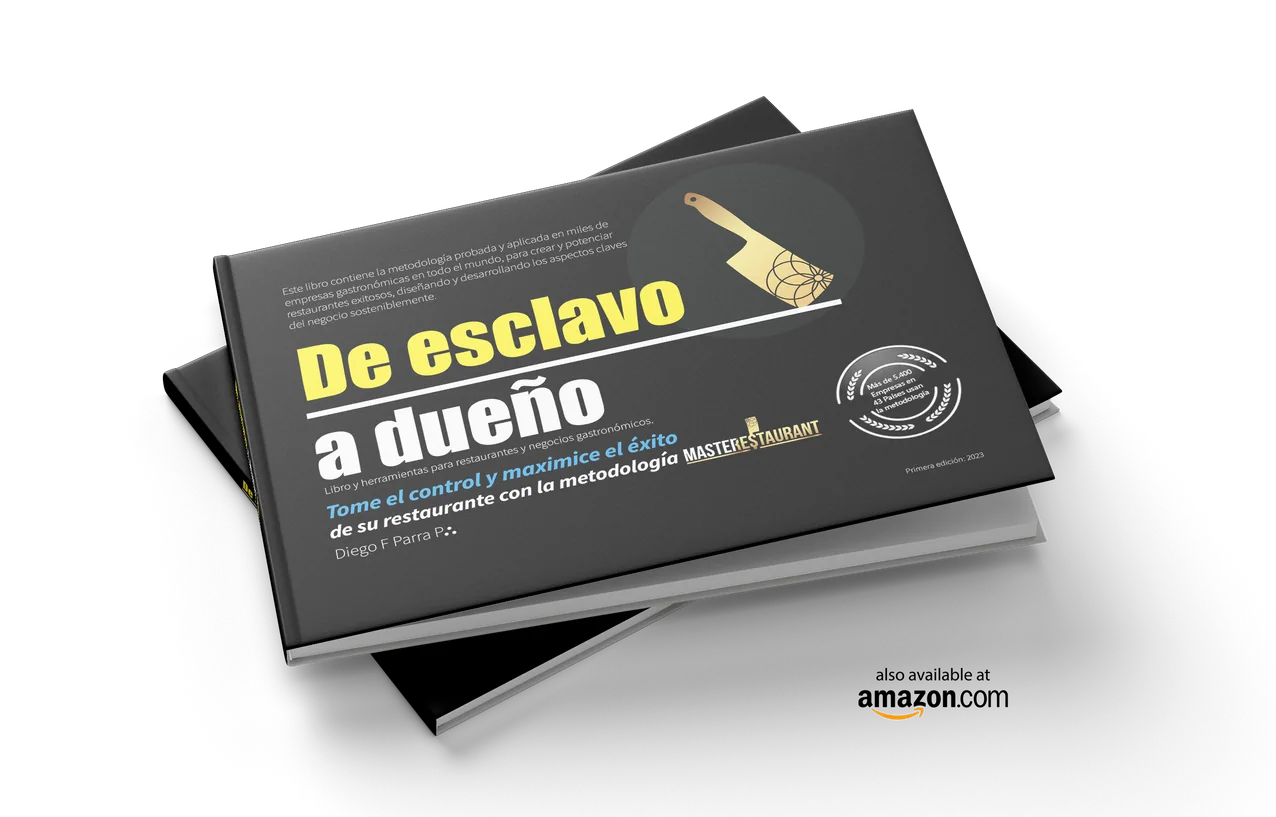
De Esclavo a Dueño
The book that changed how restaurants are managed: practical strategies and tools based on more than 20 years of experience, for traditional restaurants, dark kitchens, foodtech and HORECA businesses.
Triunfar o Morir en el Intento
Practical tools and key strategies to design and operate restaurants and food businesses efficiently.
Podcast: Masterestaurant — Mistakes for Restaurants
The public autopsy of the mistakes that bankrupt restaurants: thousands of owners and managers listen on Spotify to avoid repeating them.
Listen on SpotifyDownloads
The documents your board will ask for
MASTERESTAURANT services portfolio
The complete corporate intervention catalog: consulting, executive bootcamps, advisory and specialized services, with scopes and formats. The document to decide with your board.
Download PDFBook: From Slave to Owner
The full doctrine behind the methodology: how to structure restaurants that run without depending on the owner. Ideal pre-reading before your group's diagnosis.
View on AmazonPortfolio
More services by Diego F Parra and his team
As the group grows, every new site needs managers trained to the same standard. That is why the ecosystem's services start from the same method and tools as the corporate consulting: training and courses for managers in each market, the membership to keep learning going and the Pitch Deck and investment service when expansion needs capital. The full ecosystem is available:
International keynote speakerOne-on-one consulting and advisoryPersonalized mentoring for owners (limited spots)Corporate groups and holdings consultingCelebrity Restaurants consultingThemed restaurant advisorySpecialized training programs52-Week membershipPitch deck and restaurant investment readinessExponential Program0.1 Program — Elevate Your RestaurantInteractive training kit
Direct contact
Get a quote for corporate consulting for your group in New York City
Your message goes straight to Diego's team: group or chain, number of sites, stage and what you need to achieve in New York City.
“A restaurant group does not scale because it opens fast; it scales because it has engineered a business system that replicates unit profitability across locations. In competitive, high-cost markets, that difference is what separates a scaled group worth hundreds of millions from one that fails at the third location.”
Diego F. Parra — International consultant, expert in creating, scaling and improving restaurants, HORECA and hospitality
MASTERESTAURANT® methodology applied by 8,400+ restaurants across 43 countries · Author of 3 ISBN-registered books, including «De esclavo a dueño» · 20+ years operating restaurants, franchises, dark kitchens and HORECA groups across 4 continents
Full profile →Before the next opening in New York City
Tell us how many units the network runs and which decision the board has to make.
Explore more
Restaurant groups: territories, services and ecosystem resources
Related links for boards, C-Suite and teams evaluating Diego F Parra's corporate consulting for restaurant groups and chains: nearby territories, sister services in the MASTERESTAURANT ecosystem and management tools, all built on the same method.
World's best restaurant keynote speakerWorld's best restaurant consultantC-Suite restaurant consultant for chains & groupsDiego F Parra — professional profileKeynote speaker serviceCorporate groups & holdings consultingCelebrity restaurant consultingInternational themed restaurant advisoryRestaurant chain expansion in AnaheimCorporate hospitality consulting in ArlingtonRestaurant group consultant in AtlantaRestaurant chain expansion in Atlantic City, New JerseyCorporate hospitality consulting in Augusta GeorgiaCorporate hospitality consulting in Aurora Illinois
FAQ
Frequently asked questions
Our group has three brands (casual dining, QSR, independent premium) across different zones. If we standardize operations, don't we destroy what makes each one different?
No. Correct standardization locks down processes where they matter (costing, inventory, human resources, margin governance), not creativity. A QSR in a high-density urban area and a casual concept in a residential neighborhood both use the same centralized procurement system and Prime Cost template, but menu, service style, and staffing reflect their geography and format. Diego designs what to standardize (financial and operational processes) and what to keep flexible (offering, presentation, experience). The result is protected margins in both without homogenization.
How do I know if my next location in a new zone will replicate profitability, or if I'm opening a unit that will drain capital?
The portfolio diagnostics and bespoke financial model of MASTERESTAURANT analyze your actual unit performance, zone benchmarks, and location-specific factors (real estate cost, available talent, competitive intensity, demand). It then models the new location's financial projection under realistic execution scenarios, not optimistic ones. That allows the board to expand with data and set clear operational targets for margin realization. It is the difference between 'sounds good' and 'we know what profitability looks like and what will make or break it.'
How does corporate consulting for restaurant groups and chains work?
It starts with a strategic diagnosis of the group and its portfolio of brands and units. Based on it, the growth plan is designed —portfolio strategy, multi-site standardization, per-unit profitability and expansion—and leadership is supported through implementation.
Is the confidentiality of the group's information protected?
Yes. The whole process operates under confidentiality agreements (NDA). The group's financial, operational and strategic information is and remains the client's. Limited spots worldwide exist to guarantee dedication and focus on each organization.
How long does it take and what are the phases of the corporate engagement?
It depends on the group's size and complexity: diagnosis, strategic planning, standardization and implementation, and support during operation and expansion. Scaling a group profitably is a process with method, not an event.
What is the investment for a corporate program?
Corporate programs range from USD $50K to USD $500K+ and are priced to the group's size and complexity, number of sites and scope of the engagement. They are quoted tailor-made after the diagnosis.
Do you work with growing groups and also with consolidated chains?
Both: expanding groups that need to standardize and get in order before growing, and consolidated chains looking to recover per-unit profitability, restructure the portfolio or prepare franchising and new markets.
