 MASTERESTAURANT®
Piura is the second most populous department in Peru, according to the 2017 National Census (INEI).
INEI - Censos Nacionales 2017
Corporate consulting · Piura

DIEGO F PARRA · CREATOR OF THE MASTERESTAURANT® METHODOLOGY
RESTAURANT CHAIN CONSULTING Who does a holding in Piura turn to in order to know which brand is carrying which?
If you lead a group, a chain or a restaurant holding in Piura, Diego F. Parra brings the MASTERESTAURANT methodology to your organization: corporate diagnosis, standardization, profitability and governed expansion.
Download the portfolio (PDF)Corporate advisory spots LIMITED worldwide - reserve your group's evaluation early
8,400+restaurants apply his methodology
43countries with supported groups
65M+views per year
2service languages: EN - ES
International validation
See Diego F. Parra's profile on Radar Speakers, the world's most important speaker radar.
See profile on Radar Speakers →
1,856,809 inhabitants
S/ 6.832 billion
2.5% of GDP
31,237,385 inhabitants

@masterestaurant
The portfolio seen with one yardstick in Piura
The MASTERESTAURANT methodology and its TOOLKIT have been applied across 8,400+ restaurants in 43 countries, from three-site groups to networks with dozens of units. Growing a group is harder than opening a restaurant: each new site multiplies costs, standards, talent and complexity, and a group only scales when a system replicates per-unit profitability, not when it depends on founders or operational heroes.
In Piura, the method adapts to the size, stage and expansion model of each group, in an order that does not change: measure, standardize, and only then replicate. That means a corporate diagnosis brand by brand and site by site, standards and financial governance that hold across the network, and a decision on owned units, licensing or franchising based on the documented standard and the team available.
How does restaurant group consulting work in Piura?
The first step is a corporate diagnosis: every unit the group runs in Piura is measured on EBITDA, Prime Cost, standards and the team behind it. With that map the board decides which sites to open, convert or close.
The work runs on four fronts together: portfolio strategy, standards that hold across every site, financial governance and a clear expansion rule. Units are compared on the same indicators, so the board sees which locations carry the group and which ones drain it. Then come the systems that make growth repeatable: recipes and processes on paper, a KPI dashboard reviewed on a fixed calendar and a leadership layer that runs without the founders in the room. Everything is built on the group's own numbers, on site or remote, in English or Spanish. This page cites four verified figures for Piura, from sources such as INEI and MINCETUR.
What do the numbers say about running a restaurant group in Piura?
1,856,809 inhabitants — Piura is the second most populous department in Peru, according to INEI. A figure like this sizes the opportunity; it does not say whether each new unit will earn money.
For a group, the useful reading is the unit economics behind each opening: Prime Cost under control, a theoretical food cost close to the real one and EBITDA measured site by site. That is what decides whether a new location in Piura multiplies profit or only multiplies complexity. Other reference points cited on this page: S/ 6.832 billion (revenue from gastronomic tourism in Peru in 2024, equal to 21.9% of national tourism GDP, MINCETUR); 2.5% of GDP (restaurant sector contribution to Peru GDP in 2024, equal to S/ 14,567 million, PRODUCE); 31,237,385 inhabitants (total population of Peru, INEI).
Data
Market figures for restaurant groups in Piura
The figures cited on this page, with what each one measures and its source.
| Figure | What it measures | Source |
|---|---|---|
| 1,856,809 inhabitants | Piura is the second most populous department in Peru | INEI - Censos Nacionales 2017 |
| S/ 6.832 billion | Revenue from gastronomic tourism in Peru in 2024, equal to 21.9% of national tourism GDP, per MINCETUR | MINCETUR |
| 2.5% of GDP | Restaurant sector contribution to Peru GDP in 2024, equal to S/ 14,567 million, per PRODUCE | PRODUCE (OGEIEE) |
| 31,237,385 inhabitants | Total population of Peru according to the 2017 National Census (INEI) | INEI - Censos Nacionales 2017 |
Each figure links to its source in the data cards on this page.
The local market
What to know about Piura before the next unit opens
A restaurant group in the region that expands without systems faces an inevitable challenge: each new location multiplies operational costs, requires specialized teams at every point of sale, demands process standardization unnecessary at two or three units, and requires financial governance previously not needed. Most regional groups expand on commercial impulse—a location is identified, the restaurant opens—without portfolio diagnosis, without brand or unit strategy, and without operational structure designed to work across multiple sites. The result: eroded margins at the second or third opening, replicated costs without control, operational standards that collapse, key talent scattered. It is not about opening faster: it is about expanding a proven business system where each new location inherits processes, controls, unit economics, and governance. That is the gap between a group that grows and one that dilutes.
The transformation this service delivers converts a group expanding by impulse into a governed hospitality company. It begins with portfolio diagnosis: which brands and units drive profitability, which erode capital, where expansion potential exists. Then, tailored strategy: which brands to strengthen, which to restructure, how to allocate capital based on data. Then, multi-location standardization: operational manuals for kitchen, floor, and administration; replicable processes; quality and cost control. The MASTERESTAURANT® methodology integrates unit economics—actual profit per location—, Prime Cost governed at portfolio level, dashboards by unit and portfolio, and organizational structure that scales without founder dependence. Finally, expansion and franchise models: replication frameworks, legal-financial structures, territory evaluation. All 100% designed for regional realities: local operational costs, differentiated market, available talent, consumer dynamics.
Diego F. Parra's global authority reduces expansion risk because it is not intuition or generic best practice application. It is twenty-five years of real C-Suite consulting experience with restaurant groups and chains, working in 43 countries with over 8,400 restaurants, negotiating leases, signing payroll, structuring partnerships and closing expansions in portfolios worth hundreds of millions of dollars. His MASTERESTAURANT® methodology is verifiable: author of 3 ISBN-registered books ('From Slave to Owner'), 65+ million annual community visualizations, architect of proprietary technology suite (Restaurant Model Canvas, MTIE—Masterestaurant Territory Engine, Gastronomic Radar, Indicators Dashboard). The board gains confidence not from promises but from a system proven at global scale applied to regional operational reality.
The concrete return for a corporate restaurant group is direct: profitability replicated at each new unit, margin protected at each opening, portfolio decisions informed by data (which brands to strengthen, which to restructure, how to allocate capital), an operation independent of the founder or operational heroes but governed by processes and teams, and a consolidated group more valuable and attractive to investors, franchisors, and strategic partners. The corporate program is 100% bespoke: no off-the-shelf packages. It integrates diagnosis, strategy, multi-location standardization, control dashboards, organizational structure, and board and C-Suite accompaniment throughout expansion. For a holding or restaurant chain seeking to scale without eroding unit profitability, it is the only service designed specifically for governance and growth of hospitality portfolios.
Market data
The restaurant-group and chain market in Piura in figures
Revenue from gastronomic tourism in Peru in 2024, equal to 21.9% of national tourism GDP
MINCETURRestaurant sector contribution to Peru GDP in 2024, equal to S/ 14,567 million
PRODUCE (OGEIEE)Total population of Peru according to the 2017 National Census (INEI).
INEI - Censos Nacionales 2017Piura as a market
What sets the pace of the network in Piura
The regional corporate hospitality ecosystem comprises groups and chains in rotisserie, gourmet cevichería, grills, contemporary and tourist Peruvian cuisine, distributed across strategic commercial corridors (Castilla, historic center, El Silencio, Urb. Miraflores, Vegueta). These groups serve both local consumption and tourism: travelers from Lima, Ecuador, and Brazil attracted by gastronomy and nearby beaches (Máncora, Chicama). Availability of C-Suite-level operational and management talent is limited, making multi-location team replication costly. Lease costs are lower than major metropolitan centers but market structure is more fragile: narrower margins, centralized purchasing difficult to scale, local suppliers with limited supply. This means a group expanding must radically optimize operations to maintain profitability.
Expansion of a group or chain offers clear opportunities: new points of sale in growth corridors (new commercial zones, residential expansion), tourism as constant driver, local consumer with differentiated purchasing power by zone (center vs. periphery). But it erodes profitability without systems: replicating costs across multiple sites without standardization, talent turnover that fragments knowledge, weak financial and operational governance between units, intense regional competition. The local consumer varies by zone: center and Castilla demand cuisine with local identity and narrative; peripheries, accessible and family-friendly options; tourism segment, differentiated experience and visibility. A corporate consulting program must understand those local dynamics and translate them into brand strategy, positioning, and operations.
RESOURCES
MASTERESTAURANT studies, guides & tools
Reference content for owners and directors in Piura: proprietary indexes, tools and industry analysis:
- STUDYBar Location: Before vs After the Masterestaurant Method
- CASE STUDYCase study: from 41% food cost and 14-hour days to a profitable, autonomous steakhouse
- COMPARISONRestaurant Social Media Content 2026: Mistakes vs the Right
- COMPARISONDelegating Restaurant Operations: Before vs After
- CONCEPTWaiter Training: Before vs After · Definition
- CHECKLISTDeciding With Data vs Intuition in Restaurants: 2026
The corporate consultant
Why his judgment matters in this decision
When an owner hires corporate restaurant consulting, what he is really buying is judgment: someone who has already watched the same plan fail three times and knows where it breaks. Diego F Parra has two decades of that material — engineer and C-Suite consultant, restaurants, franchises, dark kitchens and HORECA groups created, rescued and expanded across four continents, with payrolls signed, leases negotiated and expansions closed in operations worth hundreds of millions of dollars.
That judgment is written into the MASTERESTAURANT® methodology, used by 8,400+ restaurants across 43 countries, and into its TOOLKIT: MTIE, Gastronomic Radar, Standard Recipe Generator, Tech Sheets and KPI Dashboard. The goal is not for you to depend on the consultant, but on the system.
Author of 3 ISBN-registered books, including «De esclavo a dueño», creator of the industry's leading podcast and of the largest bilingual community of owners, chefs and operations directors in the region (65M+ views per year as @masterestaurant), recognized among the top Latino restaurant operations experts globally. More in Diego F Parra's professional profile.
Corporate consulting with its own doctrine, not generic frameworks
Consulting for restaurant groups is not solved with management theory. Every engagement is built on the Restaurant Model Canvas and real industry data—profitability, Prime Cost, cost structure, multi-site standardization and expansion—applied to the specific business model of a group, a chain or a holding. The goal is not to open more restaurants, but to build a business system that replicates per-unit profitability, governs the portfolio and sustains operations on clear rules rather than indispensable people. Every board decision rests on the group's own indicators, measured at each site.
Corporate consulting from start to finish
Advisory that covers the full restaurant-group lifecycle
Turning over more is not earning more
A network can grow in sales and lose margin per site. That is not growth, it is dilution, and only EBITDA per unit shows it.
Get a quoteThe standard is the asset
Written, measured and held. Without it, the group's value depends on who happens to be on shift at each location.
Quote standardizationThe system replaces the hero
Structure and processes that work without depending on two or three indispensable people across the whole network.
Quote expansionGrowth is a decision, not a drift
Opening because a site came up is the most expensive way to expand. The staged plan exists to prevent it.
See the services portfolio (PDF)The methodology
Discover the MASTERESTAURANT methodology
Behind every group that scales profitably there is a system, not luck: tools, processes and models that turn impulse growth into governed expansion.
Who is it for?
Built for those who lead and expand restaurant groups
Tailor-made 1-on-1 support, for new projects and for operations already running:
Organized foodservice
Quick-service, fast-casual and full-service chains, where the standard is as much the product as the menu.
Dark kitchens and delivery
Multi-node operations where margin is decided by packaging, ticket time and channel mix.
Franchisors
Those already selling a model who need what they hand over to be a system rather than an expectation.
Investment and portfolio
Funds and family offices with foodservice assets that need an operational reading, not only a financial one.
What's included
What the work with leadership includes
The programme is built on whichever MASTERESTAURANT methodology modules your case calls for:
- Diagnosis brand by brand and site by site
- Portfolio strategy and capital allocation
- Multi-site standardization
- Financial governance and decision dashboards
- Menu engineering consistent across the network
- Talent, structure and leadership
- Readiness for franchising and licensing
- Entry into new markets
- Support through implementation
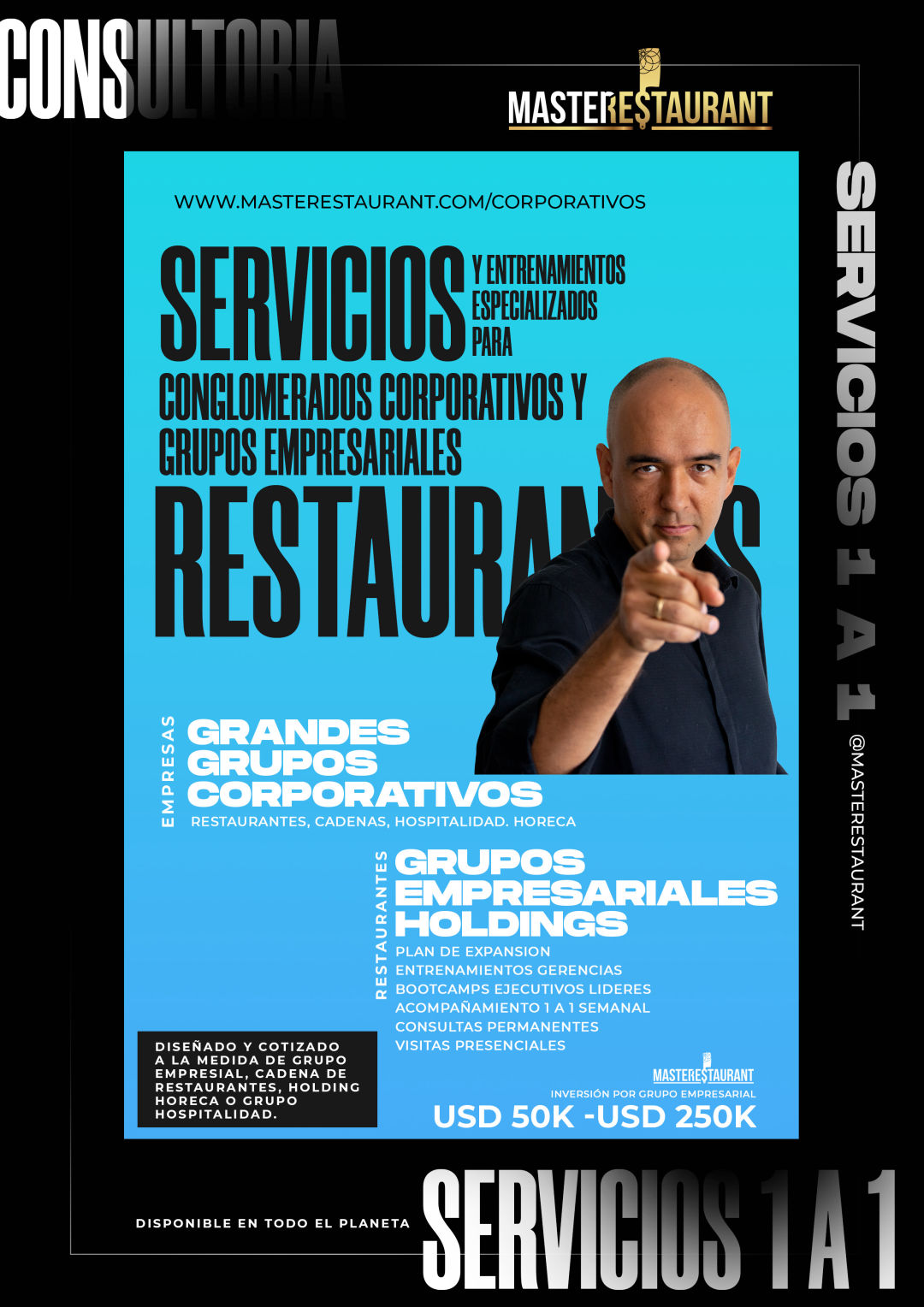
Investment: from USD $50K to USD $500K+ - tailor-made corporate programs, priced to the group's size and complexity - spots LIMITED worldwide.
Corporate programs
Tailor-made corporate consulting programs for groups and chains
Every corporate program is 100% personalized and tailor-made to the group. It starts with a strategic portfolio diagnosis and works through the key elements of the business model in the MASTERESTAURANT Restaurant Canvas, from portfolio strategy and standardization to per-unit profitability and expansion. Priced to the group's size and complexity (from USD $50K to USD $500K+), with limited spots worldwide to ensure dedicated attention and discretion for each client. The diagnosis sets the scope and the phases (strategic planning, standardization and implementation, and support through operations and expansion), working from the group's own numbers, on site or remote, in English or Spanish.
Corporate coverage
Chain engagements available near Piura
Explore other territories or the worldwide index:
Restaurant chain expansion across PeruAdvisory for restaurant groups in ArequipaAdvisory for restaurant groups in AyacuchoRestaurant group consultant in CallaoAdvisory for restaurant groups in ChiclayoCorporate hospitality consulting in ChimboteRestaurant chain consulting in CuzcoAdvisory for restaurant groups in HuancayoRestaurant chain expansion in IcaRestaurant group consulting in IquitosRestaurant group consulting in LimaAdvisory for restaurant groups in PeruCorporate hospitality consulting in PucallpaCorporate hospitality consulting in PunoRestaurant group consulting in TrujilloRestaurant chain consulting in AustraliaRestaurant chain expansion in AustriaRestaurant chain consulting in IsraelRestaurant chain consulting in South AfricaCorporate hospitality consulting in AlajuelaAdvisory for restaurant groups across ArgentinaAdvisory for restaurant groups across BoliviaRestaurant chain expansion across BrazilRestaurant group consulting across CanadaMore countries →More cities →
We do serve — and every city on the planet
Served on site or virtually, in English and Spanish.
Who is Diego F Parra?
Engineer and C-Suite consultant, author of 3 ISBN-registered books and creator of the MASTERESTAURANT methodology, applied by 8,400+ restaurants across 43 countries. The method comes with its own technology suite: MTIE, Gastronomic Radar and KPI Dashboard.
He is the consultant that business groups, chains, holdings and family offices choose to grow, standardize and expand their restaurant portfolio with profitability and governance. His method comes from two decades operating, rescuing and expanding restaurants, franchises, dark kitchens and HORECA groups across four continents, and it arrives with instruments proven in real operations, not generic templates. He works in English or Spanish, on site or remote.
HORECA · Chains · Holdings · Foodtech
Private programs for boards and family offices
Consulting, bootcamps and private advisory for boards and family offices.
From USD $50K, priced to the group; limited spots worldwide.
Published doctrine
The books that changed restaurant management
De Esclavo a Dueño
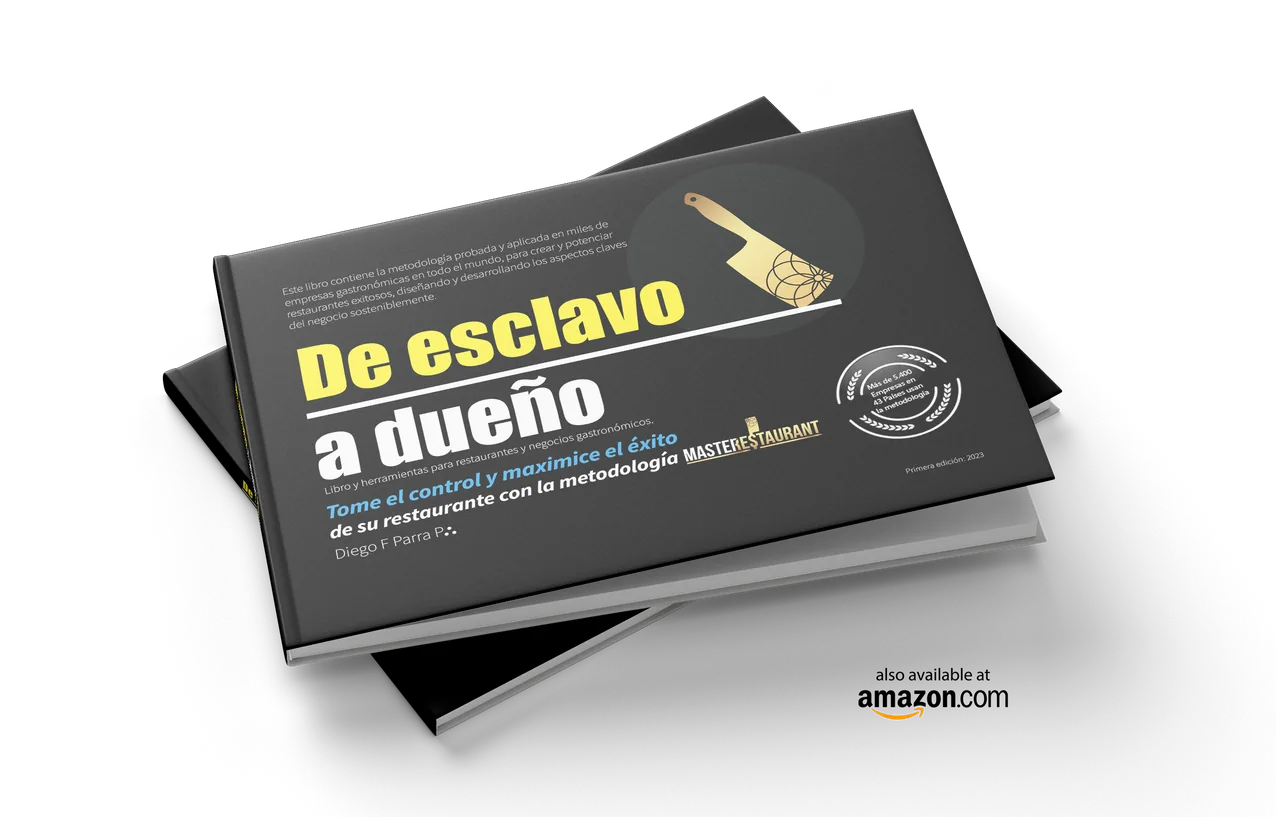
The book that changed how restaurants are managed: practical strategies and tools based on more than 20 years of experience, for traditional restaurants, dark kitchens, foodtech and HORECA businesses.
Triunfar o Morir en el Intento
Practical tools and key strategies to design and operate restaurants and food businesses efficiently.
Podcast: Masterestaurant — Mistakes for Restaurants
The public autopsy of the mistakes that bankrupt restaurants: thousands of owners and managers listen on Spotify to avoid repeating them.
Listen on SpotifyDownloads
The documents your board will ask for
MASTERESTAURANT services portfolio
The complete corporate intervention catalog: consulting, executive bootcamps, advisory and specialized services, with scopes and formats. The document to decide with your board.
Download PDFBook: From Slave to Owner
The full doctrine behind the methodology: how to structure restaurants that run without depending on the owner. Ideal pre-reading before your group's diagnosis.
View on AmazonPortfolio
More services by Diego F Parra and his team
As the group grows, every new site needs managers trained to the same standard. That is why the ecosystem's services start from the same method and tools as the corporate consulting: training and courses for managers in each market, the membership to keep learning going and the Pitch Deck and investment service when expansion needs capital. The full ecosystem is available:
International keynote speakerOne-on-one consulting and advisoryPersonalized mentoring for owners (limited spots)Corporate groups and holdings consultingCelebrity Restaurants consultingThemed restaurant advisorySpecialized training programs52-Week membershipPitch deck and restaurant investment readinessExponential Program0.1 Program — Elevate Your RestaurantInteractive training kit
Direct contact
Get a quote for corporate consulting for your group in Piura
Your message goes straight to Diego's team: group or chain, number of sites, stage and what you need to achieve in Piura.
“In twenty-five years working with restaurant groups of all sizes, I saw those scaling without systems—just opening faster—face eroded profitability within five years. Those who build the system first expand without losing margin. In the region, the market differs from Lima, but the rule is the same: it is business design that determines whether a group consolidates or dilutes.”
Diego F. Parra — International consultant, expert in creating, scaling and improving restaurants, HORECA and hospitality
MASTERESTAURANT® methodology applied by 8,400+ restaurants across 43 countries · Author of 3 ISBN-registered books, including «De esclavo a dueño» · 20+ years operating restaurants, franchises, dark kitchens and HORECA groups across 4 continents
Full profile →Start with the corporate diagnosis, in Piura
Tell us how many units the network runs and which decision the board has to make.
Explore more
Restaurant groups: territories, services and ecosystem resources
Related links for boards, C-Suite and teams evaluating Diego F Parra's corporate consulting for restaurant groups and chains: nearby territories, sister services in the MASTERESTAURANT ecosystem and management tools, all built on the same method.
World's best restaurant keynote speakerWorld's best restaurant consultantC-Suite restaurant consultant for chains & groupsDiego F Parra — professional profileKeynote speaker serviceCorporate groups & holdings consultingCelebrity restaurant consultingInternational themed restaurant advisoryRestaurant chain expansion across PeruAdvisory for restaurant groups in ArequipaAdvisory for restaurant groups in AyacuchoRestaurant group consultant in CallaoAdvisory for restaurant groups in ChiclayoCorporate hospitality consulting in Chimbote
FAQ
Frequently asked questions
We have three locations with good margins but we are considering opening five or more in the next eighteen months. How do we prevent margin erosion per unit like other groups in the region experienced?
Erosion occurs when costs are replicated without replication of standardization. The program diagnoses real unit economics per location, establishes Prime Cost governed at portfolio level, designs replicable operational manuals for kitchen and floor, and implements unit dashboards. Each new opening inherits proven processes, controlled costs, and scalable organizational structure. It is not 'open faster': it is open profitably.
Our founder and field operator are the only ones who truly understand how the business works. How do we structure the group to grow without depending on key people?
It requires systematic transfer of knowledge to documents, processes, and teams. The program designs organizational structure with defined roles (finance, operations, kitchen, HR), operational manuals per function, portfolio governance at board level, and teams that can be replicated. The founder moves from operational to strategic; operations move to systems and trained people.
We turn over more every year and earn less per site. What is happening?
That is not growth, it is dilution. Almost always it is group fixed costs that grew with the openings and a Prime Cost nobody governs corporately. It shows the moment you look at EBITDA per unit.
What is the most expensive mistake of a chain in expansion?
Opening before documenting. Every new site copies whichever version of the standard existed that month, and past a certain number nobody can say which one each location is running.
What part does talent play?
A decisive one, which is why the engagement includes organizational structure and leadership development. A written standard without trained managers to hold it lasts until the first high season.
Do you work with funds and family offices?
Yes: operational due diligence, value thesis and support to management, to enter or grow in foodservice with industry judgement.
What is the investment for a corporate program?
Corporate programs range from USD $50K to USD $500K+ and are priced to the group's size and complexity, number of sites and scope of the engagement. They are quoted tailor-made after the diagnosis.
