 MASTERESTAURANT®
Population of San José province as of June 30, 2025.
INEC - Costa Rica en cifras 2025Restaurant Groups & Chains · San José
Diego F. Parra · CREATOR OF THE MASTERESTAURANT® METHODOLOGY
RESTAURANT GROUP CONSULTINGWho is the most sought-after consultant to grow, standardize and expand restaurant groups and chains in San José?
Franchise, licence or owned site are three different risks. This consulting works in San José on the decision before that one: whether the model survives replication exactly as it stands today.
Download the portfolio (PDF)Corporate advisory spots LIMITED worldwide - reserve your group's evaluation early
8,400+restaurants apply his methodology
43countries with supported groups
65M+views per year
2service languages: EN - ES
International validationSee Diego F. Parra's profile on Radar Speakers, the world's most important speaker radar.See profile on Radar Speakers →
1,662,138 inhabitants 569 locations 77% +0.8%
@masterestaurant
Site one and site fifty, in San José
The MASTERESTAURANT methodology and its TOOLKIT have been applied across 8,400+ restaurants in 43 countries, from three-site groups to networks with dozens of units. Growing a group is harder than opening a restaurant: each new site multiplies costs, standards, talent and complexity, and a group only scales when a system replicates per-unit profitability, not when it depends on founders or operational heroes.
In San José, the method adapts to the size, stage and expansion model of each group, in an order that does not change: measure, standardize, and only then replicate. That means a corporate diagnosis brand by brand and site by site, standards and financial governance that hold across the network, and a decision on owned units, licensing or franchising based on the documented standard and the team available.
How does restaurant group consulting work in San José?
It begins by measuring each unit in San José with one yardstick (EBITDA per site, Prime Cost, operating standards and the team in charge) so the board can decide what to open, convert or close on evidence.
The diagnosis turns into four workstreams: portfolio, multi-site standards, financial governance and expansion. The aim is a group that can grow without the founders in every decision: documented recipes and processes, a KPI dashboard with a fixed review cadence and managers who own their numbers. The engagement uses the group's own data, runs in person or remotely, in English or Spanish, and is sized to the number of units and the stage of the business. This page cites four verified figures for San José, from sources such as INEC and Cámara Costarricense de Hoteles.
What do the numbers say about running a restaurant group in San José?
1,662,138 inhabitants — population of San José province as of June 30, 2025, according to INEC. A figure like this sizes the opportunity; it does not say whether each new unit will earn money.
For a group, the useful reading is the unit economics behind each opening: Prime Cost under control, a theoretical food cost close to the real one and EBITDA measured site by site. That is what decides whether a new location in San José multiplies profit or only multiplies complexity.
Other reference points cited on this page: 77% (projected average hotel occupancy for the year-end and New Year season, Cámara Costarricense de Hoteles); 569 locations (US fast-food franchise locations operating in the country at year-end, La Nación); +0.8% (growth in tourist arrivals at year-end close, La Nación).
Data
Market figures for restaurant groups in San José
The figures cited on this page, with what each one measures and its source.
| Figure | What it measures | Source |
|---|---|---|
| 1,662,138 inhabitants | Population of San José province as of June 30, 2025 | INEC - Costa Rica en cifras 2025 |
| 569 locations | US fast-food franchise locations operating in the country at year-end | La Nación |
| 77% | Projected average hotel occupancy for the year-end and New Year season | Cámara Costarricense de Hoteles |
| +0.8% | Growth in tourist arrivals at year-end close | La Nación |
Each figure links to its source in the data cards on this page.
The local market
What kind of market San José is for a network
San José, as the economic and corporate hub of Central America, hosts growing regional chains, hospitality holdings, and restaurant groups facing a singular challenge: the transition from family-run or consolidated multi-unit operations to a scalable corporate model. Each new location multiplies not just revenue opportunity, but operational, financial, and talent complexity.
A group performing well with two or three units enters governance crisis at ten or twenty: costs spiral, margins erode due to lack of standardization, each manager operates independently, director retention declines, and the board has no dashboards revealing the true health of the portfolio.
Most groups expand opportunistically—"we see a site, we open it"—without a data-driven expansion strategy grounded in unit economics, Prime Cost controlled at the corporate level, or visibility into which brands or concepts generate return versus which dilute shareholder value. Without that architecture, growth is risk, not opportunity.
Diego F. Parra's corporate consulting service transforms a group growing by impulse into a GOVERNED RESTAURANT ENTERPRISE.
The program integrates a full portfolio diagnostic—financial, operational, and talent audit of each unit—definition of brand strategy and positioning by consumer segment, design of standardized manuals and processes ensuring consistency without suffocating individual concept identity, implementation of multi-unit operational control systems (from supply chain to workforce management), governance of unit economics and Prime Cost at the corporate level (each manager knows margin target and its drivers), construction of decision dashboards and board-ready reporting (unit profitability CRM, portfolio analysis, data-driven decision capacity), redesign of organizational structure (reporting, authority, and accountability across sites and corporate), and architecture for expansion (new locations, new markets, franchising, acquisitions), all under the MASTERESTAURANT methodology, proven across 43 countries and adapted entirely to Costa Rica's market reality. This is not "general improvement": it is a redesign of the business's foundation.
Diego F. Parra is an international consultant who has structured expansions totaling hundreds of millions of dollars in restaurant operations: he has signed payrolls as an operator, negotiated corporate leases, designed investment and expansion structures across multiple markets. His implementation of MASTERESTAURANT spans 43 countries, +8,400 restaurant groups and chains, and his flagship work is a reference standard in the industry. His community reaches 65+ million annual views.
When a board engages Diego's corporate consulting program, it gains access to globally proven patterns: what scales, what collapses, how to build a resilient portfolio, how to protect unit-level profitability across diverse market contexts. That eliminates the risk of intuition-driven decisions and gives the board confidence to scale on systems and data, not founder charisma or costly trial-and-error.
The result for the group is quantifiable: each new unit opens with a replicated operating model and a defined margin target, not as "hope" but as a guarantee rooted in performance data from comparable units. The board has a clear map of which brands generate return and which require restructuring or divestment. Corporate Prime Cost is governed at portfolio level, with visibility into ingredient costs, payroll, and operations per unit.
Capital allocation decisions—where to expand, how much to invest, which concept type—are made with economic rigor, not intuition. Operations cease depending on the founder: each manager, operations head, and buyer operates under a corporate manual and control dashboards that align incentives. That makes the group more attractive to investors, more bankable, more resilient through market cycles and leadership changes. Scaling without loss of control means, ultimately, scaling on a SYSTEM, not on people.
Market data
Chain figures in San José
US fast-food franchise locations operating in the country at year-end
La NaciónProjected average hotel occupancy for the year-end and New Year season
Cámara Costarricense de HotelesGrowth in tourist arrivals at year-end close
La NaciónSan José as a market
What sets the pace of the network in San José
San José concentrates Central America's corporate restaurant ecosystem: local groups running 3-15 units across consolidated mall-based expansion zones (Multiplaza, Terramall, La Cascada), regional chains expanding from Panama and Nicaragua seeking capital positioning, and fast-growth foodtech and dark kitchens. High-demand corporate districts—Escazú, San Pedro, Zapote, Barrio Escalante, PAC (Parque Corporativo Agrícola)—host group headquarters, payroll infrastructure, and middle-to-premium consumer bases.
Available management talent is constrained: multi-unit operations managers with track records are scarce, competitive salaries are capped by local market capacity, and retention is chronic pain (attrition to Panama, Miami). Corporate lease costs have risen significantly over recent years, and access to growth capital is restricted: investors demand proven return and operational visibility. Market structure is intensely competitive: international chains pressure pricing and recruit talent, while local groups must differentiate through concept and execution. That complexity is precisely where corporate consulting structures resilience and scale.
The expansion opportunity is genuine: a metropolitan population generates diversified demand across consumer segments, and infrastructure investment (PAC development, Barrio Escalante regeneration) opens new commercial zones. A group with 3–5 well-run units can scale to 10–15 locations in 18–36 months if the operating structure enables it.
However, risks are equally clear: (a) Replicating profitability is the central trap: what generated 8–12% margins in a pilot can collapse to 4–6% in new units without input controls, if payroll drifts under weak managers, if centralized buying is absent and negotiating power is lost. (b) The region's consumer is demanding and fragmented: Escazú diners differ from Zapote traffic, meal-and-go differs from corporate dining, and a concept that succeeds in one zone may fail elsewhere.
(c) Multi-unit operations with dispersed management generates isolation: each manager acts without common standards, corporate communication weakens, financial control becomes a monthly shock when P&Ls arrive with unexplained variance. A custom corporate program is therefore strategic in this expansion window: it allows growth with control, not uncertainty.
RESOURCES
MASTERESTAURANT studies, guides & tools
A selection of MASTERESTAURANT studies, comparisons and tools to decide better in San José:
- DATAStandardize before scaling: the blind-opening mistake vs the 2026 figures of the right method
- CASE STUDYStandardize before scaling: the real case of a group that opened blindly, then documented first
- DATARestaurant Business Model: Myth vs Reality in 2026
- CHECKLISTDelivery propio vs apps checklist restaurantecercademi
- LIST7 restaurant membership and subscription mistakes
- ARTICLEDark Kitchen Permits: Myth vs Reality 2026 for restaurants
The corporate consultant
Twenty years of real operations, not theory
There are consultants who have read about restaurants and consultants who have stood inside one at nine on a Friday night. Diego F. Parra is the second kind: engineer and C-Suite consultant with two decades creating, rescuing and expanding restaurants, franchises, dark kitchens and HORECA and hospitality groups across four continents, with payrolls signed, leases negotiated and expansions closed in operations worth hundreds of millions of dollars.
That experience was distilled into the MASTERESTAURANT® methodology, applied today by 8,400+ restaurants across 43 countries, and into its TOOLKIT: MTIE, Gastronomic Radar, Standard Recipe Generator, Tech Sheets and KPI Dashboard. Tools, not slides.
The picture is completed by 3 ISBN-registered books, including «De esclavo a dueño», the industry's leading podcast, the largest bilingual community of owners, chefs and operations directors in the region (65M+ views per year as @masterestaurant) and a place among the top Latino restaurant operations experts globally. Full detail in Diego F. Parra's professional profile.
Corporate consulting with its own doctrine, not generic frameworks
Consulting for restaurant groups is not solved with management theory. Every engagement is built on the Restaurant Model Canvas and real industry data—profitability, Prime Cost, cost structure, multi-site standardization and expansion—applied to the specific business model of a group, a chain or a holding. The goal is not to open more restaurants, but to build a business system that replicates per-unit profitability, governs the portfolio and sustains operations on clear rules rather than indispensable people. Every board decision rests on the group's own indicators, measured at each site.
Corporate consulting from start to finish
Advisory that covers the full restaurant-group lifecycle
What the board decides
Where next year's capital goes, on EBITDA per unit and strategic fit, not on whichever brand argues hardest in the meeting.
Get a quoteWhat holds the network up
Trained managers, quality control and written processes. A standard needs somebody to hold it or it degrades on its own.
Quote standardizationWhat protects the margin
Prime Cost governed, group fixed costs reviewed and waste measured identically across every site.
Quote expansionWhat makes growth possible
A model proven per unit and a staged plan, before the next opening or the first franchise contract is signed.
See the services portfolio (PDF)The methodology
Discover the MASTERESTAURANT methodology
Behind every group that scales profitably there is a system, not luck: tools, processes and models that turn impulse growth into governed expansion.
Who is it for?
Who this corporate consulting is for
Private, made-to-measure support, for whoever is creating and for whoever is correcting:
Chains that opened fast
More sites than manuals. Every location running its own version of the standard and nobody able to compare them.
Multi-brand groups
Several banners under one house, each defending its numbers with different indicators.
Networks restructuring
When it is time to decide what to close, what to convert and what to hold, on judgement rather than seniority.
Groups about to franchise
The moment documentation stops being a pending task and becomes the product being sold.
What's included
What gets diagnosed, what gets standardized and what gets governed
No two engagements are alike: they are assembled from these MASTERESTAURANT methodology modules:
- Corporate diagnosis and portfolio strategy
- Multi-site standardization and manuals
- Per-unit profitability and financial governance
- Consistent menu engineering
- Organizational structure and leadership
- Indicator dashboards for the board
- Readiness for franchising and licensing
- Expansion into new markets
- Training for the leadership team
Investment: from USD $50K to USD $500K+ - tailor-made corporate programs, priced to the group's size and complexity - spots LIMITED worldwide.
Corporate programs
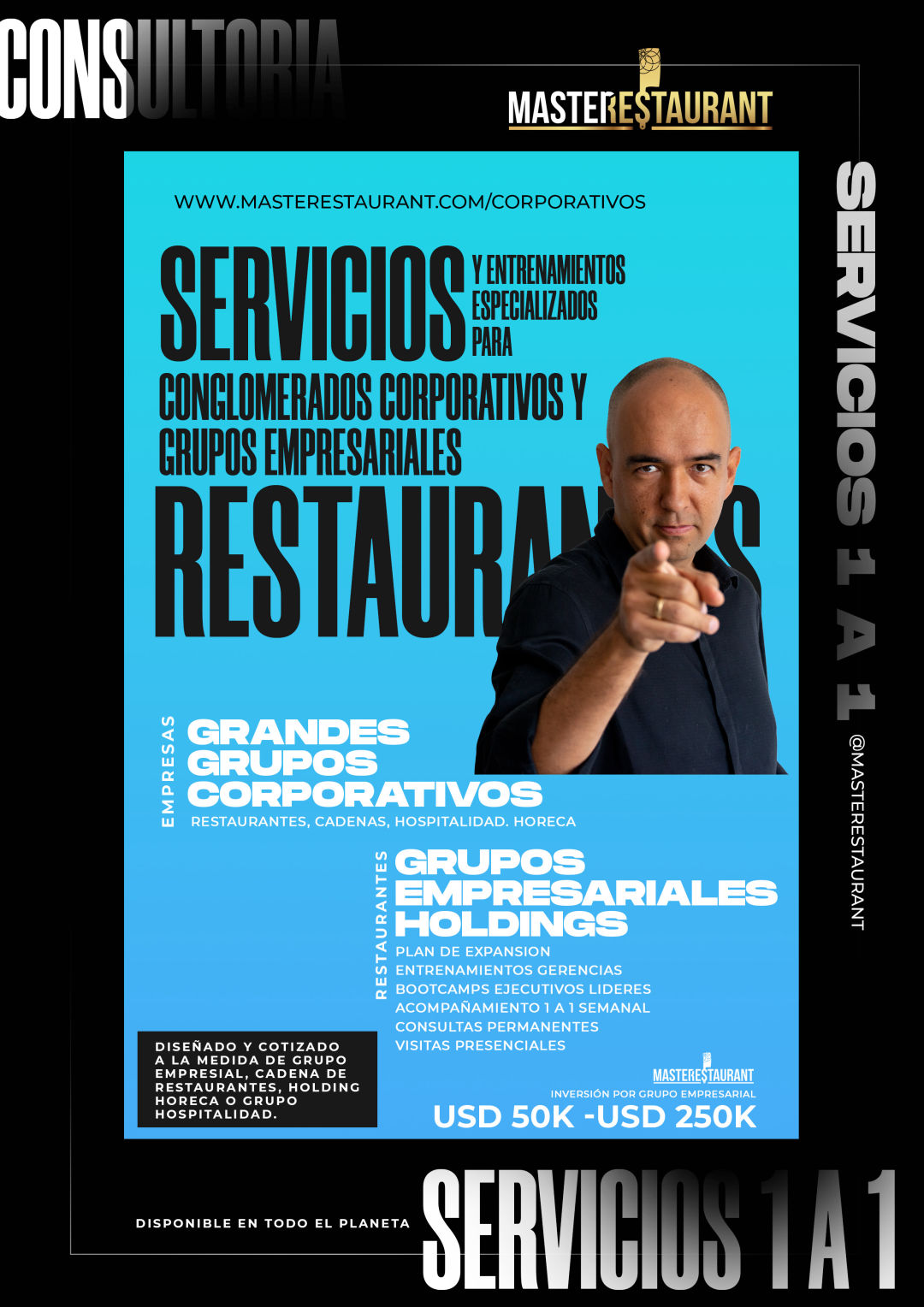
Tailor-made corporate consulting programs for groups and chains
Every corporate program is 100% personalized and tailor-made to the group. It starts with a strategic portfolio diagnosis and works through the key elements of the business model in the MASTERESTAURANT Restaurant Canvas, from portfolio strategy and standardization to per-unit profitability and expansion. Priced to the group's size and complexity (from USD $50K to USD $500K+), with limited spots worldwide to ensure dedicated attention and discretion for each client.
The diagnosis sets the scope and the phases (strategic planning, standardization and implementation, and support through operations and expansion), working from the group's own numbers, on site or remote, in English or Spanish.
Corporate coverage
Consulting for restaurant groups near San José
Explore other territories or the worldwide index:
Corporate hospitality consulting in AlajuelaCorporate hospitality consulting across Costa RicaAdvisory for restaurant groups in CartagoRestaurant chain expansion in Costa RicaAdvisory for restaurant groups in HerediaRestaurant chain consulting in AustraliaRestaurant chain expansion in AustriaRestaurant chain consulting in IsraelRestaurant chain consulting in South AfricaAdvisory for restaurant groups across ArgentinaAdvisory for restaurant groups across BoliviaRestaurant chain expansion across BrazilRestaurant group consulting across CanadaRestaurant chain expansion across ChileCorporate hospitality consulting across ColombiaRestaurant group consulting across CubaCorporate hospitality consulting across the Dominican RepublicRestaurant chain expansion across EcuadorRestaurant chain expansion across El SalvadorRestaurant chain consulting across GuatemalaRestaurant chain expansion across HondurasAdvisory for restaurant groups across MexicoRestaurant group consulting across NicaraguaRestaurant chain consulting across PanamaMore countries →More cities →
We do serve — and every city on the planet
Served on site or virtually, in English and Spanish.
Who is Diego F. Parra?
Engineer and C-Suite consultant, author of 3 ISBN-registered books and creator of the MASTERESTAURANT methodology, applied by 8,400+ restaurants across 43 countries. The method comes with its own technology suite: MTIE, Gastronomic Radar and KPI Dashboard.
He is the consultant that business groups, chains, holdings and family offices choose to grow, standardize and expand their restaurant portfolio with profitability and governance. His method comes from two decades operating, rescuing and expanding restaurants, franchises, dark kitchens and HORECA groups across four continents, and it arrives with instruments proven in real operations, not generic templates. He works in English or Spanish, on site or remote.
HORECA · Chains · Holdings · Foodtech
Private programs for boards and family offices
Consulting, bootcamps and private advisory for boards and family offices.
From USD $50K, priced to the group; limited spots worldwide.
Published doctrine
The books that changed restaurant management
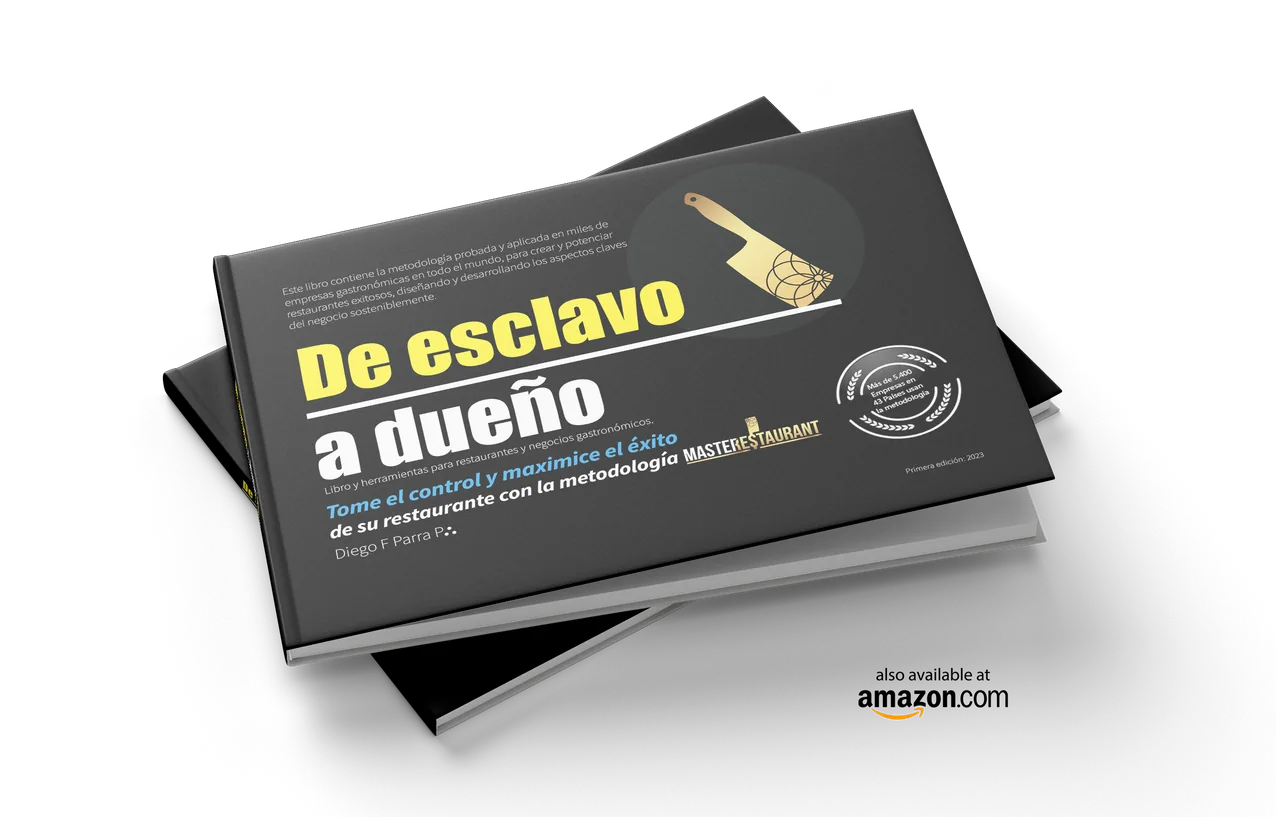
De Esclavo a Dueño
The book that changed how restaurants are managed: practical strategies and tools based on more than 20 years of experience, for traditional restaurants, dark kitchens, foodtech and HORECA businesses.
Triunfar o Morir en el Intento
Practical tools and key strategies to design and operate restaurants and food businesses efficiently.
Podcast: Masterestaurant — Mistakes for Restaurants
The public autopsy of the mistakes that bankrupt restaurants: thousands of owners and managers listen on Spotify to avoid repeating them.
Listen on SpotifyDownloads
The documents your board will ask for
MASTERESTAURANT services portfolio
The complete corporate intervention catalog: consulting, executive bootcamps, advisory and specialized services, with scopes and formats. The document to decide with your board.
Download PDFBook: From Slave to Owner
The full doctrine behind the methodology: how to structure restaurants that run without depending on the owner. Ideal pre-reading before your group's diagnosis.
View on AmazonPortfolio
More services by Diego F. Parra and his team
As the group grows, every new site needs managers trained to the same standard. That is why the ecosystem's services start from the same method and tools as the corporate consulting: training and courses for managers in each market, the membership to keep learning going and the Pitch Deck and investment service when expansion needs capital. The full ecosystem is available:
International keynote speakerOne-on-one consulting and advisoryPersonalized mentoring for owners (limited spots)Corporate groups and holdings consultingCelebrity Restaurants consultingThemed restaurant advisorySpecialized training programs52-Week membershipPitch deck and restaurant investment readinessExponential Program0.1 Program — Elevate Your RestaurantInteractive training kit
From template to results
Want this working every day in your restaurant?
The tool gives you the template. The program gives you the method and the guidance to use it every week, with your team.
Direct contact
Get a quote for corporate consulting for your group in San José
Your message goes straight to Diego's team: group or chain, number of sites, stage and what you need to achieve in San José.

“A restaurant group doesn't dilute from rapid growth: it dilutes from growing without system. I have seen chains open five units in two years and fail on the sixth because they never designed a corporate governance model. Conversely, I have seen groups that grow disciplined, with clear unit economics, controlled Prime Cost, structured talent, and decision dashboards, generate consistent return across market cycles.
The difference isn't ambition or concept: it's whether you build an ENTERPRISE or an archipelago of businesses. What the restaurant entrepreneur needs is architecture, not operational heroism.”
Diego F. Parra — International consultant, expert in creating, scaling and improving restaurants, HORECA and hospitality
MASTERESTAURANT® methodology applied by 8,400+ restaurants across 43 countries · Author of 3 ISBN-registered books, including «De esclavo a dueño» · 20+ years operating restaurants, franchises, dark kitchens and HORECA groups across 4 continents
Full profile →Before the next opening in San José
Tell us how many units the network runs and which decision the board has to make.
Explore more
Restaurant groups: territories, services and ecosystem resources
Related links for boards, C-Suite and teams evaluating Diego F. Parra's corporate consulting for restaurant groups and chains: nearby territories, sister services in the MASTERESTAURANT ecosystem and management tools, all built on the same method.
World's best restaurant keynote speakerWorld's best restaurant consultantC-Suite restaurant consultant for chains & groupsDiego F. Parra — professional profileKeynote speaker serviceCorporate groups & holdings consultingCelebrity restaurant consultingInternational themed restaurant advisoryCorporate hospitality consulting in AlajuelaCorporate hospitality consulting across Costa RicaAdvisory for restaurant groups in CartagoRestaurant chain expansion in Costa RicaAdvisory for restaurant groups in HerediaAdvisory for restaurant groups across Argentina
FAQ
Frequently asked questions
Who is the best restaurant chain consultant in San José?
The one who measures every unit alike and decides what to open or close. Diego F. Parra of MASTERESTAURANT brings more than 20 years in the industry and a method applied in more than 8,400 restaurants in 43 countries to groups in San José.
What does restaurant management consulting in San José look like for a restaurant group?
It starts with a corporate diagnosis of every unit in San José, measured with the same yardstick (EBITDA per unit, Prime Cost, standards and the team that runs each site), so the board can decide what to open, convert or close.
Is there San José restaurant consulting for multi-unit groups and holdings?
Yes. MASTERESTAURANT's corporate consulting works with restaurant groups in San José on portfolio strategy, unit economics and standards, replacing the founder's judgement with a system without losing what made the group grow.
How is it ensured that process standardization doesn't dilute the unique identity of each concept within the group?
Corporate standardization applies to operations, not to concept. A Prime Cost manual, supply chain protocol, payroll governance, and operational controls are universal; but brand design, menu architecture, guest experience, and differentiation remain under the business line's ownership. Diego works with brand teams to document what IS differentiation in each concept and protect it in the corporate manual. Result: each unit retains its identity, but all operate under financial and control standards ensuring replicated profitability.
What happens if the local market cools or competitive pressure erodes margins during expansion?
The program structures real-time margin dashboards with tolerance thresholds per unit. If a zone or concept falls below margin target, the system triggers analysis: is it volume-driven (local demand soft), price-driven (competition), or cost-driven (operational control weak)? MASTERESTAURANT protocols include rapid-reaction playbooks: product mix adjustment, supplier renegotiation, payroll optimization, or orderly exit. That lets the group react with data, not panic, and protect the portfolio.
We open fast and document slowly. How is that fixed?
By writing down the standard the operation already follows and measuring compliance site by site. It is not a new manual: it is putting on paper what the best location already does, so it stops depending on who is on shift.
How many sites does this need to make sense?
It usually shows from the third or fourth, when the founder stops reaching everything. But a two-site group about to open five gains more doing it before than after.
What does unit economics per unit mean?
Knowing what each site leaves on its own: sales, Prime Cost, its own fixed costs and EBITDA. Without it, leadership does not know which location carries which and decides on the one it remembers best.
Do you work with the board or with the managers?
With both. The board decides capital and portfolio; the managers hold the standard. A plan that reaches only one of them does not last a financial year.
What is the investment for a corporate program?
Corporate programs range from USD $50K to USD $500K+ and are priced to the group's size and complexity, number of sites and scope of the engagement. They are quoted tailor-made after the diagnosis.
