 MASTERESTAURANT®
Total population of Bolivia according to the 2024 Population and Housing Census
INE Bolivia - Censo de Población y Vivienda 2024
Restaurant holdings · All Bolivia

DIEGO F PARRA · CREATOR OF THE MASTERESTAURANT® METHODOLOGY
HOSPITALITY GROUP CONSULTANT Who is the most sought-after consultant to grow, standardize and expand restaurant groups and chains across Bolivia?
Franchise, licence or owned site are three different risks. This consulting works across Bolivia on the decision before that one: whether the model survives replication exactly as it stands today.
Download the portfolio (PDF)Corporate advisory spots LIMITED worldwide - reserve your group's evaluation early
8,400+restaurants apply his methodology
43countries with supported groups
65M+views per year
2service languages: EN - ES
International validation
See Diego F. Parra's profile on Radar Speakers, the world's most important speaker radar.
See profile on Radar Speakers →
11,365,333 inhabitants
200 certified tourist destinations
+17.5%
12% of GDP

@masterestaurant
Site one and site fifty, across Bolivia
The MASTERESTAURANT methodology and its TOOLKIT have been applied across 8,400+ restaurants in 43 countries, from three-site groups to networks with dozens of units. Growing a group is harder than opening a restaurant: each new site multiplies costs, standards, talent and complexity, and a group only scales when a system replicates per-unit profitability, not when it depends on founders or operational heroes.
In Bolivia, the method adapts to the size, stage and expansion model of each group, in an order that does not change: measure, standardize, and only then replicate. That means a corporate diagnosis brand by brand and site by site, standards and financial governance that hold across the network, and a decision on owned units, licensing or franchising based on the documented standard and the team available.
How does restaurant group consulting work in Bolivia?
The first step is a corporate diagnosis: every unit the group runs in Bolivia is measured on EBITDA, Prime Cost, standards and the team behind it. With that map the board decides which sites to open, convert or close.
The work runs on four fronts together: portfolio strategy, standards that hold across every site, financial governance and a clear expansion rule. Units are compared on the same indicators, so the board sees which locations carry the group and which ones drain it. Then come the systems that make growth repeatable: recipes and processes on paper, a KPI dashboard reviewed on a fixed calendar and a leadership layer that runs without the founders in the room. Everything is built on the group's own numbers, on site or remote, in English or Spanish. This page cites four verified figures for Bolivia, from sources such as INE Bolivia and Ministerio de Desarrollo Productivo, Rural y Agua de Bolivia.
What do the numbers say about running a restaurant group in Bolivia?
11,365,333 inhabitants — total population of Bolivia, according to INE Bolivia. A figure like this sizes the opportunity; it does not say whether each new unit will earn money.
For a group, the useful reading is the unit economics behind each opening: Prime Cost under control, a theoretical food cost close to the real one and EBITDA measured site by site. That is what decides whether a new location in Bolivia multiplies profit or only multiplies complexity. Other reference points cited on this page: 200 certified tourist destinations (number of nationally and internationally certified tourist destinations in Bolivia, localities, protected areas, thematic routes and tourism regions, Ministerio de Desarrollo Productivo, Rural y Agua de Bolivia); +17.5% (growth in the tax contribution of restaurants and hotels through April, Nueva Economía); 12% of GDP (gastronomy sector's share of national GDP, Nueva Economía).
Data
Market figures for restaurant groups in Bolivia
The figures cited on this page, with what each one measures and its source.
| Figure | What it measures | Source |
|---|---|---|
| 11,365,333 inhabitants | Total population of Bolivia according to the 2024 Population and Housing Census | INE Bolivia - Censo de Población y Vivienda 2024 |
| 200 certified tourist destinations | Number of nationally and internationally certified tourist destinations in Bolivia (localities, protected areas, thematic routes and tourism regions) | Ministerio de Desarrollo Productivo, Rural y Agua de Bolivia |
| +17.5% | Growth in the tax contribution of restaurants and hotels through April | Nueva Economía |
| 12% of GDP | Gastronomy sector's share of national GDP, per Expo Gastronómica | Nueva Economía |
Each figure links to its source in the data cards on this page.
The local market
Why opening fast across Bolivia does not guarantee earning more
A restaurant group in expansion faces a paradox: each new location multiplies operating costs, demands consistent standards, and absorbs management talent. What worked with two or three units—close management, fast decisions, protected margins—collapses when reaching ten, fifteen, or twenty units. The reality is that most restaurant groups grow by commercial impulse, not business architecture: they open a location because they see opportunity or an investor pushes, without portfolio diagnosis, without multi-unit standardization, without Prime Cost control at group level. The result is predictable: eroding profitability, higher operational staff turnover, margins that compress without effective control, expansion decisions based on intuition. The gap that exists is not 'open more units faster'—anyone can open more locations—but rather building a business system that replicates profitability in each unit, allowing the group to grow without the founder living in the restaurant, and enabling the board to make capital allocation decisions from data, not hope.
The transformation that a specialized corporate program delivers is converting a chaotically growing group into a governed hospitality enterprise. This means: exhaustive diagnosis of each brand and unit in the portfolio (what is healthy, what is cost, what requires restructuring); portfolio strategy (which brands to develop, which to rationalize, how to allocate capital); multi-unit standardization of processes, operational manuals, centralized purchasing, and management control; unit economics engineering by category (labor, cost of goods sold, exact Prime Cost); dashboard indicators that speak to the C-Suite and board in business language (profitability per unit, net margin, capital turnover, days of cash); scalable organizational structure (regional management, functional specialists) that does not depend on the founder for every decision; and an expansion and franchise plan backed by data, not appetite for growth. All of this integrates through the MASTERESTAURANT methodology—proven in 43 countries—and its specialized tools (Restaurant Model Canvas, MTIE for territorial analysis, Indicator Radar, Operational Datasheets).
Diego F. Parra's authority as a C-Suite consultant specialized in restaurant group scaling significantly reduces expansion risk. He has advised hospitality operations worth hundreds of millions of dollars (lease negotiation, corporate structure, multi-brand group governance), worked with +8,400 restaurants in 43 countries, and his methodology is the reference standard in the global industry. As author of 3 ISBN-registered books ('From Slave to Owner') and a reference point with +65 million annual community interactions, he brings to the board something generic consultants cannot: the perspective of a real operator (not theorist) who has closed expansion deals, restructured portfolios in crisis, and scaled groups from single units to profitable multi-brand portfolios. When the board decides on expansion, on which brand to push or which to rationalize, or on organizational structure, it does so based on systems and benchmarks proven in similar contexts, not on intuition or the opinion of a consultant who has never met a payroll in a restaurant.
The concrete return for a group implementing this program is measurable and cumulative. First: replicated profitability—each new unit enters with the same operational foundations and cost standards as existing ones, meaning protected margins and fewer closing surprises. Second: data-informed portfolio decisions—the board knows which brand is in growth quadrant, which in harvest, which needs restructuring, how to allocate capital investment across options. Third: an operation independent of the founder—when processes, manuals, and control dashboards are designed, the group scales without the owner micromanaging every detail. Fourth: a more valuable group—when investors, funds, or potential buyers audit a restaurant chain, they value an enterprise with clear data, documented processes, consistent profitability, and scalable organization far more than a collection of units with variable margins. The program transforms the group from 'a house of business' into 'a managed portfolio.'
Market data
The numbers leadership decides on across Bolivia
Number of nationally and internationally certified tourist destinations in Bolivia (localities, protected areas, thematic routes and tourism regions)
Ministerio de Desarrollo Productivo, Rural y Agua de BoliviaGrowth in the tax contribution of restaurants and hotels through April
Nueva EconomíaGastronomy sector's share of national GDP, per Expo Gastronómica
Nueva EconomíaAll Bolivia as a market
The sector calendar and stages across Bolivia
The corporate hospitality ecosystem in Bolivia operates across three distinct urban markets—La Paz (political and financial hub), Santa Cruz (commercial dynamism and consumption), Cochabamba (regional market)—with different configurations. La Paz is dominated by casual dining groups with strong local format, food courts in commercial galleries, and fine dining concentrated in exclusive zones; Santa Cruz shows greater diversity (fast casual chains, dark kitchens, quick-service concepts) and land availability for horizontal expansion; Cochabamba has smaller, typically single-concept groups. Existing groups vary in structure: family holdings operating 5-8 brands, single-brand chains with territorial expansion ambitions, food court operators acting as platforms for multiple brands. Key commercial corridors are major shopping centers (retail chains), food galleries, business districts, and tourist or entertainment zones. Executive talent is scarce (multi-unit operations specialists prefer Lima or Colombia), and rents vary dramatically by location: premium in formal commercial centers, low in secondary zones. Local consumers show differentiated spending behaviors by income and location—very price-sensitive in middle-to-lower segments, more tolerant of premium in high-income and tourist zones.
Expansion opportunity in Bolivia is real but surrounded by specific risks that erode profitability when a group scales without architecture. Today's successful groups opened units organically, managing each closely; when they attempt to expand to five, ten, or more units simultaneously, they encounter costs they hadn't accounted for (regional management, information systems, centralized purchasing versus local relationships), standards that blur across units (quality, timing, cost of goods), and operational staff turnover far exceeding what they face in a single location. Moreover, the Bolivian consumer is loyal to a specific location, not a brand, meaning each opening competes against existing chain units (cannibalization) and requires strong local investment; an operational error in one unit can damage brand perception across the city. Local governments and regulations also vary: operating permits, waste management, industry and commerce taxes differ between La Paz and Santa Cruz. A group unprepared for this, that doesn't centralize purchasing, that doesn't standardize recipes and processes, and that doesn't control Prime Cost at portfolio level, will watch margins compress when scaling from single-unit to multi-unit operation.
RESOURCES
MASTERESTAURANT studies, guides & tools
Support material to raise operations across Bolivia — MASTERESTAURANT research, real cases and tools:
- STUDYOwner-Dependent Restaurant: The Questions Every Owner Asks in 2026
- RADARMasterestaurant AI Adoption Index 2026: what the winning operator automates
- DATAValue Proposition: Before vs After Masterestaurant
- CANVASRestaurant Business Model: Definition, Canvas and Example 2026
- ARTICLEMenu just like the competition vs differentiated value
- CASE STUDYComo montar una cafeteria caso estudio
The corporate consultant
Twenty years of real operations, not theory
There are consultants who have read about restaurants and consultants who have stood inside one at nine on a Friday night. Diego F Parra is the second kind: engineer and C-Suite consultant with two decades creating, rescuing and expanding restaurants, franchises, dark kitchens and HORECA and hospitality groups across four continents, with payrolls signed, leases negotiated and expansions closed in operations worth hundreds of millions of dollars.
That experience was distilled into the MASTERESTAURANT® methodology, applied today by 8,400+ restaurants across 43 countries, and into its TOOLKIT: MTIE, Gastronomic Radar, Standard Recipe Generator, Tech Sheets and KPI Dashboard. Tools, not slides.
The picture is completed by 3 ISBN-registered books, including «De esclavo a dueño», the industry's leading podcast, the largest bilingual community of owners, chefs and operations directors in the region (65M+ views per year as @masterestaurant) and a place among the top Latino restaurant operations experts globally. Full detail in Diego F Parra's professional profile.
Corporate consulting with its own doctrine, not generic frameworks
Consulting for restaurant groups is not solved with management theory. Every engagement is built on the Restaurant Model Canvas and real industry data—profitability, Prime Cost, cost structure, multi-site standardization and expansion—applied to the specific business model of a group, a chain or a holding. The goal is not to open more restaurants, but to build a business system that replicates per-unit profitability, governs the portfolio and sustains operations on clear rules rather than indispensable people. Every board decision rests on the group's own indicators, measured at each site.
Corporate consulting from start to finish
Advisory that covers the full restaurant-group lifecycle
What gets measured first
Unit economics per brand and per unit. Everything that follows rests on it.
Get a quoteWhat gets fixed first
Whatever returns margin in weeks: Prime Cost, waste and group fixed costs. The structural work comes next, and in writing.
Quote standardizationWhat gets written down
Manuals, indicator definitions and a structure of roles, which is what survives changes of team.
Quote expansionWhat gets measured again
The same figures from the diagnosis, at the close. That is the contract with leadership and what separates this from a report.
See the services portfolio (PDF)The methodology
Discover the MASTERESTAURANT methodology
Behind every group that scales profitably there is a system, not luck: tools, processes and models that turn impulse growth into governed expansion.
Who is it for?
For chains that already grew and now need order
1-on-1 consulting, no templates, for restaurants in any of these situations:
Those who want to open better
Not faster: better. With the model proven per unit before replicating it in the next market.
Those who want margin back
Networks that trade and do not earn: Prime Cost governed, fixed costs reviewed and sites compared on the same yardstick.
Those who want to franchise
Manuals, quality control and a demonstrably profitable unit before the first franchisee signs.
Those selling or raising capital
A group with written processes and comparable indicators negotiates better and holds up in due diligence.
What's included
Contents of the corporate program
Every engagement is built tailor-made from these modules of the MASTERESTAURANT methodology:
- Diagnosis brand by brand and site by site
- Portfolio strategy and capital allocation
- Multi-site standardization
- Financial governance and decision dashboards
- Menu engineering consistent across the network
- Talent, structure and leadership
- Readiness for franchising and licensing
- Entry into new markets
- Support through implementation
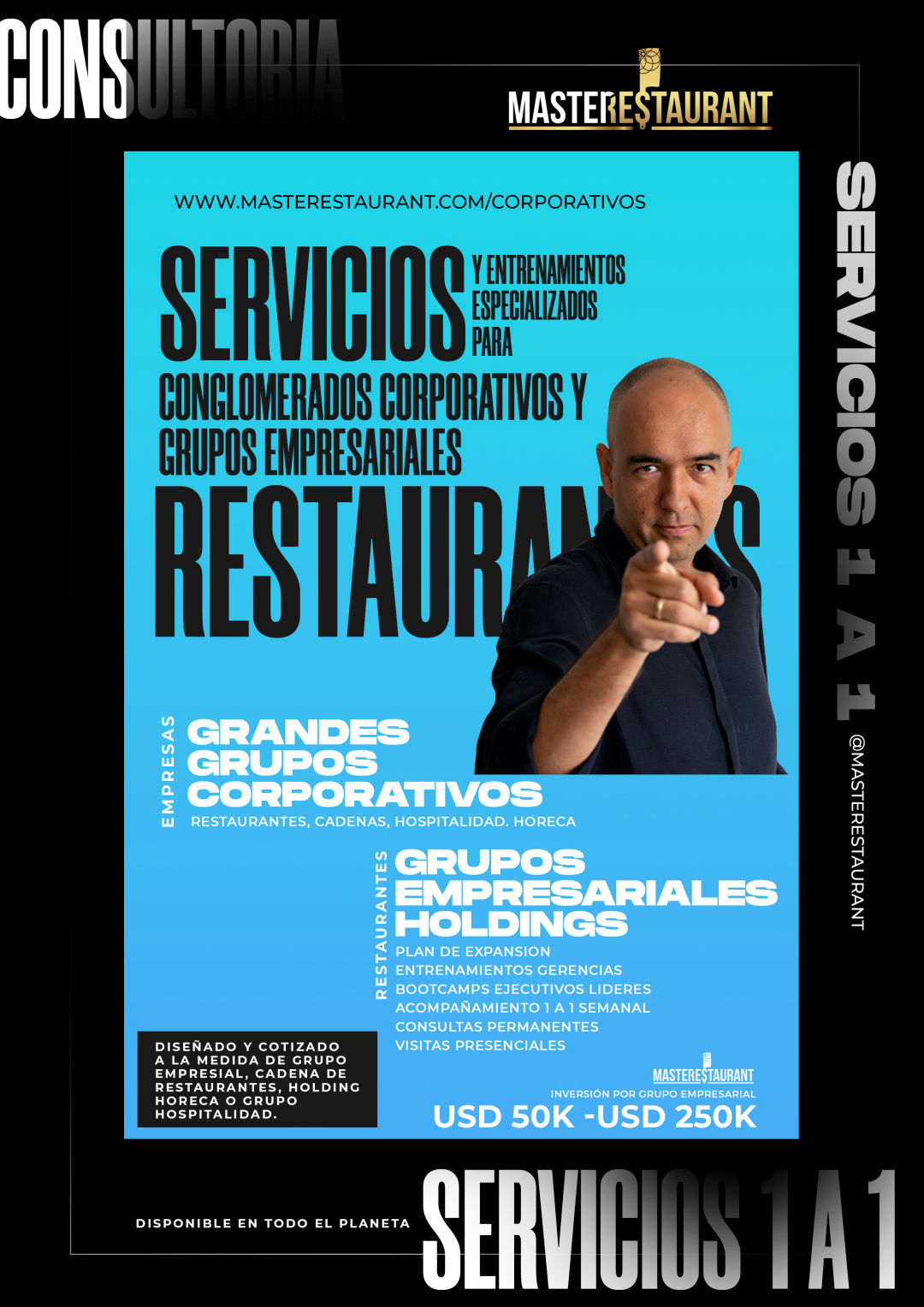
Investment: from USD $50K to USD $500K+ - tailor-made corporate programs, priced to the group's size and complexity - spots LIMITED worldwide.
Corporate programs
Tailor-made corporate consulting programs for groups and chains
Every corporate program is 100% personalized and tailor-made to the group. It starts with a strategic portfolio diagnosis and works through the key elements of the business model in the MASTERESTAURANT Restaurant Canvas, from portfolio strategy and standardization to per-unit profitability and expansion. Priced to the group's size and complexity (from USD $50K to USD $500K+), with limited spots worldwide to ensure dedicated attention and discretion for each client. The diagnosis sets the scope and the phases (strategic planning, standardization and implementation, and support through operations and expansion), working from the group's own numbers, on site or remote, in English or Spanish.
Corporate coverage
Consulting for restaurant groups near All Bolivia
Explore other territories or the worldwide index:
Restaurant chain expansion in BoliviaRestaurant chain expansion in CochabambaRestaurant chain expansion in El AltoAdvisory for restaurant groups in La PazCorporate hospitality consulting in OruroCorporate hospitality consulting in PotosiRestaurant chain expansion in Santa Cruz De La SierraRestaurant group consulting in SucreRestaurant chain consulting in AustraliaRestaurant chain expansion in AustriaRestaurant chain consulting in IsraelRestaurant chain consulting in South AfricaCorporate hospitality consulting in AlajuelaAdvisory for restaurant groups across ArgentinaRestaurant chain expansion across BrazilRestaurant group consulting across CanadaRestaurant chain expansion across ChileCorporate hospitality consulting across ColombiaCorporate hospitality consulting across Costa RicaRestaurant group consulting across CubaCorporate hospitality consulting across the Dominican RepublicRestaurant chain expansion across EcuadorRestaurant chain expansion across El SalvadorRestaurant chain consulting across GuatemalaMore countries →More cities →
We do serve — and every city on the planet
Served on site or virtually, in English and Spanish.
Who is Diego F Parra?
Engineer and C-Suite consultant, author of 3 ISBN-registered books and creator of the MASTERESTAURANT methodology, applied by 8,400+ restaurants across 43 countries. The method comes with its own technology suite: MTIE, Gastronomic Radar and KPI Dashboard.
He is the consultant that business groups, chains, holdings and family offices choose to grow, standardize and expand their restaurant portfolio with profitability and governance. His method comes from two decades operating, rescuing and expanding restaurants, franchises, dark kitchens and HORECA groups across four continents, and it arrives with instruments proven in real operations, not generic templates. He works in English or Spanish, on site or remote.
HORECA · Chains · Holdings · Foodtech
Private programs for boards and family offices
Consulting, bootcamps and private advisory for boards and family offices.
From USD $50K, priced to the group; limited spots worldwide.
Published doctrine
The books that changed restaurant management
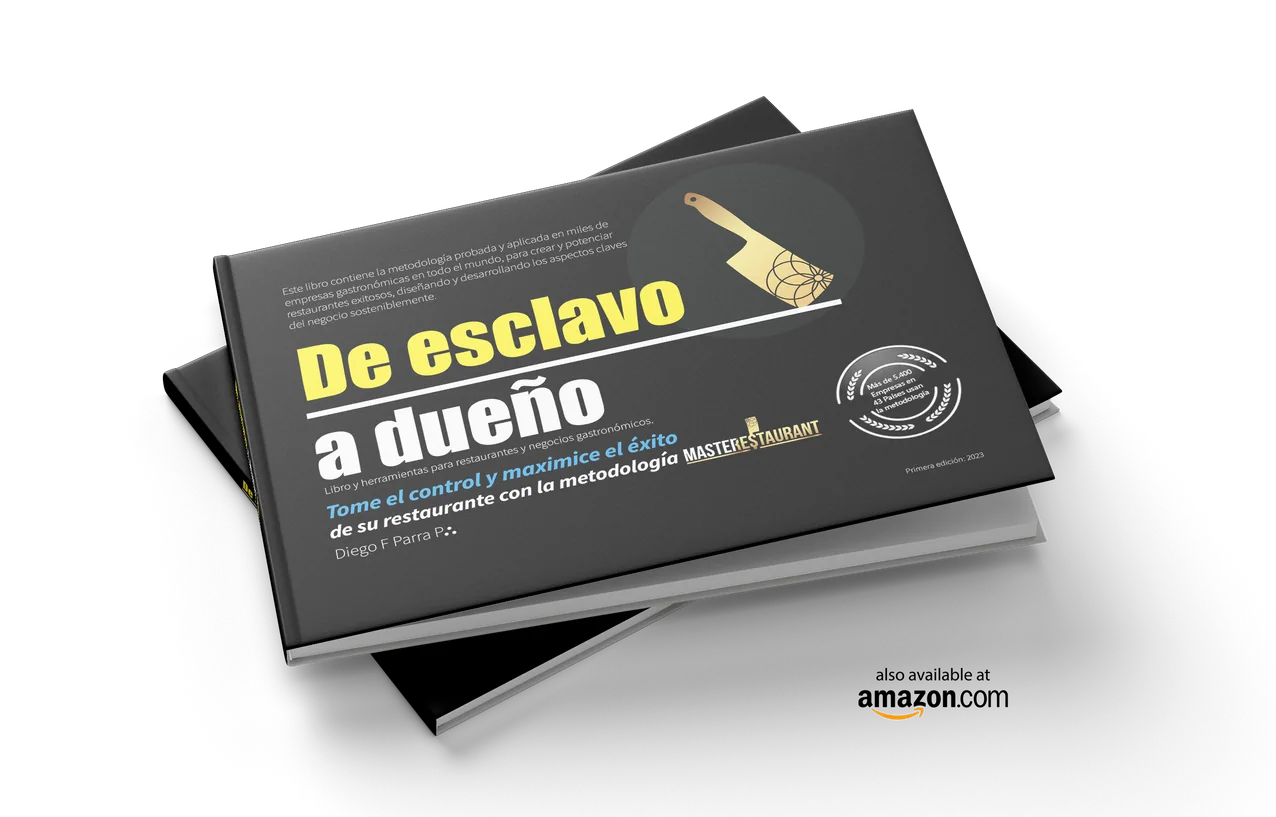
De Esclavo a Dueño
The book that changed how restaurants are managed: practical strategies and tools based on more than 20 years of experience, for traditional restaurants, dark kitchens, foodtech and HORECA businesses.
Triunfar o Morir en el Intento
Practical tools and key strategies to design and operate restaurants and food businesses efficiently.
Podcast: Masterestaurant — Mistakes for Restaurants
The public autopsy of the mistakes that bankrupt restaurants: thousands of owners and managers listen on Spotify to avoid repeating them.
Listen on SpotifyDownloads
The documents your board will ask for
MASTERESTAURANT services portfolio
The complete corporate intervention catalog: consulting, executive bootcamps, advisory and specialized services, with scopes and formats. The document to decide with your board.
Download PDFBook: From Slave to Owner
The full doctrine behind the methodology: how to structure restaurants that run without depending on the owner. Ideal pre-reading before your group's diagnosis.
View on AmazonPortfolio
More services by Diego F Parra and his team
As the group grows, every new site needs managers trained to the same standard. That is why the ecosystem's services start from the same method and tools as the corporate consulting: training and courses for managers in each market, the membership to keep learning going and the Pitch Deck and investment service when expansion needs capital. The full ecosystem is available:
International keynote speakerOne-on-one consulting and advisoryPersonalized mentoring for owners (limited spots)Corporate groups and holdings consultingCelebrity Restaurants consultingThemed restaurant advisorySpecialized training programs52-Week membershipPitch deck and restaurant investment readinessExponential Program0.1 Program — Elevate Your RestaurantInteractive training kit
Direct contact
Get a quote for corporate consulting for your group across Bolivia
Your message goes straight to Diego's team: group or chain, number of sites, stage and what you need to achieve across Bolivia.
“A restaurant group scales or dilutes depending on the business system it builds, not the pace of openings. I've seen chains open two locations per month and fail; I've seen others open two per year and double in value. The difference is architecture: standardization, cost control, portfolio decisions backed by data. That's why groups that endure don't grow fast; they grow systematically.”
Diego F. Parra — International consultant, expert in creating, scaling and improving restaurants, HORECA and hospitality
MASTERESTAURANT® methodology applied by 8,400+ restaurants across 43 countries · Author of 3 ISBN-registered books, including «De esclavo a dueño» · 20+ years operating restaurants, franchises, dark kitchens and HORECA groups across 4 continents
Full profile →Your restaurant group across Bolivia deserves a system worthy of its ambition
Tell us how many units the network runs and which decision the board has to make.
Explore more
Restaurant groups: territories, services and ecosystem resources
Related links for boards, C-Suite and teams evaluating Diego F Parra's corporate consulting for restaurant groups and chains: nearby territories, sister services in the MASTERESTAURANT ecosystem and management tools, all built on the same method.
World's best restaurant keynote speakerWorld's best restaurant consultantC-Suite restaurant consultant for chains & groupsDiego F Parra — professional profileKeynote speaker serviceCorporate groups & holdings consultingCelebrity restaurant consultingInternational themed restaurant advisoryRestaurant chain expansion in BoliviaRestaurant chain expansion in CochabambaRestaurant chain expansion in El AltoAdvisory for restaurant groups in La PazCorporate hospitality consulting in OruroCorporate hospitality consulting in Potosi
FAQ
Frequently asked questions
How do we ensure that when we open a second or third location, operating margin doesn't fall like it has at other groups that tried to expand?
Through recipe standardization, process documentation, centralized purchasing, and Prime Cost control at portfolio level. Before opening, we audit the pilot unit, document exact processes (labor by function, cost of goods by dish, fixed costs), and design the new location replicating those numbers, not imagining 'it will work the same way.' Each opening enters with clear margin targets from day one.
We have five different brands in the group. How do we decide which one to invest capital in, which to develop further, and which to simply maintain?
Through portfolio diagnosis: real profitability of each brand, return on investment rate, territorial growth potential, position in lifecycle. The board then decides which are 'engines' (growth), which are 'cash cows' (stable margins without new investment), and which need restructuring. Capital is allocated on data, not founder preference.
When is a chain ready to franchise?
When the unit is profitable on its own, the standard is documented and there is structure to control quality. Franchising earlier hands an unsolved problem to third parties who also paid for it.
Franchise, licence or owned site?
Three different risks. Owned demands capital and team; a licence gives up brand control; a franchise gives up operations and requires quality control many groups have not built.
Which indicators should leadership see weekly?
Prime Cost per site, theoretical-versus-actual variance, waste, labour productivity and average ticket. Five comparable figures beat a forty-page monthly report.
What do you do with a site that will not lift?
First measure whether the problem is the location, the model or the management, because the three fixes are different. Closing without knowing repeats the mistake at the next opening.
What is the investment for a corporate program?
Corporate programs range from USD $50K to USD $500K+ and are priced to the group's size and complexity, number of sites and scope of the engagement. They are quoted tailor-made after the diagnosis.
