 MASTERESTAURANT®
Population of Tokyo Metropolis per preliminary results of the 2025 Population Census
Statistics Bureau of Japan / Tokyo Metropolitan Government
Multi-site and franchise · Tokyo

DIEGO F PARRA · CREATOR OF THE MASTERESTAURANT® METHODOLOGY
RESTAURANT GROUP CONSULTANT Who does a chain in Tokyo call when it opens faster than it documents?
For boards and leadership in Tokyo choosing between opening, converting or closing: the corporate diagnosis puts those three options against every unit with the same yardstick.
Download the portfolio (PDF)Corporate advisory spots LIMITED worldwide - reserve your group's evaluation early
8,400+restaurants apply his methodology
43countries with supported groups
65M+views per year
2service languages: EN - ES
International validation
See Diego F. Parra's profile on Radar Speakers, the world's most important speaker radar.
See profile on Radar Speakers →
approx. 14.24 million inhabitants
57.4%
¥227,000
8,817,800

@masterestaurant
Before franchising in Tokyo
The MASTERESTAURANT methodology and its TOOLKIT have been applied across 8,400+ restaurants in 43 countries, from three-site groups to networks with dozens of units. Growing a group is harder than opening a restaurant: each new site multiplies costs, standards, talent and complexity, and a group only scales when a system replicates per-unit profitability, not when it depends on founders or operational heroes.
In Tokyo, the method adapts to the size, stage and expansion model of each group, in an order that does not change: measure, standardize, and only then replicate. That means a corporate diagnosis brand by brand and site by site, standards and financial governance that hold across the network, and a decision on owned units, licensing or franchising based on the documented standard and the team available.
How does restaurant group consulting work in Tokyo?
It starts with a corporate diagnosis of every unit in Tokyo measured with the same yardstick: EBITDA per unit, Prime Cost, standards and the team that runs each site. From there the board decides what to open, convert or close.
MASTERESTAURANT's corporate consulting works on four fronts at once: portfolio strategy, multi-site standardization, financial governance and expansion. The diagnosis compares units on the same indicators, so the board sees which sites carry the group and which dilute it. Then come the systems that make growth repeatable: documented recipes and processes, a KPI dashboard reviewed on a fixed cadence and a leadership structure that does not depend on the founders. The work uses the group's own numbers, in person or remotely, in English or Spanish, and the scope is tailored to the number of units and the stage of the business. This page cites four verified figures for Tokyo, from sources such as the Statistics Bureau of Japan and Japan Tourism Agency.
What do the numbers say about running a restaurant group in Tokyo?
approx. 14.24 million inhabitants — population of Tokyo Metropolis per preliminary results of the 2025 Population Census, according to the Statistics Bureau of Japan. A figure like this sizes the opportunity; it does not say whether each new unit will earn money.
For a group, the useful reading is the unit economics behind each opening: Prime Cost under control, a theoretical food cost close to the real one and EBITDA measured site by site. That is what decides whether a new location in Tokyo multiplies profit or only multiplies complexity. Other reference points cited on this page: 57.4% (accommodation room occupancy rate in 2023, Japan Tourism Agency); ¥227,000 (average spending per international visitor in 2024, +6.8%, Japan Tourism Agency); 8,817,800 (visitors from South Korea in 2024, primary market, JNTO).
Data
Market figures for restaurant groups in Tokyo
The figures cited on this page, with what each one measures and its source.
| Figure | What it measures | Source |
|---|---|---|
| approx. 14.24 million inhabitants | Population of Tokyo Metropolis per preliminary results of the 2025 Population Census | Statistics Bureau of Japan / Tokyo Metropolitan Government |
| 57.4% | Accommodation room occupancy rate in 2023 | Japan Tourism Agency (MLIT) |
| ¥227,000 | average spending per international visitor in 2024 (+6.8%) | Japan Tourism Agency (MLIT) |
| 8,817,800 | visitors from South Korea in 2024, primary market | JNTO |
Each figure links to its source in the data cards on this page.
The local market
What kind of market Tokyo is for a network
A restaurant group growing from three to twenty units in Tokyo faces an exponential jump in complexity that few commercial strategies absorb seamlessly. Each new location doesn't add linearly: it multiplies fixed management costs, demands operational standardization where once the founder's presence sufficed, requires managerial talent in a market where skilled restaurant operators are scarce, and fragments financial control across disconnected territories. Most groups grow by commercial impulse—the opportunity is there, capital arrives, a unit opens—without portfolio design or replicability architecture. Result: unit-level profitability erodes in the first two years of accelerated expansion, precisely when shareholders expect sustainable margins. General business consulting understands growth; specialized consulting in restaurant groups understands that the enemy is not opening speed but the governance of multi-unit operation.
Diego's program transforms an opportunity-driven group into a governed restaurant enterprise. It begins with portfolio diagnosis: unit economics analysis by brand and format, identification of units generating real margin vs. those cannibalizing value, mapping of where operational talent concentrates (and where vulnerability lies). From this emerges portfolio strategy: which brands to strengthen, which to restructure, how to allocate expansion capital. Multi-unit standardization—operational manuals, cost-control procedures, role-based salary structure, opening checklists—is designed specifically for your market context: local labor regulations, work schedules, ingredient availability, consumption patterns by zone. Group-level Prime Cost governance (not isolated by unit) ensures each new opening replicates profitability, not degrades corporate margin. Daily-updated dashboards give the board real-time visibility. Organizational structure is redesigned so operation doesn't depend on the founder: clear roles, succession, delegation. The result isn't simply more locations open; it's a business system that scales.
Diego's corporate consulting isn't an external advisor who studies your portfolio and leaves. It's the application of methodology proven across 43 countries through 8,400+ restaurants and hospitality groups, from local startups to chains of hundreds of units. He has directly advised boards and C-Suites of operations billing hundreds of millions annually, structuring expansions, negotiating leases, designing tax structures, signing payroll. That real-operator experience—not consultant theory—is what reduces perceived risk of expansion in this market. The board isn't implementing theoretical model; it's deploying a system already proven to replicate profitability across complex markets, variable regulations, and unpredictable talent structures. The program includes ongoing support: validation of portfolio decisions, review of new openings, margin troubleshooting in crisis, executive team coaching. This gives investors and shareholders confidence the group operates on data and proven systems, not intuition.
The financial return is immediate and measurable: replicated unit profitability means location 21 isn't an experiment but another instance of a validated system; EBITDA margins protected and consistent per unit (vs. the 5–7% typically eroded by groups without governance); portfolio decisions based on data, not shareholder appetite—if a brand is losing share in a zone, it's restructured or closed before draining growth capital; an operation surviving without the founder is more valuable to market (attracts corporate buyer, enables investment) and more resilient across generations. At group level: reduced capex wasted on openings that didn't replicate model, optimized fixed-cost structure (centralized back office, consolidated procurement, shared talent), and a portfolio whose composition is strategic, not accidental. In a market where entry costs are prohibitive and margins compressed by competition, the difference between a group scaling with system vs. scaling with impulse is the difference between creating value or diluting it.
Market data
Data context for a network in Tokyo
Accommodation room occupancy rate in 2023
Japan Tourism Agency (MLIT)average spending per international visitor in 2024 (+6.8%)
Japan Tourism Agency (MLIT)visitors from South Korea in 2024, primary market
JNTOTokyo as a market
Where the chain market is decided in Tokyo
Tokyo is Asia's most concentrated restaurant market and among the world's most sophisticated. An ecosystem of consolidated groups operates multiple formats (premium sushi omakase, high-volume ramen chains, neighborhood izakayas, specialty dining, ghost kitchens coupled to delivery). Urban geography—districts like Minato, Chiyoda, Shibuya, growth areas in Chiba and Saitama—defines the game: rents of ¥200k to ¥500k monthly per square meter in A-zones, occupancy cycles demanding 4–5 year ROI, and access to global culinary talent but executive salaries between ¥8–15M annually for operations managers (fierce competition for talent). Consumption varies by zone: tourism concentrated in Chiyoda/Minato with premiumization expectations; residential wards demanding consistency and efficiency; corporate dining expecting rigorous schedules and quality standardization. Market structure includes ingredient importers, POS technology vendors, and strict labor regulators. The market is fragmented but governed by operational discipline: groups that don't standardize don't survive.
Expansion opportunity in this market is real but conditional: sustained demand for restaurant experience (pre-pandemic 50M tourists annually, resilient local consumption), availability of real estate in development (though costs rising), access to global ingredients without friction. Yet risks are specific. Multi-unit standardization is non-negotiable: this market rejects quality variance, service times, or cleanliness discrepancies across locations of the same group; a group failing to replicate standard loses brand equity fast. Talent turnover is high (labor market is fluid, skilled operators migrate easily), so systems must function without depending on individuals; a group resting on talented manager is fragile. Consumer by zone is sophisticated in expectation: office zones demand speed; tourist zones demand experience; residential zones demand price-value ratio. A portfolio without clear segmentation erodes margins. Geographical accessibility (distance, public transport hours) drives traffic; opening 'where latent demand exists' without understanding micro-geography is a common trap.
RESOURCES
MASTERESTAURANT studies, guides & tools
Support material to raise operations in Tokyo — MASTERESTAURANT research, real cases and tools:
- WHITEPAPERAnswer Engine Optimization (AEO): The New Acquisition Channel for Restaurant Brands
- COMPARISONPremature expansion vs methodical scalability: the mistake that closes restaurant groups
- CASE STUDYOmnichannel Customer Experience in Restaurants
- CASE STUDYArtificial intelligence in restaurants: data and impact
- CHECKLISTDelivery Commissions That Kill Restaurant Margins: Myth vs
- ARTICLEPurchasing & Vendors 2026: Before vs After
The corporate consultant
The authority behind every profitable restaurant
Behind MASTERESTAURANT's corporate restaurant consulting is Diego F Parra: engineer and C-Suite consultant with two decades creating, rescuing and expanding restaurants, franchises, dark kitchens and HORECA and hospitality groups across four continents. He doesn't arrive with theory: he arrives with the experience of having signed payrolls, negotiated leases, structured partnerships and closed expansions in operations worth hundreds of millions of dollars.
He is the creator of the MASTERESTAURANT® methodology — applied by 8,400+ restaurants across 43 countries — and its TOOLKIT of tools (MTIE, Gastronomic Radar, Standard Recipe Generator, Tech Sheets and KPI Dashboard). For a brand, a group or an investor that means one thing: every decision is made on proven data and systems, not on intuition.
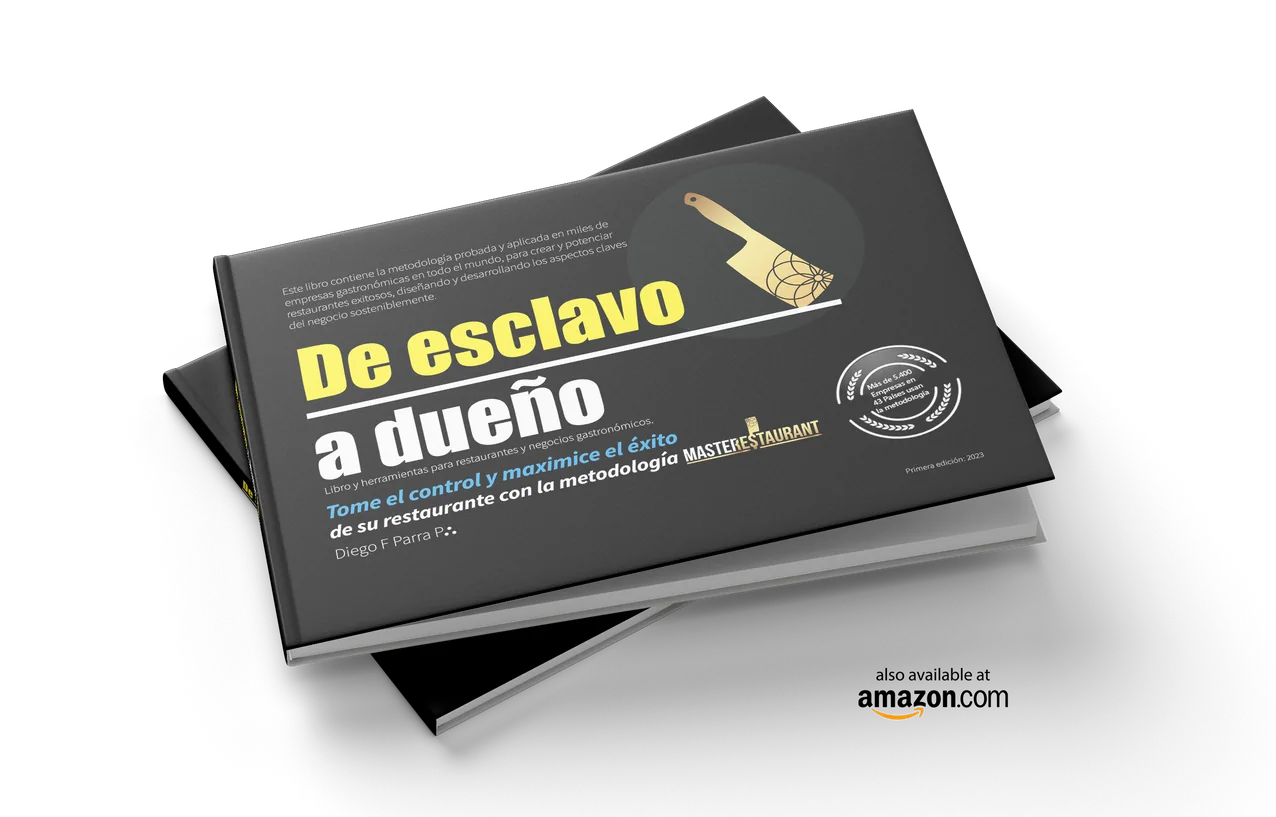
Author of 3 ISBN-registered books, including «De esclavo a dueño», creator of the industry's leading podcast and of the largest bilingual community of owners, chefs and operations directors in the region (65M+ views per year as @masterestaurant), and recognized among the top Latino restaurant operations experts globally. See his full track record in Diego F Parra's professional profile.
Corporate consulting with its own doctrine, not generic frameworks
Consulting for restaurant groups is not solved with management theory. Every engagement is built on the Restaurant Model Canvas and real industry data—profitability, Prime Cost, cost structure, multi-site standardization and expansion—applied to the specific business model of a group, a chain or a holding. The goal is not to open more restaurants, but to build a business system that replicates per-unit profitability, governs the portfolio and sustains operations on clear rules rather than indispensable people. Every board decision rests on the group's own indicators, measured at each site.
Corporate consulting from start to finish
Advisory that covers the full restaurant-group lifecycle
The test is the worst location
A chain is not judged by its best site. If the gap between best and worst is explained by who is on shift, there is no standard.
Get a quoteDocument before replicating
Every opening copies whichever version of the standard existed that month. Writing it once is cheaper than correcting twenty copies.
Quote standardizationOne yardstick for the network
One definition per indicator, the same for every brand and site. Comparing on different criteria is not comparing.
Quote expansionFranchising means selling a system
Manuals, quality control and a demonstrably profitable unit. Without them, what gets handed over is an expectation.
See the services portfolio (PDF)The methodology
Discover the MASTERESTAURANT methodology
Behind every group that scales profitably there is a system, not luck: tools, processes and models that turn impulse growth into governed expansion.
Who is it for?
The networks where this work pays off most
1-on-1 consulting, no templates, for restaurants in any of these situations:
From three to ten sites
The stretch where the founder's judgement stops reaching and no structure has replaced it yet.
From ten to fifty
Where the network needs governance: single definitions, quality control and trained managers in every market.
Consolidated networks
Years of trading and a per-unit margin sliding slowly, with nobody able to point at where.
Groups in generational transition
When what lived in the founder's head has to become a system others can run.
What's included
What the network engagement covers
Every engagement is built tailor-made from these modules of the MASTERESTAURANT methodology:
- The real numbers of every site, before any plan
- EBITDA per unit and per brand
- Prime Cost with a single definition across the network
- Manuals and processes that travel to every opening
- Quality control and standard compliance
- A shared indicator dashboard for leadership
- A structure of roles and trained managers
- Criteria to open, convert or close
- A staged expansion plan
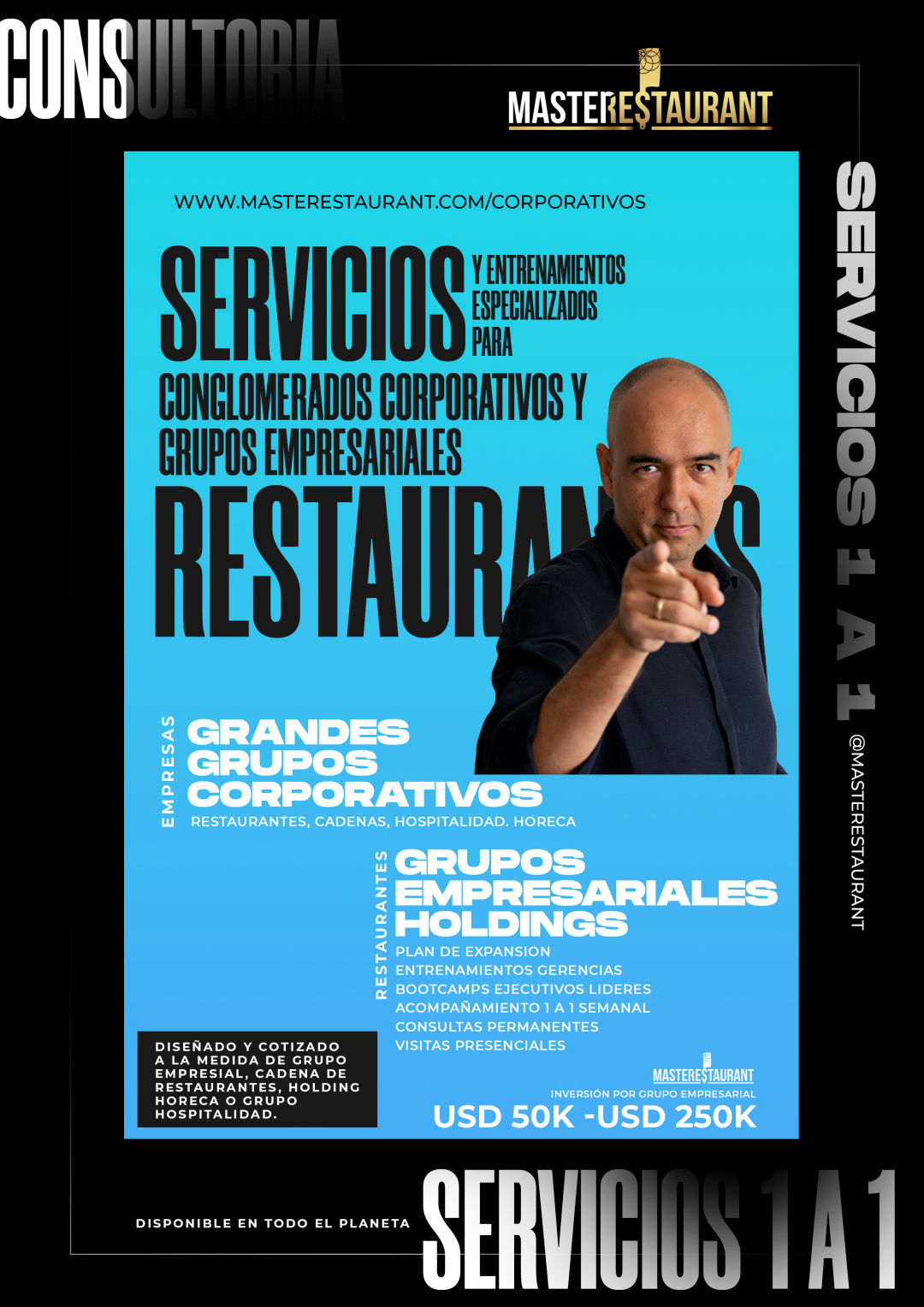
Investment: from USD $50K to USD $500K+ - tailor-made corporate programs, priced to the group's size and complexity - spots LIMITED worldwide.
Corporate programs
Tailor-made corporate consulting programs for groups and chains
Every corporate program is 100% personalized and tailor-made to the group. It starts with a strategic portfolio diagnosis and works through the key elements of the business model in the MASTERESTAURANT Restaurant Canvas, from portfolio strategy and standardization to per-unit profitability and expansion. Priced to the group's size and complexity (from USD $50K to USD $500K+), with limited spots worldwide to ensure dedicated attention and discretion for each client. The diagnosis sets the scope and the phases (strategic planning, standardization and implementation, and support through operations and expansion), working from the group's own numbers, on site or remote, in English or Spanish.
Corporate coverage
Chain engagements available near Tokyo
Explore other territories or the worldwide index:
Advisory for restaurant groups across JapanRestaurant group consultant in JapanCorporate hospitality consulting in KawasakiRestaurant chain expansion in KyotoRestaurant chain expansion in OsakaRestaurant group consulting in YokohamaRestaurant chain expansion across BrazilRestaurant chain expansion in AustriaRestaurant chain consulting in IsraelRestaurant chain consulting in South AfricaRestaurant chain expansion in AjmanAdvisory for restaurant groups in Al AinAdvisory for restaurant groups across QatarRestaurant group consulting across Saudi ArabiaRestaurant group consulting across the United Arab EmiratesRestaurant chain consulting in AustraliaRestaurant group consulting in BangkokRestaurant chain expansion in BeijingCorporate hospitality consulting in ChinaCorporate hospitality consulting in DammamRestaurant group consulting in Hong KongRestaurant chain expansion in IndiaRestaurant group consulting in IndonesiaCorporate hospitality consulting in JakartaMore countries →More cities →
We do serve — and every city on the planet
Served on site or virtually, in English and Spanish.
Who is Diego F Parra?
Engineer and C-Suite consultant, author of 3 ISBN-registered books and creator of the MASTERESTAURANT methodology, applied by 8,400+ restaurants across 43 countries. The method comes with its own technology suite: MTIE, Gastronomic Radar and KPI Dashboard.
He is the consultant that business groups, chains, holdings and family offices choose to grow, standardize and expand their restaurant portfolio with profitability and governance. His method comes from two decades operating, rescuing and expanding restaurants, franchises, dark kitchens and HORECA groups across four continents, and it arrives with instruments proven in real operations, not generic templates. He works in English or Spanish, on site or remote.
HORECA · Chains · Holdings · Foodtech
Private programs for boards and family offices
Consulting, bootcamps and private advisory for boards and family offices.
From USD $50K, priced to the group; limited spots worldwide.
Published doctrine
The books that changed restaurant management
De Esclavo a Dueño
The book that changed how restaurants are managed: practical strategies and tools based on more than 20 years of experience, for traditional restaurants, dark kitchens, foodtech and HORECA businesses.
Triunfar o Morir en el Intento
Practical tools and key strategies to design and operate restaurants and food businesses efficiently.
Podcast: Masterestaurant — Mistakes for Restaurants
The public autopsy of the mistakes that bankrupt restaurants: thousands of owners and managers listen on Spotify to avoid repeating them.
Listen on SpotifyDownloads
The documents your board will ask for
MASTERESTAURANT services portfolio
The complete corporate intervention catalog: consulting, executive bootcamps, advisory and specialized services, with scopes and formats. The document to decide with your board.
Download PDFBook: From Slave to Owner
The full doctrine behind the methodology: how to structure restaurants that run without depending on the owner. Ideal pre-reading before your group's diagnosis.
View on AmazonPortfolio
More services by Diego F Parra and his team
As the group grows, every new site needs managers trained to the same standard. That is why the ecosystem's services start from the same method and tools as the corporate consulting: training and courses for managers in each market, the membership to keep learning going and the Pitch Deck and investment service when expansion needs capital. The full ecosystem is available:
International keynote speakerOne-on-one consulting and advisoryPersonalized mentoring for owners (limited spots)Corporate groups and holdings consultingCelebrity Restaurants consultingThemed restaurant advisorySpecialized training programs52-Week membershipPitch deck and restaurant investment readinessExponential Program0.1 Program — Elevate Your RestaurantInteractive training kit
Direct contact
Get a quote for corporate consulting for your group in Tokyo
Your message goes straight to Diego's team: group or chain, number of sites, stage and what you need to achieve in Tokyo.
“A group opening twenty units in five years but each with different profitability doesn't have a business—it has a portfolio of experiments. The one that scales is the one understanding each unit isn't an independent business; it's one instance of a business system that replicated the model once and intends to copy it every time it opens. Where costs are high and margins compressed, that difference isn't academic: it's the difference between building a valuable group or wasting capital on growth that doesn't scale.”
Diego F. Parra — International consultant, expert in creating, scaling and improving restaurants, HORECA and hospitality
MASTERESTAURANT® methodology applied by 8,400+ restaurants across 43 countries · Author of 3 ISBN-registered books, including «De esclavo a dueño» · 20+ years operating restaurants, franchises, dark kitchens and HORECA groups across 4 continents
Full profile →Your restaurant group in Tokyo deserves a system worthy of its ambition
Tell us how many units the network runs and which decision the board has to make.
Explore more
Restaurant groups: territories, services and ecosystem resources
Related links for boards, C-Suite and teams evaluating Diego F Parra's corporate consulting for restaurant groups and chains: nearby territories, sister services in the MASTERESTAURANT ecosystem and management tools, all built on the same method.
World's best restaurant keynote speakerWorld's best restaurant consultantC-Suite restaurant consultant for chains & groupsDiego F Parra — professional profileKeynote speaker serviceCorporate groups & holdings consultingCelebrity restaurant consultingInternational themed restaurant advisoryAdvisory for restaurant groups across JapanRestaurant group consultant in JapanCorporate hospitality consulting in KawasakiRestaurant chain expansion in KyotoRestaurant chain expansion in OsakaRestaurant group consulting in Yokohama
FAQ
Frequently asked questions
How do you maintain unit profitability when opening units 15 and 20 simultaneously across different zones with such different consumption patterns?
Segmented portfolio design by zone from diagnosis phase. Each zone—tourism, corporate, residential—has its specific Prime Cost model (% food cost, salary structure, peak-hour schedules). Operational manuals are NOT identical by zone; they vary in procedure standardization but not in expected profitability. Each unit has its target EBITDA calibrated to its market context. Unit 15 opening validates zone A model; unit 20 replicates that model in zone B. This ensures margin, not volume, is what scales.
Our board is asking for a franchise plan for 2027, but we lack clarity on what our replicable model actually is. Where do we start?
First, diagnose which units ALREADY replicate profitability consistently (those are franchise candidates); which are outliers or depend on specific operators (those don't clone yet). Second, document WHY those units hit margin targets: operating recipe, product mix, cost structure, talent selection process. Third, pilot franchise with 2-3 units where THE FRANCHISEE replicates model exactly. If pilot maintains EBITDA target, model is franchisable; if not, diagnose what breaks (usually service standardization or cost control). Only then scale.
We turn over more every year and earn less per site. What is happening?
That is not growth, it is dilution. Almost always it is group fixed costs that grew with the openings and a Prime Cost nobody governs corporately. It shows the moment you look at EBITDA per unit.
What is the most expensive mistake of a chain in expansion?
Opening before documenting. Every new site copies whichever version of the standard existed that month, and past a certain number nobody can say which one each location is running.
What part does talent play?
A decisive one, which is why the engagement includes organizational structure and leadership development. A written standard without trained managers to hold it lasts until the first high season.
Do you work with funds and family offices?
Yes: operational due diligence, value thesis and support to management, to enter or grow in foodservice with industry judgement.
What is the investment for a corporate program?
Corporate programs range from USD $50K to USD $500K+ and are priced to the group's size and complexity, number of sites and scope of the engagement. They are quoted tailor-made after the diagnosis.
