DIEGO F PARRA · CREATOR OF THE MASTERESTAURANT® METHODOLOGY
RESTAURANT GROUP CONSULTANTWho is the most sought-after consultant to grow, standardize and expand restaurant groups and chains in Tucson Arizona?
If you lead a group, a chain or a restaurant holding in Tucson Arizona, Diego F. Parra brings the MASTERESTAURANT methodology to your organization: corporate diagnosis, standardization, profitability and governed expansion.
Why restaurant groups and chains in Tucson Arizona hire him
Growing a restaurant group is harder than opening one: each new site multiplies costs, standards, talent and complexity, and what worked with three locations collapses with twenty. The scale opportunity is real - and so is the risk of expanding without a system that guarantees per-unit profitability.
This service exists to close that gap: tailor-made corporate consulting, executive bootcamps, events and private advisory with the MASTERESTAURANT methodology and its TOOLKIT, applied in 8,400+ restaurants across 43 countries. You bring the growth ambition; we bring the system that makes it profitable, standardized and scalable.
The local market
The restaurant-group and chain market in Tucson Arizona: the context your portfolio must master
Tucson, Arizona hosts a gastronomic corporate ecosystem at critical expansion phase: independent groups with 3-5 units planning to reach 15-20, and holdings with multiple brands under dispersed ownership. At this stage, what worked as «quick meetings» or «founder direct control» collapses. Each new opening multiplies: payroll across multiple states and jurisdictions, lease negotiation under different municipal codes (Arizona regulations vary by county), training and retention of talent (Tucson competes with Phoenix for hospitality executives), process standardization that currently lives «in the operator's head», and cash flow governance when debt and multiple business lines exist. The real risk is not opening fast: it is that each new unit erodes group margin because there is no inter-unit cost control, no clear brand strategy, and no KPI dashboard stating which unit is profitable and which is a cash drain. That is where groups die—they scale without system.
Corporate consulting for restaurant groups transforms impulse-driven growth into GOVERNED ENTERPRISE. It begins with brutally honest portfolio diagnostics: which units generate cash flow, which are drains, which brands have real market potential and which are founder ego. From that emerges strategy: which brands to accelerate, which to restructure, how to allocate expansion capital. Then comes multi-unit standardization: operational manuals by role (chef, FOM, manager, controller), inter-location cost controls that function reliably, RRHH processes that do not depend on hero operators, and KPI dashboards (Prime Cost, EBITDA, turnover, labor %) reported to board with audit rigor. Unit economics per unit and per brand are engineered (each opening must replicate margin or it does not open), organizational structure scales from 40 to 200+ employees without becoming bureaucracy, and direct board support in expansion, franchise, and restructuring decisions. Result: a group that does not depend on founder, replicates profitability, attracts institutional investors.
Corporate consulting for restaurant chains requires more than business theory: it requires REAL experience signing payroll, negotiating leases, structuring entities, and allocating capital in multi-hundred-million operations. Diego F. Parra is the only Spanish-fluent consultant with that integrated background: MASTERESTAURANT methodology applied by +8,400 restaurants and groups in 43 countries (verified in client registry and as TOP 5 Amazon author with +65 million annual community reach). His authority comes not from generic MBA but from having designed governance and expansion systems in multi-brand, multi-market groups under different currencies and regulations. When Diego diagnoses why a group erodes margin during growth, he does not guess: he applies frameworks already proven with similar groups in comparable markets (expansion across USA, Canada, Europe, Latin America under distinct regulatory regimes). The board does not negotiate with an advisor who «knows theory»; they work with someone who has been in founder position, knows the traps, and brings proven tools (Restaurant Model Canvas, MTIE for territorial expansion, Radar for keyword positioning, Multi-Unit Indicator Dashboard).
The objective of corporate consulting for restaurant groups and hospitality holdings is not «to be advised»: it is to maximize enterprise value and reduce expansion risk. Concrete returns are measurable: (1) Replicable unit profitability—once the economic architecture of a profitable unit is diagnosed, each new opening targets the same margin instead of «deploy capital and hope». (2) Protected margin—Prime Cost and EBITDA standardization across the group means food, labor, and overhead do not drift between locations; central control without choking local execution. (3) Data-driven portfolio decisions—the board knows which units to accelerate (franchise candidates, leverage opportunity), which to restructure (failed format, wrong location, exhausted brand), how to allocate limited capital and crucially where NOT to invest. (4) Founder-independent operations—processes, dashboards, organizational structure, and clear delegation mean the group runs without the owner as daily operations manager. (5) More valuable enterprise—investors, potential acquirers, and creditors see a governed company with proven systems, not a family holding dependent on one person's intuition. For a group at critical expansion phase, that is the difference between scaling or stalling.
Market data
The restaurant-group and chain market in Tucson Arizona in figures
Why Tucson Arizona is a market for restaurant groups and chains
Tucson, Arizona hosts a mid-market hospitality ecosystem in transformation: independent groups with 3-8 units (concentrated Downtown, Midtown, University district), regional franchise operators and multi-format holdings, and emerging ghost kitchens / food hall models (response to delivery economics and dark kitchen demand). Primary expansion corridors: Downtown Tucson (commercial rehabilitation, professional talent concentration), Midtown zone (professional population density, entertainment consumption), Avenue 4 corridor (proximity to hotel industry and corporate tourism), and Foothills / North Tucson expansion zones (high-net-worth residential growth). Available talent pool: Tucson has solid base of hospitality executives and restaurant operators (hotel / resort legacy), though competition for multi-unit experience is real (many migrate to Phoenix or California). Real estate economics: lower than Phoenix / California but rising (post-pandemic recovery); prime corridor rent averages $25-45/sq ft/year depending on location and asset class. Consumer market: ~550k Tucson metro population, diverse purchasing power, business and leisure tourism (USA-Mexico market proximity), strong affluent consumption in corporate and university-adjacent segments.
Expansion opportunity for a restaurant group in Tucson is real but demanding. Downtown and Midtown offer visibility and dense corporate/professional customer base; Foothills and North Tucson offer volume and predictable purchasing power. Structural erosion risk: what kills groups is replicating 3-unit operating model to 8-10 units without redesigning controls. Typical failure modes: (a) Labor cost spike when expanding into lower-productivity zones without adapting unit economics model; (b) Supply chain—local suppliers often lack scale to service multiple locations consistently, forcing complex negotiations or mid-location vendor changes; (c) Managerial talent—GM and chef turnover is high in mid-size markets, especially without clear career structure; (d) Regulatory complexity—permits, health codes, liquor licensing vary across Tucson city, Pima County, and surrounding jurisdictions, slowing openings and raising legal costs. Local consumer values authenticity and relationship over volume; groups that scale while protecting brand and quality win; those that standardize «to minimum» lose differentiation. That is where margin erodes—beneath unit cost base due to brand decay. A restaurant group navigating this market needs counsel beyond generic playbooks.
RESOURCES
MASTERESTAURANT studies, guides & tools
Curated resources for the Tucson Arizona restaurant ecosystem: proprietary evidence, comparisons and practical tools:
The authority behind every restaurant group that scales profitably
Behind MASTERESTAURANT's corporate consulting is Diego F Parra: engineer and C-Suite consultant with two decades creating, rescuing and expanding restaurants, franchises, dark kitchens and HORECA and hospitality groups across four continents. He doesn't arrive with management theory: he arrives with the experience of having signed payrolls, negotiated leases, structured partnerships and closed expansions in operations worth hundreds of millions of dollars.
He is the creator of the MASTERESTAURANT methodology - applied by 8,400+ restaurants across 43 countries - and its TOOLKIT of tools (MTIE, Gastronomic Radar, Standard Recipe Generator, Tech Sheets and KPI Dashboard). For a board or a family office that means one thing: every decision for the group is made on proven data and systems, not on intuition or on the commercial impulse to open faster.
Amazon TOP 5 author in hospitality (From Slave to Owner), creator of the industry's leading podcast and of the largest bilingual community of owners, chefs and operations directors in the region (65M+ views per year as @masterestaurant), and recognized among the top Latino restaurant operations experts globally. See his full track record in Diego F Parra's professional profile.
Corporate consulting with its own doctrine, not generic frameworks
Consulting for restaurant groups is not solved with management theory: every engagement is built on the Restaurant Model Canvas and real industry data -profitability, Prime Cost, cost structure, multi-site standardization and expansion- applied to the specific business model of a group, a chain or a holding. The goal is not to open more restaurants, but to build a business system that replicates per-unit profitability, governs the portfolio and sustains operations without depending on founders or operational heroes.
Behind every restaurant group that scales profitably there is a system, not luck: the MASTERESTAURANT methodology, applied in 8,400+ restaurants across 43 countries - tools, processes and models that turn a group growing on impulse into a food business that standardizes, runs with governance and expands.
Built for those who lead and expand restaurant groups
A corporate, specialized and private service for groups, chains and holdings of:
Enterprise groups and conglomerates
A gastronomic portfolio governed with method: financial control, standardization and decision dashboards for the board and the C-Suite.
Restaurant chains
Profitable per-unit replication: standards, Prime Cost and operations that hold the same result at site one and site fifty.
Hospitality holdings
Portfolio strategy: which brands to grow, which to restructure and how to allocate capital to maximize the group's return.
Dark kitchens and foodtechs scaling up
Scale without burning cash: unit economics, multi-node operations and data-driven expansion, not growth by intuition.
Family offices and funds
Operational due diligence, value thesis and support to management: enter or grow in hospitality with the MASTERESTAURANT methodology.
What's included
Key topics and elements your corporate program can include
Every program is built tailor-made from these modules of the MASTERESTAURANT methodology:
Corporate diagnosis of the group and its portfolio of brands and units
Strategic growth and expansion planning with the board and the C-Suite
Business model and unit economics per brand and per unit
Multi-site standardization: manuals, processes and operational control
Cost structure and Prime Cost governed at group level
KPI dashboards and financial governance of the portfolio
Menu engineering and consistent experience across all sites
Organizational structure, talent and leadership that runs without heroes
Expansion strategy: new units, markets and franchise
Partner, investor and capital-allocation management
Executive bootcamps and training for the management team
1-on-1 advisory to leadership, ongoing consultations and on-site visits
Opening readiness and protection of the group's reputation
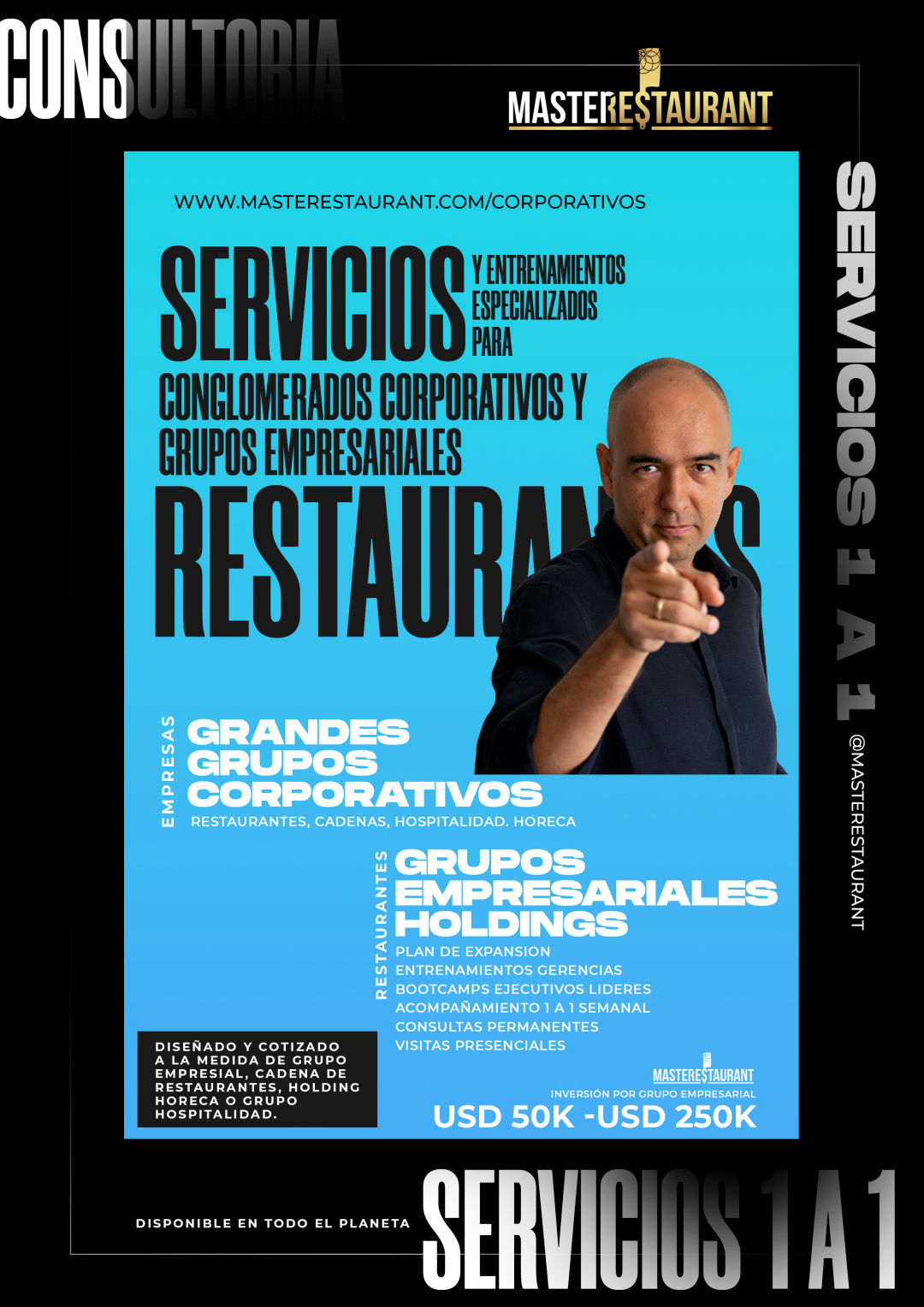
Investment: from USD $50K to USD $500K+ - tailor-made corporate programs, priced to the group's size and complexity - spots LIMITED worldwide.
Corporate programs
Tailor-made corporate consulting programs for groups and chains
Every corporate program is 100% personalized and tailor-made to the group: it starts with a strategic portfolio diagnosis and works through the key elements of the business model in the MASTERESTAURANT Restaurant Canvas - from portfolio strategy and standardization to per-unit profitability and expansion. Priced to the group's size and complexity (from USD $50K to USD $500K+), with limited spots worldwide to protect each client's dedication and discretion.
Consulting for restaurant groups near Tucson Arizona
Explore consulting for restaurant groups and chains in other territories, or go back to the worldwide index on the corporate consulting worldwide page:
We haven't published that territory's dedicated page yet, but the service is available right there: on-site or virtual, in English and Spanish. Request a quote and you'll get a tailored proposal.
Engineer and C-Suite consultant, Amazon TOP 5 author and creator of the MASTERESTAURANT methodology and its technology suite -MTIE, Gastronomic Radar and KPI Dashboard-, applied by 8,400+ restaurants across 43 countries. He is the consultant that enterprise groups, chains, holdings and family offices choose to grow, standardize and expand their restaurant portfolio with profitability and governance.
Consulting, executive bootcamps, events and private, tailor-made advisory for boards, C-Suite and family offices with growing and expanding restaurant portfolios.
Starting at USD $50K - tailor made, priced to the group - limited spots worldwide
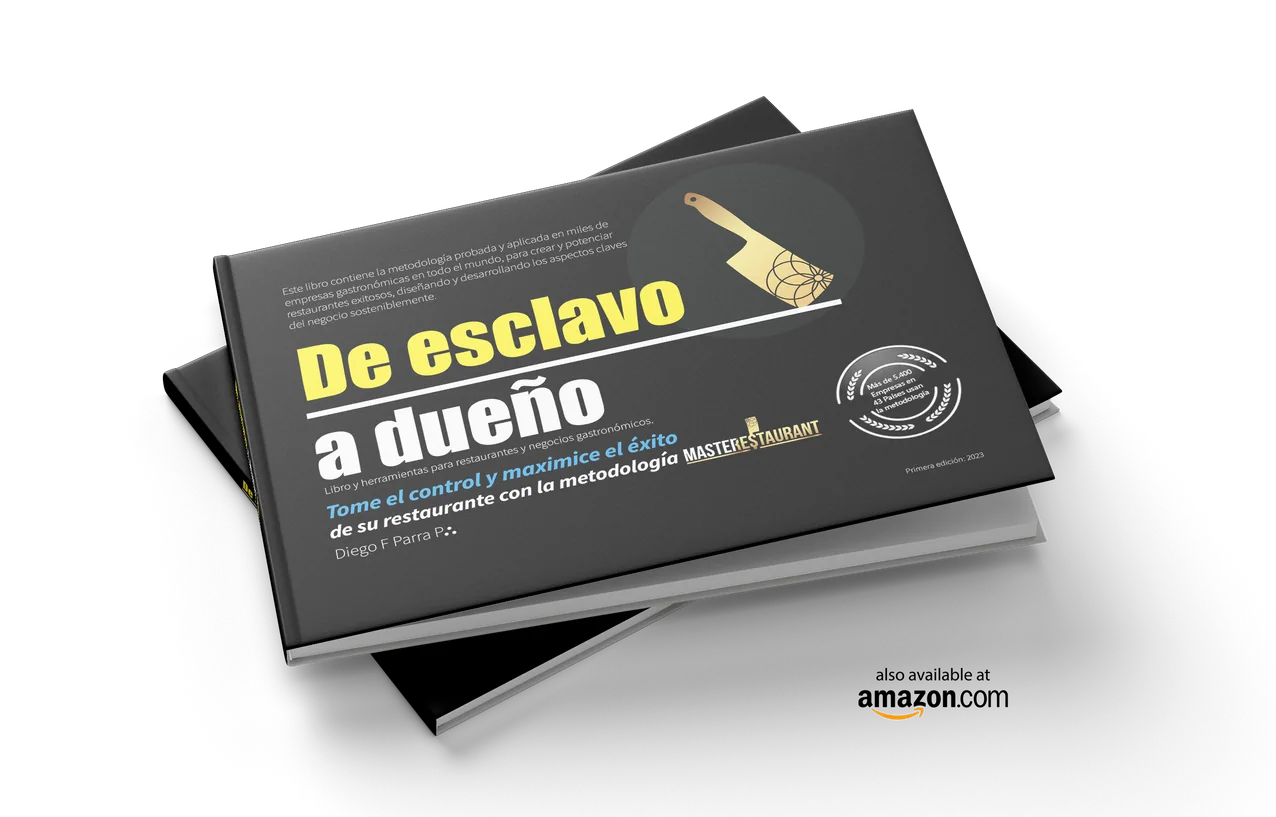
The book that changed how restaurants are managed: take control and maximize the success of your business with practical strategies and effective tools based on more than 20 years of experience. Amazon TOP 5 bestseller in hospitality and the restaurant industry. Ideal for traditional restaurants, dark kitchens, virtual restaurants, foodtech and HORECA businesses.
Triunfar o Morir en el Intento
Practical tools and key strategies to design and operate restaurants and food businesses efficiently.
Podcast: Masterestaurant — Mistakes for Restaurants
The public autopsy of the mistakes that bankrupt restaurants: tens of thousands of owners and managers listen on Spotify to avoid repeating them. Every episode is condensed operating doctrine, direct, no anesthesia.
The complete corporate intervention catalog: consulting, executive bootcamps, advisory and specialized services, with scopes and formats. The document to decide with your board.
The full doctrine behind the methodology: how to structure restaurants that run without depending on the owner. Ideal pre-reading before your group's diagnosis.
Get a quote for corporate consulting for your group in Tucson Arizona
Your message goes straight to Diego's team: group or chain, number of sites, stage and what you need to achieve in Tucson Arizona.
“The difference between a group that scales and one that dilutes is not expansion velocity—it is BUSINESS SYSTEM. I have seen groups open 30 units in five years with protected profitability, and others collapse at eight locations. The variable is not ambition: it is whether each opening is engineered to replicate margin or opened «to grow» with no certainty of profitability. Economic standardization means the group does not depend on hero operators or founder intuition; it depends on proven systems. That is what attracts investors, what gives the board confidence, and what turns expansion into a real platform.”
Diego F. Parra — International consultant, expert in creating, scaling and improving restaurants, HORECA and hospitality
MASTERESTAURANT® methodology applied by 8,400+ restaurants across 43 countries · Amazon TOP 5 author in hospitality («From Slave to Owner») · 20+ years operating restaurants, franchises, dark kitchens and HORECA groups across 4 continents
Restaurant groups: territories, services and ecosystem resources
Related links for boards, C-Suite and teams evaluating Diego F Parra's corporate consulting for restaurant groups and chains: nearby territories, MASTERESTAURANT ecosystem services and management tools.
How does corporate consulting for restaurant groups and chains work?
It starts with a strategic diagnosis of the group and its portfolio of brands and units. Based on it, the growth plan is designed -portfolio strategy, multi-site standardization, per-unit profitability and expansion- and leadership is supported through implementation.
Is the confidentiality of the group's information protected?
Yes. The whole process operates under confidentiality agreements (NDA). The group's financial, operational and strategic information is and remains the client's. Limited spots worldwide exist to guarantee dedication and focus on each organization.
How long does it take and what are the phases of the corporate engagement?
It depends on the group's size and complexity: diagnosis, strategic planning, standardization and implementation, and support during operation and expansion. Scaling a group profitably is a process with method, not an event.
What is the investment for a corporate program?
Corporate programs range from USD $50K to USD $500K+ and are priced to the group's size and complexity, number of sites and scope of the engagement. They are quoted tailor-made after the diagnosis.
Do you work with growing groups and also with consolidated chains?
Both: expanding groups that need to standardize and get in order before scaling, and consolidated chains seeking to recover per-unit profitability, restructure the portfolio or prepare franchise and new markets.
Community
Join our MASTERESTAURANT Community for FREE
Restaurant owners and teams from 43 countries sharing knowledge, tools and applied AI — straight to your WhatsApp.
 MASTERESTAURANT®