 MASTERESTAURANT®
Jobs created by bars and restaurants in Brazil in 2024, a record high for the sector.
ABRASELCorporate governance · All Brazil
Diego F. Parra · CREATOR OF THE MASTERESTAURANT® METHODOLOGY
HOSPITALITY GROUP CONSULTANTWho is the most sought-after consultant to grow, standardize and expand restaurant groups and chains across Brazil?
For boards and leadership across Brazil choosing between opening, converting or closing: the corporate diagnosis puts those three options against every unit with the same yardstick.
Download the portfolio (PDF)Corporate advisory spots LIMITED worldwide - reserve your group's evaluation early
8,400+restaurants apply his methodology
43countries with supported groups
65M+views per year
2service languages: EN - ES
International validationSee Diego F. Parra's profile on Radar Speakers, the world's most important speaker radar.See profile on Radar Speakers →
230,000 jobs 70% 230,000 4%
@masterestaurant
Why restaurant groups and chains across Brazil hire him
The MASTERESTAURANT methodology and its TOOLKIT have been applied across 8,400+ restaurants in 43 countries, from three-site groups to networks with dozens of units. Growing a group is harder than opening a restaurant: each new site multiplies costs, standards, talent and complexity, and a group only scales when a system replicates per-unit profitability, not when it depends on founders or operational heroes.
In Brazil, the method adapts to the size, stage and expansion model of each group, in an order that does not change: measure, standardize, and only then replicate. That means a corporate diagnosis brand by brand and site by site, standards and financial governance that hold across the network, and a decision on owned units, licensing or franchising based on the documented standard and the team available.
How does restaurant group consulting work in Brazil?
It starts with a corporate diagnosis of every unit in Brazil measured with the same yardstick: EBITDA per unit, Prime Cost, standards and the team that runs each site. From there the board decides what to open, convert or close.
MASTERESTAURANT's corporate consulting works on four fronts at once: portfolio strategy, multi-site standardization, financial governance and expansion. The diagnosis compares units on the same indicators, so the board sees which sites carry the group and which dilute it. Then come the systems that make growth repeatable: documented recipes and processes, a KPI dashboard reviewed on a fixed cadence and a leadership structure that does not depend on the founders.
The work uses the group's own numbers, in person or remotely, in English or Spanish, and the scope is tailored to the number of units and the stage of the business. This page cites four verified figures for Brazil, from sources such as ABRASEL and Masterestaurant.
What do the numbers say about running a restaurant group in Brazil?
230,000 jobs — jobs created by bars and restaurants in Brazil in 2024, a record high for the sector, according to ABRASEL. A figure like this sizes the opportunity; it does not say whether each new unit will earn money.
Other reference points cited on this page: 230,000 (new job openings in bars and restaurants, 2024, record, ABRASEL); 70% (Prime-cost overspend in 70% of restaurants, Masterestaurant); 4% (global foodservice market growth in 2025, Euromonitor International). For a group, the useful reading is the unit economics behind each opening: Prime Cost under control, a theoretical food cost close to the real one and EBITDA measured site by site. That is what decides whether a new location in Brazil multiplies profit or only multiplies complexity.
Data
Market figures for restaurant groups in Brazil
The figures cited on this page, with what each one measures and its source.
| Figure | What it measures | Source |
|---|---|---|
| 230,000 jobs | Jobs created by bars and restaurants in Brazil in 2024, a record high for the sector, per ABRASEL | ABRASEL |
| 70% | Prime-cost overspend in 70% of restaurants | Masterestaurant - Índice de Prime Cost 2026 |
| 230,000 | new job openings in bars and restaurants (2024, record) | ABRASEL / IBGE |
| 4% | Global foodservice market growth in 2025 | Euromonitor International |
Each figure links to its source in the data cards on this page.
The local market
The restaurant-group and chain market across Brazil: the context your portfolio must master
When a restaurant group or chain in Brazil scales from three to twenty units, operational and financial complexity multiplies non-linearly. Each new location introduces variations in rent, salary structures, customer profile, and market dynamics that differ between São Paulo, Rio de Janeiro, Brasília, or secondary cities.
What worked in a centralized operation with two or three locations collapses when replicated without standardization: margins erode, operational inconsistency grows, talent turnover spikes, and the board discovers it lacks real visibility into profitability per unit. Growth driven by commercial impulse, without portfolio design or structured financial governance, generates groups that open locations but fail to replicate earnings, losing clarity at each expansion about which brand to strengthen, which to restructure, or where to allocate capital next.
Here, corporate consulting specialized in restaurants and hospitality is not a luxury: it is the system that transforms expansion from an act of faith into governed business architecture.
The service delivers transformation that repositions the group from reactive (open and solve) to strategic and repeatable. It begins with a portfolio diagnosis at group level: unit-level analysis of each location (unit economics, Prime Cost, EBITDA), identification of profitability patterns, brand and category analysis in the mix, and mapping of the organizational structure growth requires.
From there, expansion strategy is designed (which new brands to launch, in which markets and with which operating model), operational manuals and processes are standardized (centralized purchasing, recipe control, structured training, KPIs by role), and group financial governance is implemented (indicator dashboards per unit, Prime Cost and margin management at corporate level, shared cost allocation).
The MASTERESTAURANT methodology provides the integrated toolkit: territorial analysis using MTIE (Masterestaurant Territory Engine), unit technical sheets, restaurant model canvas per concept, group indicator dashboard, and integration with board decision processes. The result is not generic recommendations: it is a transformation plan tailored to the group's specific assets, structure, and markets.
Diego F. Parra has designed and implemented this transformation across more than 43 countries with +8,400 restaurants and hospitality groups, working directly with boards and C-Suite teams in operations managing hundreds of millions of dollars. His authority is not theoretical: he has signed payroll, negotiated leases, structured partnerships, and closed expansions in complex portfolios; he is author of 3 ISBN-registered books in his category and architect of a community with +65 million annual views.
This means when a Brazilian group's board brings Diego into its growth strategy, it is not hiring a generic business advisor who also discusses restaurants: it is accessing real experience from someone who has seen which mistakes kill profitability in expansion, which systems work in multi-location and multi-market contexts, and how to govern financially when the group no longer fits in a founder's vision. This tangibly reduces the risk that the next expansion repeats patterns that erode margin.
Return for the group is concrete and measurable. First, replicated profitability per unit: when each opening arrives with standardization, proven processes, and prepared teams, operating margin does not erode with scale but stabilizes. Second, portfolio decisions with data: instead of intuition or commercial pressure, the board decides which brands to strengthen, which to restructure, in which territories to invest and when to divest, based on profitability data and market potential.
Third, operations independent of founder or operational heroes: organizational structure and documented systems transfer know-how so the organization scales without everything flowing through one person. Fourth, a group more valuable to investors: a diversified portfolio, profitable per unit, with governance structure and clear financial visibility is an asset that attracts capital, can be leveraged for expansion, and has exit potential (consolidation, funds, IPO). Diego's corporate consulting transforms the group from a sum of locations into a hospitality enterprise with business architecture.
Market data
All Brazil in numbers: groups, chains and franchises
Prime-cost overspend in 70% of restaurants
Masterestaurant - Prime Cost Index 2026new job openings in bars and restaurants (2024, record)
ABRASEL / IBGEGlobal foodservice market growth in 2025
Euromonitor InternationalAll Brazil as a market
Where the chain market is decided across Brazil
The ecosystem of restaurant groups and chains in Brazil is one of Latin America's most dynamic: from quick-service operations in malls and food courts (present in São Paulo, Rio de Janeiro, Brasília, Recife, Salvador and secondary cities), to casual dining chains with 15 to 100 units, delivery-focused dark kitchens in urban markets, publicly traded hospitality holdings, and family offices with portfolios in hospitality and F&B.
Cost structure varies drastically between regions: rent on Avenida Paulista or Ipanema is not comparable to secondary cities' interior; personnel costs also differ by zone and sector origin (corporate vs. tourism vs. local). Availability of management talent is concentrated (São Paulo and Rio absorb the majority), and consumer market is highly sensitive to macro factors (employment stability, purchasing power, delivery vs. dine-in preferences).
Business and leisure tourism also varies: São Paulo is a corporate hub; Rio attracts international and domestic tourism; cities like Brasília, Salvador, and Recife have their own dynamics. Understanding profitability geography and opportunity requires specific diagnosis, not model replication from other markets.
Growth opportunity for a restaurant group in Brazil is real, but most expansions fail to replicate profitability.
Risks are specific: first, variation in structural costs between units in different regions generates financial surprises without zone-by-zone forecasting; second, lack of operational standardization (recipes, processes, training) produces product and service inconsistency that erodes brand; third, operational talent turnover in Brazil is high, especially in smaller cities, which weakens control and operational quality without structured training and retention; fourth, weak portfolio governance leads each unit to function as a silo, without corporate visibility into what is profitable, what is cash-flow, what is passing fad.
The Brazilian consumer is also heterogeneous: consumption habits in São Paulo (delivery, premium casual, experience) do not replicate in the same mix in smaller cities; preference for experience vs. convenience varies; brand loyalty is sensitive to price and proximity. A group expanding without understanding these nuances opens units that function temporarily but never optimize unit profitability.
RESOURCES
MASTERESTAURANT studies, guides & tools
Support material to raise operations across Brazil — MASTERESTAURANT research, real cases and tools:
- STUDYRetail expansion and brand products: traditional method vs Masterestaurant method
- DATASelling a Restaurant: Before vs After with Masterestaurant
- CHECKLISTOperations Manuals: Before vs After
- ARTICLERetail expansion and brand products: traditional
- ARTICLEFast food business model: which method wins in 2026?
- LISTDelegating Operations: Before vs After
The corporate consultant
Why his judgment matters in this decision
When an owner hires corporate restaurant consulting, what he is really buying is judgment: someone who has already watched the same plan fail three times and knows where it breaks. Diego F. Parra has two decades of that material — engineer and C-Suite consultant, restaurants, franchises, dark kitchens and HORECA groups created, rescued and expanded across four continents, with payrolls signed, leases negotiated and expansions closed in operations worth hundreds of millions of dollars.
That judgment is written into the MASTERESTAURANT® methodology, used by 8,400+ restaurants across 43 countries, and into its TOOLKIT: MTIE, Gastronomic Radar, Standard Recipe Generator, Tech Sheets and KPI Dashboard. The goal is not for you to depend on the consultant, but on the system.
Author of 3 ISBN-registered books, including «De esclavo a dueño», creator of the industry's leading podcast and of the largest bilingual community of owners, chefs and operations directors in the region (65M+ views per year as @masterestaurant), recognized among the top Latino restaurant operations experts globally. More in Diego F. Parra's professional profile.
Corporate consulting with its own doctrine, not generic frameworks
Consulting for restaurant groups is not solved with management theory. Every engagement is built on the Restaurant Model Canvas and real industry data—profitability, Prime Cost, cost structure, multi-site standardization and expansion—applied to the specific business model of a group, a chain or a holding. The goal is not to open more restaurants, but to build a business system that replicates per-unit profitability, governs the portfolio and sustains operations on clear rules rather than indispensable people. Every board decision rests on the group's own indicators, measured at each site.
Corporate consulting from start to finish
Advisory that covers the full restaurant-group lifecycle
Diagnosis and portfolio strategy
Corporate diagnosis brand by brand and unit by unit, with each one's unit economics on the table before anything is decided.
Get a quoteStandardization and multi-site control
Manuals, processes and operational control so site fifty delivers what site one delivers.
Quote standardizationProfitability and financial governance
Prime Cost governed corporately, EBITDA per unit and dashboards leadership decides on without commissioning a report.
Quote expansionExpansion, franchise and new markets
Owned unit, licence or franchise are three different risks. The choice depends on the documented standard and the team available.
See the services portfolio (PDF)The methodology
Discover the MASTERESTAURANT methodology
Behind every group that scales profitably there is a system, not luck: tools, processes and models that turn impulse growth into governed expansion.
Who is it for?
Built for those who lead and expand restaurant groups
1-on-1 consulting, no templates, for restaurants in any of these situations:
Organized foodservice
Quick-service, fast-casual and full-service chains, where the standard is as much the product as the menu.
Dark kitchens and delivery
Multi-node operations where margin is decided by packaging, ticket time and channel mix.
Franchisors
Those already selling a model who need what they hand over to be a system rather than an expectation.
Investment and portfolio
Funds and family offices with foodservice assets that need an operational reading, not only a financial one.
What's included
Key topics and elements your corporate program can include
No two engagements are alike: they are assembled from these MASTERESTAURANT methodology modules:
- Executive bootcamps for the leadership team
- Working sessions with the board
- A full corporate diagnosis
- Unit economics per brand and per unit
- Multi-site manuals and operational control
- Prime Cost governed corporately
- KPI dashboards for leadership
- Readiness for franchising and new markets
- Support through implementation
Investment: from USD $50K to USD $500K+ - tailor-made corporate programs, priced to the group's size and complexity - spots LIMITED worldwide.
Corporate programs
Tailor-made corporate consulting programs for groups and chains
Every corporate program is 100% personalized and tailor-made to the group. It starts with a strategic portfolio diagnosis and works through the key elements of the business model in the MASTERESTAURANT Restaurant Canvas, from portfolio strategy and standardization to per-unit profitability and expansion. Priced to the group's size and complexity (from USD $50K to USD $500K+), with limited spots worldwide to ensure dedicated attention and discretion for each client.
The diagnosis sets the scope and the phases (strategic planning, standardization and implementation, and support through operations and expansion), working from the group's own numbers, on site or remote, in English or Spanish.
Corporate coverage
Consulting for restaurant groups near All Brazil
Explore other territories or the worldwide index:
Restaurant group consultant in BrasíliaAdvisory for restaurant groups in BrazilCorporate hospitality consulting in CuritibaRestaurant group consulting in Rio de JaneiroCorporate hospitality consulting in São PauloRestaurant chain consulting in AustraliaRestaurant chain expansion in AustriaRestaurant chain consulting in IsraelRestaurant chain consulting in South AfricaCorporate hospitality consulting in AlajuelaAdvisory for restaurant groups across ArgentinaAdvisory for restaurant groups across BoliviaRestaurant group consulting across CanadaRestaurant chain expansion across ChileCorporate hospitality consulting across ColombiaCorporate hospitality consulting across Costa RicaRestaurant group consulting across CubaCorporate hospitality consulting across the Dominican RepublicRestaurant chain expansion across EcuadorRestaurant chain expansion across El SalvadorRestaurant chain consulting across GuatemalaRestaurant chain expansion across HondurasAdvisory for restaurant groups across MexicoRestaurant group consulting across NicaraguaMore countries →More cities →
We do serve — and every city on the planet
Served on site or virtually, in English and Spanish.
Who is Diego F. Parra?
Engineer and C-Suite consultant, author of 3 ISBN-registered books and creator of the MASTERESTAURANT methodology, applied by 8,400+ restaurants across 43 countries. The method comes with its own technology suite: MTIE, Gastronomic Radar and KPI Dashboard.
He is the consultant that business groups, chains, holdings and family offices choose to grow, standardize and expand their restaurant portfolio with profitability and governance. His method comes from two decades operating, rescuing and expanding restaurants, franchises, dark kitchens and HORECA groups across four continents, and it arrives with instruments proven in real operations, not generic templates. He works in English or Spanish, on site or remote.
HORECA · Chains · Holdings · Foodtech
Private programs for boards and family offices
Consulting, bootcamps and private advisory for boards and family offices.
From USD $50K, priced to the group; limited spots worldwide.
Published doctrine
The books that changed restaurant management
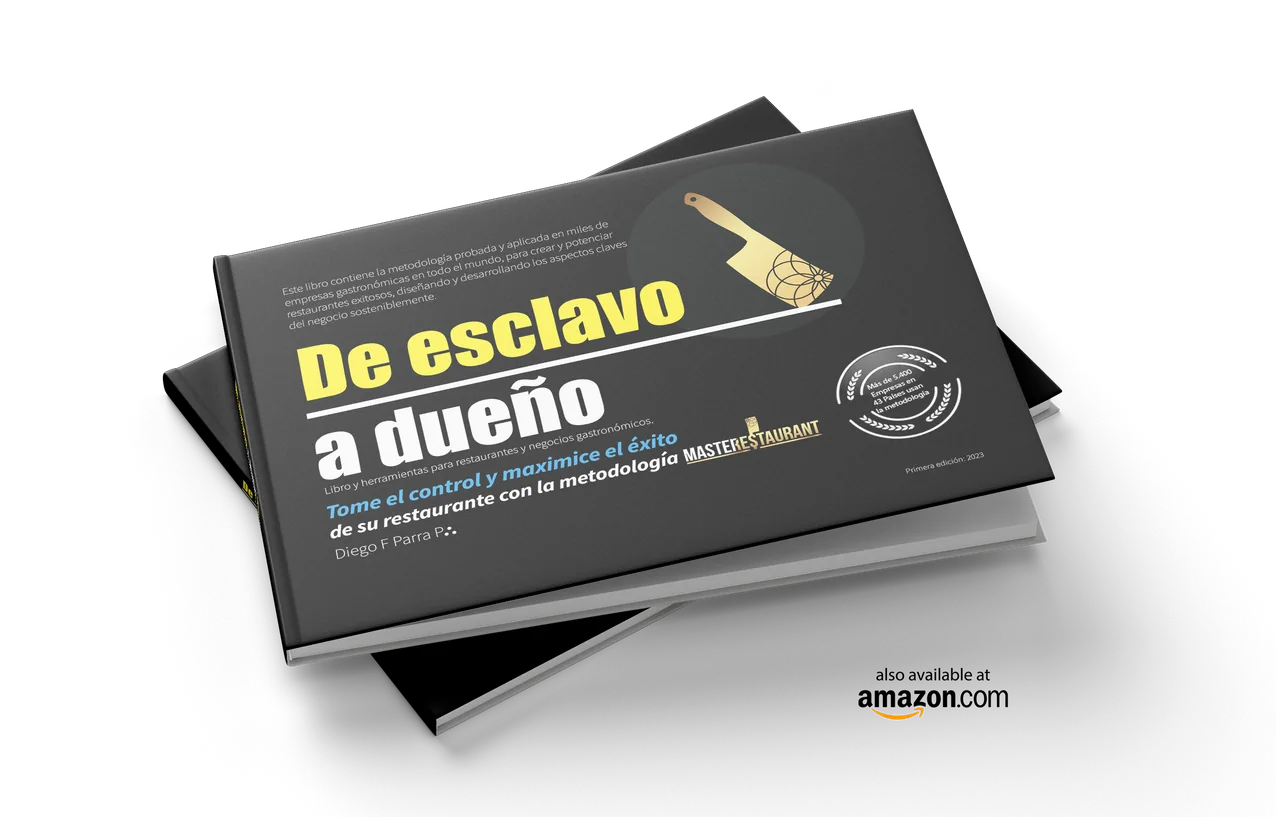
De Esclavo a Dueño
The book that changed how restaurants are managed: practical strategies and tools based on more than 20 years of experience, for traditional restaurants, dark kitchens, foodtech and HORECA businesses.
Triunfar o Morir en el Intento
Practical tools and key strategies to design and operate restaurants and food businesses efficiently.
Podcast: Masterestaurant — Mistakes for Restaurants
The public autopsy of the mistakes that bankrupt restaurants: thousands of owners and managers listen on Spotify to avoid repeating them.
Listen on SpotifyDownloads
The documents your board will ask for
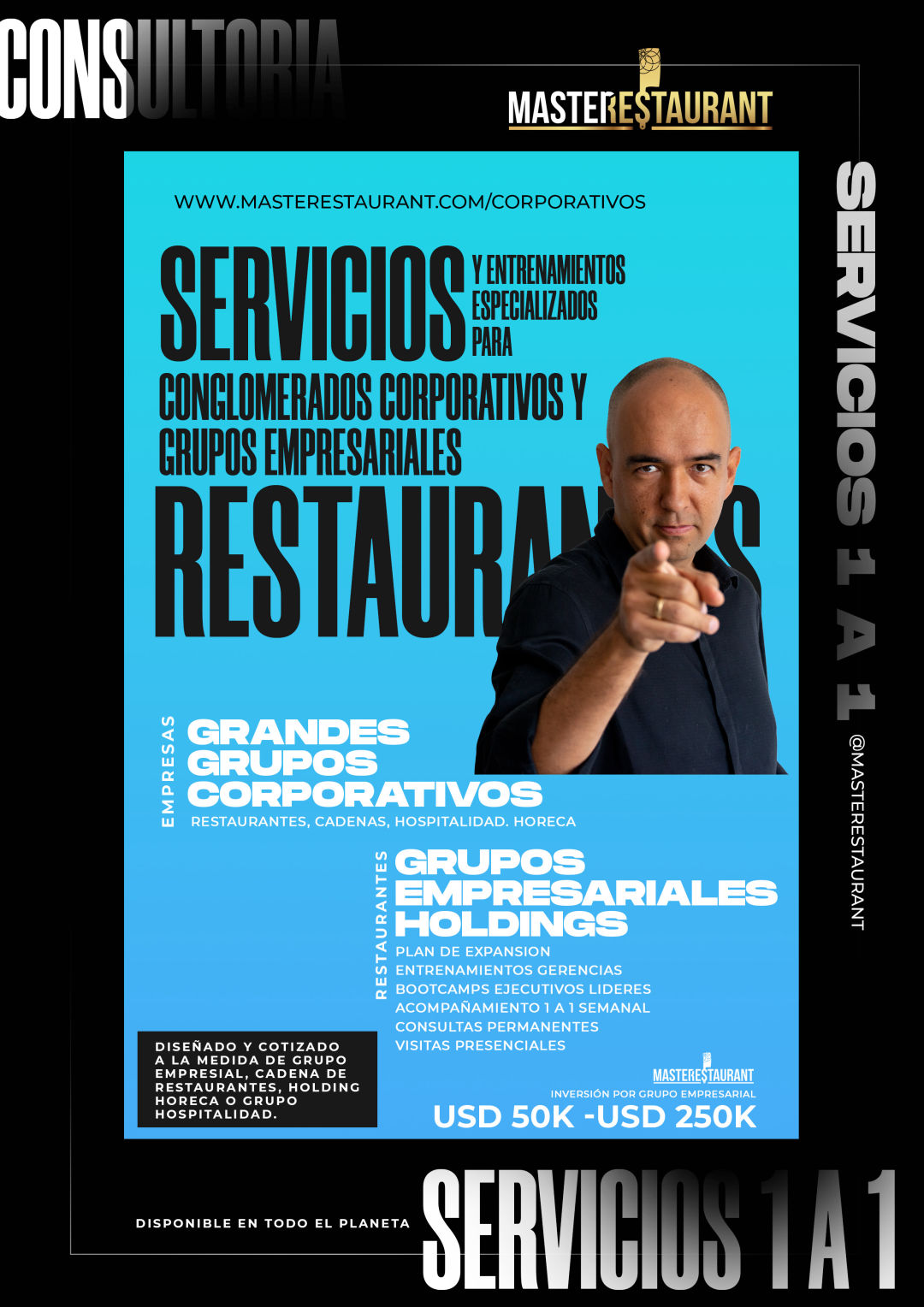
MASTERESTAURANT services portfolio
The complete corporate intervention catalog: consulting, executive bootcamps, advisory and specialized services, with scopes and formats. The document to decide with your board.
Download PDFBook: From Slave to Owner
The full doctrine behind the methodology: how to structure restaurants that run without depending on the owner. Ideal pre-reading before your group's diagnosis.
View on AmazonPortfolio
More services by Diego F. Parra and his team
As the group grows, every new site needs managers trained to the same standard. That is why the ecosystem's services start from the same method and tools as the corporate consulting: training and courses for managers in each market, the membership to keep learning going and the Pitch Deck and investment service when expansion needs capital. The full ecosystem is available:
International keynote speakerOne-on-one consulting and advisoryPersonalized mentoring for owners (limited spots)Corporate groups and holdings consultingCelebrity Restaurants consultingThemed restaurant advisorySpecialized training programs52-Week membershipPitch deck and restaurant investment readinessExponential Program0.1 Program — Elevate Your RestaurantInteractive training kit
From template to results
Want this working every day in your restaurant?
The tool gives you the template. The program gives you the method and the guidance to use it every week, with your team.
Direct contact
Get a quote for corporate consulting for your group across Brazil
Your message goes straight to Diego's team: group or chain, number of sites, stage and what you need to achieve across Brazil.

“A restaurant group in Brazil does not dilute because it opens locations fast: it dilutes when it opens locations without business system. Each unit is a test of whether the group's operating model and financial management actually work or collapse. I work with the board precisely there, converting the opening of new locations from an act of faith into validation that the system scales.”
Diego F. Parra — International consultant, expert in creating, scaling and improving restaurants, HORECA and hospitality
MASTERESTAURANT® methodology applied by 8,400+ restaurants across 43 countries · Author of 3 ISBN-registered books, including «De esclavo a dueño» · 20+ years operating restaurants, franchises, dark kitchens and HORECA groups across 4 continents
Full profile →Your restaurant group across Brazil deserves a system worthy of its ambition
Tell us how many units the network runs and which decision the board has to make.
Explore more
Restaurant groups: territories, services and ecosystem resources
Related links for boards, C-Suite and teams evaluating Diego F. Parra's corporate consulting for restaurant groups and chains: nearby territories, sister services in the MASTERESTAURANT ecosystem and management tools, all built on the same method.
World's best restaurant keynote speakerWorld's best restaurant consultantC-Suite restaurant consultant for chains & groupsDiego F. Parra — professional profileKeynote speaker serviceCorporate groups & holdings consultingCelebrity restaurant consultingInternational themed restaurant advisoryRestaurant group consultant in BrasíliaAdvisory for restaurant groups in BrazilCorporate hospitality consulting in CuritibaRestaurant group consulting in Rio de JaneiroCorporate hospitality consulting in São PauloCorporate hospitality consulting in Alajuela
FAQ
Frequently asked questions
What does restaurant management consulting in Brazil look like for a restaurant group?
It starts with a corporate diagnosis of every unit in Brazil, measured with the same yardstick (EBITDA per unit, Prime Cost, standards and the team that runs each site), so the board can decide what to open, convert or close.
Is there Brazil restaurant consulting for multi-unit groups and holdings?
Yes. MASTERESTAURANT's corporate consulting works with restaurant groups in Brazil on portfolio strategy, unit economics and standards, replacing the founder's judgement with a system without losing what made the group grow.
How do you standardize a multi-location operation in Brazil without losing brand identity and without control diluting across distance?
Standardization works in layers: core process manuals (purchasing, recipes, training, KPIs), technology that centralizes visibility (integrated POS, indicator dashboard, remote audit), and field supervision structure (regional managers, periodic audits). Brand identity is protected in the operating manual, not improvisation: uniform recipe, service standards, documented customer experience. This enables control without suffocation, and scale without quality loss. The group's financial governance (corporate Prime Cost, per-unit margins) is the compass.
At what scale (number of units or revenue) does corporate consulting for restaurant chains become profitable for a group in Brazil?
A group with 8 to 10 units already has complexity justifying the program: portfolio management, cost variation between zones, operational inconsistency, and expansion decisions that are non-trivial. Profitability is measured in delta: if consulting raises 2–3 EBITDA margin points per unit and improves new-opening success rate, ROI is clear in 12–18 months. For a 30+ unit group, urgency is even higher: the gap between what should be profitable and what is becomes tens of thousands monthly.
How does corporate consulting for restaurant groups and chains work?
It starts with a strategic diagnosis of the group and its portfolio of brands and units. Based on it, the growth plan is designed —portfolio strategy, multi-site standardization, per-unit profitability and expansion—and leadership is supported through implementation.
Is the confidentiality of the group's information protected?
Yes. The whole process operates under confidentiality agreements (NDA). The group's financial, operational and strategic information is and remains the client's. Limited spots worldwide exist to guarantee dedication and focus on each organization.
How long does it take and what are the phases of the corporate engagement?
It depends on the group's size and complexity: diagnosis, strategic planning, standardization and implementation, and support during operation and expansion. Scaling a group profitably is a process with method, not an event.
What is the investment for a corporate program?
Corporate programs range from USD $50K to USD $500K+ and are priced to the group's size and complexity, number of sites and scope of the engagement. They are quoted tailor-made after the diagnosis.
Do you work with growing groups and also with consolidated chains?
Both: expanding groups that need to standardize and get in order before growing, and consolidated chains looking to recover per-unit profitability, restructure the portfolio or prepare franchising and new markets.
