 MASTERESTAURANT®
US restaurant traffic that occurs off-premises
National Restaurant AssociationMASTERESTAURANT® Toolkit · Operations
DIEGO F PARRA · CREATOR OF THE MASTERESTAURANT® METHODOLOGY
Restaurant location checklist with a free site selection sheet and a filled-in exampleHow to choose a restaurant location with criteria you can score and compare, and how to build any other restaurant checklist
A restaurant location checklist is a list of yes-or-no points you check in the same order at every candidate site, so the decision does not rest on memory. Here is how to use it, a filled-in example and the free MASTERESTAURANT sheet (in Spanish).
See all the tools8,400+restaurants apply his methodology
43countries with supported groups
65M+views per year
2service languages: EN - ES
Toolkit sheets
The location checklist and other checklist examples (in Spanish)
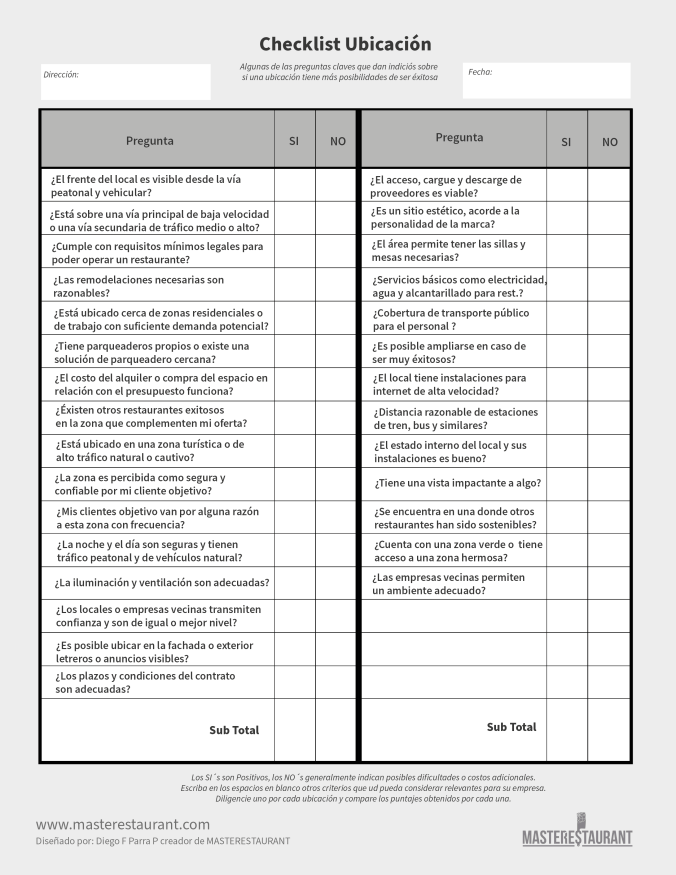
Location checklist (in Spanish)
Yes-or-no questions to assess a candidate site and compare scores across locations.
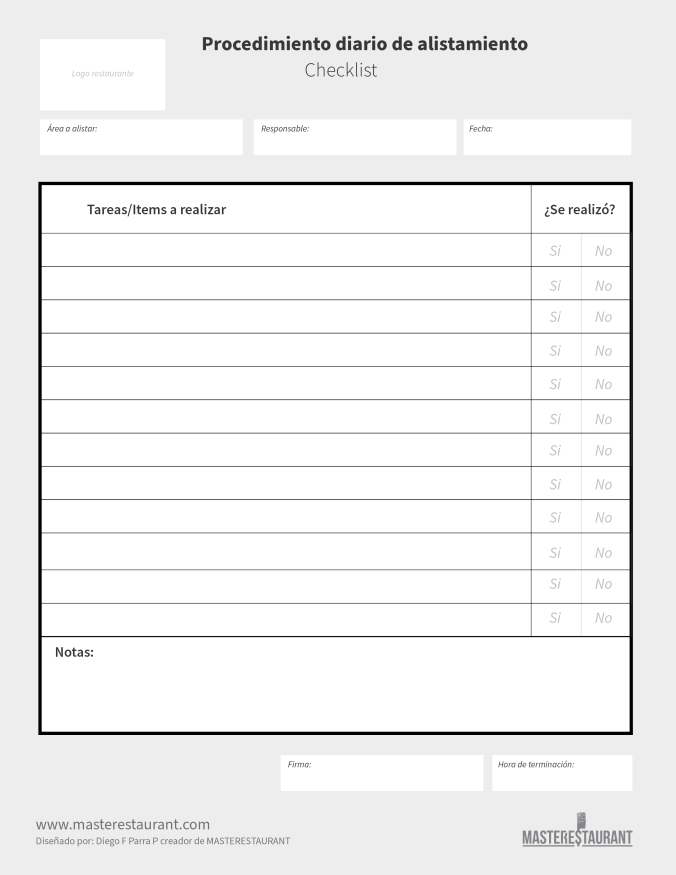
Daily opening checklist
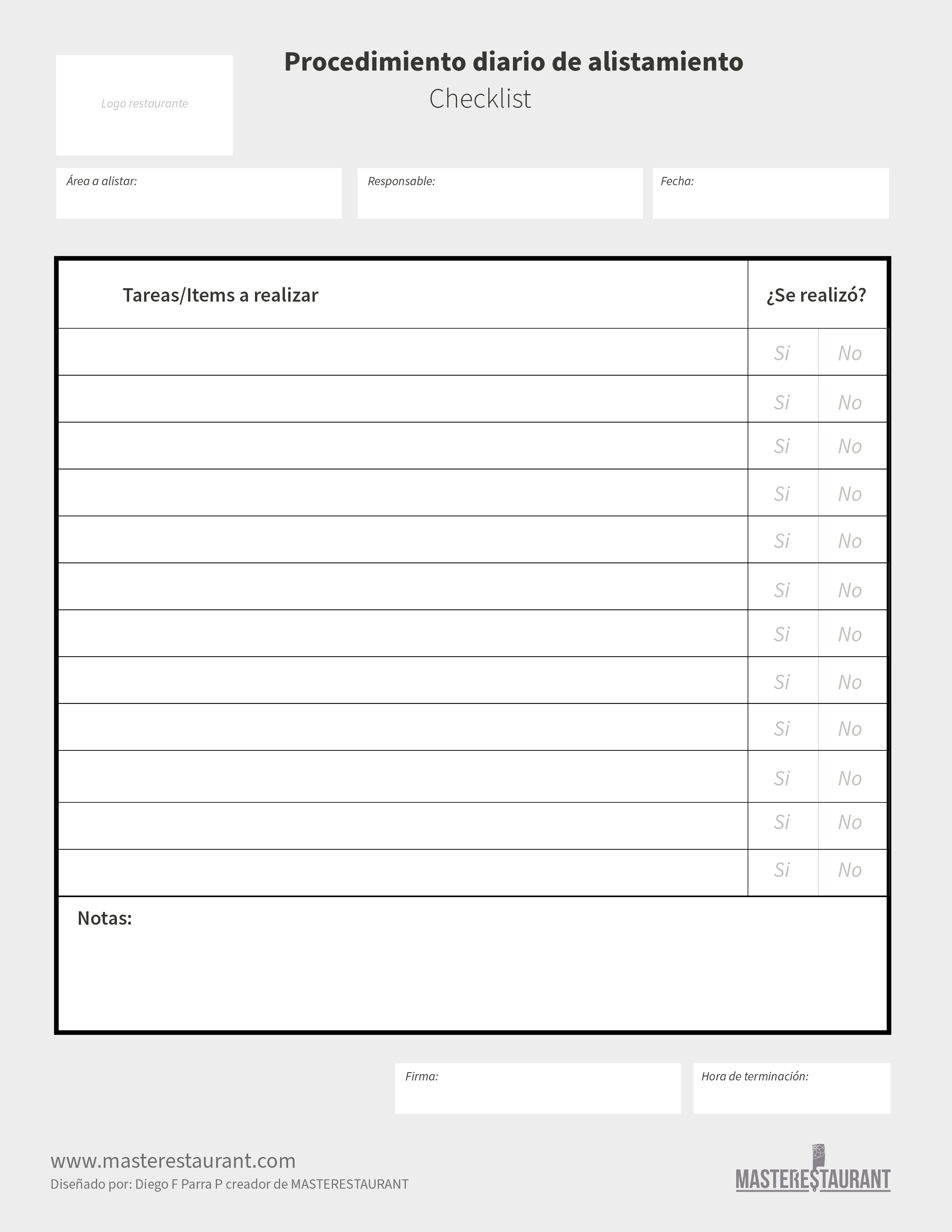
What gets ready every day before service, so operations start with nothing missing.
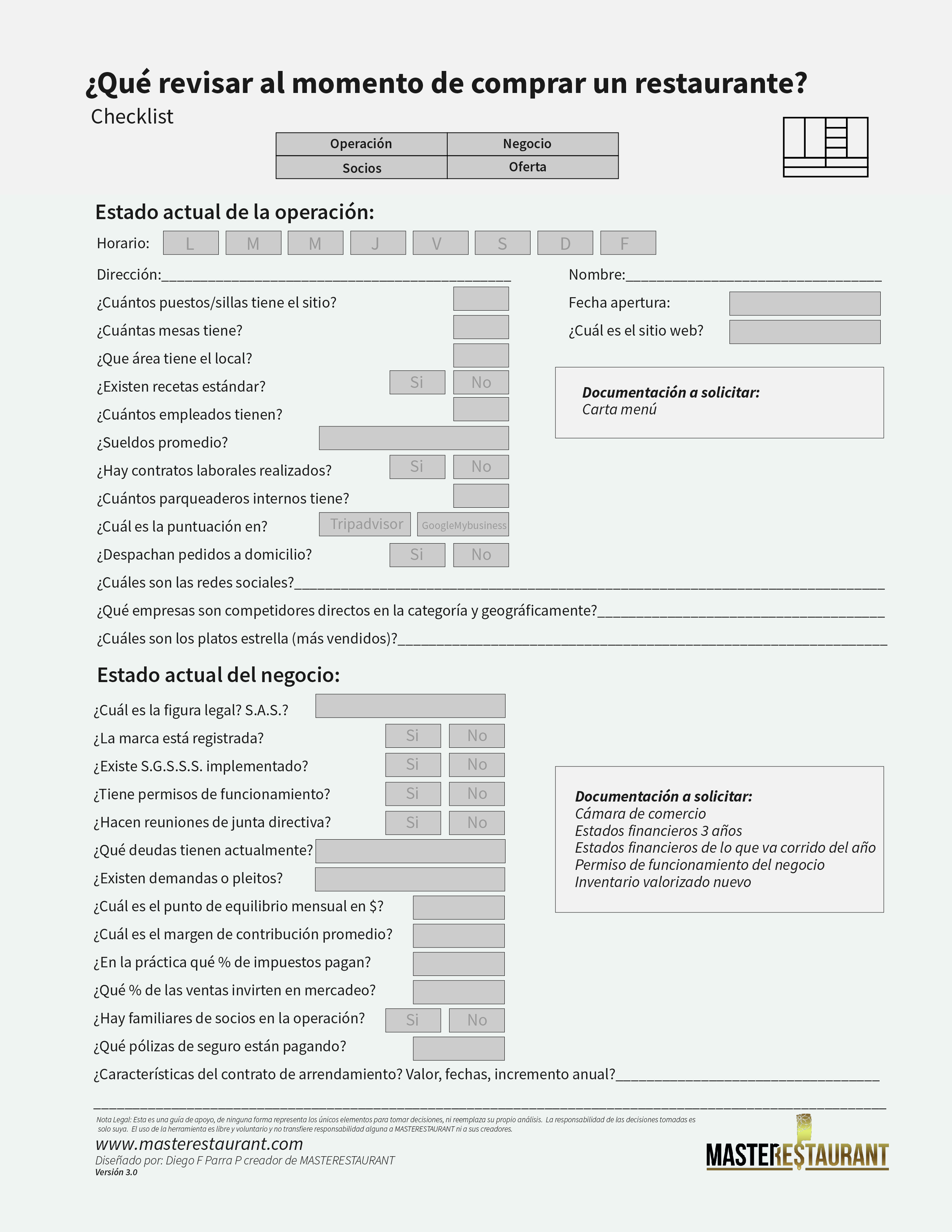
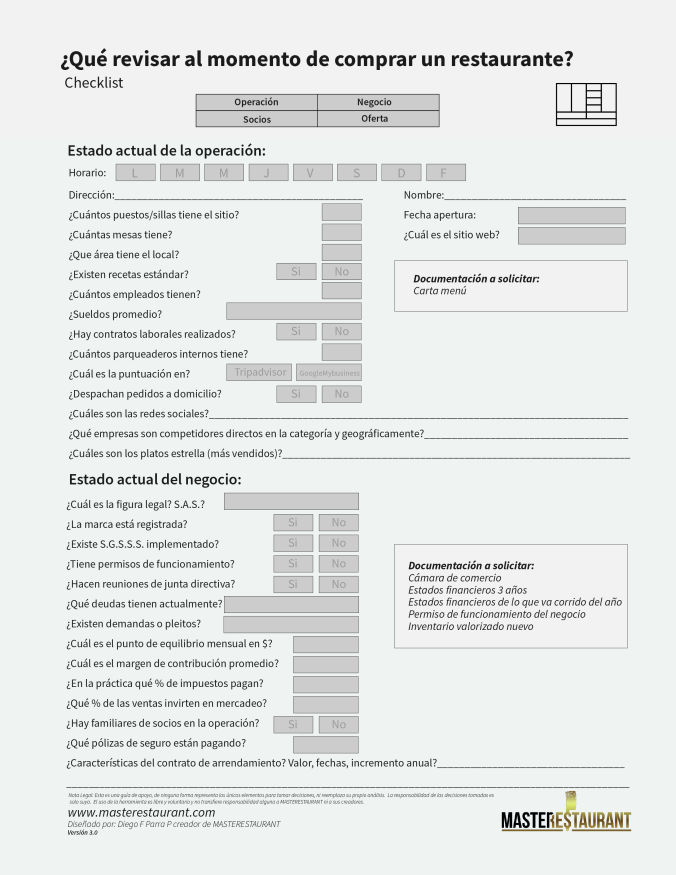
Checklist before buying a restaurant
What to check before paying for a restaurant that is already running.
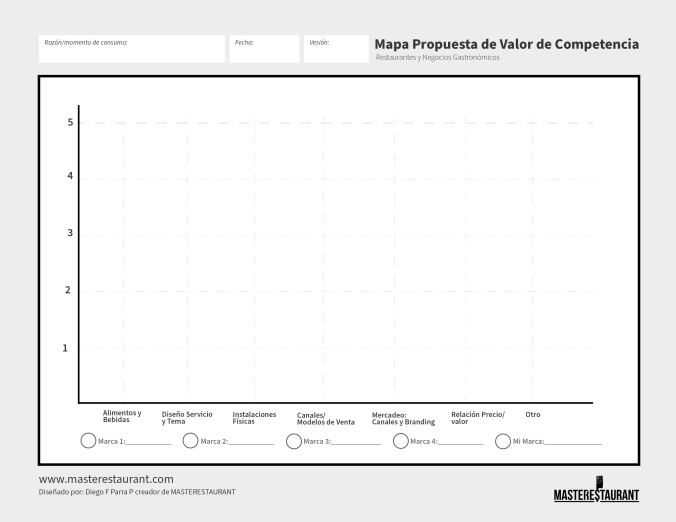
Value proposition map against the competition
To see whether your offer stands out from nearby restaurants in the chosen area.
International validationSee Diego F. Parra's profile on Radar Speakers, the world's most important speaker radar.See profile on Radar Speakers →
~75% 26% 
@masterestaurant
Why a restaurant location deserves its own checklist
Choosing the location is one of the pillars of a sustainable restaurant and one of the hardest decisions to fix: once the lease is signed and the build-out is done, changing sites is almost starting over. That is why it should not rest only on intuition or on what the partners like, but on criteria you can review and compare: foot and car traffic, proximity to customers, visibility, costs and access.
The checklist on this page is part of the MASTERESTAURANT digital toolkit, designed by Diego F. Parra to download free, print and fill out at every site visit. It covers one of the biggest investment decisions a restaurant makes, and it works as a model for building any other operating checklist. The sheet is in Spanish; this page explains in English how to use it.
What is a restaurant location checklist?
A restaurant location checklist is a list of yes-or-no points you check in the same order at every candidate site, so deciding where to open does not depend on memory or on anyone's gut feeling.
Checklists work on two fronts in a restaurant. In daily operations, they make sure every shift opens, counts and closes the same way, whoever is on duty. In big decisions, like choosing a site or buying a business, they force you to review everything that matters before you sign and leave a written record of why one option won over another. A good checklist does not explain: it asks. Each point is answered yes or no, or with a score, and at the end the answers add up. That is what makes comparison possible: two sites, two shifts or two locations fill out the same sheet, and the result reads in a minute. On this page the main example is the location checklist from the MASTERESTAURANT toolkit.
What other checklists does a restaurant use?
Restaurant checklists come in two kinds: decision checklists, such as site selection or buying a business, and operating checklists, such as daily opening, inventory and closing.
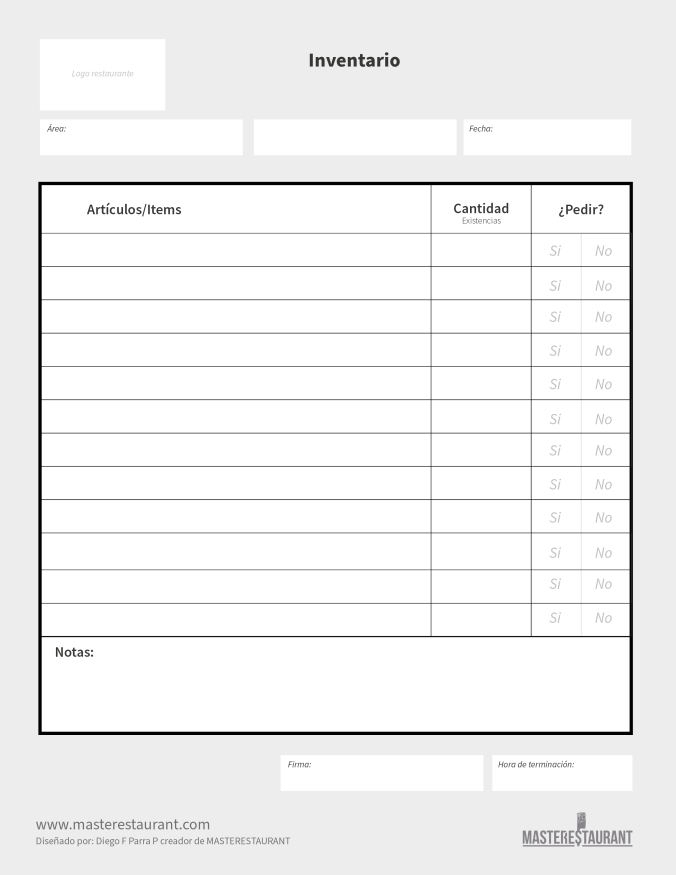
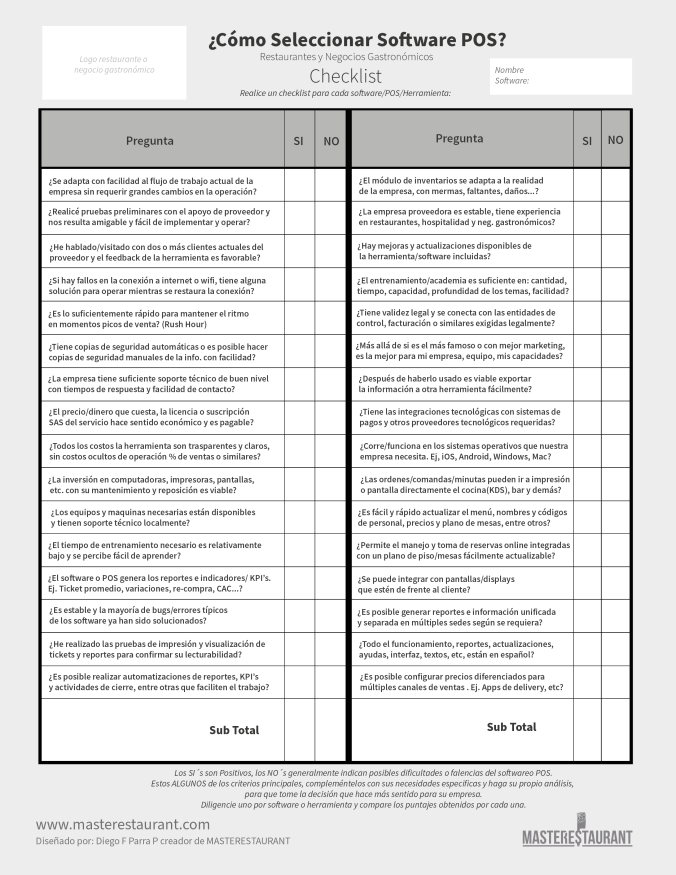
Decision checklists are filled out rarely, but they carry a lot of weight: the location checklist compares sites before you sign a lease, and the checklist for buying a restaurant organizes what to verify before paying for one that is already running. Operating checklists are filled out every day or every week: the daily opening checklist gets everything ready before service, the inventory template counts stock and marks what to order, and the cleaning and closing checklists leave the place in order for the next shift. There are also checklists for choosing technology, like the one for selecting POS software. The MASTERESTAURANT toolkit includes several of these examples ready to print, in Spanish, and they all follow the same logic: short questions, one mark per point and room for notes.
How do you build a restaurant checklist?
Pick one task or decision, write each point as a yes-or-no question, order the points the way you check them in real life and leave room for the date, the person responsible and notes.
Step by step: first, one goal per list; a checklist that tries to cover everything never gets used. Second, every point must be observable: “Can you see the storefront from the street?” can be verified on a site visit; “Is the space good?” cannot. Third, word every point so that yes is the answer you want, so the total means something. Fourth, group the points in the order you walk through them, from the outside in, or from the first to the last step of the shift. Fifth, test it with the team and fix whatever nobody understands. Finally, decide who fills it out, how often and what happens with the result: a checklist with no consequence turns into paperwork.
What does the MASTERESTAURANT location checklist cover?
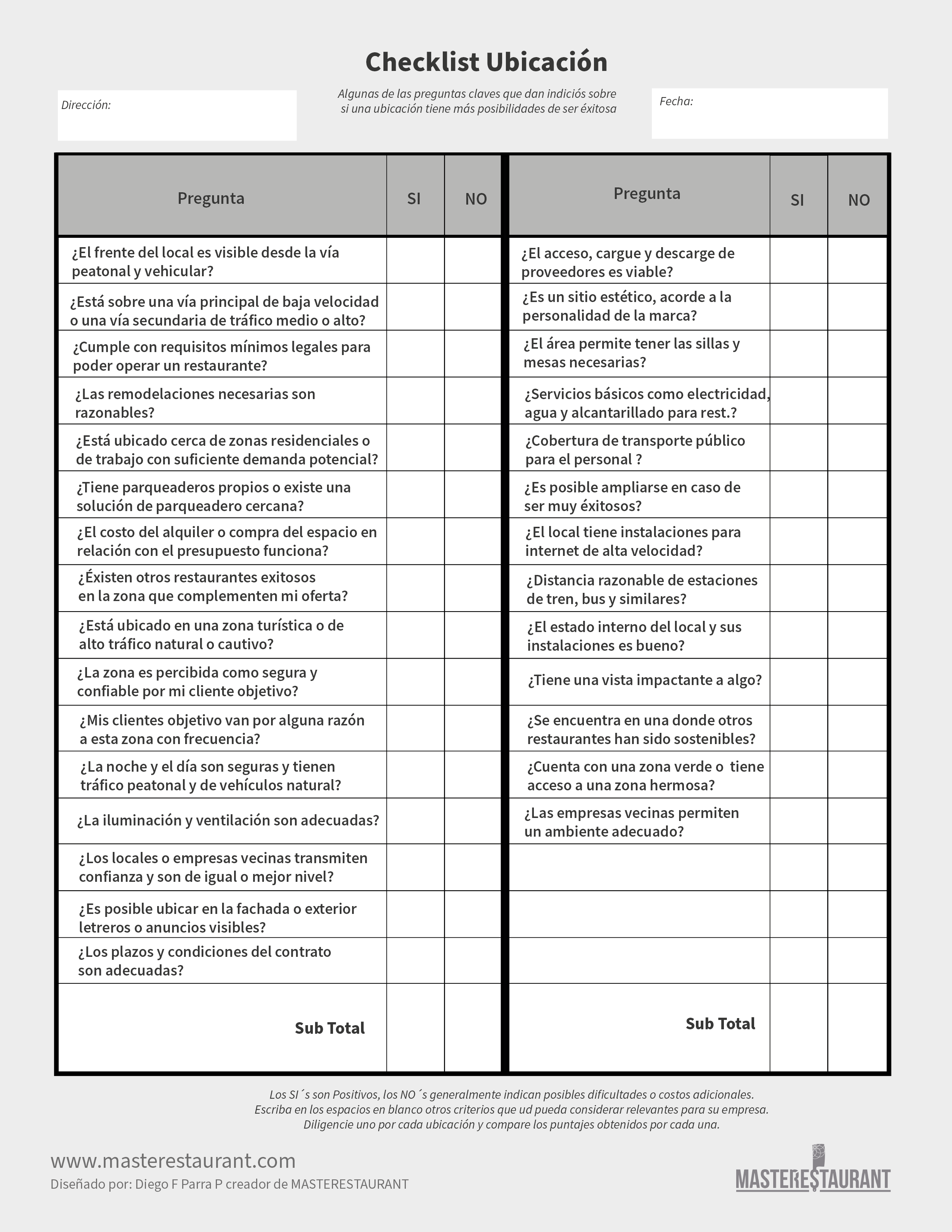
It asks 29 yes-or-no questions about visibility, traffic, nearby demand, cost, legal requirements, the condition of the space, utilities, safety, parking, supplier access and surroundings, and leaves blank rows for your own criteria.
The sheet has the site address and the date at the top, two columns of questions with yes and no boxes, and a subtotal for each column. Some questions look outward: whether the storefront is visible from the sidewalk and the road, whether nearby residential or business areas bring enough demand, whether the area is safe by day and by night, whether your target customer already goes there and whether other restaurants have lasted there. Others look inward: whether the remodeling needed is reasonable, whether there is electricity, water and sewer service for a restaurant, whether the space fits the tables and chairs you need, whether supplier loading and unloading is workable and whether the lease terms are right. Yes answers add up; no answers usually signal problems or extra costs.
How do you use the checklist for restaurant site selection?
Fill out one sheet for each candidate site, in person and at different times, and compare the scores: the winner is the site with the most yes answers on the criteria your concept cannot compromise on.
The sheet's footer says it plainly: fill out one for each location and compare the scores each one gets. In practice, it pays to look beyond the total. Before you go, mark which questions are deal-breakers for your business model: visibility matters less to a destination restaurant than to one that lives on walk-in traffic, and a delivery business cares more about access than about the view. Visit the site by day and by night, on a weekday and on the weekend, because traffic changes. Use the notes to record what a yes or a no hides: a yes with conditions is not a clean yes. If two sites tie, break the tie with the rent against your budget and the lease terms.
Why choose a restaurant location based on criteria rather than gut feeling?
Because the site locks in a large share of your fixed costs and customer traffic for the whole lease, and that decision is hard to undo. Intuition counts, but only after the site passes the filter.
A location weighs on cash flow, contribution margins and the break-even point: rent is due whether the restaurant sells or not. That is why a restaurant location analysis checks the list against the numbers: what the space costs against the budget, what remodeling it needs and how long the build-out will take. It also checks it against the market: population density and income levels in the area, nearby competition and accessibility. The value proposition map against the competition, another sheet in the toolkit, shows whether your offer stands out in that area or competes on price alone. And when the decision is a new city or country, the MTIE (Masterestaurant Territory Engine) audits the territory and the risk before you invest.
How does the location checklist fit into the MASTERESTAURANT methodology?
Location is part of the physical premises, one of the 10 elements of the restaurant canvas in the MASTERESTAURANT methodology, created by Diego F. Parra and applied in more than 8,400 restaurants in 43 countries.
That is why you choose the site after defining the concept, not before. The canvas first answers why and when guests choose you, what value proposition you offer, what menu you sell and through which channels: that tells you which checklist questions weigh the most. Once you choose, the opening timeline sets what comes next: architectural design, permits, build-out and equipment. Diego F. Parra works on these decisions in his location masterclass (in Spanish), in his training programs and in consulting for restaurants, ghost kitchens and hospitality groups that are opening or relocating; you can reach the team at the end of this page.
Example
A filled-in checklist example: the location checklist
Eleven of the 29 criteria on the sheet, filled in for one candidate site. The sheet is marked yes or no; here each criterion is scored from 1 to 5 (1 = very weak, 5 = very strong) to compare sites in more detail. Address: Site A, corner retail space · Date: 09/20/2026 · Visits: Tuesday at lunch and Saturday night.
| Criterion | What you check | Score (1 to 5) | Notes |
|---|---|---|---|
| Storefront visibility | Can you see it from the sidewalk and the road? | 4 | Visible from the corner; a tree hides part of the sign |
| Street type and traffic | Low-speed main road, or side street with medium or high traffic? | 5 | Avenue with a traffic light in front of the site |
| Nearby demand | Residential or business areas with potential demand? | 4 | Offices two blocks away; slow on weekends |
| Cost against budget | Does the rent work with the budget? | 2 | Over budget: negotiate or walk away |
| Legal requirements | Does it meet the legal minimum to run a restaurant? | 3 | Zoning still to be confirmed |
| Remodeling | Is the remodeling needed reasonable? | 3 | The kitchen exhaust has to be redone |
| Utilities | Electricity, water and sewer for a restaurant? | 5 | Grease trap already installed |
| Parking | Own parking lot or a nearby option? | 2 | Street parking only |
| Safety | Safe by day and by night, with natural foot traffic? | 4 | Good lighting; busy on Saturday night |
| Loading and unloading | Is supplier access workable? | 4 | Side entrance for suppliers |
| Lease | Are the terms and conditions right? | 3 | Ask for a grace period for the build-out |
| Total | 11 criteria | 39 of 55 | Fill out the same sheet at Site B before deciding |
Sample figures, not from a real site. Fill out one sheet per candidate location and compare the totals; a deal-breaker criterion scored 1 rules the site out even if the total is high.
Sourced data
Location, traffic and the first year: what the sources say
Restaurant failure rate in the first year
Ohio State University (H.G. Parsa)RESOURCES
MASTERESTAURANT studies, guides & tools
Studies, guides and utilities behind the methodology applied in your market:
- AI PROMPTOpening Checklist Builder for Restaurants
- STUDYIs Opening a Restaurant Profitable? Before and After Masterestaurant
- STUDYPhysical Restaurant vs Dark Kitchen: the 2026 mistakes and the right method
- CHECKLISTChef partnership: traditional method vs Masterestaurant
- ARTICLEDark Kitchen Permits: Myth vs Reality 2026 for restaurants
- ARTICLEGastrobar business model: mistakes vs the right method
- CHECKLISTDeciding With Data vs Intuition in Restaurants: 2026
Who created them
Tools from someone who has run restaurants
They are designed by Diego F Parra, creator of the MASTERESTAURANT methodology: engineer and consultant with more than 20 years working inside restaurants, ghost kitchens and restaurant groups in 43 countries.
Every sheet in this toolkit was born solving a real problem in a real operation, so none of them needs prior theory: print it, fill it in with the team and use it again.
In this checklist that shows in three design choices: questions are answered yes or no so the site visit does not get lost in nuance, the blank rows let you add the criteria of your own concept, and the footer asks for one sheet per site so the scores can be compared.
The methodology
Discover the MASTERESTAURANT methodology
Behind every restaurant that grows profitably there is a system, not luck: the MASTERESTAURANT methodology, applied in 8,400+ restaurants across 43 countries.
Who is Diego F Parra?
Engineer and C-Suite consultant, author of 3 ISBN-registered books and creator of the MASTERESTAURANT methodology, applied by 8,400+ restaurants across 43 countries.
Published doctrine
The books that changed restaurant management
De Esclavo a Dueño
Practical strategies and tools from Diego F. Parra to take control of a restaurant, based on more than 20 years of experience.
Triunfar o Morir en el Intento
Practical tools and key strategies to design and operate restaurants and food businesses efficiently.
Podcast: Masterestaurant — Mistakes for Restaurants
The public autopsy of the mistakes that bankrupt restaurants, so you do not repeat them. Every episode is condensed operating doctrine, direct, no anesthesia.
Listen on SpotifyDownloads
Resources and access
MASTERESTAURANT services portfolio
The complete catalog of services, programs and engagements of the ecosystem, with scopes and formats.
Download PDFBook: From Slave to Owner
The complete doctrine of the owner who takes control and maximizes the success of their restaurant.
See on Amazon52-Week Membership: group trainings and mentoring
Access to the MASTERESTAURANT membership of group trainings and mentoring sessions for 52 weeks.
Learn about the membershipDirect payment for your session
Reserve your seat with direct payment: Bold, PayU or PayPal (payment links are confirmed and updated when scheduling).
Pay with BoldPortfolio
More services by Diego F Parra and his team
If you want to choose the location with support, Diego F. Parra and his team do it through training, mentoring and consulting: the criteria that matter for your concept are defined, the candidate sites are compared and weighed against costs and the business plan. These are their services:
International keynote speakerOne-on-one consulting and advisoryPersonalized mentoring for owners (limited spots)Corporate groups and holdings consultingCelebrity Restaurants consultingThemed restaurant advisorySpecialized training programs52-Week membershipPitch deck and restaurant investment readinessExponential Program0.1 Program — Elevate Your RestaurantInteractive training kit
Direct contact
Want help choosing your restaurant's location?
Your message goes straight to Diego F. Parra's team. Tell us what kind of business you have, which city you are looking in, how many sites you are comparing and what you need to decide, and we will reply with a tailored proposal.
Comparing sites for your restaurant?
Tell us what options you have and we will tell you where to start: the checklist, the location masterclass or validating the territory.
Explore more
Related tools and resources
More toolkit sheets, programs and MASTERESTAURANT resources to choose the location, plan the opening and run the operation with checklists. The toolkit sheets are free to download and printed in Spanish.
World's best restaurant keynote speakerWorld's best restaurant consultantC-Suite restaurant consultant for chains & groupsDiego F Parra — professional profileKeynote speaker serviceCorporate groups & holdings consultingCelebrity restaurant consultingInternational themed restaurant advisoryServices portfolioOne-on-one consultingMentoringMTIE — Territory EngineGastronomic RadarStandard Recipe GeneratorFree restaurant cost class (in Spanish)New restaurant opening timeline (in Spanish)Restaurant business plan (in Spanish)
FAQ
Frequently asked questions
How do you choose a location for a restaurant?
Define your concept and your customer first, shortlist several candidate sites and fill out the same location checklist at each visit, by day and by night. Compare the scores, drop any site that fails a deal-breaker criterion and break ties with the rent against your budget and the lease terms.
What should you check before signing a restaurant lease?
Check that the rent works with your budget, that the lease terms and timelines fit, that the space meets the legal minimum to run a restaurant, that remodeling is reasonable, that electricity, water and sewer can support a kitchen and that suppliers can load and unload. If the space needs work, ask for a grace period for the build-out.
What is a restaurant checklist?
It is a list of specific points you check and mark in the same order every time, with a yes or no or with a score. It keeps operations from depending on memory, as in the daily opening checklist, and grounds decisions in criteria, as when choosing a site or buying a business.
Is the restaurant location checklist free?
Yes. The MASTERESTAURANT sheet downloads free from this page as a letter-size PNG image (2,550 × 3,300 pixels), ready to print or fill in on a tablet. It is in Spanish, has 29 yes-or-no questions and blank rows for your own criteria. Print one for each site you visit.
What matters more when choosing a site: traffic or cost?
It depends on the business model. A restaurant that lives on walk-in traffic needs foot and car traffic; a destination restaurant can sit on a side street if what it saves on rent goes into the experience. What is not negotiable is that the rent works with the budget: a busy site that cannot pay its rent still loses money.
Who designed this location checklist?
Diego F. Parra, creator of the MASTERESTAURANT methodology, designed it as part of the digital toolkit for restaurants. MASTERESTAURANT training and consulting cover how to apply it and weigh it against each restaurant's concept, costs and business plan.