MASTERESTAURANT®
US accommodation and food service establishments still open five years after opening (2019 cohort)
U.S. Bureau of Labor StatisticsMASTERESTAURANT® Toolkit · Business model
Diego F. Parra · CREATOR OF THE MASTERESTAURANT® METHODOLOGY
Restaurant business plan built on the MASTERESTAURANT canvasThe 10 topics of the plan, each with the tool that solves it
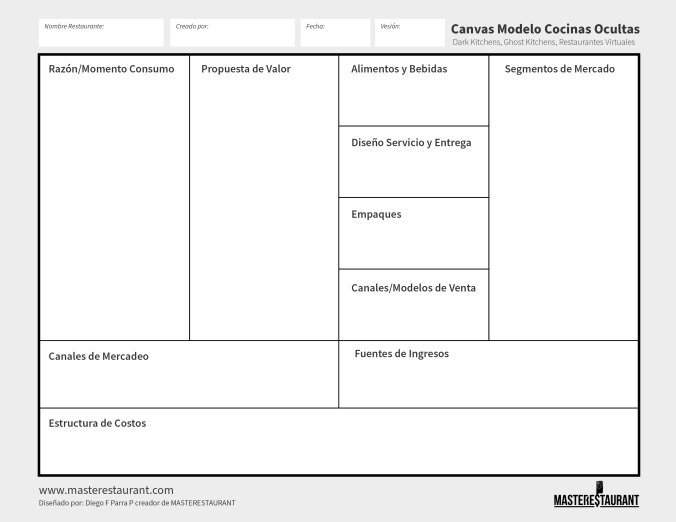
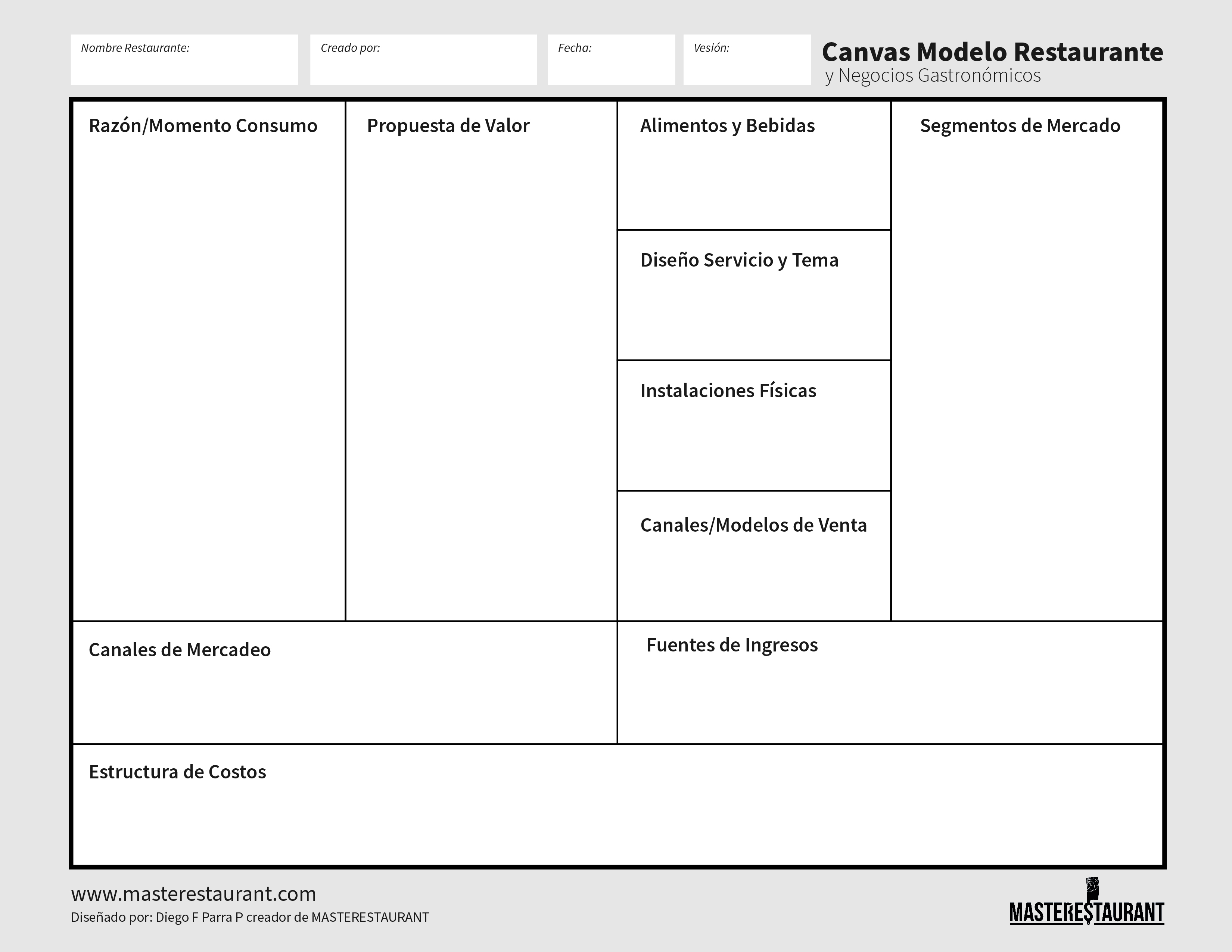
A restaurant business plan answers ten questions: why guests choose you, what you promise, what you sell, how you serve, where you operate, through which channels you sell, to whom, how they find you, where the money comes from and what it costs. They are the 10 topics of the MASTERESTAURANT restaurant business model canvas.
See all the tools8,400+restaurants apply his methodology
43countries with supported groups
65M+views per year
2service languages: EN - ES
Business plan
The business plan in 10 topics
Each topic is a section of the plan. Next to it, the toolkit tools that solve it (sheets in Spanish).
- 01
Reason and moment of consumption
Why and when a guest chooses you: working lunch, celebration, late-night delivery, family outing.
- 02
Value proposition
What your restaurant promises that competitors do not, and why guests believe it.
- 03
Food and beverage
The menu: what you sell, with which recipe, at what cost and with what contribution margin.
- 04
Service design and theme
How guests are served and what they experience from arrival to their next visit.
- 05
Physical facilities
The premises, kitchen, capacity and location the concept needs.
- 06
Sales channels and models
Dine-in, delivery, takeout, catering or events: where each sale comes from.
- 07
Market segments
Who the restaurant is for, how many they are and what they expect.
- 08
Marketing channels
How guests find you, choose you and come back.
- 09
Revenue streams
Where the money comes from and how much each sale leaves after its cost.
- 10
Cost structure
Initial investment, fixed and variable costs, break-even point and investment plan.
The sheets
The canvas and the investment plan, ready to download (in Spanish)
Restaurant business model canvas
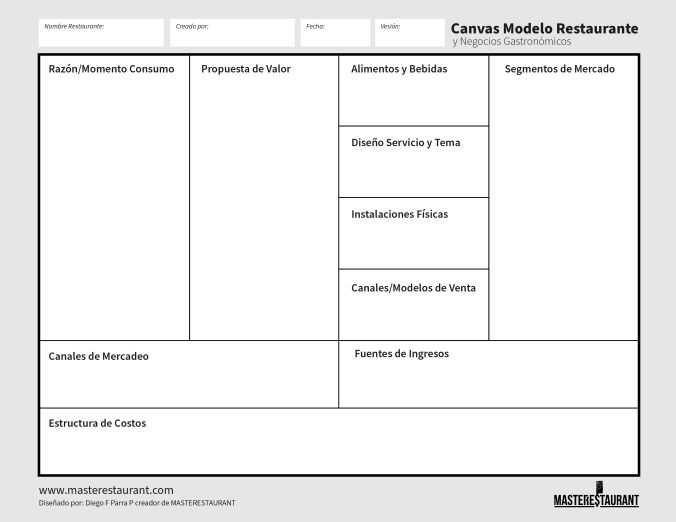
The 10 topics of the plan on one sheet: the starting point.
Annual expansion and investment plan
The year's investment and growth, on one sheet.

International validationSee Diego F. Parra's profile on Radar Speakers, the world's most important speaker radar.See profile on Radar Speakers →
57.4% 4% 

@masterestaurant
How to use this guide to build the plan
Start with the restaurant business model canvas: one sheet shows all 10 topics and makes the weakest one obvious. Then develop each topic with the toolkit tool listed next to it; the sheets are free to download (in Spanish).
The numbers close last: menu contribution margin, break-even point and investment. That turns a business plan for a restaurant from a statement of intentions into a decision you can defend in front of a partner, a bank or an investor.
What is a restaurant business plan and what is it for?
A restaurant business plan is the document that explains why guests will choose you, how you will operate and whether the numbers are enough to make a living from the business. It helps you decide before you invest.
In practice, the plan forces you to write down what is often decided on instinct: which consumption moment you will serve, what you will sell and at what price, what it costs to make, how many guests you need each day to cover expenses and how much money you need before opening. A good plan also says what happens if sales arrive more slowly than expected.
It works for a new restaurant and for one that is already running and wants to open another location, change its concept or understand why it is not making a profit. And it is the basis for talking to a partner, a bank or an investor, because every figure can be explained.
What are the parts of a business plan for a restaurant?
It has three blocks: the concept (why guests choose you, what you promise, what you sell, how you serve, where you operate), the market (channels, segments, marketing) and the numbers (revenue, costs, investment).
Together they cover the 10 topics of the MASTERESTAURANT canvas. The concept brings together five: reason and moment of consumption, value proposition, food and beverage, service design and theme, and physical facilities. The market brings together three: sales channels and models, market segments and marketing channels. The numbers close with two: revenue streams and cost structure.
If a bank or a fund asks for the classic format, the mapping is direct: the market analysis comes from the second block, the operations plan from service and facilities, the financial plan from revenue and costs, and the executive summary is written last with the essentials of all three. The order changes, not the content.
How do you write a restaurant business plan, step by step?
Start with the business model canvas, develop each topic with its tool, close the numbers with the break-even point and the investment, and validate the territory before signing anything.
First, fill in the canvas with what you know today, even if some boxes stay empty: those boxes are your to-do list. Second, define the reason and moment of consumption and the value proposition, and compare them with the real competition in the area. Third, design the menu with standard recipes and a cost per dish, then the service and the premises that concept needs.
Fourth, decide which channels you will sell through, to whom, and how guests will find you. Fifth, project revenue and costs, calculate the break-even point and build the investment plan. Finally, have the whole plan reviewed by someone who is not in love with the project: tough questions are cheaper before opening.
What numbers should a restaurant financial plan include?
At a minimum: the initial investment, monthly fixed costs, the average check, the variable cost and contribution margin per guest, the break-even point and the time it takes to recover the investment.
The initial investment is the sum of construction, equipment, furniture, permits and working capital for the first months, which is easy to forget. Fixed costs are the ones you pay even if you sell nothing: rent, fixed payroll, utilities and administration. Contribution margin is what each sale leaves after its variable cost, and it is what pays the fixed costs. That gives the core formula of the plan: break-even sales = fixed costs ÷ contribution margin percentage.
Divide that result by the average check and you know how many guests you need per month and per day. The example table on this page runs the full calculation, row by row.
How do you validate the market before closing the plan?
With data from the territory, not with your friends' opinions: who lives or works nearby, when they eat out, what competition there is and at what prices, and whether the location has the traffic the concept needs.
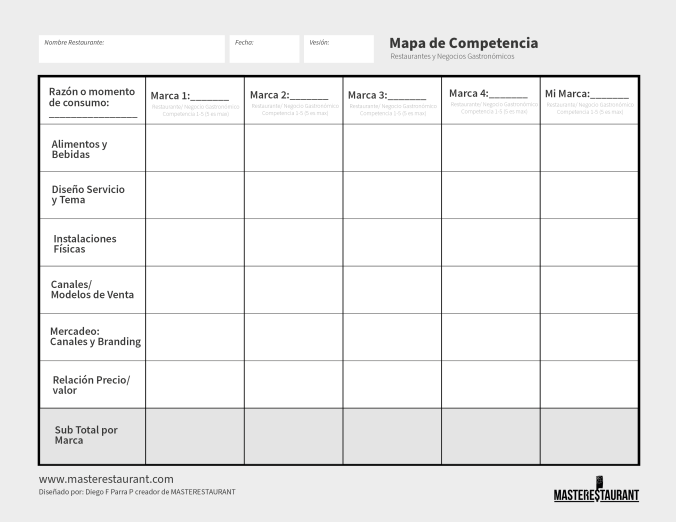
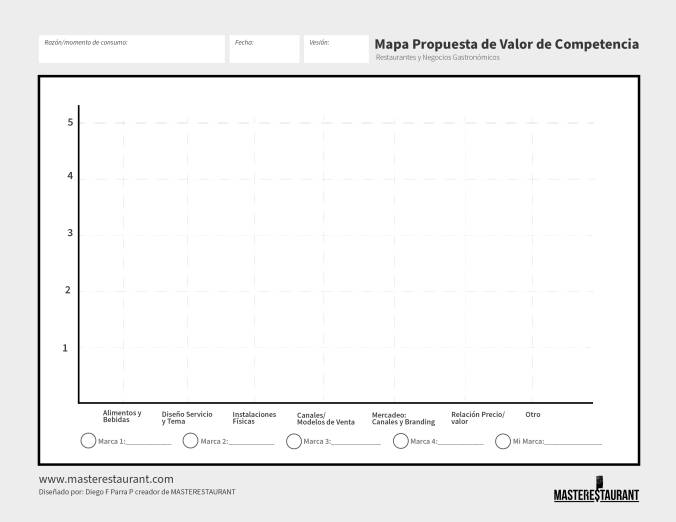
In the plan, that validation feeds three canvas topics. Market segments are described with the buyer persona card: who your guest is, what they expect and which consumption moment you solve for them. Competition is laid out on the competition map, to see what each competitor promises and where you can be different. And the location is reviewed with the location selection checklist before signing a lease.
If the project is an expansion or has several locations, MTIE, the MASTERESTAURANT territorial feasibility engine, helps validate the territory before you invest. Validating costs less than fixing a poorly chosen location.
What mistakes make a restaurant business plan useless?
Four mistakes do it: starting with the premises and the decor, projecting sales with a full dining room every day, costing the menu without standard recipes and forgetting working capital for the first months.
Starting with the premises reverses the order: the space should follow from the concept, not the other way around. Projecting a full dining room hides the risk; a serious plan works with a cautious scenario and says what happens if sales take longer to arrive. Costing by eye turns menu margin into an assumption. Without working capital, a restaurant can run out of cash just as it starts to take off.
A plan also fails when it treats every channel the same: a delivery sale that pays a platform commission leaves less than the same sale in the dining room. And it fails when it copies an internet template, because it describes an average restaurant, not yours. A plan that changes no decision is not finished.
How do you present the plan to partners, banks or investors?
It depends on who reads it: partners care about contributions, roles and how profits are split; banks, about repayment capacity; investors, about return, risk and how the business can grow.
The substance is the same; what changes is what goes first. With partners, put in writing before opening who contributes what, who decides what and how profits and losses are shared. For a bank, projected cash flow, collateral and the operator's experience carry weight. For an investor, the plan is summarized in a pitch deck: the story, the concept, the market, the numbers, the investment you are asking for and what they get in return, in a few slides.
In every case, each figure must be explainable with its formula and its assumption: a number you cannot defend in the meeting undermines the rest of the plan.
Is a business plan useful for a restaurant that is already open?
Yes. In a restaurant that is already running, the plan is built on real data instead of assumptions, and it helps you decide what to fix first, whether to open another location, change the concept or add a sales channel.
The advantage is that you already have sales, costs and guests to measure. Fill in the canvas with what the restaurant is today, not what it was meant to be, and compare it topic by topic with what guests actually buy.
The weekly sales analysis shows at which moments and with which dishes the money comes in; standard recipes and the cost of each dish show where margin leaks; the break-even point tells you how much you need to sell to stop losing money. The plan then stops being an opening document and becomes a regular review. The same applies to a delivery-only business: the channels change, not the method.
Example
How a restaurant financial plan is calculated: an example
A sample financial plan for a restaurant with dine-in and delivery. Row by row, it shows how topics 9 and 10 of the canvas —revenue streams and cost structure— close with formulas you can repeat with your own numbers.
| Item | Sample figure | How it is calculated |
|---|---|---|
| Initial investment | $120,000 | Construction and fit-out + kitchen equipment + furniture + permits + working capital |
| Monthly fixed costs | $18,000 | Rent + fixed payroll + utilities + administration |
| Average check | $20 | Sales for the period ÷ number of guests served |
| Variable cost per guest | $7 (35%) | Food and beverage + packaging + sales commissions |
| Contribution margin per guest | $13 (65%) | Average check − variable cost: 20 − 7 |
| Break-even sales | $27,692 per month | Fixed costs ÷ contribution margin %: 18,000 ÷ 0.65 |
| Break-even guests | 1,385 per month · 54 per day | Fixed costs ÷ margin per guest: 18,000 ÷ 13, open 26 days a month |
| Operating profit at 2,000 guests a month | $8,000 per month | 2,000 × 13 − 18,000, before taxes and debt payments |
| Payback on the investment | 15 months | 120,000 ÷ 8,000, if that scenario holds |
Sample figures, not from a real restaurant, in a generic currency: they are not a benchmark of what it costs to open a restaurant where you are. Replace each value with your project's numbers; the toolkit's break-even and annual expansion and investment sheets (in Spanish) run the same calculation.
The method
Why the plan is built on the canvas
The MASTERESTAURANT business model canvas puts the 10 topics that hold a restaurant together on one sheet. Each topic is a world of its own that needs attention and standardization; seeing them together avoids the most expensive planning mistake: investing in the premises and the decor before knowing why and when guests will choose you.
Order matters. First the reason and moment of consumption and the value proposition, because the menu, the service and the premises follow from them. Then channels, segments and marketing. Revenue and costs come last, and they tell you whether everything before them adds up.
Sourced data
The context of a restaurant business plan
Global foodservice market growth in 2025
Euromonitor InternationalRESOURCES
MASTERESTAURANT studies, guides & tools
MASTERESTAURANT original research, tools and analysis you can apply to operations in your market:
- AI PROMPTLaunch Plan Builder for Restaurants
- CHECKLISTChef partnerships: traditional method vs Masterestaurant method
- STUDYFast food business model: traditional method vs. Masterestaurant method
- CHECKLISTLocation for restaurant managers: traditional
- LISTRestaurant Co-Branding: Traditional vs MR Method
- CANVASRestaurant Business Model: Definition, Canvas and Example 2026
- LISTRestaurant membership & subscription model: myth · List
Who created them
Tools from someone who has run restaurants
They are designed by Diego F. Parra, creator of the MASTERESTAURANT methodology: engineer and consultant with more than 20 years working inside restaurants, ghost kitchens and restaurant groups in 43 countries.
Every sheet in this toolkit was born solving a real problem in a real operation, so none of them needs prior theory: print it, fill it in with the team and use it again.
This guide shows it in three design choices: the plan follows the canvas order, with why guests choose you first and the numbers last; every topic has the tool that solves it right next to it, so the plan does not stay a list of intentions; and the figures close with formulas, contribution margin and break-even point, not with optimistic projections.
The methodology
Discover the MASTERESTAURANT methodology
Behind every restaurant that grows profitably there is a system, not luck: the MASTERESTAURANT methodology, applied in 8,400+ restaurants across 43 countries.
Who is Diego F. Parra?
Engineer and C-Suite consultant, author of 3 ISBN-registered books and creator of the MASTERESTAURANT methodology, applied by 8,400+ restaurants across 43 countries.
Published doctrine
The books that changed restaurant management
De Esclavo a Dueño
Practical strategies and tools from Diego F. Parra to take control of a restaurant, based on more than 20 years of experience.
Triunfar o Morir en el Intento
Practical tools and key strategies to design and operate restaurants and food businesses efficiently.
Podcast: Masterestaurant — Mistakes for Restaurants
The public autopsy of the mistakes that bankrupt restaurants, so you do not repeat them. Every episode is condensed operating doctrine, direct, no anesthesia.
Listen on SpotifyDownloads
Resources and access
MASTERESTAURANT services portfolio
The complete catalog of services, programs and engagements of the ecosystem, with scopes and formats.
Download PDFBook: From Slave to Owner
The complete doctrine of the owner who takes control and maximizes the success of their restaurant.
See on Amazon52-Week Membership: group trainings and mentoring
Access to the MASTERESTAURANT membership of group trainings and mentoring sessions for 52 weeks.
Learn about the membershipDirect payment for your session
Reserve your seat with direct payment: Bold, PayU or PayPal (payment links are confirmed and updated when scheduling).
Pay with BoldPortfolio
More services by Diego F. Parra and his team
If you want to build or review your plan with support, Diego F. Parra and his team work with owners, partners and restaurant groups through one-on-one consulting and advisory, mentoring and training. To validate a territory before signing a lease there is MTIE, the MASTERESTAURANT territorial feasibility and expansion engine, and to take the project to investors, the pitch deck and restaurant investment readiness service, which helps structure it into a solid financial story. These are their services:
International keynote speakerOne-on-one consulting and advisoryPersonalized mentoring for owners (limited spots)Corporate groups and holdings consultingCelebrity Restaurants consultingThemed restaurant advisorySpecialized training programs52-Week membershipPitch deck and restaurant investment readinessExponential Program0.1 Program — Elevate Your RestaurantInteractive training kit
Direct contact
Want help applying them in your restaurant?
Your message goes straight to Diego F. Parra's team. Tell us whether you are opening or already operating, where your plan stands and what you need to achieve, and we will reply with a tailored proposal.
“A business plan is not written for the bank: it is written so you don't open the wrong restaurant.”
Diego F. Parra — International consultant, expert in creating, scaling and improving restaurants, HORECA and hospitality
MASTERESTAURANT® methodology applied by 8,400+ restaurants across 43 countries · Author of 3 ISBN-registered books, including «De esclavo a dueño» · 20+ years operating restaurants, franchises, dark kitchens and HORECA groups across 4 continents
Full profile →Want your plan reviewed by someone who has seen thousands?
Tell us where your project stands and we will tell you what is missing: canvas, numbers, territory or pitch.
Explore more
Related tools and resources
The MASTERESTAURANT toolkit sheets are free to download and in Spanish. A practical order for a restaurant business plan: start with the canvas, develop each topic with its sheet, close the numbers with the break-even and investment tools, and validate the territory with MTIE. The programs and services below help owners and teams put the plan to work.
World's best restaurant keynote speakerWorld's best restaurant consultantC-Suite restaurant consultant for chains & groupsDiego F. Parra — professional profileKeynote speaker serviceCorporate groups & holdings consultingCelebrity restaurant consultingInternational themed restaurant advisoryServices portfolio for restaurant groupsOne-on-one consulting for restaurant groupsMentoring for restaurant groupsMTIE — Territory Engine for restaurant groupsGastronomic Radar for restaurant groupsStandard Recipe Generator for restaurant groups
FAQ
Frequently asked questions
What is a business model canvas restaurant?
A one-sheet tool that shows the 10 topics explaining your restaurant concept, market strategy, and financial numbers.
What is the best restaurant business plan template to use?
The restaurant business model canvas, which displays all 10 topics on one sheet and makes the weakest topic obvious.
What should a restaurant business plan include?
The 10 topics of the MASTERESTAURANT canvas: reason and moment of consumption, value proposition, food and beverage, service design and theme, physical facilities, sales channels and models, market segments, marketing channels, revenue streams and cost structure. The cost structure carries the initial investment, the break-even point and the investment plan.
Where do I start a business plan for a restaurant?
With the canvas: one sheet shows the 10 topics together and reveals the weakest one. Each topic is then developed with its toolkit tool, and the numbers close with the break-even point and the investment plan. Start with the reason and moment of consumption and the value proposition; the premises come later.
How much does it cost to open a restaurant?
It depends on the concept, the premises and the city, which is why the plan works it out in its cost structure: initial investment, fixed costs, variable costs and break-even point. The tools for that topic are on this page. The example table shows how to run that calculation, with illustrative figures that are not a benchmark.
Can I use the plan to pitch investors?
Yes, once the numbers are closed. To present it, the plan becomes a pitch deck: the story, the model, the market, the investment and the return in a few slides. Before the meeting, check that every figure has its formula and its assumption, because you will be asked about them.
What is the difference between the business model canvas and the business plan?
The canvas is the map: it puts the 10 topics of the restaurant on a single sheet so you can see the whole model and its weakest topic. The business plan is the development: each topic with its analysis, its tools and its numbers, down to the investment and the break-even point.