Diego F. Parra · CREATOR OF THE MASTERESTAURANT® METHODOLOGY
Food cost calculator and recipe costing for restaurantsCost your recipes, work out food cost percentage and the contribution margin of every dish
Food cost is the cost of a dish's ingredients divided by its menu price before tax. This food cost calculator works it out with your numbers, recipe by recipe, on the standard recipe format of the MASTERESTAURANT methodology, and tells you the price you need to hit your target food cost.
Enter each ingredient as you buy it and what the recipe uses. The calculator returns the recipe and portion cost, the food cost percentage, the contribution margin and the price you need to hit your target food cost. Everything runs in your browser.
1 · The recipe
Total recipe cost
2 · The dish
Cost per portion
Food cost
Contribution margin
Contribution margin %
Price for your target food cost
3 · Prime cost for the period
Prime cost
Prime cost as % of sales
Cost of goods as % of sales
Labor as % of sales
The formulas it uses
Ingredient cost = quantity used × purchase price ÷ (yield ÷ 100), with units converted.
Food cost % = cost per portion ÷ menu price before tax × 100.
Contribution margin = menu price − cost per portion.
Price for a target food cost = cost per portion ÷ (target food cost ÷ 100).
Prime cost = cost of goods sold + total labor cost; prime cost % = prime cost ÷ sales × 100.
Food cost measures the share of a dish's price that goes to ingredients. Recipe cost ÷ portions = cost per portion; cost per portion ÷ menu price before tax × 100 = food cost percentage. A dish with 4.50 in ingredients that sells for 15.00 runs a 30% food cost.
Recipe costing comes first: list every ingredient with the quantity the recipe uses, the price you pay and its yield, because what is lost in trimming or cooking is paid for too. Without a standard recipe there is no reliable food cost, and without a reliable food cost the menu price is a guess.
Food cost is not the whole story. Contribution margin shows how much money each dish leaves to cover fixed costs, and prime cost -cost of goods sold plus labor- puts the two largest restaurant costs side by side. The calculator returns all three.
What is recipe costing and why does it matter?
Recipe costing means working out what each dish costs to make from its ingredients, the quantity the recipe uses, the purchase price and the yield. It lets you set menu prices with numbers and know what every sale leaves.
Without it, menu prices get set by looking at the competition or by gut feel, and the restaurant finds out at the end of the month that it sold a lot and made little. Once each recipe is costed, three numbers drive the decisions: cost per portion; food cost percentage, which is that cost as a share of the menu price before tax; and contribution margin, the money left to cover fixed costs.
With them you can see which dish to push, which one needs a change in portion, ingredient or price, and which one no longer earns its place on the menu. It all rests on the standard recipe: if the kitchen does not serve the same quantity every time, no costing holds up.
How do you cost a recipe step by step?
List every ingredient with the quantity the recipe uses, its purchase price and its yield; work out the cost of each one, add them up, divide by the number of portions and compare the result with the menu price.
First, list the ingredients in the unit the kitchen uses: ounces, grams, milliliters or units. Second, take the price from the latest invoice and convert it to that same unit. Third, apply the yield: ingredient cost = quantity used × purchase price ÷ (yield ÷ 100). Fourth, add up every ingredient, including oil, sauces and garnishes, which are the ones most often forgotten. Fifth, divide the total by the number of portions the recipe makes.
Finally, divide the cost per portion by the menu price before tax and multiply by 100: that is your food cost percentage. The sample table on this page shows the whole calculation for one dish. Cost the recipe again whenever the price of a key ingredient changes.
What is ingredient yield and how does it change cost?
Yield is the percentage of an ingredient that reaches the plate after trimming, peeling, deboning or cooking. It is usable weight ÷ purchased weight × 100: the lower it is, the more each ounce you serve really costs.
For example, if you buy 10 lb of potatoes and 8 lb are left after peeling, the yield is 80%: each usable pound costs the purchase price ÷ 0.8, which is 25% more than the invoice says. Costing with the gross quantity makes a dish look more profitable than it is. There are two losses to measure: trim loss, before cooking, and cooking loss, because many meats and vegetables lose weight on the grill or in the oven.
Do not rely on generic charts: weigh before and after in your own kitchen, with your supplier and your cut, and repeat the test whenever either one changes. That is why the calculator asks for the yield of every ingredient.
How do you price a dish from a target food cost?
Divide the cost per portion by the target food cost as a decimal. For example, if a portion costs $4.50 and the target is 30%, the menu price before tax should be $4.50 ÷ 0.30 = $15.00.
That is the minimum price that holds the target, not necessarily the price on the menu. Next, test it against what guests will pay for your value proposition and against prices in your area: if the calculated price comes out far too high, the answer is not to accept a higher food cost but to review the portion, the ingredient or the presentation. If it comes out lower, there may be room to earn more margin without touching the recipe.
The formula always uses the price before tax. In Diego F. Parra's experience with more than 8,400 restaurants, the most common food cost range is 22% to 38%; the right target for each menu depends on its concept.
Why doesn't a low food cost always mean more contribution margin?
Because food cost is a percentage and contribution margin is money. A dish with a higher food cost can leave more dollars per sale if its price is higher, and fixed costs are paid in dollars, not in percentages.
For example, dish A costs $2.40 and sells for $8.00: its food cost is 30% and it leaves $5.60 in contribution margin. Dish B costs $7.00 and sells for $20.00: its food cost is 35%, but it leaves $13.00 per sale, more than twice as much.
If the only goal were a lower food cost, B would look like the worst dish on the menu, when it is the one contributing most to rent, payroll and profit. That is why the calculator returns both numbers side by side. To decide which dishes to push, cross that margin with how many of each you sell: that is the job of the toolkit's contribution margin sheets and menu optimization matrix.
What is the difference between theoretical and actual food cost?
Theoretical food cost comes from costed recipes: what the dishes you sold should have cost. Actual food cost comes from inventory: what was really used. The gap between them is waste, spoilage, over-portioning or missing product.
Actual food cost is calculated for a period from the physical count: (beginning inventory + purchases − ending inventory) ÷ food sales for the period × 100. Theoretical food cost adds up, dish by dish, cost per portion times units sold, and divides it by the same sales. For example, if theoretical comes to 30% and actual to 34%, those 4 points are money that left the kitchen without reaching a sale.
The gap is not fixed by raising prices but by finding where it goes: receiving, storage, portioning or staff meals that are not recorded. For the comparison to mean anything, inventory has to be counted the same way every time, on the same dates and with the same sheet.
How do you calculate prime cost and what does it show?
Prime cost is cost of goods sold for food and beverage plus total labor cost for the same period. It is read against sales: prime cost % = prime cost ÷ sales × 100.
It brings together the two largest costs a restaurant can control, which is why they are read together: a low food cost does not help if it takes more kitchen hours to achieve, and a lean payroll does not make up for a badly costed recipe. For example, with monthly sales of $80,000, cost of goods sold of $26,400 and labor of $24,000, prime cost is $50,400, or 63% of sales.
The example shows the math; it is not a benchmark. Labor includes wages, benefits, payroll taxes and overtime for all staff, not just the kitchen. This page gives no prime cost range: compare yours with your own history, month by month, and see which part moved.
How do you use this food cost calculator?
Enter each ingredient with the quantity the recipe uses, its purchase price and its yield; then the portions, the menu price before tax and your target food cost. It returns cost per portion, food cost percentage, contribution margin and the price you need.
Block 1 is the recipe: add or remove ingredients and pick the recipe unit and the purchase unit separately (ounces, pounds, grams, kilos, milliliters, liters or units), because the calculator converts one into the other. Block 2 is the dish: with the portions the recipe makes and the menu price, it works out food cost percentage, contribution margin and the price that hits your target.
Block 3 is optional and covers a whole period: with sales, cost of goods sold and labor, it returns prime cost. Everything runs in your browser, and the result can be printed or saved as a PDF to file next to the dish's standard recipe.
Example
Recipe costing example: one dish worked out line by line
A sample dish costed with the same formulas as the calculator: grilled chicken breast with rice and salad, 1 portion, menu price before tax of $15.00. Ingredient cost = quantity used × purchase price ÷ (yield ÷ 100).
Ingredient or result
Quantity used
Purchase price
Yield
Cost
Chicken breast
6 oz
$7.48 per lb
85%
$3.30
Rice
4 oz
$1.32 per lb
100%
$0.33
Lettuce
4 oz
$2.40 per lb
80%
$0.75
Oil
15 ml
$8.00 per liter
100%
$0.12
Cost per portion (sum of ingredients)
—
—
—
$4.50
Food cost percentage ($4.50 ÷ $15.00 × 100)
—
—
—
30%
Contribution margin ($15.00 − $4.50)
—
—
—
$10.50 (70%)
Price for a 25% target food cost ($4.50 ÷ 0.25)
—
—
—
$18.00
Sample figures, not from a real restaurant. Swap in the prices from your latest invoices and the yields you measure in your own kitchen.
The method
From recipe costing to menu margin
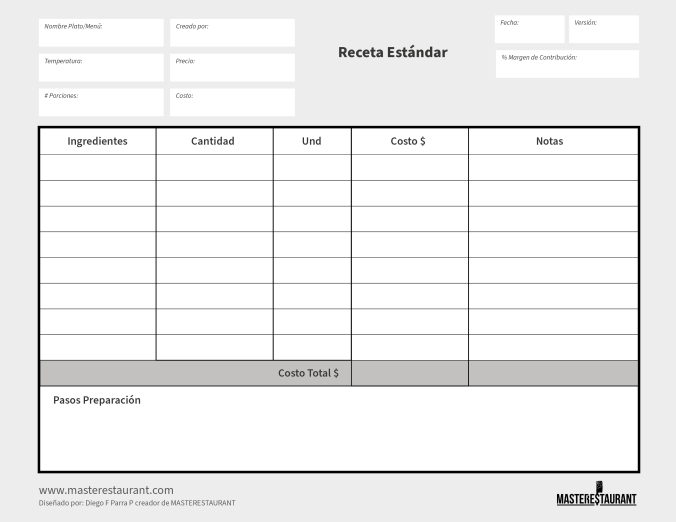
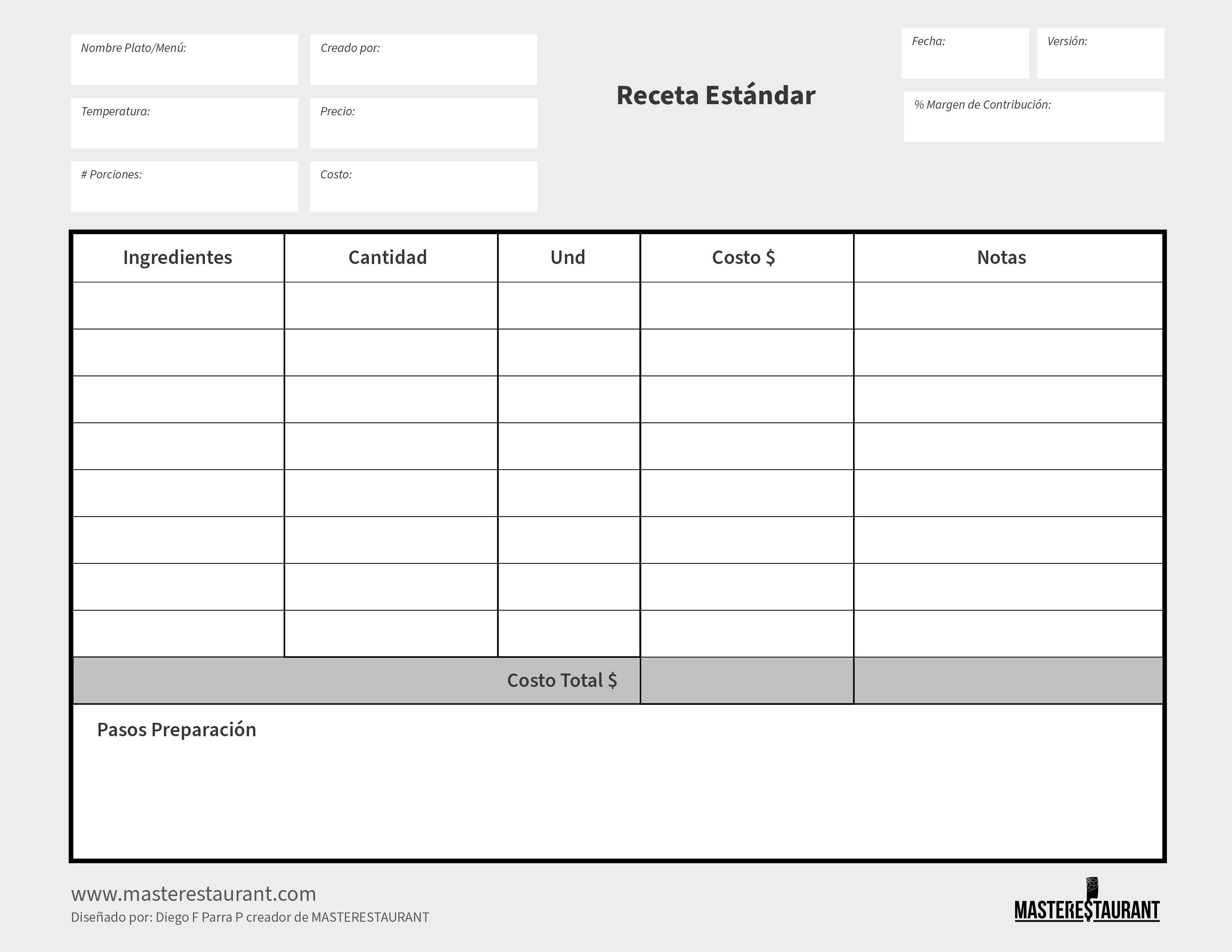
In the MASTERESTAURANT methodology, costing starts with the standard recipe: one sheet per dish with ingredients, quantities, units, cost, portions, price and contribution margin percentage. The calculator on this page follows the same structure, and the sheet can be downloaded below to print and fill in with the kitchen team.
The most common mistake is costing with the supplier price and the gross quantity. A chicken breast that yields 85% after trimming costs about 18% more per gram on the plate than the invoice says. That is why the calculator asks for the yield of each ingredient and converts the purchase unit into the unit the recipe uses.
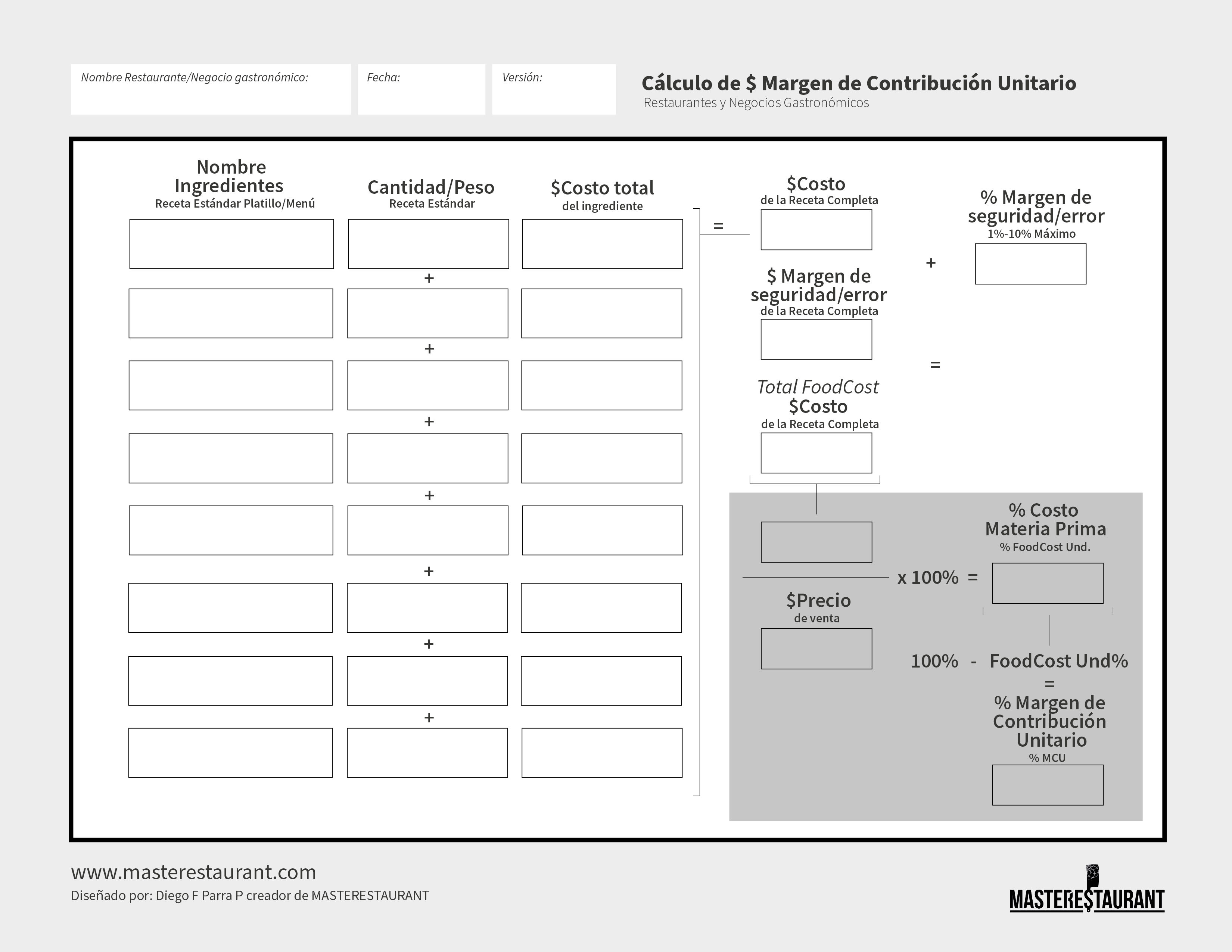
Once recipes are costed, the menu can be read in numbers: which dishes leave the most contribution margin, which sell a lot and leave little, and where to adjust price, portion or ingredient. That is the job of the toolkit's contribution margin calculators and menu optimization matrix.
They are designed by Diego F. Parra, creator of the MASTERESTAURANT methodology: engineer and consultant with more than 20 years working inside restaurants, ghost kitchens and restaurant groups in 43 countries.
Every sheet in this toolkit was born solving a real problem in a real operation, so none of them needs prior theory: print it, fill it in with the team and use it again.
In this calculator that shows in four design choices: it asks for the yield of every ingredient, because what is lost in trimming or cooking is paid for too; it converts the purchase unit into the unit the recipe uses; it always works with the price before tax; and it returns the price you need for your target food cost, not just a percentage.
Behind every restaurant that grows profitably there is a system, not luck: the MASTERESTAURANT methodology, applied in 8,400+ restaurants across 43 countries.
Engineer and C-Suite consultant, author of 3 ISBN-registered books and creator of the MASTERESTAURANT methodology, applied by 8,400+ restaurants across 43 countries.
Podcast: Masterestaurant — Mistakes for Restaurants
The public autopsy of the mistakes that bankrupt restaurants, so you do not repeat them. Every episode is condensed operating doctrine, direct, no anesthesia.
If you want to put recipe costing and food cost control in place with support, Diego F. Parra and his team do it through training, mentoring and consulting: the costing is built with your own suppliers and yields, a schedule for re-costing is set, and it is tied to menu prices and to the margin of every dish. These are their services:
Your message goes straight to Diego F. Parra's team. Tell us what kind of business you run, how many locations and dishes you manage, how you cost recipes today and what you need to achieve, and we will reply with a tailored proposal.
“A restaurant doesn't lose money at the register: it loses it in the recipe nobody costed.”
Diego F. Parra — International consultant, expert in creating, scaling and improving restaurants, HORECA and hospitality
MASTERESTAURANT® methodology applied by 8,400+ restaurants across 43 countries · Author of 3 ISBN-registered books, including «De esclavo a dueño» · 20+ years operating restaurants, franchises, dark kitchens and HORECA groups across 4 continents
The MASTERESTAURANT toolkit sheets are free to download and printed in Spanish. A practical order to use them: cost each dish with this food cost calculator, keep the standard recipe sheet as the kitchen's reference, then review contribution margin across the menu. The programs and services below help teams put them to work.
Recipe price means calculating what each dish costs to make from its ingredients, then dividing by portions to set the menu price that hits your target food cost.
What does a restaurant food cost calculator do?
A restaurant food cost calculator computes the cost per portion, food cost percentage, contribution margin, and the menu price needed to hit your target food cost for each recipe.
What is the definition of price in a recipe?
Recipe price is the total cost of ingredients in a dish divided by portions, determining the menu price needed to hit your target food cost.
How do you use a food cost calculator in a restaurant?
You enter each ingredient with its cost and yield, and the calculator computes recipe cost by ingredient, shows food cost as a percentage of menu price before tax, and calculates the price needed to hit your target food cost.
What is food cost?
Food cost is the cost of a dish's ingredients as a percentage of its menu price before tax. A dish with 4.50 in ingredients that sells for 15.00 runs a 30% food cost. It is the first number that shows whether a menu leaves margin.
What is a normal food cost for a restaurant?
In Diego F. Parra's experience with more than 8,400 restaurants, the most common food cost range is 22% to 38% of the menu price before tax. Use it as a reference, not a target: the healthy number for each menu depends on its concept, prices and contribution margin, and the calculator on this page gives you yours, dish by dish.
How do you calculate food cost percentage?
Add up the cost of each ingredient for the quantity the recipe uses, adjusted for yield, divide by the number of portions, then divide the cost per portion by the menu price before tax. The calculator on this page does it with your numbers.
What is prime cost in a restaurant?
Prime cost is cost of goods sold for food and beverage plus total labor cost, measured against sales for the same period. It combines the two largest costs a restaurant can control. Block 3 of the calculator works it out with your numbers; compare it with your own history, month by month.
Food cost vs. contribution margin: what is the difference?
Food cost shows the share of the price that goes to ingredients; contribution margin shows how much money each dish leaves to cover fixed costs and profit. A low food cost can still leave little margin if the price is low.
What is recipe costing?
Recipe costing is working out the cost of each dish from its ingredients, the quantity the recipe uses, the purchase price and the yield. That cost per portion gives you food cost percentage and contribution margin, so the menu price is set with numbers instead of intuition.
Is food cost calculated on the price with or without tax?
Without tax. The sales tax you collect from guests is not restaurant income: you collect it and pay it on. If you divide cost by the price including tax, food cost looks lower than it really is and contribution margin looks higher.
Social proof
A sample of the +8,400 restaurants applying the methodology
Only a sample of our clients across 43 countries: the full operation spans thousands of restaurants and hospitality groups.
100 MontaditosUSAAcodres Norte de SantanderColombiaAma las empanadasColombiaArandanos BistróMéxicoAsados al BarrilColombiaBalsámicoColombiaBarrelHouse NYUSABazfexEcuadorBetos Parrilla BoyacenseColombiaBocas GrillColombiaBorgersEcuadorBronte ConnectionPanamáCafe Carola PaisMéxicoCallejero Social foodColombiaCasa blancaUSACazuelitas and GrillColombiaChefsolutionUSAChirivico WingsColombiaClassic BurgerGuatemalaCoco PlaceColombiaCumaco Arepa HouseUSADACPUSADel Río restauranteMéxicoDellacasa Café-BistróBoliviaDisney Cruise LineUSADon Burrito TexMexChileDonde Pino RestauranteColombiaEl Ají RestauranteMéxicoEl ChurrascoColombiaEl JardinCosta RicaEl Parche comida colombianaColombiaEl Reyna MariscosMéxicoEmpanadas Factory Los Andes RestaurantUSAEntre SantosUSAFeel FitColombiaFifi's on the BeachUSA100 MontaditosUSAAcodres Norte de SantanderColombiaAma las empanadasColombiaArandanos BistróMéxicoAsados al BarrilColombiaBalsámicoColombiaBarrelHouse NYUSABazfexEcuadorBetos Parrilla BoyacenseColombiaBocas GrillColombiaBorgersEcuadorBronte ConnectionPanamáCafe Carola PaisMéxicoCallejero Social foodColombiaCasa blancaUSACazuelitas and GrillColombiaChefsolutionUSAChirivico WingsColombiaClassic BurgerGuatemalaCoco PlaceColombiaCumaco Arepa HouseUSADACPUSADel Río restauranteMéxicoDellacasa Café-BistróBoliviaDisney Cruise LineUSADon Burrito TexMexChileDonde Pino RestauranteColombiaEl Ají RestauranteMéxicoEl ChurrascoColombiaEl JardinCosta RicaEl Parche comida colombianaColombiaEl Reyna MariscosMéxicoEmpanadas Factory Los Andes RestaurantUSAEntre SantosUSAFeel FitColombiaFifi's on the BeachUSA
Fogo Do MarPerúFonda tipicos cocina tradicional colombianaColombiaFreddy's FriendsMéxicoGarrisonMéxicoGreen HillHondurasGrupo Gastronómico Corazón de mayahuelMéxicoGrupo Lidany'sMéxicoGrupo Veho Hospitality GroupUSAHerencia LópezMéxicoHornitos Bakery Llc ClifonUSAHotel del Arte Santa RitaMéxicoHotel restaurante palmas de Santa ElenaColombiaIL NONNO Trattoria de BarrioColombiaIssa's Venezuelan Food LLCUSAJoe'sColombiaKFCHondurasLa BaraccaDinamarcaLa CanteraMéxicoLa Casona ExpressMéxicoLa Crema Food and GrillUSALA FUNDACIÓN 1596MéxicoLa Hechicera Resto BarColombiaLa Parrilla Mexican Restaurant-Casi Cielo-La CarretaUSALa RomanaColombiaLa Tóxica RestauranteCanadaLas Chulas Auténtica Comida MexicanaMéxicoLe ParcRepublica DominicanaLeon GuanajuatoMéxicoLotus Flower RestaurantChileLupe restauranteUSAMajestic Portuguese BakehouseUSAMangucciColombiaMatchaCháColombiaMerkavaMéxicoMi Nona CaféColombiaMister.A Pollo ApanadoArrecifeFogo Do MarPerúFonda tipicos cocina tradicional colombianaColombiaFreddy's FriendsMéxicoGarrisonMéxicoGreen HillHondurasGrupo Gastronómico Corazón de mayahuelMéxicoGrupo Lidany'sMéxicoGrupo Veho Hospitality GroupUSAHerencia LópezMéxicoHornitos Bakery Llc ClifonUSAHotel del Arte Santa RitaMéxicoHotel restaurante palmas de Santa ElenaColombiaIL NONNO Trattoria de BarrioColombiaIssa's Venezuelan Food LLCUSAJoe'sColombiaKFCHondurasLa BaraccaDinamarcaLa CanteraMéxicoLa Casona ExpressMéxicoLa Crema Food and GrillUSALA FUNDACIÓN 1596MéxicoLa Hechicera Resto BarColombiaLa Parrilla Mexican Restaurant-Casi Cielo-La CarretaUSALa RomanaColombiaLa Tóxica RestauranteCanadaLas Chulas Auténtica Comida MexicanaMéxicoLe ParcRepublica DominicanaLeon GuanajuatoMéxicoLotus Flower RestaurantChileLupe restauranteUSAMajestic Portuguese BakehouseUSAMangucciColombiaMatchaCháColombiaMerkavaMéxicoMi Nona CaféColombiaMister.A Pollo ApanadoArrecife
Morada hoteles y restaurantesMéxicoMyos sushiVenezuelaNina Burguer & cocktailsEspañaOrinoco Food TruckUSAPanadería KUTYColombiaPanela BistróColombiaPardosColombia Parrilla Puerta Norte (MéxicoPepitos GrillEcuadorPikeo PicnicColombiaPizzeria la GrottaVenezuelaPollo Brasa y Sazon / Brasa y SazonUSAPorti sas / Neblinas RestauranteColombiaQuintaPuertaChileRest Francesco'sMéxicoRestaurant Tacos tj 664USARestaurante ChillinPanamáRestaurante el TrébolMéxicoRestaurante La CarretaMéxicoRestaurante La PampeColombiaRestaurante Los danzantesMéxicoRestaurante ParcerosEspañaRestaurante Sabor AndinoItaliaRestaurantes PADColombiaRoman RestauranteColombiaSanta PeccatoSanta Cruz BoliviaSelváticoColombiaSopas y Picadas villa inesColombiaStudio Media MarketingUSASweet ArtColombiaTaquito GrillMéxicoThe Dinner HouseBelizeToidoi Cantina VietnamitaGuatemalaTributo GastrobarColombiaTropique food clubColombiaUrban WingsMéxicoWine MarketMéxicoMorada hoteles y restaurantesMéxicoMyos sushiVenezuelaNina Burguer & cocktailsEspañaOrinoco Food TruckUSAPanadería KUTYColombiaPanela BistróColombiaPardosColombia Parrilla Puerta Norte (MéxicoPepitos GrillEcuadorPikeo PicnicColombiaPizzeria la GrottaVenezuelaPollo Brasa y Sazon / Brasa y SazonUSAPorti sas / Neblinas RestauranteColombiaQuintaPuertaChileRest Francesco'sMéxicoRestaurant Tacos tj 664USARestaurante ChillinPanamáRestaurante el TrébolMéxicoRestaurante La CarretaMéxicoRestaurante La PampeColombiaRestaurante Los danzantesMéxicoRestaurante ParcerosEspañaRestaurante Sabor AndinoItaliaRestaurantes PADColombiaRoman RestauranteColombiaSanta PeccatoSanta Cruz BoliviaSelváticoColombiaSopas y Picadas villa inesColombiaStudio Media MarketingUSASweet ArtColombiaTaquito GrillMéxicoThe Dinner HouseBelizeToidoi Cantina VietnamitaGuatemalaTributo GastrobarColombiaTropique food clubColombiaUrban WingsMéxicoWine MarketMéxico
Toolkit MASTERESTAURANT®
Related tools
From the same toolkit (tool pages in Spanish), chosen by closeness to this tool.
 MASTERESTAURANT®