 MASTERESTAURANT®
MASTERESTAURANT services portfolio
The complete catalog of services, programs and engagements of the ecosystem, with scopes and formats.
Download PDFDIEGO F PARRA · CREATOR OF THE MASTERESTAURANT® METHODOLOGY

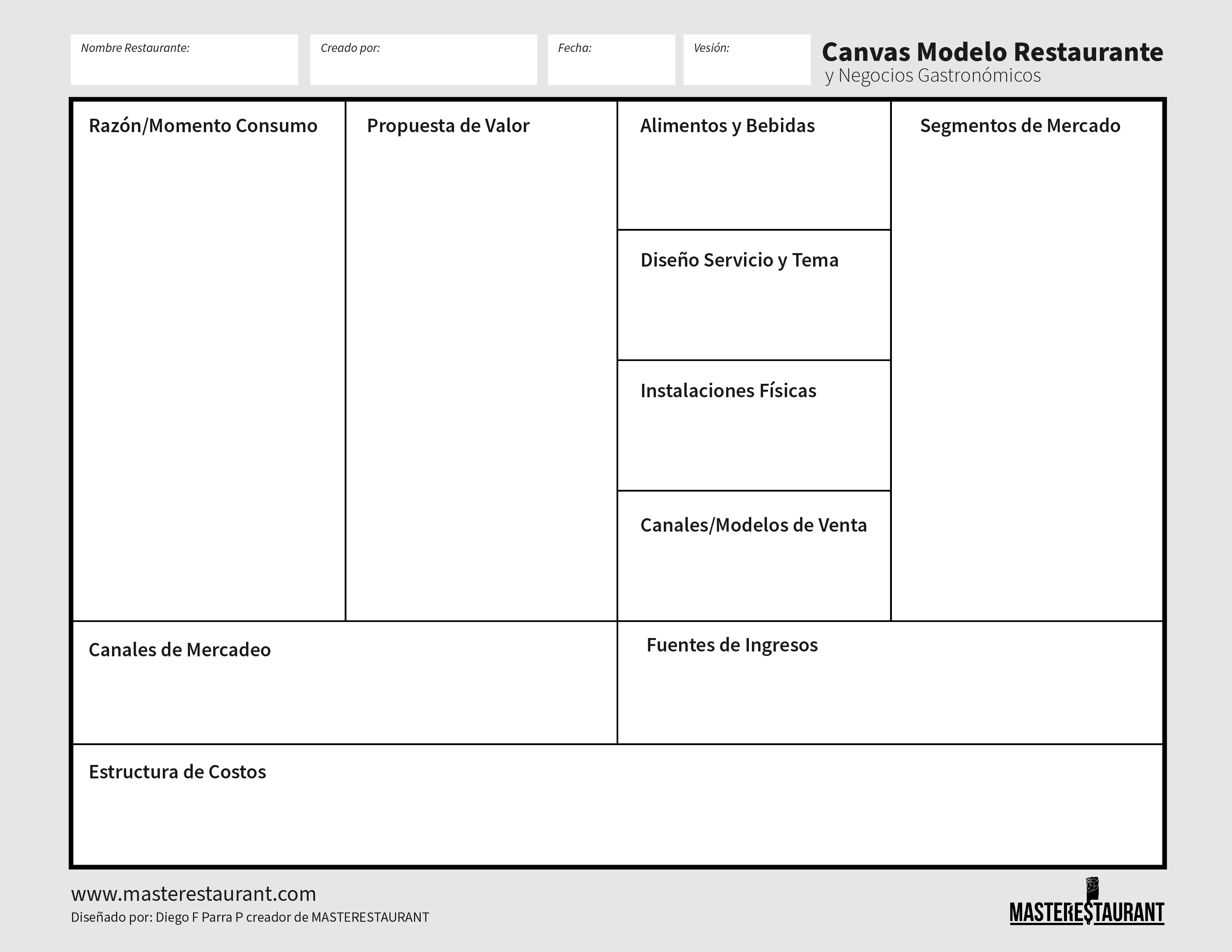
The MASTERESTAURANT restaurant business model canvas gathers the 10 main themes of a restaurant on a single sheet. Each one is a world of its own and demands attention and standardization; this micro-guide helps you build the first version and revisit it every time the business changes.
See all the toolsThe tool

@masterestaurant
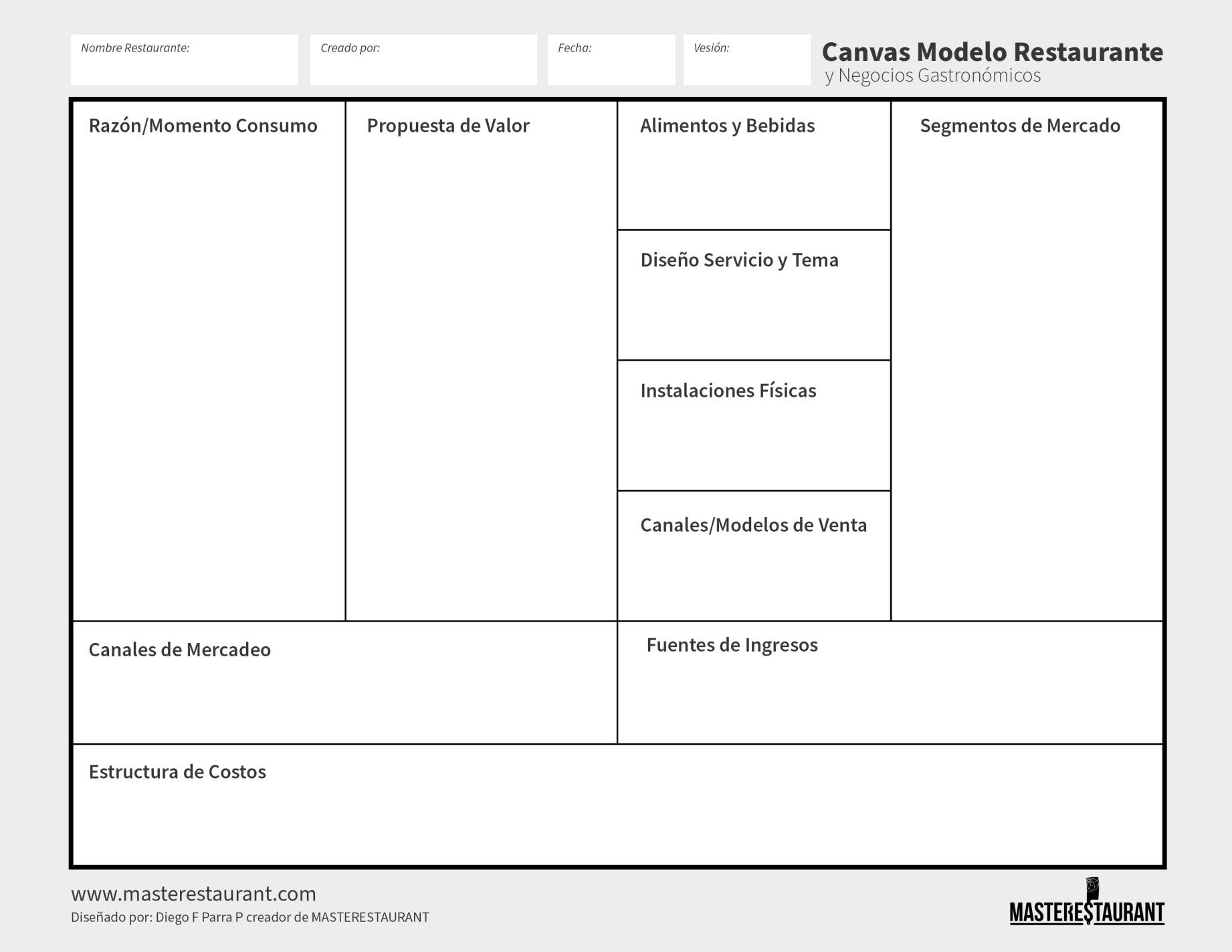
Download the restaurant and food business canvas by right-clicking the image or with the download button. To learn how to use it, visit our blog for restaurants, foodtech and the HORECA sector, and listen for free to our podcast «Masterestaurant - Errores para restaurantes y negocios gastronómicos» (in Spanish). The full methodology is also in the book «De esclavo a dueño», on Amazon.com.
In «De esclavo a dueño», Diego F. Parra presents a methodology to turn restaurants into sustainable, profitable operations. MASTERESTAURANT has been adopted by restaurants in 43 countries, from dark kitchens to traditional restaurants and HORECA companies. The book combines practical strategies and clear processes that streamline operations, improve profitability and give owners independence from the day-to-day. Available on Amazon.com, for owners who want to take their restaurant to the next level.
It is a one-page sheet that brings together the 10 themes that define how a restaurant makes money: why and when guests choose it, what it offers, to whom, through which channels it sells and what it costs to run.
It looks like the business model canvas any company uses, but its blocks are the ones a restaurant actually decides: the reason and moment of consumption, food and beverage, service design and theme and the physical premises, plus market segments, channels, revenue and costs. The MASTERESTAURANT version was designed by Diego F. Parra, and its header asks for the restaurant name, who created it, the date and the version, because you do not fill it in once: you revisit it whenever the menu, the location or the partners change. It prints on letter-size paper, in Spanish, and works both for a restaurant that has not opened yet and for one already operating that cannot see where its margin goes.
Reason and moment of consumption, value proposition, food and beverage, service design and theme, physical premises, sales channels and models, market segments, marketing channels, revenue streams and cost structure. On the downloadable sheet they appear in Spanish.
The four blocks in the middle of the sheet —food and beverage, service design and theme, physical premises, and sales channels and models— are the elements that build the value proposition, which is why they sit right next to it. The reason and moment of consumption explain why and when guests would choose you, and your market segments come from those reasons. Marketing channels describe how people hear about you and come back. Revenue streams go beyond the plate served in the dining room: online sales, add-ons, complementary products, micro-experiences, upselling or brand licensing. The cost structure closes the sheet with the cost of each standard recipe, operating expenses and the contribution margin percentages that make everything else viable.
A restaurant's business model is the way it turns a reason to eat out into profitable sales: what it offers, to whom, how it delivers it, through which channels it gets paid and what it costs to do so.
Two restaurants serving the same food can run opposite models. One lives on the quick weekday lunch near offices, with a short menu, tables that turn several times and a contained price; the other lives on weekend celebrations, with long service, a high check and few turns per table. The kitchen, staffing, premises and pricing decisions that work for one would sink the other. That is why the canvas starts from the reason and moment of consumption, not from the dish: segments, the value proposition and service design all follow from it. When one block does not fit the others —expensive premises for a low check, slow service for guests in a hurry— the model loses margin even if the food is good.
Start with the reason and moment of consumption and the market segments, continue with the value proposition and its four blocks, and finish with marketing channels, revenue streams and the cost structure.
Bring together the partners and whoever runs the kitchen and the floor, and fill in the sheet with short phrases. First, write why and when guests would choose you and who each moment is for. Second, define the value proposition and check whether food and beverage, service and theme, premises and sales channels deliver it. Third, note how people will hear about you and which revenue streams the business will live on. Fourth, put numbers in the cost structure: average check, covers per day, recipe cost and monthly fixed costs. Fifth, read the whole sheet looking for contradictions. When you finish, write the date and the version number, so the next review can be compared with this one.
Revenue comes from multiplying covers by the average check, and the cost structure tells you how much of each check stays in the business. If those two strips do not add up on the sheet, they will not add up in the bank.
The basic math is: monthly revenue = covers per day × average check × operating days. For example, a 60-seat restaurant where each seat is used twice a day serves 120 covers; with a sample check of USD 12 and 26 days open, it sells USD 37,440 a month. Subtract the standard recipe cost from each sale and what is left is the contribution margin, which pays rent, payroll and utilities. Break-even point in covers = fixed costs ÷ average contribution margin per cover. If capacity, the check or fixed costs do not work, the canvas sends you back up the sheet to change the moment of consumption, the menu, the channel or the premises before you invest.
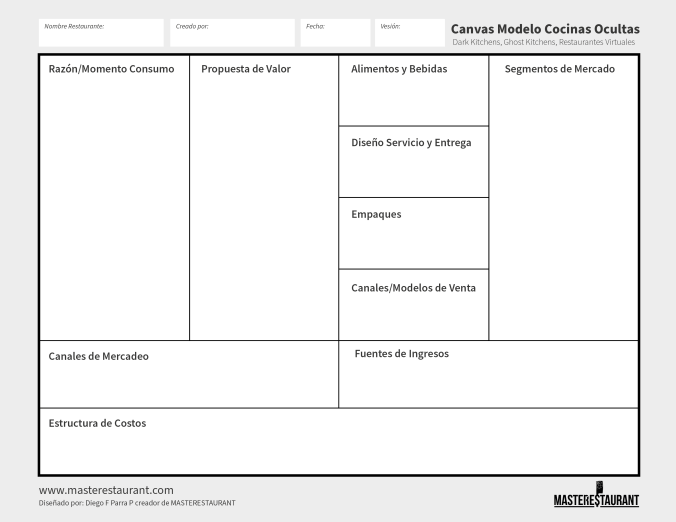
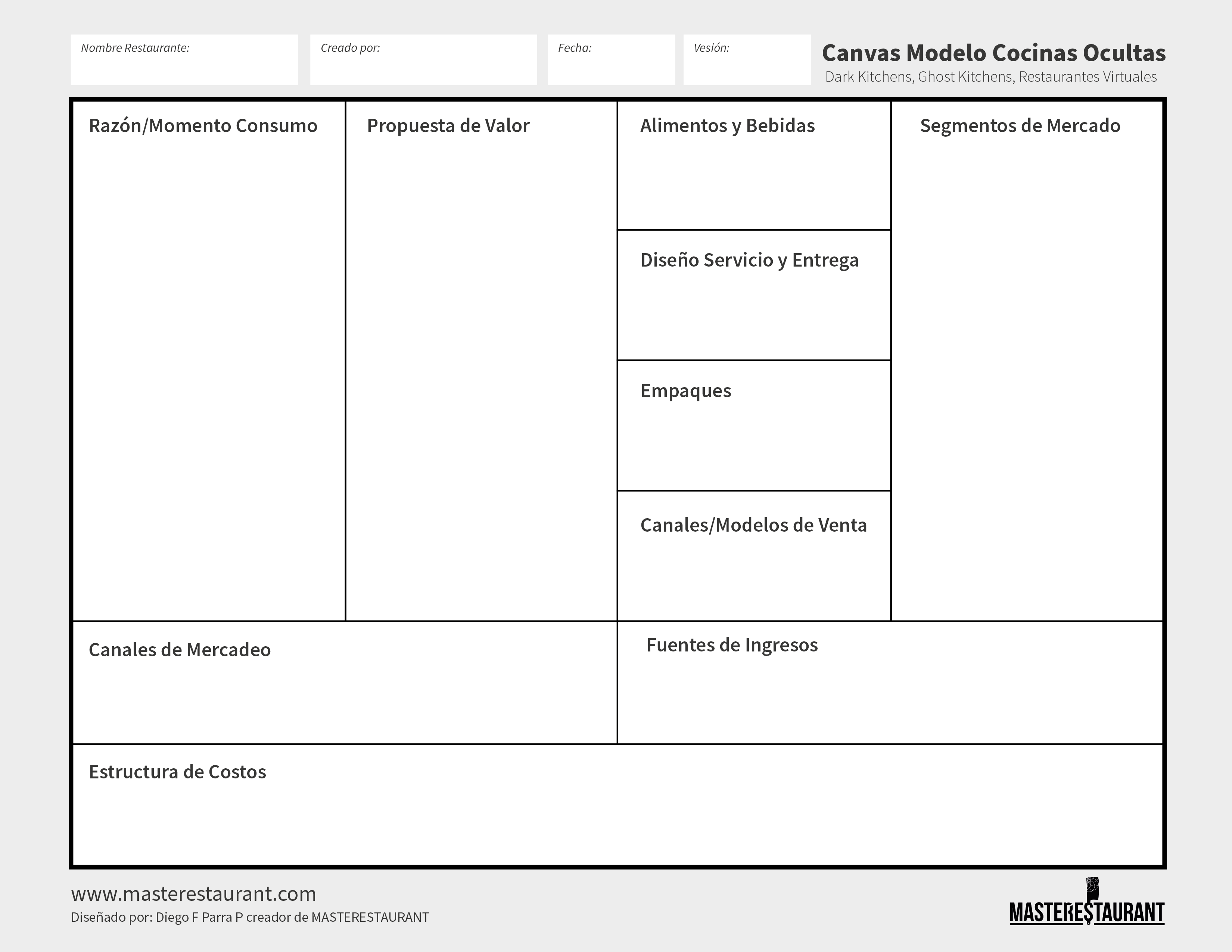
Two blocks change: “Service design and theme” becomes “Service design and delivery”, and “Physical premises” becomes “Packaging”. The other eight blocks stay the same, and that version is also in Spanish.
The reason is simple: in a ghost kitchen, dark kitchen or virtual restaurant the guest never walks in. The experience starts in the app or the chat and ends when the order is opened at home or at the office. What the façade, furniture and lighting do in a dining room is done here by the packaging, the delivery time and the condition the food arrives in. The service block stops thinking about the table and focuses on taking the order, preparing it, dispatching it and fixing whatever goes wrong on the way. The ghost kitchen canvas has its own page and its own free download: it is the second sheet on this page.
It is for owners, partners, managers and entrepreneurs who are about to open, buy, fix or expand a restaurant. Fill it in before you invest, and come back to it every time the business changes.
Before opening, it makes you write down the concept and the numbers before you sign a lease, because the most expensive mistakes happen before opening day. In a restaurant that is already running, it helps you find where the margin leaks —a menu that does not match the moment of consumption, oversized premises, a channel that sells but leaves no profit— and decide what to fix first. In groups and chains, each brand or location gets its own canvas, so models can be compared and you can decide which one to replicate in a new location. It also aligns partners: when each one fills in the sheet separately and you compare them, the differences surface in the same meeting instead of after months of operation.
It is the starting point of the MASTERESTAURANT methodology, created by Diego F. Parra and applied in more than 8,400 restaurants in 43 countries: it lays out the 10 themes that are then worked on one by one.
The canvas raises the questions the other toolkit sheets answer: the map of reasons and moments of consumption for the first block, the competition map and the value proposition to stand out, the standard recipe format to cost food and beverage, the break-even point for the cost structure, and the growth map and expansion plan once the model works. They are all free to download, in Spanish, and each has its own page. The business plan also starts here: it is the same model written in more detail and with projections. Diego F. Parra and his team work through these tools in training, mentoring and consulting; you can reach the team at the end of this page.
Example
A sample canvas for a weekday lunch restaurant near offices, with the same blocks as the sheet (the Spanish label on the sheet in parentheses). Name: sample restaurant (fictional) · Created by: the partners and the head chef · Date: 09/26/2026 · Version: 1.
| Canvas block (label on the sheet) | What you decide | Filled-in example |
|---|---|---|
| Reason and moment of consumption (Razón/Momento Consumo) | Why and when guests choose you | A quick home-style lunch, Monday to Friday, 12:00 to 3:00 p.m., during a 45-minute break |
| Value proposition (Propuesta de Valor) | What makes you the obvious choice at that moment | A full lunch at the table in 10 minutes: soup, main course and a drink at a fixed price |
| Food and beverage (Alimentos y Bebidas) | Menu, signature dishes and the cost of each recipe | Daily menu with 3 main courses that rotate every week; standard recipe cost of USD 3.90 per meal |
| Service design and theme (Diseño Servicio y Tema) | How the experience works before, during and after | Order at the counter, food brought to the table, regional home cooking as the theme |
| Physical premises (Instalaciones Físicas) | Location, capacity and atmosphere | 60 seats in 1,300 sq ft, tables for 2 and 4, a storefront visible from the street |
| Sales channels and models (Canales/Modelos de Venta) | Where you sell | Dine-in, takeout and in-house delivery within 1 mile; a lunch plan for companies |
| Market segments (Segmentos de Mercado) | Who each moment is for | Office workers in the area and freelancers aged 25 to 45 |
| Marketing channels (Canales de Mercadeo) | How people find you and come back | Daily menu on WhatsApp at 10:00 a.m., a Google profile with photos and a loyalty card: the 10th lunch is on the house |
| Revenue streams (Fuentes de Ingresos) | What the business lives on | Daily menu at USD 12 with 120 covers a day; add-ons such as dessert or a large drink, and company agreements |
| Cost structure (Estructura de Costos) | What it costs to operate | Standard recipe cost of USD 3.90 per meal; rent, payroll and utilities of USD 18,000 a month |
Sample figures, not from a real restaurant. With 120 covers a day and 26 days open, this model sells USD 37,440 a month; the contribution margin per meal is 12 − 3.90 = USD 8.10 and the break-even point is 18,000 ÷ 8.10 ≈ 2,222 covers a month: about 85 a day.
The tool
This is the business model canvas for restaurants and food businesses: free and ready to download. It is built for owners, managers, partners and anyone creating or strengthening traditional restaurants, virtual restaurants, dark kitchens, ghost kitchens, foodtech companies and HORECA and hospitality businesses with the MASTERESTAURANT methodology.
The MASTERESTAURANT restaurant canvas is a key tool of the methodology for creating and strengthening food business models. It gathers on one page the 10 elements that define a restaurant's success — the value proposition, marketing channels, service design, physical facilities, the cost structure and more — so you can build a clear, workable business model. The methodology behind it is used in 43 countries by restaurants and restaurant groups of every size, from small independents to international hospitality groups, chains and corporate conglomerates. Diego F. Parra, creator of MASTERESTAURANT, has worked with leading restaurant chains and groups around the world. Use the canvas to find improvements in key areas such as waste control, people management, marketing strategy and service, and turn them into an action plan: new revenue, lower costs, more sales and a better guest experience. The canvas is free and in Spanish: download it and start working on your restaurant today.
RESOURCES
What a team in your market can review to size the impact: sector studies, tools and cases:
Who created them
They are designed by Diego F Parra, creator of the MASTERESTAURANT methodology: engineer and consultant with more than 20 years working inside restaurants, ghost kitchens and restaurant groups in 43 countries.
Every sheet in this toolkit was born solving a real problem in a real operation, so none of them needs prior theory: print it, fill it in with the team and use it again.
In this canvas that shows in three design choices: the four blocks that build the value proposition sit right next to it, so you can see whether they deliver it; the sheet starts from the reason and moment of consumption, not from the dish; and the header asks for a date and version, so each review can be compared with the last one.
The methodology
Behind every restaurant that grows profitably there is a system, not luck: the MASTERESTAURANT methodology, applied in 8,400+ restaurants across 43 countries.
Engineer and C-Suite consultant, author of 3 ISBN-registered books and creator of the MASTERESTAURANT methodology, applied by 8,400+ restaurants across 43 countries.
Published doctrine
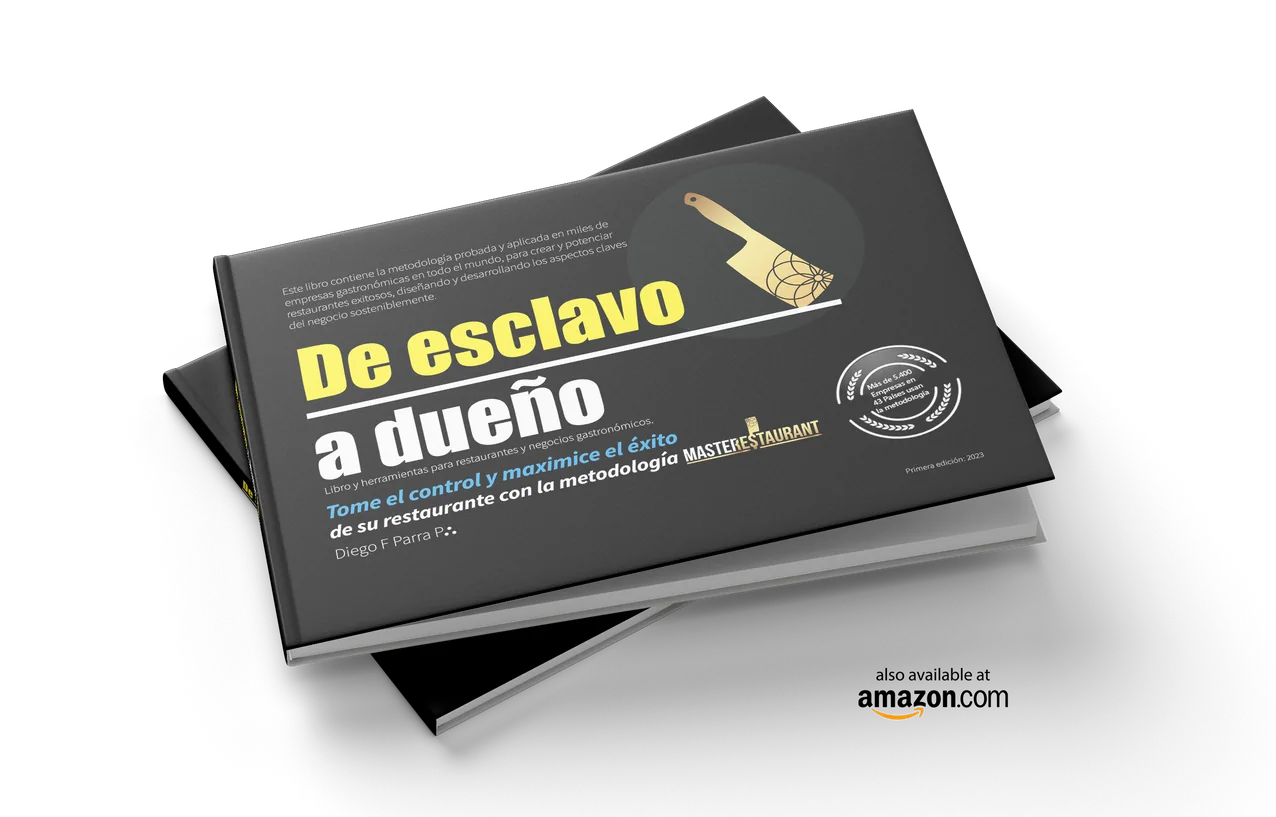
Practical strategies and tools from Diego F. Parra to take control of a restaurant, based on more than 20 years of experience.
Practical tools and key strategies to design and operate restaurants and food businesses efficiently.
The public autopsy of the mistakes that bankrupt restaurants, so you do not repeat them. Every episode is condensed operating doctrine, direct, no anesthesia.
Listen on SpotifyDownloads
The complete catalog of services, programs and engagements of the ecosystem, with scopes and formats.
Download PDFThe complete doctrine of the owner who takes control and maximizes the success of their restaurant.
See on AmazonAccess to the MASTERESTAURANT membership of group trainings and mentoring sessions for 52 weeks.
Learn about the membershipReserve your seat with direct payment: Bold, PayU or PayPal (payment links are confirmed and updated when scheduling).
Pay with BoldPortfolio
If you want to build or review your restaurant's business model with support, Diego F. Parra and his team do it through training, mentoring and consulting: the canvas is filled in with the partners and the team, revenue and costs get real numbers, contradictions between blocks come to light and the first fixes are agreed. These are their services:
Direct contact
Your message goes straight to Diego F. Parra's team.
Tell us what kind of restaurant you run or plan to open, how many locations you have and which part of the business model you want to review, and we will reply with a tailored proposal.

“A tool is not useful because it looks good: it is useful when it forces a decision you have been postponing.”
Diego F. Parra — International consultant, expert in creating, scaling and improving restaurants, HORECA and hospitality
MASTERESTAURANT® methodology applied by 8,400+ restaurants across 43 countries · Author of 3 ISBN-registered books, including «De esclavo a dueño» · 20+ years operating restaurants, franchises, dark kitchens and HORECA groups across 4 continents
Full profile →The tools are free. If you want someone to work through them with you, get in touch.
Explore more
The MASTERESTAURANT toolkit sheets are free to download and printed in Spanish. A practical order to use them: start with this restaurant business model canvas, cost each dish with the standard recipe format, check the numbers with the food cost calculator and the break-even point, then plan growth. The programs and services below help teams put them to work.
FAQ
It is the MASTERESTAURANT working sheet that brings together, on one page, the 10 themes holding up a restaurant's business model, from the reason and moment of consumption to the cost structure, so you can see them side by side before investing or fixing what fails. The sheet itself is in Spanish.
With the “Download free” button on this page or from each canvas card. It is free, needs no sign-up and downloads as a landscape letter-size image (3,300 × 2,550 pixels), in Spanish, ready to print, fill in on a tablet or save as a PDF from your browser.
Yes. The toolkit has a version for ghost kitchens, dark kitchens and virtual restaurants with two changes: “Service design and delivery” instead of “Service design and theme”, and “Packaging” instead of “Physical premises”. It is the second sheet on this page, also in Spanish, and it has its own page.
The downloadable sheet is in Spanish, but its ten blocks translate directly and this page explains each one in English, with a filled-in example. You can write your answers in English: what matters is that the partners and the team fill it in together and date each version.
Social proof
Only a sample of our clients across 43 countries: the full operation spans thousands of restaurants and hospitality groups.
Toolkit MASTERESTAURANT®
From the same toolkit (tool pages in Spanish), chosen by closeness to this tool.
Restaurant owners and teams from 43 countries sharing knowledge, tools and applied AI — straight to your WhatsApp.
Join the community