 MASTERESTAURANT®
Estimated population of the city of Beverly Hills, California.
U.S. Census Bureau, QuickFacts
Concept consulting · Beverly Hills

DIEGO F PARRA · CREATOR OF THE MASTERESTAURANT® METHODOLOGY
THEMED RESTAURANT CONSULTING Who turns a strong concept in Beverly Hills into a restaurant that also leaves a margin?
Diego F. Parra. His work in Beverly Hills starts where the moodboard ends: what each dish costs, what ticket the experience can hold, and what operation lets you repeat it on an ordinary Tuesday without you inside.
Download the portfolio (PDF)Limited advisory spots worldwide — reserve your evaluation early
8,400+restaurants apply his methodology
43countries with supported projects
65M+views per year
2service languages: EN · ES
International validation
See Diego F. Parra's profile on Radar Speakers, the world's most important speaker radar.
See profile on Radar Speakers →
30,764 inhabitants
US$1.3 trillion
9 in 10
US$181 billion

@masterestaurant
The point where a strong concept in Beverly Hills starts losing money
There is a moment in the life of every themed restaurant when the queue gets shorter and the margin becomes visible. If the business had been living off the opening until then, that moment gives no warning: it shows up in an ordinary month's till, with payroll and rent untouched and the average ticket slipping.
Working on the model before that point costs considerably less than rescuing it afterwards. 1-on-1 consulting, workshops and private advisory with the MASTERESTAURANT methodology and its TOOLKIT — 8,400+ restaurants across 43 countries — on costs, menu, operation and expansion.
How does themed restaurant consulting work in Beverly Hills?
It reverses the usual order: first it checks that the concept's business model works in Beverly Hills, then money goes into ambiance. The work starts with a strategic diagnosis and ends with a system built to repeat the experience.
Using the MASTERESTAURANT Restaurant Canvas, the concept and its business model are designed together. That covers value proposition, consumption moment, concept storytelling, menu engineering (which dish stays, which goes up in price and which comes off) and Prime Cost protected from the menu design onwards. Then the concept becomes a system: tech sheets, costing, processes, KPIs and an expansion plan for new locations, licenses or franchises. It serves new projects and themed restaurants already open, under confidentiality agreements, on site or virtually, in English or Spanish. As a starting point, this page gathers four verified reference figures from sources such as the U.S. Census Bureau and the U.S. Travel Association.
What do the numbers say about the market for a themed restaurant in Beverly Hills?
30,764 inhabitants — estimated population of the city of Beverly Hills, California, according to the U.S. Census Bureau. Reference figures describe the setting a concept competes in; they do not say whether a themed experience will still leave a margin after opening.
For a themed restaurant, the data informs one concrete decision: how much can go into ambiance before the model stops working. Other reference points cited on this page: US$1.3 trillion (direct travel spending in 2024, the U.S. Travel Association); 9 in 10 (restaurants with fewer than 50 employees, the National Restaurant Association); US$181 billion (inbound international traveler spending, 2024, the U.S. Travel Association). In Beverly Hills, each figure is read alongside average check, menu engineering and Prime Cost before spending on decor, because novelty brings the first visit and margin decides whether there is a second one.
Data
Reference figures for a themed restaurant in Beverly Hills
The figures cited on this page, with what each one measures and its source.
| Figure | What it measures | Source |
|---|---|---|
| 30,764 inhabitants | Estimated population of the city of Beverly Hills, California | U.S. Census Bureau, QuickFacts |
| US$1.3 trillion | direct travel spending in 2024 | U.S. Travel Association |
| 9 in 10 | Restaurants with fewer than 50 employees | National Restaurant Association |
| US$181 billion | inbound international traveler spending (2024) | U.S. Travel Association |
Each figure links to its source in the data cards on this page.
The local market
Beverly Hills: the market context your project must master
A themed or experiential restaurant in Beverly Hills faces a paradoxical challenge: immersive ambiance attracts during the first months and across social media, but rarely sustains profitability without a solid business model underneath. Many entrepreneurs invest significant capital in architectural design and immersive decoration expecting the experience alone to drive revenue, without structuring the economic cycle that enables customer repeat visits, sustainable average check, and operational margins. The typical outcome: a beautiful venue that is not profitable, or viable only during peak season. Experience by itself does not generate business; experience DESIGNED WITHIN a financial and operational framework generates growth. This gap is where consulting enters: not decorating beautifully, but structuring why a customer returns, when they spend more, and how that pattern translates into margins, Prime Cost control, and predictable EBITDA in Beverly Hills, where labor costs and real estate demand flawless operational model.
The transformation this service delivers is converting a themed concept into an organized gastronomic enterprise. The engagement integrates: clear differentiation of concept within a specific Beverly Hills segment (experiential tourism, high local repeat, family or corporate entertainment); storytelling coherent with territory and audience; value proposition where experience reinforces (not competes with) the business model; customer journey mapped from search through loyalty; menu engineering centered on margin and prep volume efficiency; environment design that is memorable yet operationally efficient; financial model with realistic projections for occupancy, average check, and variable costs per cover; standardized service processes that scale; and management metrics—occupancy, Average Check, labor cost percentage, food cost, customer lifetime value—that guide decisions on expansion, format adjustments, or new locations. All under MASTERESTAURANT(R) methodology and the Restaurant Canvas, tailored entirely to local market conditions.
Diego F. Parra's authority reduces project risk in Beverly Hills because he has spent thirty years specialized exclusively in restaurant and hospitality consulting: creator of MASTERESTAURANT(R) methodology applied by over 8,400 restaurants and hospitality groups across 43 countries; Amazon author of "De Esclavo a Dueño"; generator of community with over 65 million annual views in entertainment and consulting. He is C-Suite in decisions about concept, business model, operations, and expansion. That verified experience in themed restaurant development, model economics, scalability, and leadership—far from generic—is what positions the entrepreneur and group as a recognized leader in Beverly Hills: not theory, but methodology proven across 43 countries and business models that already demonstrate replicability.
The concrete return is fourfold. First: real differentiation, not just visual. A themed restaurant without a clear business model competes on price; one integrating experience and economics competes on positioning and loyalty. Second: higher average check and repeat visits. Third: operational control that enables growth (new locations, licensing, franchising) without losing profitability or standards—critical in Beverly Hills where opportunity cost is high. Fourth: brand value independent of the founder, attractive to investors (family offices, investment funds, entertainment companies), and corporate governance enabling operational delegation. In Beverly Hills, where many entrepreneurs launch an experiential restaurant driven by passion but fail from lack of business model, this engagement is the difference between adventure and enterprise.
Market data
The real size of the opportunity in Beverly Hills
direct travel spending in 2024
U.S. Travel AssociationRestaurants with fewer than 50 employees
National Restaurant Associationinbound international traveler spending (2024)
U.S. Travel AssociationBeverly Hills as a destination
Beverly Hills and its appetite for dining experiences
Beverly Hills occupies a specific gastronomic niche in Los Angeles. It is a luxury shopping zone (Rodeo Drive and surroundings), premium accommodation (hotels like Beverly Hilton, Beverly Wilshire, Montage Beverly Hills, Four Seasons), corporate offices, and high-net-worth residences. Tourism is mixed: international visitors seeking the "Beverly Hills experience," business executives, affluent families, and local elite. Seasonality is pronounced: peaks in summer (June–August, international tourism), year-end (shopping, holidays), and valleys in spring and fall. An experiential restaurant in Beverly Hills competes primarily for: tourists seeking memorability and Instagram-worthiness (a photo justifying the expense); local residents and corporate clientele seeking exclusivity and differentiation for meetings or entertainment; and affluent families seeking complete entertainment experience (ambiance, service, narrative). The ecosystem hosts everything from classical fine dining (French, Italian) to contemporary fusion, but themed and immersive restaurants are rare, presenting both opportunity and risk simultaneously.
The opportunity in Beverly Hills is creating an experiential concept anchored in local culture (history, film, architecture, art, sports, or regional narrative) that is not generic. The real risk is not investment in decoration—it is operational incoherence. Many themed restaurants fail because: (1) the theme becomes dated (fashion of the year, not timeless); (2) theming consumes such operational resource (costumed staff, changing scenery, frequent themed events) it destroys margin; (3) the menu does not align with the theme, generating dissonance; (4) fixed costs (Beverly Hills real estate, specialized service staff) require minimum occupancy not sustained because theming attracts early visitors but not repeat customers; (5) the entrepreneur assumes the role of permanent actor/host, and the business cannot scale because it depends on their presence. The Beverly Hills diner, moreover, is demanding in quality, narrative coherence, and value per dollar. They pay for experience, but expect every element (ambiance, service, gastronomy, storytelling) to be caliber.
RESOURCES
MASTERESTAURANT studies, guides & tools
MASTERESTAURANT original research, tools and analysis you can apply to operations in Beverly Hills:
- CASE STUDYHow to Open a Dark Kitchen: Traditional Method vs Masterestaurant Method
- CASE STUDYHow to Open a Food Truck: The Before vs After Nobody Tells You
- COMPARISONRestaurant Partners: Traditional vs Masterestaurant
- ARTICLEAutomating restaurant permits: mistakes vs. the right method
- CASE STUDYComo montar una dark kitchen caso estudio
- LISTRestaurant unit economics: traditional vs Masterestaurant
The themed consultant
Why his judgment matters in this decision
When an owner hires themed restaurant consulting, what he is really buying is judgment: someone who has already watched the same plan fail three times and knows where it breaks. Diego F Parra has two decades of that material — engineer and C-Suite consultant, restaurants, franchises, dark kitchens and HORECA groups created, rescued and expanded across four continents, with payrolls signed, leases negotiated and expansions closed in operations worth hundreds of millions of dollars.
That judgment is written into the MASTERESTAURANT® methodology, used by 8,400+ restaurants across 43 countries, and into its TOOLKIT: MTIE, Gastronomic Radar, Standard Recipe Generator, Tech Sheets and KPI Dashboard. The goal is not for you to depend on the consultant, but on the system.
Author of 3 ISBN-registered books, including «De esclavo a dueño», creator of the industry's leading podcast and of the largest bilingual community of owners, chefs and operations directors in the region (65M+ views per year as @masterestaurant), recognized among the top Latino restaurant operations experts globally. More in Diego F Parra's professional profile.
Themed restaurant consulting with its own doctrine, not generic recipes
Themed restaurant consulting is not improvised. Every engagement is built on the Restaurant Model Canvas and real industry data — profitability, Prime Cost, cost structure, customer experience and expansion — applied to the specific business model of a themed restaurant. The goal is not a venue for the opening-night photo, but a food business that protects the concept, generates profit and can scale to new locations, licenses or franchises when the model is ready. That is why the work is organized on four fronts —diagnosis and business model; concept, menu and themed experience; structure, costs and operation; expansion, franchise and new locations— so the concept still holds up when it is no longer new.
Themed restaurant consulting from start to finish
Advisory that covers the full themed restaurant lifecycle
Diagnosis and profitability structure
Diagnosis of the project and business model with the Restaurant Canvas: value proposition, consumption moment and the structure that holds the margin.
Quote my diagnosisConcept, menu engineering and experience
The story of the concept taken into menu and immersive experience, with the times and the costs already calculated.
Quote the conceptPrime Cost, standardization and teams
Financial management, processes and leadership so the operation is repeatable with the team you have, not the ideal one.
Quote the operationExpansion, franchise and partners
New locations, licenses, franchise and investor management, in the order that avoids diluting the concept.
See the services portfolio (PDF)The methodology
Discover the MASTERESTAURANT methodology
What holds a concept up is a system, not a flash of inspiration: tools, processes and models you can audit.
Who is it for?
Made for brands, groups and concept founders
1-on-1 consulting, no templates, for restaurants in any of these situations:
Entrepreneurs and concept creators
Turn your idea into a gastronomic asset: concept, brand and business model that earn far beyond the novelty of opening day.
Restaurant groups and chains
A new structured concept to add to your portfolio: investment protected by method, partner management and financial control.
Hotels and tourism developments
A themed restaurant that becomes a destination: storytelling, menu and operation that uphold the experience promise every day.
Brands, IP and franchises
From the brand to the dining room: a business that runs on system, with standardization and teams ready to replicate the concept in new locations.
Investors and family offices
Capital + the MASTERESTAURANT methodology: enter hospitality with a profitable, scalable concept, without paying the beginner's learning curve.
What's included
Key topics and elements your engagement can include
Depending on the diagnosis, the engagement draws on some of these MASTERESTAURANT modules:
- A business model able to hold the concept once the novelty passes
- Strategic diagnosis: where the project stands and where the money is going
- Concept, brand and storytelling written for the dining room, not the moodboard
- Menu engineering: which dish stays, which goes up in price and which goes
- Prime Cost and cost structure, protected from the menu design onwards
- Standardization and operational improvements you can audit
- The 10 key elements of the Restaurant Canvas
- Processes, teams and leadership that work with the owner out of the room
- Expansion: new locations, licenses, franchises and the order between them
- Partner and investor management while the business scales
- Executive bootcamps for the management team
- 1-on-1 advisory, ongoing consultations and visits to the venue
- Opening readiness: there is only one chance to open well
Investment: USD $35K – $250K · tailor-made, priced to each company · spots LIMITED worldwide to guarantee the best service.
Themed packages
Tailor-made themed restaurant consulting packages
Every themed restaurant engagement is 100% personalized and tailor-made to the project and the brand. After a strategic diagnosis, it works through the 10 key elements of the business model in the MASTERESTAURANT Restaurant Canvas — from value proposition and concept to profitability, standardization and expansion. Depending on the case, the package adds menu engineering, Prime Cost and cost structure, partner and investor management, executive bootcamps for the management team, ongoing consultations with visits to the venue and opening readiness. The quote starts from the concept, where the project stands and the numbers already on the table. Priced to each project's scope (USD $35K – $250K), with limited spots worldwide to ensure dedicated attention and discretion for each client.
Themed coverage
Concept consulting around Beverly Hills
Explore themed restaurant consulting in other territories, or go back to the worldwide index on the themed restaurants worldwide page:
Themed dining expert in AnaheimConcept restaurants in ArlingtonThemed restaurants in AtlantaThemed restaurant advisory in Atlantic City, New JerseyConcept restaurants in Augusta GeorgiaThemed restaurant consultant in Aurora IllinoisThemed dining expert in AustinThemed dining expert in Baltimore MarylandThemed restaurants in Baton Rouge, LouisianaThemed restaurant consultant in Boca Raton FloridaThemed dining expert in BostonThemed restaurant consulting in Brookhaven, New YorkThemed restaurant consulting in Carson City NevadaThemed restaurants in Charlotte, North CarolinaThemed restaurant consultant in ChicagoThemed restaurant consulting in Columbia MarylandThemed restaurant advisory in Coral Gables FloridaThemed restaurant consultant in Corpus ChristiThemed dining expert in Cupertino CaliforniaConcept restaurants in DallasThemed dining expert in Delray Beach FloridaThemed restaurant consultant in El PasoThemed dining expert in State of ArizonaThemed restaurant advisory in State of CaliforniaMore countries →More cities →
We do serve — and every city on the planet
Available on site or virtually, in English and Spanish.
Who is Diego F Parra?
Diego F Parra is an engineer and C-Suite consultant, creator of the MASTERESTAURANT® methodology —applied by 8,400+ restaurants across 43 countries— and author of 3 ISBN-registered books.
He is the consultant that brands and concepts, athletes, artists and investors choose to turn their brand into a profitable, standardized themed restaurant ready to expand. He has spent two decades creating, rescuing and expanding restaurants, franchises, dark kitchens and HORECA groups across four continents, and he works with his own tools: MTIE, Gastronomic Radar and KPI Dashboard. For a themed restaurant, that means the concept is designed as a system —tech sheets, costing, processes and KPIs— so it can be repeated in new locations, licenses or franchises without being diluted.
HORECA · Chains · Holdings · Foodtech
Private programs for groups and family offices
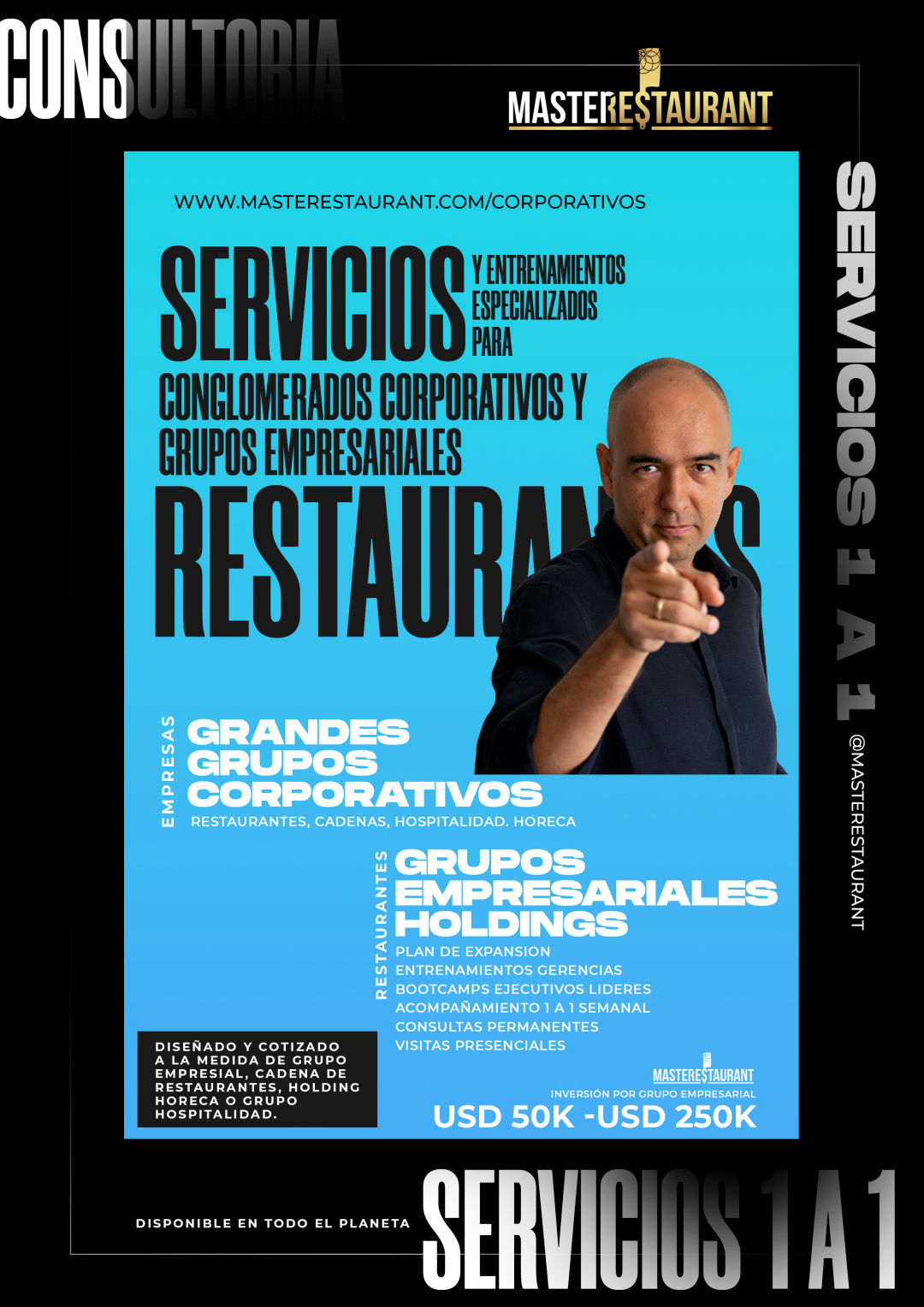
Training, consulting, executive bootcamps and private advisory for restaurant groups, holdings and investor families with themed restaurants.
Starting at USD $50K · tailor made, custom quoted · limited spots worldwide
Published doctrine
The books that changed restaurant management
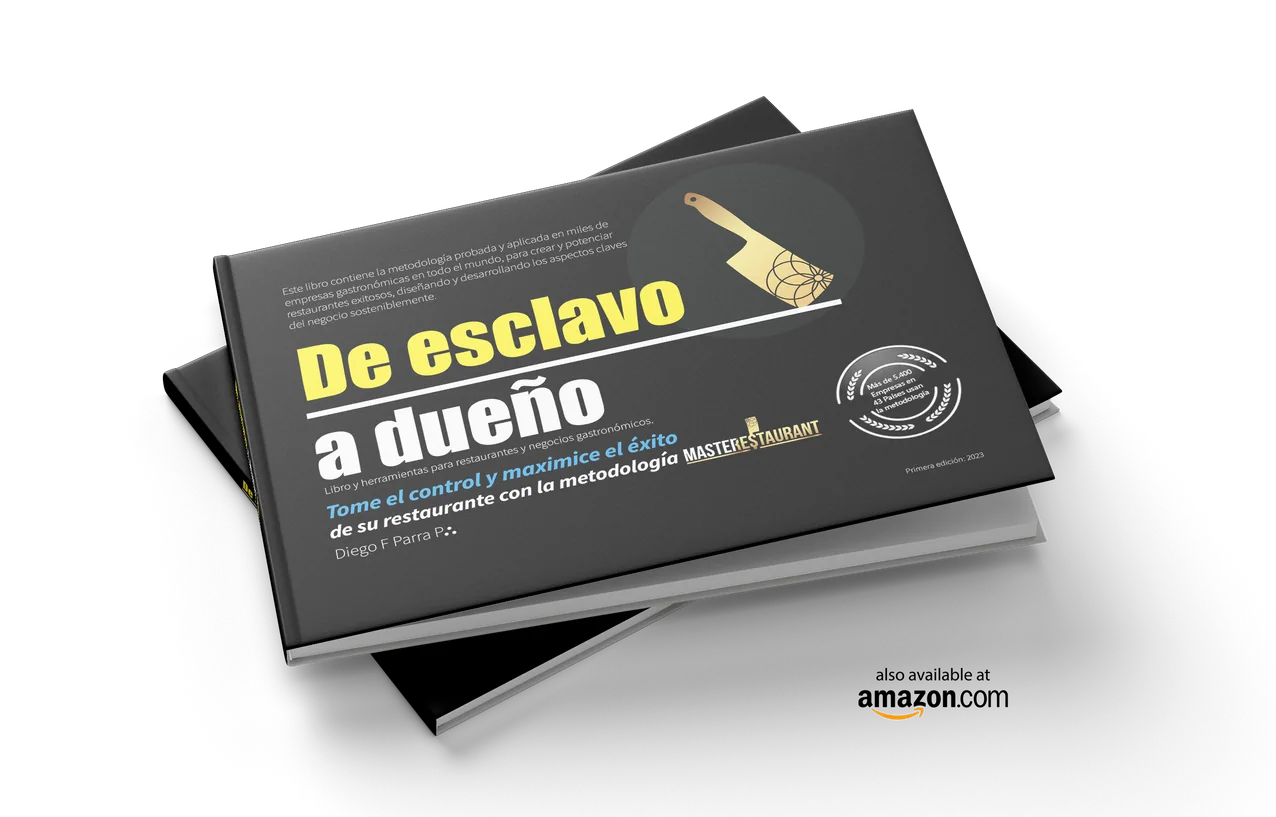
De Esclavo a Dueño
The book that changed how restaurants are managed: practical strategies and tools based on more than 20 years of experience, for traditional restaurants, dark kitchens, foodtech and HORECA businesses.
Triunfar o Morir en el Intento
Practical tools and key strategies to design and operate restaurants and food businesses efficiently.
Podcast: Masterestaurant — Mistakes for Restaurants
The public autopsy of the mistakes that bankrupt restaurants: thousands of owners and managers listen on Spotify to avoid repeating them. Condensed operating doctrine, free and direct.
Listen on SpotifyDownloads
The documents your management will ask for
MASTERESTAURANT® services portfolio
The complete intervention catalog: consulting, training, advisory and specialized services, with scopes and formats. The document to decide with your team.
Download PDFBook: From Slave to Owner
The full doctrine behind the methodology: how to structure a restaurant that runs without depending on the owner. Ideal pre-reading before your project's diagnosis.
View on AmazonPortfolio
More services by Diego F Parra and his team
Beyond themed restaurant consulting, Diego F Parra and his team offer keynotes, mentoring for owners, consulting for groups, training, programs, a membership and an interactive training kit. Everything starts from the same method and the same tools, so once the concept works, the dining-room team can train with that kit, partners can prepare the investment with the Pitch Deck service and the group can take the concept to new sites with the same criteria. The full ecosystem is available:
International keynote speakerOne-on-one consulting and advisoryPersonalized mentoring for owners (limited spots)Corporate groups and holdings consultingCelebrity Restaurants consultingThemed restaurant advisorySpecialized training programs52-Week membershipPitch deck and restaurant investment readinessExponential Program0.1 Program — Elevate Your RestaurantInteractive training kit
Direct contact
Get a quote for themed restaurant consulting for your project in Beverly Hills
Your message goes straight to Diego's team: concept, project stage, city and what you need to achieve in Beverly Hills.
“In Beverly Hills, the most expensive and beautiful decoration closes in eighteen months if the business model does not sustain it. Theming is the hook, but permanence is financial structure, operations, and leadership. That is what I do differently: I design the experience inside the business, not the business around the experience.”
Diego F. Parra — International consultant, expert in creating, scaling and improving restaurants, HORECA and hospitality
MASTERESTAURANT® methodology applied by 8,400+ restaurants across 43 countries · Author of 3 ISBN-registered books, including «De esclavo a dueño» · 20+ years operating restaurants, franchises, dark kitchens and HORECA groups across 4 continents
Full profile →Your themed restaurant in Beverly Hills deserves a model worthy of the concept
Send the concept, its stage and your numbers for a tailored proposal.
Explore more
Themed restaurants: territories, services and ecosystem resources
Useful links for concept founders, restaurant groups, hotels, brands and investors weighing themed restaurant consulting before they decide. They cover nearby territories where the service is published, sister services in the MASTERESTAURANT ecosystem, Diego F Parra's professional profile and the management tools the methodology works with.
World's best restaurant keynote speakerWorld's best restaurant consultantC-Suite restaurant consultant for chains & groupsDiego F Parra — professional profileKeynote speaker serviceCorporate groups & holdings consultingCelebrity restaurant consultingInternational themed restaurant advisoryThemed dining expert in AnaheimConcept restaurants in ArlingtonThemed restaurants in AtlantaThemed restaurant advisory in Atlantic City, New JerseyConcept restaurants in Augusta GeorgiaThemed restaurant consultant in Aurora Illinois
FAQ
Frequently asked questions
How do we ensure the themed experience generates repeat visits, not just early curiosity?
Sustained repeat visits do not come from theming alone, but from clear reasons and occasions for consumption, price-value coherence, and operational consistency. The engagement maps customer journey (why they come, what they expect at each touchpoint, when they return) and menu engineering reinforcing experience without compromising margin. Then, metrics on visits, check, and lifetime value guide adjustments. In Beverly Hills, where the diner is demanding, repeat visits come from: memorable experience + quality gastronomy + personalized service + narrative coherence. All tracked.
Can an experiential themed concept scale to new locations while maintaining profitable economics?
Yes, but it requires clear standardization and resilient operational model. The service includes: definition of service standards, ambiance, gastronomy replicated across locations; documentation of key processes; metrics system monitoring profitability by location; team leadership independent of founder. Beverly Hills is the flagship; new locations (other LA districts, regional expansion, or franchises) inherit proven playbook. Thus, each location is independent business, but all share brand equity and return.
Where does the work start?
With the diagnosis, never with the concept. First we look at what is there: numbers, menu, operation and project stage. Only then is the themed restaurant's business model designed, and implementation supported through to expansion.
What happens to my concept and my brand?
They stay yours. The whole process runs under NDA, and neither the concept nor the brand nor the intellectual property changes hands at any point. Limited spots worldwide exist to guarantee real dedication to each project.
How much time does it take?
It depends on the scope agreed: diagnosis, model design, implementation and support during operation and expansion. A profitable themed restaurant is built in phases; anyone promising a result in one session is not selling method.
What does it cost?
Between USD $35K and USD $250K for the 1-on-1 consulting, priced to the scope of the project and the concept. Private programs for restaurant groups and chains are quoted separately.
My restaurant is already open — does this still apply?
It does, and it is the most frequent case. The work covers profitability, standardization of the operation and the plan to scale the concept to new locations or to franchise, starting from what already exists.
