DIEGO F PARRA · CREATOR OF THE MASTERESTAURANT® METHODOLOGY
THEMED RESTAURANT EXPERTWho audits the business model of a concept restaurant in Boston before the second one opens?
Bringing a concept to the table in Boston takes two kinds of judgment at once, and few people hold both: the creative one and the cash one. Diego F. Parra puts the second at the service of the first.
What a themed restaurant project in Boston is looking for when it calls
The mistake that repeats in Boston has a recognizable shape: the money goes first into ambiance, scenography and a long menu, and only when the novelty wears off does someone ask what each dish costs. By then the concept sits on a model that cannot hold a quiet Tuesday.
The right order is the opposite, and that is what gets worked on here: first the business model, then the experience that model can afford. 1-on-1 tailor-made consulting, workshops and private advisory with the MASTERESTAURANT methodology and its TOOLKIT, in use in 8,400+ restaurants across 43 countries.
How does themed restaurant consulting work in Boston?
First it confirms the concept leaves a margin in Boston; only then does the budget go into ambiance. The consulting starts from a strategic diagnosis and turns the project into a business model that repeats the experience without improvising.
Each project moves through the same stages, sized to it: diagnosis, business-model design with the key elements of the Restaurant Canvas, opening readiness, implementation and expansion. It covers the immersive experience, the menu and its profitability, cost structure, processes and leadership, plus partner and investor management as the concept scales. It serves concept founders, groups and chains, hotels and tourism developments, brands and investors. The concept and its intellectual property remain the client's, and the work runs on site or virtually, in English or Spanish. As a starting point, this page gathers four verified reference figures from sources such as the Bureau of Economic Analysis and the U.S. Bureau of Labor Statistics.
What do the numbers say about the market for a themed restaurant in Boston?
3.03% — travel and tourism share of GDP (2023), according to the Bureau of Economic Analysis. Reference figures describe the setting a concept competes in; they do not say whether a themed experience will still leave a margin after opening.
For a themed restaurant, the data informs one concrete decision: how much can go into ambiance before the model stops working. Other reference points cited on this page: 57.4% (US accommodation and food service establishments still open five years after opening, 2019 cohort, the U.S. Bureau of Labor Statistics); 15.9 million (Forecast US restaurant industry employees for 2025, the National Restaurant Association); 63% (of adults worked in the restaurant industry, the National Restaurant Association). In Boston, each figure is read alongside average check, menu engineering and Prime Cost before spending on decor, because novelty brings the first visit and margin decides whether there is a second one.
Data
Reference figures for a themed restaurant in Boston
The figures cited on this page, with what each one measures and its source.
Figure
What it measures
Source
15.9 million
Forecast US restaurant industry employees for 2025
National Restaurant Association
3.03%
travel and tourism share of GDP (2023)
Bureau of Economic Analysis
63%
of adults worked in the restaurant industry
National Restaurant Association
57.4%
US accommodation and food service establishments still open five years after opening (2019 cohort)
U.S. Bureau of Labor Statistics
Each figure links to its source in the data cards on this page.
The local market
The themed restaurant market in Boston: the context your project must master
Most entrepreneurs and restaurant groups that open a themed restaurant in Boston invest millions in architecture, interior design, and ambiance—the "visual calling card" that attracts curiosity in the first weeks. Yet thematic design and decor alone have never guaranteed sustained occupancy, profitability, operational margins, or customer return visits. Hospitality operators confirm that many experiential restaurants face critical profitability challenges when visual ambition is not accompanied by a coherent business model: menu without engineering, vague value proposition, customer journey without clear consumption drivers, operations without standards, and financial management that ignores Prime Cost and EBITDA. The persistent gap is the absence of specialized consulting that translates thematic ambition into profitable, scalable, and manageable enterprise architecture. This service fills that gap: it does not decorate; it builds the business that sustains the experience.
The transformative engagement converts a themed idea—a visual inspiration, a narrative, a concept of experience—into an organized, profitable, scalable, and manageable gastronomic enterprise. The MASTERESTAURANT methodology, deployed throughout this process, integrates eight dimensions into a single ecosystem: 1) Distinctive concept and authentic storytelling, aligned with local culture and target audience expectations; 2) Explicit value proposition and customer journey mapped from arrival through departure; 3) Menu engineering that balances experience, margin, turnover, and costs; 4) Ambient design and spatial layout from operational logic, not aesthetics alone; 5) Financial model with occupancy projections, average check, fixed and variable costs, and expected profitability; 6) Operational processes and standards for replication and scalability; 7) Performance indicators tied to profitability and experience; 8) Leadership and governance so the founder is not irreplaceable. The outcome: a themed restaurant that generates predictable revenue, consistent margins, trained staff, and capacity to grow—additional locations, licensing models, or franchising.
Diego F. Parra's authority in high-level restaurants significantly reduces project failure risk. His global experience is verifiable: he has worked with more than 8,400 gastronomic enterprises across 43 countries; he authored "From Slave to Owner"; he generates over 65 million annual views through educational content on hospitality topics; and he is recognized as a C-Suite consultant in the industry. His methodology—validated by decades of direct operation—is not theoretical but based on real structures, proven indicators, and architectures that work in competitive markets. When a consultant has seen 8,400 projects fail and succeed, they recognize patterns invisible to inexperienced eyes: which themes fade quickly, what the real operational break-even point is, how to retain the customer, where scalability typically collapses. For a project of this scale, this experience translates into anticipated concept architecture, operational risk diagnosis, and recognized differentiation in the market.
The concrete return from this engagement is measurable and multidimensional. In differentiation: a themed restaurant with a coherent business model positions itself as a recognized operator, attracts media coverage and higher-spending clientele. In profitability: operational and menu engineering significantly increases average check, and optimizes Prime Cost toward healthy ranges, transforming "attractive but unprofitable" projects into healthy businesses. In experience and repeat visits: when thematicity reinforces (not distracts from) the value proposition, visit frequency and average spend rise organically. In scalability: a business with documented processes, indicators, and leadership can be replicated (additional locations, franchise) without losing coherence. In investor appeal: an enterprise with predictable EBITDA, clear differentiation, and organized staff is worth significantly more than "a pretty idea with invisible operational risks." And crucially, in founder independence: the founder is not the only person who knows how to keep the experience alive; the organization is manageable and delegable.
Market data
Boston in numbers: the themed restaurant market
15.9 million
Forecast US restaurant industry employees for 2025
The Boston market for themed and immersive restaurants is characterized by a diverse gastronomic ecosystem, robust international tourism, and a public with high purchasing power. The city hosts districts of strong culinary and entertainment identity—from the historic waterfront and bohemian neighborhoods with acclaimed dining, to university areas with experimental audiences age 22-40. Tourism is multifaceted: international visitors drawn by historical heritage (American Revolution, colonial architecture), world-class museums, and renowned academic institutions; family tourism during summers and holidays; and corporate travelers from technology, finance, and healthcare firms. Luxury hotels in the area and entertainment complexes seek differentiated gastronomic concepts to offer premium experiences to guests seeking memorability, not merely food. Additionally, Boston's local culture—marked by tradition, education, and a certain weight of "old Northeast" sensibility—intersects with multicultural publics, opening opportunities for themes that connect local history, heritage, contemporary relevance, and narrative immersion.
The opportunity for an experiential restaurant in this market is real but faces specific risks. What works: concepts that dialogue with local identity or with global narratives that will resonate with educated, well-traveled audiences; authentic experiences (not superficial) where ambiance, menu, and service narrate a coherent story together; integrated entertainment (not distracting) that complements the meal without competing for attention. What typically fails: restaurants whose theme is purely decorative—a visual facade disconnected from the gastronomic proposition, service, or reason the customer returns; concepts too niche or with a visual identity that ages quickly; cost structures that prioritize visual ambition over operational profitability; and incoherent experiences where menu, pricing, or service do not support the concept. The specific risk in this market is that the public is discerning and constantly compares: an experiential restaurant that does not balance quality, differentiation, and operational efficiency simply dies from slow uptake or loss of interest. What the local diner expects is that the experience justifies the price; that it is replicable without overwhelming the operator; and that it evolves without losing its essence.
RESOURCES
MASTERESTAURANT studies, guides & tools
A selection of MASTERESTAURANT studies, comparisons and tools to decide better in Boston:
Behind MASTERESTAURANT's themed restaurant consulting is Diego F Parra: engineer and C-Suite consultant with two decades creating, rescuing and expanding restaurants, franchises, dark kitchens and HORECA and hospitality groups across four continents. He doesn't arrive with theory: he arrives with the experience of having signed payrolls, negotiated leases, structured partnerships and closed expansions in operations worth hundreds of millions of dollars.
He is the creator of the MASTERESTAURANT® methodology — applied by 8,400+ restaurants across 43 countries — and its TOOLKIT of tools (MTIE, Gastronomic Radar, Standard Recipe Generator, Tech Sheets and KPI Dashboard). For a brand, a group or an investor that means one thing: every decision is made on proven data and systems, not on intuition.
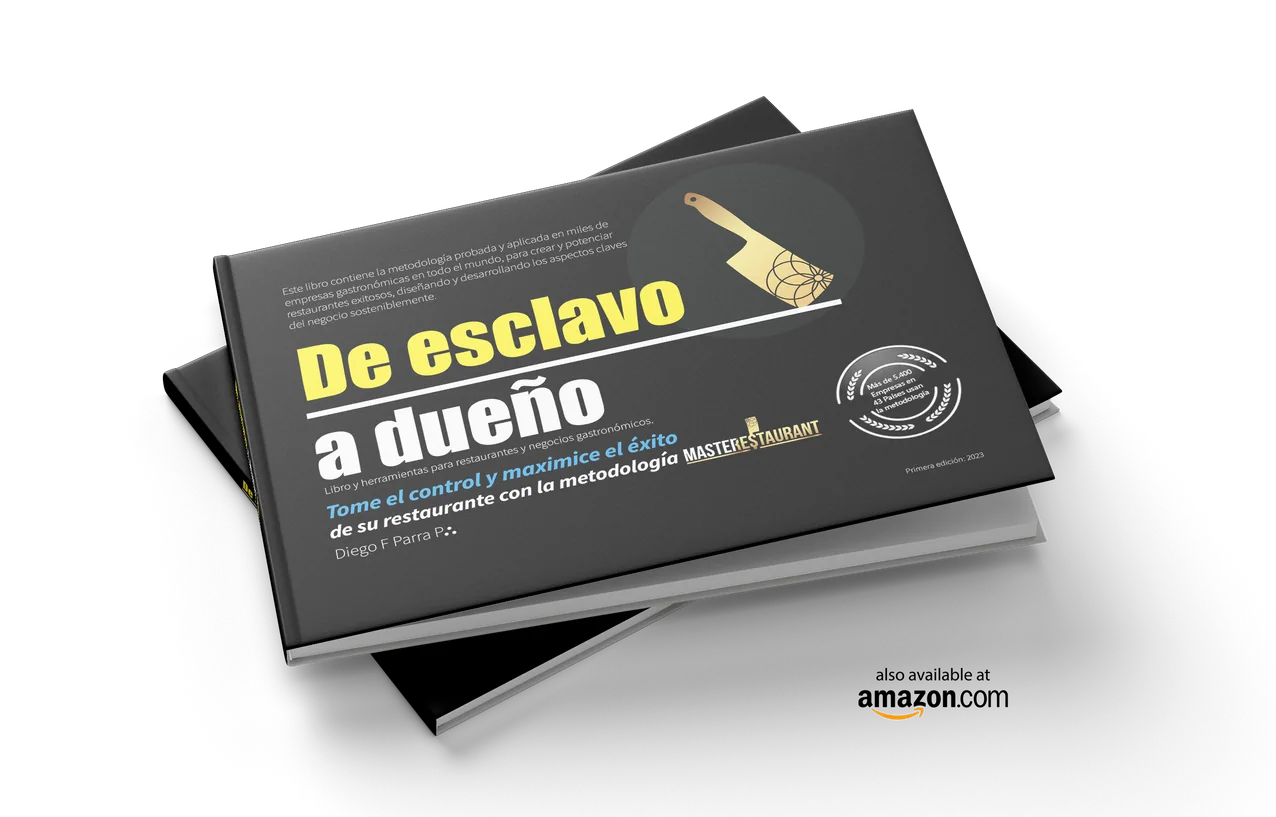
Author of 3 ISBN-registered books, including «De esclavo a dueño», creator of the industry's leading podcast and of the largest bilingual community of owners, chefs and operations directors in the region (65M+ views per year as @masterestaurant), and recognized among the top Latino restaurant operations experts globally. See his full track record in Diego F Parra's professional profile.
Themed restaurant consulting with its own doctrine, not generic recipes
Themed restaurant consulting is not improvised. Every engagement is built on the Restaurant Model Canvas and real industry data — profitability, Prime Cost, cost structure, customer experience and expansion — applied to the specific business model of a themed restaurant. The goal is not a venue for the opening-night photo, but a food business that protects the concept, generates profit and can scale to new locations, licenses or franchises when the model is ready. That is why the work is organized on four fronts —diagnosis and business model; concept, menu and themed experience; structure, costs and operation; expansion, franchise and new locations— so the concept still holds up when it is no longer new.
Advisory that covers the full themed restaurant lifecycle
Business model and diagnosis
It starts by looking at the numbers and the stage of the project, and on that the model is designed with the Restaurant Canvas: value, consumption and profitability.
A specialized, personalized 1-on-1 service for new and existing restaurants of:
Entrepreneurs and concept creators
Turn your idea into a gastronomic asset: concept, brand and business model that earn far beyond the novelty of opening day.
Restaurant groups and chains
A new structured concept to add to your portfolio: investment protected by method, partner management and financial control.
Hotels and tourism developments
A themed restaurant that becomes a destination: storytelling, menu and operation that uphold the experience promise every day.
Brands, IP and franchises
From the brand to the dining room: a business that runs on system, with standardization and teams ready to replicate the concept in new locations.
Investors and family offices
Capital + the MASTERESTAURANT methodology: enter hospitality with a profitable, scalable concept, without paying the beginner's learning curve.
What's included
The modules the engagement is assembled from
These are the MASTERESTAURANT methodology modules your tailor-made programme is built from:
The model that turns a good idea into a business with a margin
Strategic diagnosis of the project and the personal brand
Storytelling and brand architecture of the themed concept
Menu engineering and an experience designed for repeat visits
Costs, Prime Cost and break-even calculated before opening
A standardized operation, with tech sheets and written processes
The 10 elements of the Restaurant Canvas, worked one by one
Teams, processes and leadership that hold without the founder inside
Orderly expansion: new locations, licenses and franchises
Partner and investor management without losing control of the brand
Executive bootcamps and training for the management team
1-on-1 advisory, ongoing consultations and on-site visits
Opening readiness, which decides the reputation of the first year
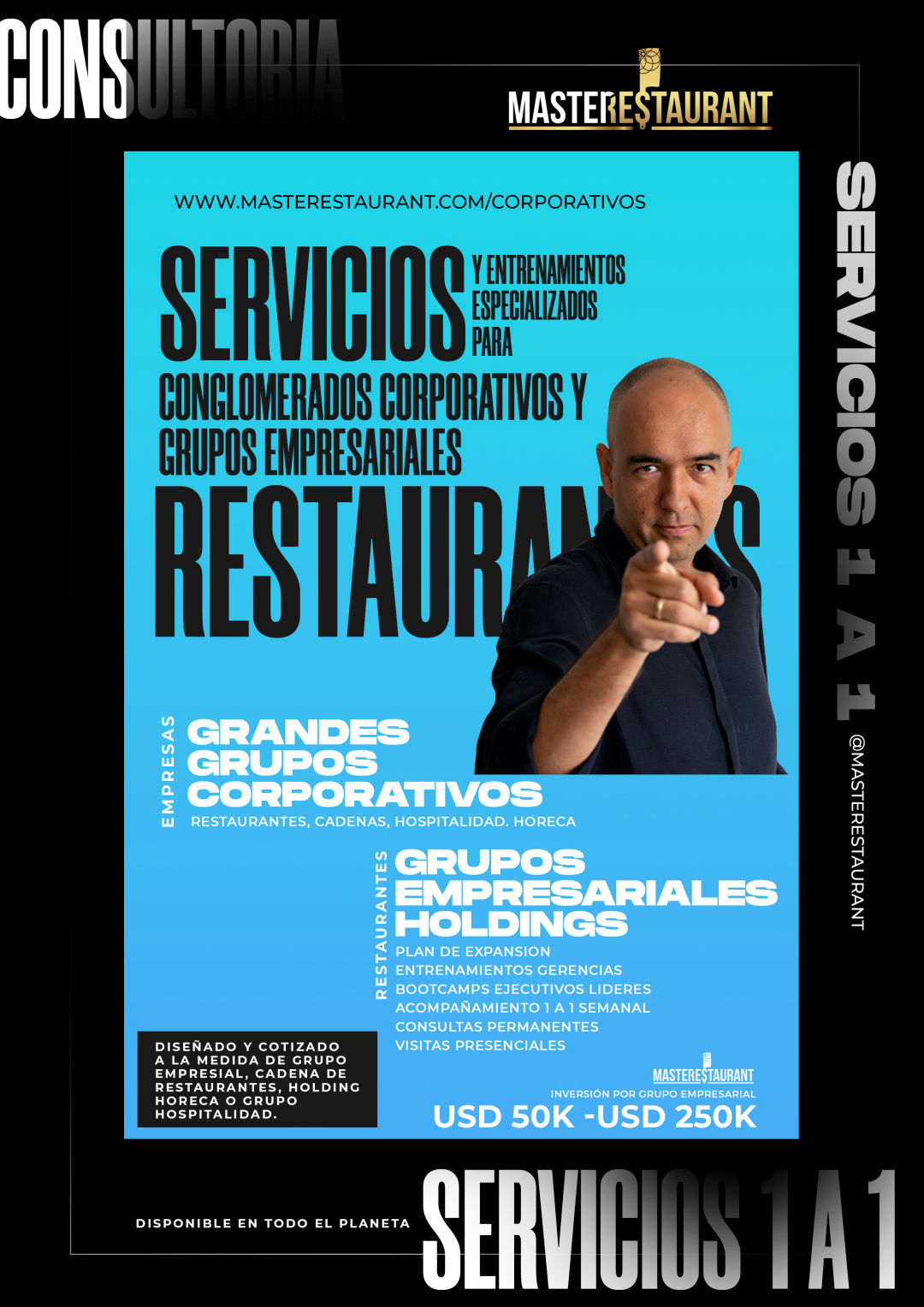
Investment: USD $35K – $250K · tailor-made, priced to each company · spots LIMITED worldwide to guarantee the best service.
Themed packages
Tailor-made themed restaurant consulting packages
Every themed restaurant engagement is 100% personalized and tailor-made to the project and the brand. After a strategic diagnosis, it works through the 10 key elements of the business model in the MASTERESTAURANT Restaurant Canvas — from value proposition and concept to profitability, standardization and expansion. Depending on the case, the package adds menu engineering, Prime Cost and cost structure, partner and investor management, executive bootcamps for the management team, ongoing consultations with visits to the venue and opening readiness. The quote starts from the concept, where the project stands and the numbers already on the table. Priced to each project's scope (USD $35K – $250K), with limited spots worldwide to ensure dedicated attention and discretion for each client.
Diego F Parra is an engineer and C-Suite consultant, creator of the MASTERESTAURANT® methodology —applied by 8,400+ restaurants across 43 countries— and author of 3 ISBN-registered books.
He is the consultant that brands and concepts, athletes, artists and investors choose to turn their brand into a profitable, standardized themed restaurant ready to expand. He has spent two decades creating, rescuing and expanding restaurants, franchises, dark kitchens and HORECA groups across four continents, and he works with his own tools: MTIE, Gastronomic Radar and KPI Dashboard. For a themed restaurant, that means the concept is designed as a system —tech sheets, costing, processes and KPIs— so it can be repeated in new locations, licenses or franchises without being diluted.
The book that changed how restaurants are managed: practical strategies and tools based on more than 20 years of experience, for traditional restaurants, dark kitchens, foodtech and HORECA businesses.
Triunfar o Morir en el Intento
Practical tools and key strategies to design and operate restaurants and food businesses efficiently.
Podcast: Masterestaurant — Mistakes for Restaurants
The public autopsy of the mistakes that bankrupt restaurants: thousands of owners and managers listen on Spotify to avoid repeating them. Condensed operating doctrine, free and direct.
The complete intervention catalog: consulting, training, advisory and specialized services, with scopes and formats. The document to decide with your team.
The full doctrine behind the methodology: how to structure a restaurant that runs without depending on the owner. Ideal pre-reading before your project's diagnosis.
Beyond themed restaurant consulting, Diego F Parra and his team offer keynotes, mentoring for owners, consulting for groups, training, programs, a membership and an interactive training kit. Everything starts from the same method and the same tools, so once the concept works, the dining-room team can train with that kit, partners can prepare the investment with the Pitch Deck service and the group can take the concept to new sites with the same criteria. The full ecosystem is available:
Get a quote for themed restaurant consulting for your project in Boston
Your message goes straight to Diego's team: concept, project stage, city and what you need to achieve in Boston.
“A themed restaurant does not fail because it is ugly or because its decor goes out of fashion. It fails because the owner or team never honestly answered this question: Does the business model sustain the experience, or is thematic design just a mask for operational inefficiency? Fashion fades; coherent business endures.”
Diego F. Parra — International consultant, expert in creating, scaling and improving restaurants, HORECA and hospitality
MASTERESTAURANT® methodology applied by 8,400+ restaurants across 43 countries · Author of 3 ISBN-registered books, including «De esclavo a dueño» · 20+ years operating restaurants, franchises, dark kitchens and HORECA groups across 4 continents
Themed restaurants: territories, services and ecosystem resources
Useful links for concept founders, restaurant groups, hotels, brands and investors weighing themed restaurant consulting before they decide. They cover nearby territories where the service is published, sister services in the MASTERESTAURANT ecosystem, Diego F Parra's professional profile and the management tools the methodology works with.
How do I ensure that investment in experience and theme translates to operational margin, and doesn't become a "beautiful but unprofitable" restaurant?
It is the core question. The consulting integrates menu engineering (each dish is designed for experience plus correct margin), a financial model with realistic occupancy and check projections, and architectural review of operational costs before investment in build-out. During the engagement, we validate that visual ambition does not strain Prime Cost, that service design is operationally viable, and that each thematic element contributes to differentiation or margin—not just expense. The result is a roadmap of "profitable experience," not two conflicting goals.
If it works in one location, how do I scale without losing the concept's essence or bleeding to death on replication costs?
That is the purpose of standardization and documentation. Through consulting, we document processes, indicators, service standards, and visual identity so that a second location or franchisee can replicate with coherence without the founder present. Additionally, we work with a scalable financial model: we renegotiate suppliers, optimize layout to scale without losing experience, and train leadership at the first site to train the second. Experiential restaurants that failed at sites 2 and 3 typically failed because they treated each location as a new project; consulting integrates scalable vision from the start.
How does the tailor-made 1-on-1 consulting for themed restaurants work?
It starts with a strategic diagnosis of the project and the concept. Based on it, the themed restaurant's business model is designed —concept, value proposition, menu, experience, costs and operation—and implementation and expansion are supported.
Is the confidentiality of the concept and intellectual property protected?
Yes. The whole process operates under confidentiality agreements (NDA). The concept, brand and intellectual property of the project are and remain the client's. Limited spots worldwide exist to guarantee dedication and focus on each project.
How long does it take and what are the phases?
It depends on scope: diagnosis, business-model design, implementation and support during operation and expansion. Building a profitable themed restaurant is a process with method, not an event.
What is the investment?
The 1-on-1 consulting ranges from USD $35K to USD $250K and is priced to the scope of each project and concept. Private programs for restaurant groups and chains are quoted separately.
Do you serve new projects and themed restaurants already operating?
Both: creation from scratch —concept, business model and opening—and growth of existing themed restaurants seeking to improve profitability, standardize operations and scale the concept to new locations or franchise.
Community
Join our MASTERESTAURANT Community for FREE
Restaurant owners and teams from 43 countries sharing knowledge, tools and applied AI — straight to your WhatsApp.
 MASTERESTAURANT®