 MASTERESTAURANT®
Projected restaurant and foodservice employment in 2026
National Restaurant Association
From diagnosis to implementation · Germany

DIEGO F PARRA · CREATOR OF THE MASTERESTAURANT® METHODOLOGY
HOSPITALITY CONSULTING Who does leadership in Germany turn to when the founder's judgement stops scaling?
In Germany, the work starts by measuring: where the money goes, what margin each dish leaves, which processes are not written down and which decisions are being made without data. The plan comes from that, not from a template.
Download the portfolio (PDF)Restaurant & hospitality consulting slots LIMITED worldwide — reserve yours
8,400+restaurants apply his methodology
43countries with supported groups
65M+views per year
2service languages: EN - ES
International validation
See Diego F. Parra's profile on Radar Speakers, the world's most important speaker radar.
See profile on Radar Speakers →
15.8 million jobs
49 %
-2.2%
5-25x

@masterestaurant
From a restaurant that works to a model that repeats, in Germany
The MASTERESTAURANT methodology and its TOOLKIT have been applied across more than 8,400 restaurants in 43 countries. This is not business-school theory: it is what was left standing after working inside real operations, and it arrives with its own instruments —MTIE, Gastronomic Radar, Standard Recipe Generator, Tech Sheets and KPI Dashboard— instead of generic templates.
In Germany it adapts to the market, the size and the stage of the business, because copying a recipe from another country is exactly what this consulting exists to prevent. The order of work stays the same from one market to the next: measure with the operation's own data first, then fix what returns margin fastest, and put the structural work in writing until the model is ready to be replicated.
How does restaurant consulting work in Germany?
In Germany, it starts with a diagnosis of the restaurant built from its own operating data, not questionnaires: where the money goes, how much margin each dish earns and which processes are missing. That becomes a work plan ranked by impact on margin.
This is one-on-one consulting with no templates, for the owner and the team that runs the restaurant. What moves money in weeks comes first: Prime Cost, actual versus theoretical cost, waste and shrinkage, menu engineering and technical sheets. The structural work follows, in writing: standard recipes, processes, manuals and an organizational structure that does not depend on the owner being there. Support continues through implementation and ends with a closing measurement against the opening one. It runs virtually, on site or in a hybrid format, in English or Spanish. This page cites four verified figures as a reference for Germany, from sources such as Destatis and the National Restaurant Association.
What do the numbers say about running a restaurant in Germany?
-2.2% — real decline in food service (Gastronomie) revenue vs 2024; source: Destatis. It is context, not a diagnosis: it does not say how much margin an operation keeps or where it leaks.
The decision comes from the restaurant's own numbers, not from market figures. Other reference points cited on this page: 15.8 million jobs (projected restaurant and foodservice employment in 2026, the National Restaurant Association); 49 % (chefs ranking social media among the top trends affecting operations in 2026, the James Beard Foundation); 5-25x (cost of acquiring a new customer vs. retaining an existing one, Harvard Business Review). Those numbers are Prime Cost, the gap between theoretical and actual cost, waste and the margin on each dish. In Germany, as in any other market, they are what show whether the next move is to adjust the menu and prices, tighten the operation or prepare a second site.
Data
Reference figures for restaurants in Germany
The figures cited on this page, with what each one measures and its source.
| Figure | What it measures | Source |
|---|---|---|
| 15.8 million jobs | Projected restaurant and foodservice employment in 2026 | National Restaurant Association |
| 49 % | Chefs ranking social media among the top trends affecting operations in 2026 | James Beard Foundation |
| -2.2% | real decline in food service (Gastronomie) revenue vs 2024 | Destatis |
| 5-25x | Cost of acquiring a new customer vs. retaining an existing one | Harvard Business Review |
Each figure links to its source in the data cards on this page.
The local market
What kind of market Germany is for a restaurant
The revenue of an established hospitality business can be solid, but revenue is not margin. Closing a month at €250,000 in sales does not mean you control where €40,000 in untracked costs disappear. Theoretical food cost per dish is not actual food cost: between waste, breakage, food loss, uncontrolled portions, and unstandardized procurement, the gap widens every service. When I audit operations, I discover businesses spent more on food cost than what menu engineering calculated. It is not poor execution; it is a business system that measures at month-end, not in real time. Pushing harder through each service closes that gap by 2%, if that. Closing the real gap requires visibility: figures on unit costs, technical specifications you can replicate, standardized recipes, written processes. Hospitality consulting that understands this type of business does not bring off-the-shelf solutions; it brings diagnosis of the business as it stands, then method applicable from day one.
The transformation this service delivers is moving from a restaurant dependent on the owner making correct decisions every day to a restaurant that operates by system. That does not sound transformative, it sounds normal; but in real operations, it is the difference between a business that grows of its own control and one that survives by improvisation. The MASTERESTAURANT methodology begins with comprehensive diagnosis: actual numbers are reviewed (revenue, costs by category, variances, margin by shift and by unit), the business model is mapped with the Restaurant Model Canvas, revenue leaks the current system does not see are identified. Then comes engineering: Prime Cost under control, standardized recipes with technical specs that replicate identically each time, documented processes so performance does not depend on who opens the kitchen, EBITDA per unit visible and governable. The result is not a folder of recommendations that gets shelved: it is an operating model that works Monday to Sunday because it sits in the hands of those who execute it, not awaiting approval. The week after the engagement ends, the restaurant operates under the new system. It is not theory; it is method that has worked across restaurants of different models and sizes.
What accelerates the path is that these are not new or theoretical learnings. Diego F. Parra has guided implementation across more than 8,400 restaurants and hospitality groups in 43 countries, has served as C-Suite consultant, and his decisions on unit economics and operational governance come from observing patterns across thousands of real cases. When auditing a hospitality business, he does not bring hypotheses; he brings what has worked where it has been tested. That does not replace local market knowledge, but it does prevent you from repeating cost and structural mistakes others have already corrected.
The return is concrete: margin recovered and defended, costs that respond to parameters, consistency across shifts and locations (if present), a team that makes decisions with data instead of intuition, and an owner no longer indispensable in each operational decision. When menu engineering aligns with real prices and real costs, the restaurant gains margin without raising check average or cutting volume. When there are written processes and technical specs, staff turnover stops costing money because new hires enter to replicate a system, not improvise. When EBITDA is measured by shift, correct decisions become visible before they burn a quarter. And when the business has structure, the owner can scale because operations do not depend on their presence. That is what restaurant consulting that understands margin as a system problem, not an effort problem, delivers.
Market data
The restaurant and hospitality market in Germany in figures
Chefs ranking social media among the top trends affecting operations in 2026
James Beard Foundationreal decline in food service (Gastronomie) revenue vs 2024
DestatisCost of acquiring a new customer vs. retaining an existing one
Harvard Business ReviewGermany as a market
Why Germany is a market for restaurants and hospitality businesses
Germany is a solid and segmented gastronomy market: from Bavarian Biergärten to fine dining in Berlin and Cologne, through regional cuisine in midsize cities where a well-positioned restaurant can bill millions annually. The typical German diner values consistency, ingredient quality, proper portions, and price clarity. Tourism—both domestic and international—generates sustained demand in capitals and historic centers, but competition by zone is fierce: in a dining district of Berlin or Frankfurt there are ten similar operations two blocks apart, and the differentiator is not creativity but operational execution and cost control. Real-estate costs vary north to south (Berlin and Hannover more accessible than Munich or Stuttgart), but availability of qualified talent is a genuine challenge: the hospitality sector struggles to retain cooks and service staff, creating wage pressure. A restaurant competes not only against other restaurants but against employers in other sectors offering higher pay. Cost engineering and labor management are not optional; they are survival.
In this market, margin erodes by factors specific to this geography, not uniform across regions. First, seasonality: summer tourism drives peaks that winter (October to March) contracts significantly in many cities, forcing the restaurant to carry fixed capacity without volume to fill it. Second, staff turnover: losing a sous-chef costs considerable time to replace and train, and the replacement often enters at a higher wage. Third, inflexibility of local fixed costs: energy, municipal services, and social insurance contributions do not negotiate or decline. Fourth, the German diner's expectation: they do not pay more because the cuisine "has story"; they pay premium price only if quality, service, and experience justify each euro. A restaurant seeking margin here cannot win on volume (longer hours) if the cost system is inefficient. Where other restaurants gain, this one loses, because density of labor and material costs rose while check average did not move. What I audit most often: a profitable business that could gain 15 EBITDA points if Prime Cost drops from 62% to 48%.
RESOURCES
MASTERESTAURANT studies, guides & tools
Reading and downloads we bring to operators in Germany: proprietary data, cases and working templates:
- AI PROMPTRecipe Cost Variance Analyzer for Restaurants
- STUDYNew Restaurant Opening 2026: Fatal Mistakes vs the Masterestaurant Method
- STUDYOpening a second location in 2026: traditional method vs Masterestaurant method
- LISTFranquiciar
- CHECKLISTScaling a Restaurant in 2026: Traditional Method
- DATARestaurant Transfer: Traditional Method vs Masterestaurant
- COMPARISONValue proposition mistakes vs the right method
The expert restaurant and hospitality consultant
The authority behind every profitable restaurant
Behind MASTERESTAURANT's restaurant consulting is Diego F Parra: engineer and C-Suite consultant with two decades creating, rescuing and expanding restaurants, franchises, dark kitchens and HORECA and hospitality groups across four continents. He doesn't arrive with theory: he arrives with the experience of having signed payrolls, negotiated leases, structured partnerships and closed expansions in operations worth hundreds of millions of dollars.
He is the creator of the MASTERESTAURANT® methodology — applied by 8,400+ restaurants across 43 countries — and its TOOLKIT of tools (MTIE, Gastronomic Radar, Standard Recipe Generator, Tech Sheets and KPI Dashboard). For a brand, a group or an investor that means one thing: every decision is made on proven data and systems, not on intuition.
Author of 3 ISBN-registered books, including «De esclavo a dueño», creator of the industry's leading podcast and of the largest bilingual community of owners, chefs and operations directors in the region (65M+ views per year as @masterestaurant), and recognized among the top Latino restaurant operations experts globally. See his full track record in Diego F Parra's professional profile.
Restaurant consulting with its own doctrine, not generic frameworks
Expert restaurant and hospitality consulting is not solved with management theory borrowed from another industry. It is solved with hospitality engineering: Prime Cost under control, theoretical versus actual cost, waste measured, standard recipes, written processes and indicators leadership reviews every week. Every engagement starts from the Restaurant Model Canvas: the whole business model is diagnosed, priorities are ranked by their impact on margin, and the team is left with its own instruments to sustain the results once the consulting ends. Decisions stop being bets: they are made on data. The method is the same for an independent restaurant, a chain or a hospitality group.
Expert restaurant and hospitality consulting, end to end
An engagement that covers the whole cycle, from diagnosis to expansion
Diagnosis and business model
Consulting that measures before it advises: the operation's numbers first, then the restaurant's business model, not the other way around.
Do you run a group or a chain?Profitability and cost engineering
Menu engineering and technical sheets that show what each dish earns, with Prime Cost, waste and shrinkage measured: where the bottom line feels the change first.
A hotel or hospitality group?Standardization and operations
Standard recipes, written processes, manuals and structure: the restaurant runs just as well on the day the owner is away.
A celebrity or high-profile investor?Leadership, indicators and growth
A trained team, indicators in plain sight and an orderly growth plan: new sites or franchises when the model can carry it.
A themed or immersive concept?The methodology
Discover the MASTERESTAURANT methodology
Behind every food business that scales profitably there is a method, not a hunch: applied from the first diagnosis, with its own instruments.
Who is it for?
Built for those who run a hospitality business and intend to scale it
A tailor-made 1-on-1 service, built for those opening and for those already operating:
Those who want to franchise
Without a standardized model that is profitable per unit, franchising sells a replicated problem. Model first, contract second.
Those who want to sell
A business with tidy numbers, written processes and demonstrable EBITDA per unit is worth more and negotiates better.
Those who want to step back
An operation that runs on the day the owner does not show up is not achieved through trust: it is achieved through system.
Those who want to grow without breaking
Expanding without losing margin or standard is the problem this consulting solves, and the order it is done in decides the outcome.
What does it include?
What expert restaurant and hospitality consulting covers
The scope is defined with you; these are the MASTERESTAURANT methodology modules available:
- Full diagnosis of the restaurant and its business
- Business model and Restaurant Model Canvas
- Concept, positioning and value proposition
- Customer experience and customer journey
- Menu and cost engineering (Prime Cost, theoretical vs. actual, waste)
- Standard recipes and technical sheets
- Financial model and EBITDA visibility per unit
- Operating model, processes and manuals
- Organizational structure and roles
- Management indicators and control dashboard
- Leadership development and management training
- Front-of-house and kitchen team training
- Readiness to grow: new locations, licensing or franchising
Investment: from USD $12K upwards — tailor-made programs, priced to the size, stage and complexity of the business.
Consulting programs
Tailor-made expert restaurant and hospitality consulting programs
Every consulting program is 100% customized to the restaurant: its size, its stage, its market and whatever is keeping it from being profitable today.
Expert coverage
Restaurant consulting available near Germany
Explore other territories or the worldwide index:
Restaurant business consultant in BerlinHospitality consulting in FrankfurtRestaurant business consultant in MunichHospitality consulting across BrazilHospitality consulting in AustraliaHospitality consulting in IsraelRestaurant business consultant in South AfricaRestaurant consulting in AalborgRestaurant business consultant in AarhusHospitality consulting in AlicanteHospitality consulting across DenmarkRestaurant profitability consultant across FranceRestaurant business consultant across SpainExpert restaurant consultant across the United KingdomExpert restaurant consultant in AmsterdamRestaurant consulting in AustriaRestaurant consulting in BarcelonaExpert restaurant consultant in BelgiumRestaurant business consultant in BirminghamRestaurant profitability consultant in BrusselsRestaurant business consultant in CannesRestaurant consulting in CopenhagenRestaurant business consultant in CórdobaRestaurant profitability consultant in DenmarkMore countries →More cities →
We do serve — and every city on the planet
Served on site or virtually, in English and Spanish.
Who is Diego F Parra?
Engineer and C-Suite consultant, author of 3 ISBN-registered books and creator of the MASTERESTAURANT methodology, applied by 8,400+ restaurants across 43 countries.
The method comes with its own technology suite: MTIE, Gastronomic Radar, Restaurant Model Canvas and KPI Dashboard. He has spent two decades creating, rescuing and expanding restaurants, franchises, dark kitchens and HORECA and hospitality groups across four continents, signing payrolls, negotiating leases and closing expansions. For an owner or a leadership team, what matters is where the method comes from: having run restaurants, not studying them from the outside. That is why every engagement arrives with proven instruments and leaves indicators the team keeps using afterwards. He works in English or Spanish, virtually, on site or in a hybrid format.
HORECA · Chains · Holdings · Foodtech
Private consulting programs for owners, partners and leadership teams
Bootcamps, training and private 1-on-1 engagements for those who run the business.
From USD $12K, priced to the business.
Published doctrine
The books that changed restaurant management
De Esclavo a Dueño
The book that changed how restaurants are managed: practical strategies and tools based on more than 20 years of experience, for traditional restaurants, dark kitchens, foodtech and HORECA businesses.
Triunfar o Morir en el Intento
Practical tools and key strategies to design and operate restaurants and food businesses efficiently.
Podcast: Masterestaurant — Mistakes for Restaurants
The public autopsy of the mistakes that bankrupt restaurants: thousands of owners and managers listen on Spotify to avoid repeating them.
Listen on SpotifyDownloads
The documents your board will ask for
MASTERESTAURANT services portfolio
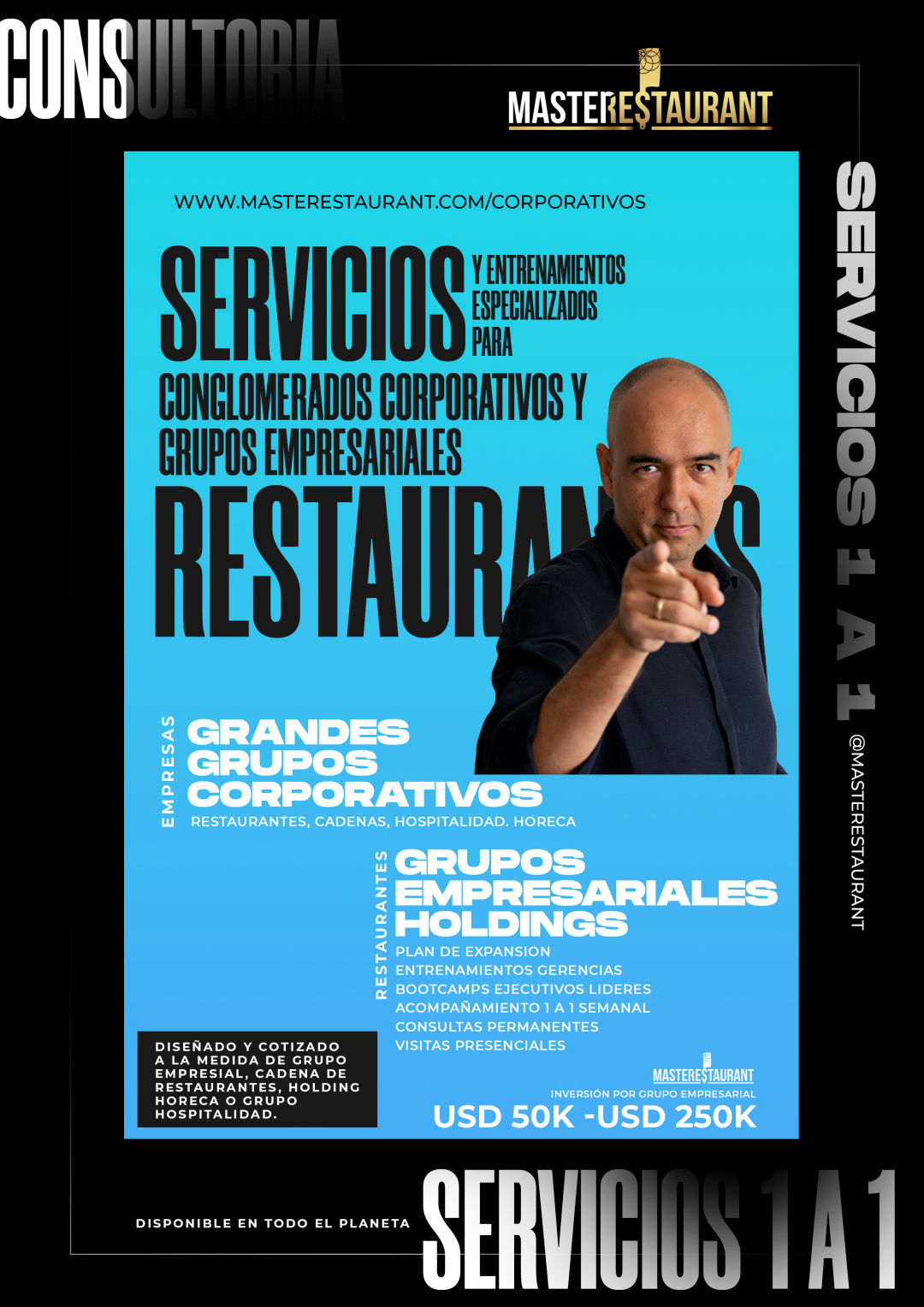
The complete corporate intervention catalog: consulting, executive bootcamps, advisory and specialized services, with scopes and formats. The document to decide with your board.
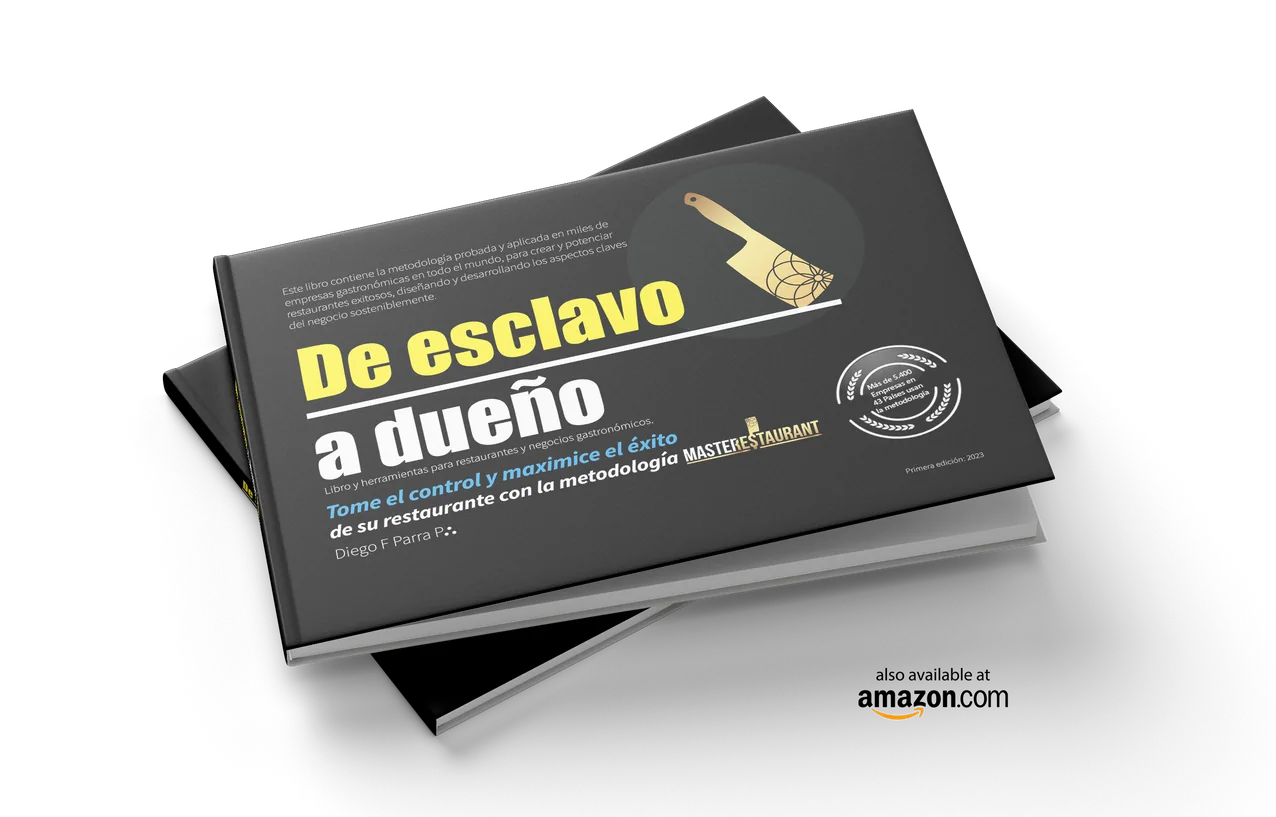
Download PDFBook: From Slave to Owner
The full doctrine behind the methodology: how to structure restaurants that run without depending on the owner. Ideal pre-reading before your group's diagnosis.
View on AmazonPortfolio
More services by Diego F Parra and his team
Is the restaurant only the beginning? Every service in the ecosystem starts from the same method and the same tools as this consulting: personalized mentoring for the owner, growth programs, the membership, training for the team and group consulting once the second or third site arrives. The full ecosystem is available:
International keynote speakerOne-on-one consulting and advisoryPersonalized mentoring for owners (limited spots)Corporate groups and holdings consultingCelebrity Restaurants consultingThemed restaurant advisorySpecialized training programs52-Week membershipPitch deck and restaurant investment readinessExponential Program0.1 Program — Elevate Your RestaurantInteractive training kit
Direct contact
Get a quote for expert consulting for your group in Germany
Your message goes straight to Diego's team: group or chain, number of sites, stage and what you need to achieve in Germany.
“Most restaurants lose margin not because they cook poorly, but because their business system measures at month-end what should be measured each shift. When you discover you spent more on food cost than what was budgeted, you feel you worked harder to earn less. What happened is the system did not see the leaks: waste, portions, unstandardized procurement. Closing that requires real-time visibility and processes that do not depend on judgment. A system that runs by method, not effort, is a business that scales.”
Diego F. Parra — International consultant, expert in creating, scaling and improving restaurants, HORECA and hospitality
MASTERESTAURANT® methodology applied by 8,400+ restaurants across 43 countries · Author of 3 ISBN-registered books, including «De esclavo a dueño» · 20+ years operating restaurants, franchises, dark kitchens and HORECA groups across 4 continents
Full profile →Start with the diagnosis, in Germany
Tell us your revenue, how many sites you have and what worries you: you'll get a concrete proposal.
Explore more
Restaurant and hospitality consulting: territories, services and ecosystem resources
Related links for owners, partners and leadership teams evaluating expert restaurant and hospitality consulting for their food business: nearby territories, sister services in the MASTERESTAURANT ecosystem and management tools, all built on the same method and the same instruments.
World's best restaurant keynote speakerWorld's best restaurant consultantC-Suite restaurant consultant for chains & groupsDiego F Parra — professional profileKeynote speaker serviceCorporate groups & holdings consultingCelebrity restaurant consultingInternational themed restaurant advisoryRestaurant business consultant in BerlinHospitality consulting in FrankfurtRestaurant business consultant in MunichRestaurant consulting in AalborgRestaurant business consultant in AarhusHospitality consulting in Alicante
FAQ
Frequently asked questions
How long before I see margin results once the engagement begins?
Comprehensive diagnosis takes 2–3 weeks; first margin results appear by week four, when identified leaks in supplies, portions, and processes close. Full engineering (technical specs, Prime Cost per line, documented processes) is operating in 8–12 weeks. Many restaurants see 3–5 points of Prime Cost improvement before quarter close, already visible as EBITDA impact. Real structural change takes three months because the team must replicate the new system under supervision until it is automatic. I do not promise figures without diagnosis; seeing the business, I deliver concrete numbers.
How do we standardize recipes and processes when each service, each chef, each shift is different?
It is not about eliminating variety; it is about controlling variability. A standardized recipe does not say "do this as you think"; it says "temperature X, grams Y, time Z, plate must look this way." The technical sheet works as a reference manual anyone can replicate. When staff rotate, the newcomer sees the sheet and executes; when taste or plating deviates, the recipe system allows you to identify where (if inbound ingredient, technique, or miscalibration). That is control, not rigidity. And good chefs—the ones who want to grow—value that because it lets them manage volume without sacrificing quality or needing to be present every shift.
When is the right time to open the next site?
When the model survives repetition: written processes, standard recipes the team follows, Prime Cost defended and EBITDA per unit in plain sight. Opening before that multiplies the problem, not the turnover.
What is Prime Cost and why insist on it?
It is food and beverage cost plus labour cost. It is the figure that moves fastest and decides the most margin in a restaurant, and most operations know it a month late.
What is the difference between theoretical and actual cost?
Theoretical is what dishes should cost according to the technical sheet; actual is what they cost. The gap is waste, uncontrolled portioning or badly negotiated purchasing, and until it is measured it cannot be fixed.
Does this apply to a hotel or only to restaurants?
It applies to the food and beverage side of a hotel operation, with its own unit economics. If you run a full hotel group, the hospitality-groups service is the right one.
What if my problem is the team, not the numbers?
It is usually both. A team without written processes or indicators does not fail on attitude: it fails because nobody told it what its good work is measured against.
