 MASTERESTAURANT®
international visitor arrivals (2024, +9.1%)
National Travel and Tourism Office
1-on-1 advisory · State of Georgia

DIEGO F PARRA · CREATOR OF THE MASTERESTAURANT® METHODOLOGY
THEMED RESTAURANT ADVISORY Who puts numbers on the experience in a themed restaurant in State of Georgia?
A themed restaurant in State of Georgia usually sinks for the same reason the last one did: the money went into ambiance before anyone checked that the model worked. Diego F. Parra reverses that order.
Download the portfolio (PDF)Limited advisory spots worldwide — reserve your evaluation early
8,400+restaurants apply his methodology
43countries with supported projects
65M+views per year
2service languages: EN · ES
International validation
See Diego F. Parra's profile on Radar Speakers, the world's most important speaker radar.
See profile on Radar Speakers →
72.4 million
15.9 million
US$1.3 trillion
1 million+

@masterestaurant
What a themed restaurant project in State of Georgia is looking for when it calls
The mistake that repeats in State of Georgia has a recognizable shape: the money goes first into ambiance, scenography and a long menu, and only when the novelty wears off does someone ask what each dish costs. By then the concept sits on a model that cannot hold a quiet Tuesday.
The right order is the opposite, and that is what gets worked on here: first the business model, then the experience that model can afford. 1-on-1 tailor-made consulting, workshops and private advisory with the MASTERESTAURANT methodology and its TOOLKIT, in use in 8,400+ restaurants across 43 countries.
How does themed restaurant consulting work in Georgia?
It reverses the usual order: first it checks that the concept's business model works in Georgia, then money goes into ambiance. The work starts with a strategic diagnosis and ends with a system built to repeat the experience.
Using the MASTERESTAURANT Restaurant Canvas, the concept and its business model are designed together. That covers value proposition, consumption moment, concept storytelling, menu engineering (which dish stays, which goes up in price and which comes off) and Prime Cost protected from the menu design onwards. Then the concept becomes a system: tech sheets, costing, processes, KPIs and an expansion plan for new locations, licenses or franchises. It serves new projects and themed restaurants already open, under confidentiality agreements, on site or virtually, in English or Spanish. As a starting point, this page gathers four verified reference figures from sources such as the National Travel and Tourism Office and the National Restaurant Association.
What do the numbers say about the market for a themed restaurant in Georgia?
72.4 million — international visitor arrivals (2024, +9.1%), according to the National Travel and Tourism Office. Reference figures describe the setting a concept competes in; they do not say whether a themed experience will still leave a margin after opening.
For a themed restaurant, the data informs one concrete decision: how much can go into ambiance before the model stops working. Other reference points cited on this page: 15.9 million (Forecast US restaurant industry employees for 2025, the National Restaurant Association); US$1.3 trillion (direct travel spending in 2024, the U.S. Travel Association); 1 million+ (restaurant and foodservice establishments, 2025, the National Restaurant Association). In Georgia, each figure is read alongside average check, menu engineering and Prime Cost before spending on decor, because novelty brings the first visit and margin decides whether there is a second one.
Data
Reference figures for a themed restaurant in Georgia
The figures cited on this page, with what each one measures and its source.
| Figure | What it measures | Source |
|---|---|---|
| 72.4 million | international visitor arrivals (2024, +9.1%) | National Travel and Tourism Office |
| 15.9 million | Forecast US restaurant industry employees for 2025 | National Restaurant Association |
| US$1.3 trillion | direct travel spending in 2024 | U.S. Travel Association |
| 1 million+ | restaurant and foodservice establishments (2025) | National Restaurant Association |
Each figure links to its source in the data cards on this page.
The local market
What ground a themed restaurant stands on in State of Georgia
A themed or experiential restaurant in Georgia requires specialized consulting because theming alone is a commercial hook, not a business. Most projects conflate concepts: they invest millions in immersive architecture, visual storytelling, and world-class ambience, yet neglect the business engineering that sustains the experience. The result is high initial visitation—the "novelty effect"—that collapses within 6–12 months because diners return only when there is a reason to consume, not merely because everything looks beautiful. In a region where entertainment and hospitality are competitive ecosystems with established options, decoration without business model is noise. The true differentiator is that the thematic concept is integrated into a clear value proposition, a coherent customer journey, an engineered menu, sustainable margins, and operations that function without the owner. An experiential restaurant succeeds when the theme SERVES the experience and the experience GENERATES business.
Diego's consulting service transforms a thematic idea into an organized, profitable, scalable, and manageable hospitality enterprise. It is not beautiful decoration; it is a system where concept, storytelling, value proposition, customer journey, consumption reasons and moments, experience and environmental design, menu engineering, financial model, operations, standardization, key performance indicators, leadership, and corporate governance work as a single integrated piece. The MASTERESTAURANT methodology, developed across 43 countries and applied in +8,400 restaurants, integrates proprietary tools—Restaurant Model Canvas, MTIE (Integral Experience Transformation Matrix), Gastronomic Radar, Operational Specification Sheets, Performance Dashboard—engineered to translate thematic experience into profitability, customer retention, and sustainability. Engagement is 100% bespoke: no two restaurants are identical, and each case reflects its market, audiences, seasonality, and competitive context. The outcome is a 12–24 month roadmap integrating diagnostic, experience redesign, gross-margin and EBITDA engineering, operations independent of the founder, and a business primed to scale.
Diego's authority in this vertical—a C-Suite consultant specialized 100% in hospitality, creator of MASTERESTAURANT, Amazon author with over 65 million annual community views, and architect of a methodology applied across 43 countries—significantly mitigates entry risk. This is not generic business consulting or design advisory; it is concentrated expertise at the exact juncture where most thematic restaurants fail: the transition from "beautiful idea" to "profitable enterprise." His methodology stems from operating real restaurants, from observing what works and what collapses after the first quarter, and from rebuilding dozens of concepts on the brink of failure. In this region, that means avoiding costly missteps discovered too late—operational overruns, weak value propositions, poorly engineered menus, experiences that do not drive return visits—and reaching market with a clear, differentiated, and sustainable offering from day one.
The concrete return from engagement is multifold. First: genuine differentiation against existing entertainment and dining options, not merely visual but operationally and commercially. Second: memorable experience with higher customer return rate and elevated average ticket, because diners return when the value proposition is clear and each visit generates additional consumption moments (pre-experience, core experience, post-experience). Third: superior operational control, predictable margins, and cost reduction through process, recipe, and training standardization. Fourth: a business model that scales—additional locations, licensing, franchising—without the concept depending on the founder's daily operations. Fifth: stronger brand equity and investor appeal, because the project is replicable and has clear metrics. Sixth: owner independence, transitioning from "working in the restaurant" to "working on the restaurant business."
Market data
Food service market data for State of Georgia
Forecast US restaurant industry employees for 2025
National Restaurant Associationdirect travel spending in 2024
U.S. Travel Associationrestaurant and foodservice establishments (2025)
National Restaurant AssociationState of Georgia as a destination
Why concepts work in State of Georgia
Georgia hosts a meaningful hospitality and entertainment ecosystem, with Atlanta as a central urban hub, an international airport with massive throughput (Hartsfield-Jackson, among the world's busiest), upscale hotels and resorts, gastronomic and entertainment districts, shopping centers with luxury experiences, and a tourism market blending urban tourism (business, culture, entertainment), family tourism, and seasonal tourism (events, holidays, travel seasons). The audience is mixed: local entrepreneurs, regional investors, domestic and international tourists, travel groups, and families seeking entertainment experiences beyond conventional dining. Seasonality matters: peaks during holidays, summer family travel, corporate events, and sustained base demand from local residents and business travelers. In this context, an experiential or immersive concept has genuine potential because the market already values experience and will pay for it; however, competition is fierce and the diner is selective.
The opportunity is real: the region possesses purchasing power, an urban and international population seeking experiential entertainment, and a hospitality and tourism market that continuously generates demand for memorable venues. Yet the risks of a themed or immersive restaurant are universal but amplified by speed: concepts that become clichés within 18–24 months (derivative, incoherent, or copied theming fails quickly), experiences where ambience is stunning but gastronomy is mediocre or expensively unjustified, decorations that age poorly or generate disproportionate operational costs (climate, maintenance, aesthetics), weak value propositions (diner visits once "for the photo" and does not return), and scaling difficulty (a concept dependent on a single design team or hands-on founder does not replicate). The local diner expects coherence: promise luxury experience, everything must feel premium; promise family-friendly, it must be safe, accessible, and fun for multiple ages; and always expects price to reflect what is received.
RESOURCES
MASTERESTAURANT studies, guides & tools
A selection of MASTERESTAURANT studies, comparisons and tools to decide better in State of Georgia:
- GUIDEHybrid dine-in + delivery model: before vs after with Masterestaurant
- STUDYHybrid Dine-in + Delivery Restaurant Model: Myth vs Reality in 2026
- CONCEPTWhat Is an Autonomous Restaurant Business? 2026
- COMPARISONTeam Culture in Restaurants: Myth vs Reality (2026)
- ARTICLEMyth vs Reality: Process standardization in restaurants
- COMPARISONPlate Costing 2026: Traditional Method vs Masterestaurant
The themed consultant
Why his judgment matters in this decision
When an owner hires themed restaurant consulting, what he is really buying is judgment: someone who has already watched the same plan fail three times and knows where it breaks. Diego F Parra has two decades of that material — engineer and C-Suite consultant, restaurants, franchises, dark kitchens and HORECA groups created, rescued and expanded across four continents, with payrolls signed, leases negotiated and expansions closed in operations worth hundreds of millions of dollars.
That judgment is written into the MASTERESTAURANT® methodology, used by 8,400+ restaurants across 43 countries, and into its TOOLKIT: MTIE, Gastronomic Radar, Standard Recipe Generator, Tech Sheets and KPI Dashboard. The goal is not for you to depend on the consultant, but on the system.
Author of 3 ISBN-registered books, including «De esclavo a dueño», creator of the industry's leading podcast and of the largest bilingual community of owners, chefs and operations directors in the region (65M+ views per year as @masterestaurant), recognized among the top Latino restaurant operations experts globally. More in Diego F Parra's professional profile.
Themed restaurant consulting with its own doctrine, not generic recipes
Themed restaurant consulting is not improvised. Every engagement is built on the Restaurant Model Canvas and real industry data — profitability, Prime Cost, cost structure, customer experience and expansion — applied to the specific business model of a themed restaurant. The goal is not a venue for the opening-night photo, but a food business that protects the concept, generates profit and can scale to new locations, licenses or franchises when the model is ready. That is why the work is organized on four fronts —diagnosis and business model; concept, menu and themed experience; structure, costs and operation; expansion, franchise and new locations— so the concept still holds up when it is no longer new.
Themed restaurant consulting from start to finish
Advisory that covers the full themed restaurant lifecycle
Diagnosis and profitability structure
Diagnosis of the project and business model with the Restaurant Canvas: value proposition, consumption moment and the structure that holds the margin.
Quote my diagnosisConcept, menu engineering and experience
The story of the concept taken into menu and immersive experience, with the times and the costs already calculated.
Quote the conceptPrime Cost, standardization and teams
Financial management, processes and leadership so the operation is repeatable with the team you have, not the ideal one.
Quote the operationExpansion, franchise and partners
New locations, licenses, franchise and investor management, in the order that avoids diluting the concept.
See the services portfolio (PDF)The methodology
Discover the MASTERESTAURANT methodology
What holds a concept up is a system, not a flash of inspiration: tools, processes and models you can audit.
Who is it for?
Made for brands, groups and concept founders
A specialized, personalized 1-on-1 service for new and existing restaurants of:
Entrepreneurs and concept creators
Idea, brand and business model worked together, so the restaurant lives off what it sells and not off the noise of the opening.
Restaurant groups and chains
For portfolios that grow: a structured concept, investment protected by method and financial control from the start.
Hotels and tourism developments
So the hotel restaurant stops depending on the captive guest and starts bringing people in from outside.
Brands, IP and franchises
To replicate the concept without it degrading: standardization, processes and teams trained location by location.
Investors and family offices
To invest in hospitality with judgment: a profitable, scalable concept, with method and numbers on the table.
What's included
The subjects the work is built on
The programme is built on whichever MASTERESTAURANT methodology modules your case calls for:
- Business model: the part that rarely comes with a good concept
- Strategic diagnosis of the project, the concept and its brand
- Concept and brand architecture of the themed restaurant
- Menu engineering and an experience design the customer pays for again
- Cost structure and Prime Cost within the range the business can hold
- Profitable standardization and concrete operational improvements
- The 10 key elements of the Restaurant Canvas, optimized
- Processes, teams and leadership with no dependence on the founder
- Growth strategy: own locations, licenses or franchise
- Partners and investors: clear rules to scale without diluting
- Executive bootcamps and leadership training
- 1-on-1 advisory with ongoing consultations and on-site visits
- Opening readiness that protects the concept's reputation
Investment: USD $35K – $250K · tailor-made, priced to each company · spots LIMITED worldwide to guarantee the best service.
Themed packages
Tailor-made themed restaurant consulting packages
Every themed restaurant engagement is 100% personalized and tailor-made to the project and the brand. After a strategic diagnosis, it works through the 10 key elements of the business model in the MASTERESTAURANT Restaurant Canvas — from value proposition and concept to profitability, standardization and expansion. Depending on the case, the package adds menu engineering, Prime Cost and cost structure, partner and investor management, executive bootcamps for the management team, ongoing consultations with visits to the venue and opening readiness. The quote starts from the concept, where the project stands and the numbers already on the table. Priced to each project's scope (USD $35K – $250K), with limited spots worldwide to ensure dedicated attention and discretion for each client.
Themed coverage
Territories neighbouring State of Georgia
Explore themed restaurant consulting in other territories, or go back to the worldwide index on the themed restaurants worldwide page:
Themed dining expert in AnaheimConcept restaurants in ArlingtonThemed restaurants in AtlantaThemed restaurant advisory in Atlantic City, New JerseyConcept restaurants in Augusta GeorgiaThemed restaurant consultant in Aurora IllinoisThemed dining expert in AustinThemed dining expert in Baltimore MarylandThemed restaurants in Baton Rouge, LouisianaThemed dining expert in Beverly HillsThemed restaurant consultant in Boca Raton FloridaThemed dining expert in BostonThemed restaurant consulting in Brookhaven, New YorkThemed restaurant consulting in Carson City NevadaThemed restaurants in Charlotte, North CarolinaThemed restaurant consultant in ChicagoThemed restaurant consulting in Columbia MarylandThemed restaurant advisory in Coral Gables FloridaThemed restaurant consultant in Corpus ChristiThemed dining expert in Cupertino CaliforniaConcept restaurants in DallasThemed dining expert in Delray Beach FloridaThemed restaurant consultant in El PasoThemed dining expert in State of ArizonaMore countries →More cities →
We do serve — and every city on the planet
Available on site or virtually, in English and Spanish.
Who is Diego F Parra?
Diego F Parra is an engineer and C-Suite consultant, creator of the MASTERESTAURANT® methodology —applied by 8,400+ restaurants across 43 countries— and author of 3 ISBN-registered books.
He is the consultant that brands and concepts, athletes, artists and investors choose to turn their brand into a profitable, standardized themed restaurant ready to expand. He has spent two decades creating, rescuing and expanding restaurants, franchises, dark kitchens and HORECA groups across four continents, and he works with his own tools: MTIE, Gastronomic Radar and KPI Dashboard. For a themed restaurant, that means the concept is designed as a system —tech sheets, costing, processes and KPIs— so it can be repeated in new locations, licenses or franchises without being diluted.
HORECA · Chains · Holdings · Foodtech
Private programs for groups and family offices
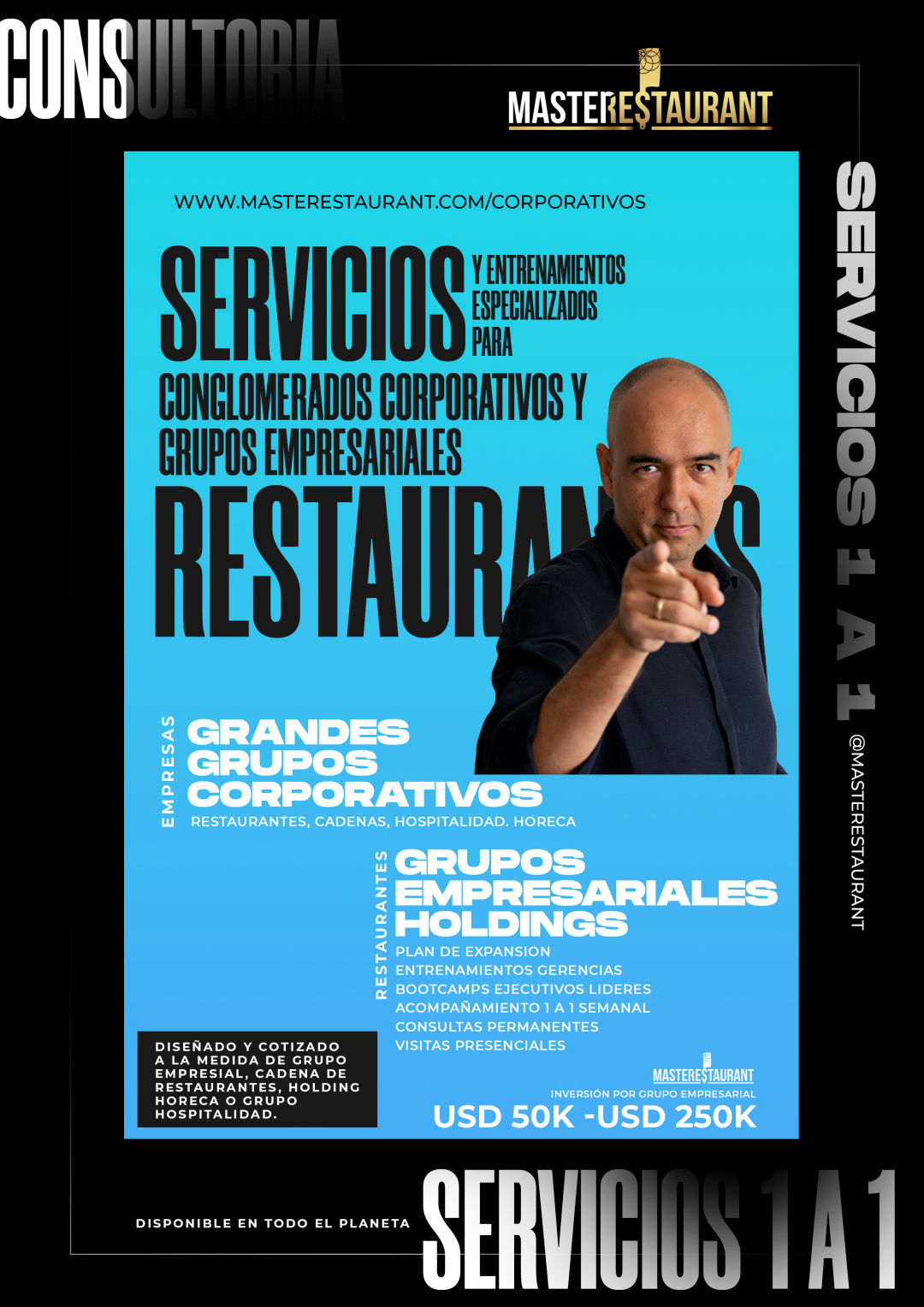
Training, consulting, executive bootcamps and private advisory for restaurant groups, holdings and investor families with themed restaurants.
Starting at USD $50K · tailor made, custom quoted · limited spots worldwide
Published doctrine
The books that changed restaurant management
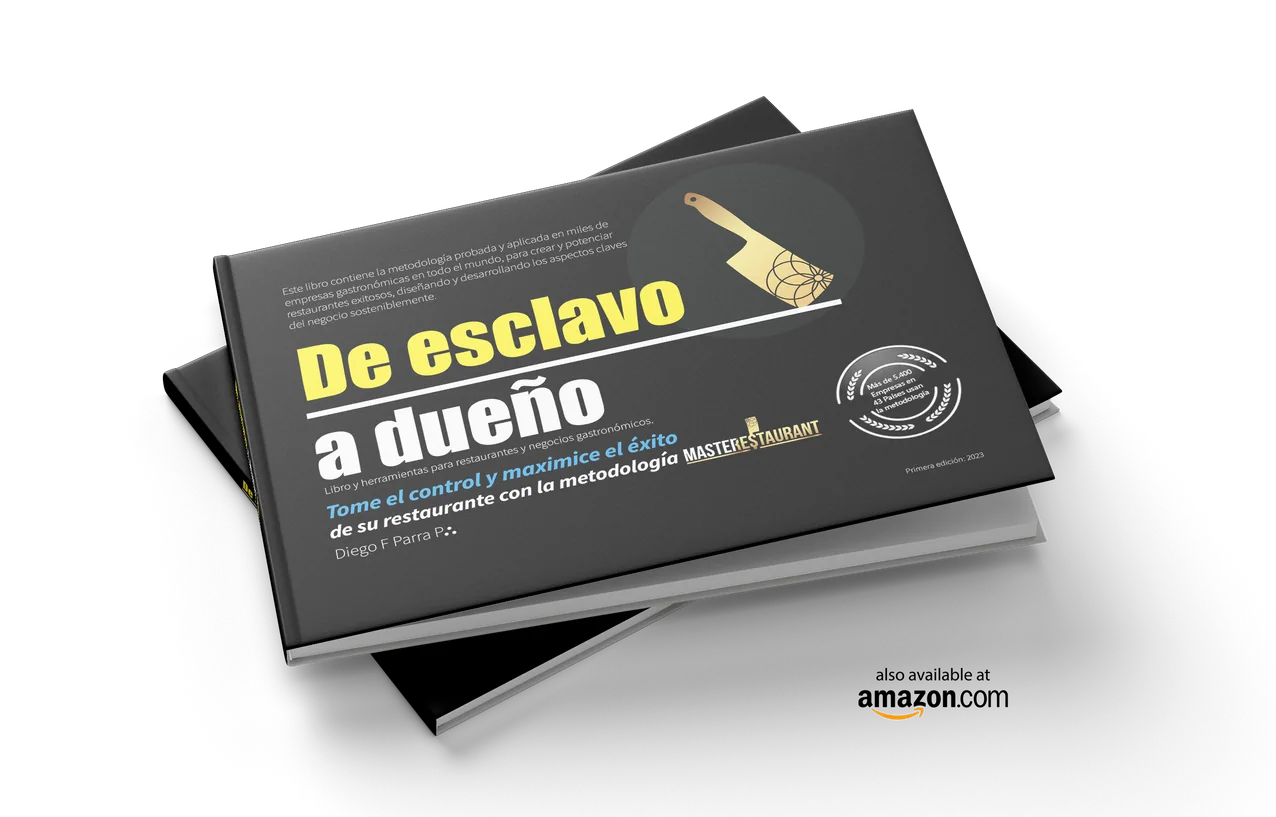
De Esclavo a Dueño
The book that changed how restaurants are managed: practical strategies and tools based on more than 20 years of experience, for traditional restaurants, dark kitchens, foodtech and HORECA businesses.
Triunfar o Morir en el Intento
Practical tools and key strategies to design and operate restaurants and food businesses efficiently.
Podcast: Masterestaurant — Mistakes for Restaurants
The public autopsy of the mistakes that bankrupt restaurants: thousands of owners and managers listen on Spotify to avoid repeating them. Condensed operating doctrine, free and direct.
Listen on SpotifyDownloads
The documents your management will ask for
MASTERESTAURANT® services portfolio
The complete intervention catalog: consulting, training, advisory and specialized services, with scopes and formats. The document to decide with your team.
Download PDFBook: From Slave to Owner
The full doctrine behind the methodology: how to structure a restaurant that runs without depending on the owner. Ideal pre-reading before your project's diagnosis.
View on AmazonPortfolio
More services by Diego F Parra and his team
Beyond themed restaurant consulting, Diego F Parra and his team offer keynotes, mentoring for owners, consulting for groups, training, programs, a membership and an interactive training kit. Everything starts from the same method and the same tools, so once the concept works, the dining-room team can train with that kit, partners can prepare the investment with the Pitch Deck service and the group can take the concept to new sites with the same criteria. The full ecosystem is available:
International keynote speakerOne-on-one consulting and advisoryPersonalized mentoring for owners (limited spots)Corporate groups and holdings consultingCelebrity Restaurants consultingThemed restaurant advisorySpecialized training programs52-Week membershipPitch deck and restaurant investment readinessExponential Program0.1 Program — Elevate Your RestaurantInteractive training kit
Direct contact
Get a quote for themed restaurant consulting for your project in State of Georgia
Your message goes straight to Diego's team: concept, project stage, city and what you need to achieve in State of Georgia.
“A thematic restaurant does not fail because of its décor; it fails because the business is not designed. I have seen projects with multimillion-dollar ambience budgets that shuttered at 18 months because no one had engineered the value proposition, margin structure, or customer return mechanics. Experience is the vehicle; but business model is the engine.”
Diego F. Parra — International consultant, expert in creating, scaling and improving restaurants, HORECA and hospitality
MASTERESTAURANT® methodology applied by 8,400+ restaurants across 43 countries · Author of 3 ISBN-registered books, including «De esclavo a dueño» · 20+ years operating restaurants, franchises, dark kitchens and HORECA groups across 4 continents
Full profile →Let's work on your themed restaurant in State of Georgia with the numbers on the table
Send the concept, its stage and your numbers for a tailored proposal.
Explore more
Themed restaurants: territories, services and ecosystem resources
Useful links for concept founders, restaurant groups, hotels, brands and investors weighing themed restaurant consulting before they decide. They cover nearby territories where the service is published, sister services in the MASTERESTAURANT ecosystem, Diego F Parra's professional profile and the management tools the methodology works with.
World's best restaurant keynote speakerWorld's best restaurant consultantC-Suite restaurant consultant for chains & groupsDiego F Parra — professional profileKeynote speaker serviceCorporate groups & holdings consultingCelebrity restaurant consultingInternational themed restaurant advisoryThemed dining expert in AnaheimConcept restaurants in ArlingtonThemed restaurants in AtlantaThemed restaurant advisory in Atlantic City, New JerseyConcept restaurants in Augusta GeorgiaThemed restaurant consultant in Aurora Illinois
FAQ
Frequently asked questions
How do you ensure that a thematic experience translates into repeat visits and not just one-time curiosity trips?
Repeat business depends on clear consumption reasons integrated into the customer journey. It is not the décor; it is what generates value on each visit. MASTERESTAURANT methodology diagnoses and redesigns those reasons (consumption moments, emotional and rational value proposition, experience-gastronomy-service coherence) and instruments them operationally. It also redesigns the menu to create repeat occasions: breakfasts, lunches, afternoon service, celebrations, private events. The result is customers returning every 4–8 weeks, not a single visit.
Which expansion model works best for a thematic restaurant: additional locations, franchising, or licensing?
It depends on the concept's design architecture. The diagnostic identifies what is replicable without losing thematic essence and what remains unique. Some models use franchising (standardized concept, local managers), others corporate locations (full control, higher investment), still others licensing (partnerships with hotels, shopping centers, entertainment parks). MASTERESTAURANT designs the governance model, process documentation, KPIs, and incentive structure enabling scale without coherence loss. The decision is strategic and defined during engagement.
Where does the work start?
With the diagnosis, never with the concept. First we look at what is there: numbers, menu, operation and project stage. Only then is the themed restaurant's business model designed, and implementation supported through to expansion.
What happens to my concept and my brand?
They stay yours. The whole process runs under NDA, and neither the concept nor the brand nor the intellectual property changes hands at any point. Limited spots worldwide exist to guarantee real dedication to each project.
How much time does it take?
It depends on the scope agreed: diagnosis, model design, implementation and support during operation and expansion. A profitable themed restaurant is built in phases; anyone promising a result in one session is not selling method.
What does it cost?
Between USD $35K and USD $250K for the 1-on-1 consulting, priced to the scope of the project and the concept. Private programs for restaurant groups and chains are quoted separately.
My restaurant is already open — does this still apply?
It does, and it is the most frequent case. The work covers profitability, standardization of the operation and the plan to scale the concept to new locations or to franchise, starting from what already exists.
