 MASTERESTAURANT®
restaurant and foodservice establishments (2025)
National Restaurant Association
Themed Restaurants · All United States

DIEGO F PARRA · CREATOR OF THE MASTERESTAURANT® METHODOLOGY
THEMED RESTAURANT EXPERT Who works across the United States with brands that want to bring their concept to the table without improvising the operation?
Bringing a concept to the table across the United States takes two kinds of judgment at once, and few people hold both: the creative one and the cash one. Diego F. Parra puts the second at the service of the first.
Download the portfolio (PDF)Limited advisory spots worldwide — reserve your evaluation early
8,400+restaurants apply his methodology
43countries with supported projects
65M+views per year
2service languages: EN · ES
International validation
See Diego F. Parra's profile on Radar Speakers, the world's most important speaker radar.
See profile on Radar Speakers →
1 million+
3.03%
9 in 10
5.4%

@masterestaurant
How a themed restaurant across the United States is built to last
A concept that lasts is not the most original one: it is the one that can be REPEATED. Repeatable means the dish comes out the same with the new cook, the cost holds when the supplier raises prices, and the experience doesn't depend on the owner being in the room telling the story table by table.
That is the goal of the engagement across the United States: turning the concept into a system — tech sheets, costing, processes, KPIs and an expansion plan — with the MASTERESTAURANT methodology and its TOOLKIT, in use in 8,400+ restaurants across 43 countries.
How does themed restaurant consulting work in the United States?
It reverses the usual order: first it checks that the concept's business model works in the United States, then money goes into ambiance. The work starts with a strategic diagnosis and ends with a system built to repeat the experience.
Using the MASTERESTAURANT Restaurant Canvas, the concept and its business model are designed together. That covers value proposition, consumption moment, concept storytelling, menu engineering (which dish stays, which goes up in price and which comes off) and Prime Cost protected from the menu design onwards. Then the concept becomes a system: tech sheets, costing, processes, KPIs and an expansion plan for new locations, licenses or franchises. It serves new projects and themed restaurants already open, under confidentiality agreements, on site or virtually, in English or Spanish. As a starting point, this page gathers four verified reference figures from sources such as the Bureau of Economic Analysis and the U.S. Bureau of Labor Statistics.
What do the numbers say about the market for a themed restaurant in the United States?
3.03% — travel and tourism share of GDP (2023), according to the Bureau of Economic Analysis. Reference figures describe the setting a concept competes in; they do not say whether a themed experience will still leave a margin after opening.
For a themed restaurant, the data informs one concrete decision: how much can go into ambiance before the model stops working. Other reference points cited on this page: 5.4% (average monthly staff separations rate in US accommodation and food services, 2024, the U.S. Bureau of Labor Statistics); 1 million+ (restaurant and foodservice establishments, 2025, the National Restaurant Association); 9 in 10 (restaurants with fewer than 50 employees, the National Restaurant Association). In the United States, each figure is read alongside average check, menu engineering and Prime Cost before spending on decor, because novelty brings the first visit and margin decides whether there is a second one.
Data
Reference figures for a themed restaurant in the United States
The figures cited on this page, with what each one measures and its source.
| Figure | What it measures | Source |
|---|---|---|
| 1 million+ | restaurant and foodservice establishments (2025) | National Restaurant Association |
| 3.03% | travel and tourism share of GDP (2023) | Bureau of Economic Analysis |
| 9 in 10 | Restaurants with fewer than 50 employees | National Restaurant Association |
| 5.4% | Average monthly staff separations rate in US accommodation and food services (2024) | U.S. Bureau of Labor Statistics |
Each figure links to its source in the data cards on this page.
The local market
The themed restaurant market across the United States: the context your project must master
A themed or experiential restaurant draws crowds in the first six months. What kills most projects between year one and two is what happens next: novelty wears off, the theme doesn't convert curiosity into repeat visits, and the operator discovers that three or four million was spent on ambiance but there's no business model to carry those fixed costs. I've audited dozens of concept restaurants where decor consumed thirty percent of the total budget and Prime Cost was out of control because no one mapped the customer journey or engineered a menu that rotated around the experience. Specialized consulting surfaces that gap before the project is operating: it converts a themed idea into a real, profitable enterprise, with clear reasons to purchase and a financial model that holds.
An experiential or immersive restaurant across the United States isn't built by decorating well and opening the door. The transformation this tailored engagement delivers is moving from a themed idea to a documented gastronomic operation: define the concept that differentiates, not repeats; map the customer's moments and reasons for dining; design experience at every touchpoint (arrival, ambiance, menu presentation, service, closure); engineer a menu that's coherent with the theme yet generates necessary operating profit (food cost, labor, table turnover); establish weekly KPIs (average check, occupancy, waste, recipe standardization and process); and build a model that can grow (new locations, licenses, franchises) without the founder being the bottleneck. The MASTERESTAURANT(R) methodology integrates strategy, business, and operations in a single lens. It's not consulting or decoration—it's business architecture.
Thirty years in the industry, 8,400 restaurants and gastronomic groups guided across 43 countries, author of recognized methodology, and 65 million people annually in my community. What that translates to the project across the United States isn't a catalog of success stories but a system that has already failed and succeeded in every possible way. When I audit a themed restaurant across the United States, I don't see only what's broken; I see the pattern that usually breaks that class of project in this market, and I have the questions that reveal whether the model will sustain. That reduces investment risk. The client isn't paying for someone else's experience; they're paying for method proven in contexts like theirs.
The return on engagement is measurable. Real differentiation in a market where purchase is conscious: whoever chooses your concept over the one next door knows why they're going and has reasons to return. Repeat visits that rise alongside coherent customer journey and experience design that's memorable, not just photogenic. Average check that grows when menu engineering encourages incremental consumption without force. Operating control that cuts silent costs and allows growth without duplicating problems. Brand value strong enough to attract investors, franchisees, or partners wanting to scale the concept. And founder independence: a model that works without the owner being the on-site operator. That's what distinguishes a themed restaurant that lasts from one that was a season.
Market data
The real size of the opportunity across the United States
travel and tourism share of GDP (2023)
Bureau of Economic AnalysisRestaurants with fewer than 50 employees
National Restaurant AssociationAverage monthly staff separations rate in US accommodation and food services (2024)
U.S. Bureau of Labor StatisticsAll United States as a destination
All United States and its appetite for dining experiences
Across the United States, tourism plays a central role in the health of an experiential or immersive concept: there's a flow of visitors seeking something beyond everyday dining, who have appetite for a higher check, and who generate occupancy in seasons other restaurants see empty. But that's a double-edged sword. An experiential restaurant dependent on tourism while neglecting local clientele falls when the season drops. The local market is also sophisticated: All United States has diners with educated palates who reject a theme if the value proposition isn't credible or if they taste incoherence (luxury decor with canteen service, or storytelling that doesn't hold on the plate). The entrepreneur opening a concept across the United States wins only by weaving both audiences into the customer journey.
A themed restaurant usually fails across the United States when it confuses experience with novelty, or when architectural investment leaves no budget for culinary leadership, trained service, or operational standards that scale. I've seen concepts open at eighty percent occupancy in the first quarter and drop to forty percent in the sixth because the experience was photogenic but not memorable, or because fixed ambiance costs ate the operating margin. What works is a concept that's operationally rational: storytelling told in every interaction but without sacrificing profit, menu that's experiential yet with measured food cost, ambiance that surprises but is maintainable with regular staff, not specialists. The All United States customer expects the theme to be coherent, the food to be good, and the money paid to be worth it. If one of those three fails, they don't return.
RESOURCES
MASTERESTAURANT studies, guides & tools
What a team across the United States can review to size the impact: sector studies, tools and cases:
- STUDYFast food business model: traditional method vs. Masterestaurant method
- STUDYFine dining model: mistakes that sink it vs the right method (Masterestaurant)
- GUIDEPurchasing & Suppliers: Before vs After
- CONCEPTConsistencia entre locales definicion
- COMPARISONRestaurant Inventory Control
- CONCEPTCocina oculta definicion restaurantecercademi
The themed consultant
From the kitchen to the boardroom, in the same language
Few consultants move as easily through a kitchen on a full service as through a board meeting reviewing EBITDA per unit. Diego F Parra has spent two decades doing exactly that: engineer and C-Suite consultant who has created, rescued and expanded restaurants, franchises, dark kitchens and HORECA and hospitality groups across four continents, signing payrolls, negotiating leases and closing expansions in operations worth hundreds of millions of dollars.
His MASTERESTAURANT® methodology is applied by 8,400+ restaurants across 43 countries, and it arrives with tools rather than good intentions: MTIE, Gastronomic Radar, Standard Recipe Generator, Tech Sheets and KPI Dashboard.
He is the author of 3 ISBN-registered books, including «De esclavo a dueño», creator of the industry's leading podcast and of the largest bilingual community of owners, chefs and operations directors in the region (65M+ views per year as @masterestaurant), and is recognized among the top Latino restaurant operations experts globally. The full track record is in Diego F Parra's professional profile.
Themed restaurant consulting with its own doctrine, not generic recipes
Themed restaurant consulting is not improvised. Every engagement is built on the Restaurant Model Canvas and real industry data — profitability, Prime Cost, cost structure, customer experience and expansion — applied to the specific business model of a themed restaurant. The goal is not a venue for the opening-night photo, but a food business that protects the concept, generates profit and can scale to new locations, licenses or franchises when the model is ready. That is why the work is organized on four fronts —diagnosis and business model; concept, menu and themed experience; structure, costs and operation; expansion, franchise and new locations— so the concept still holds up when it is no longer new.
Themed restaurant consulting from start to finish
Advisory that covers the full themed restaurant lifecycle
Business model and diagnosis
It starts by looking at the numbers and the stage of the project, and on that the model is designed with the Restaurant Canvas: value, consumption and profitability.
Quote my diagnosisConcept and experience that repeat
Storytelling, menu engineering and immersive experience, designed for the second visit and not for the photo of the first.
Quote the conceptOperation, costs and standardization
Prime Cost, financial management, processes and teams: method and system where there used to be improvisation and goodwill.
Quote the operationNew locations, licenses and franchise
Expansion challenges, launches and partner and investor management, so the concept reaches the second location intact.
See the services portfolio (PDF)The methodology
Discover the MASTERESTAURANT methodology
What holds a concept up is a system, not a flash of inspiration: tools, processes and models you can audit.
Who is it for?
Built for those who turn their brand into hospitality
Personalized one-on-one work, with projects starting out and with businesses already trading:
Entrepreneurs and concept creators
Whoever creates the concept usually falls in love with it. The work is making sure it also earns once the opening stops being news.
Restaurant groups and chains
Add a concept to the portfolio with the investment protected by method, the rules between partners written and financial control in place.
Hotels and tourism developments
A restaurant that becomes a destination in its own right: story, menu and operation that keep the promise every day, not in the photo.
Brands, IP and franchises
A business that runs on system, with written standards and teams able to replicate the concept in each new location.
Investors and family offices
Entry into hospitality with the MASTERESTAURANT methodology behind it: a concept that is profitable, scalable and auditable.
What's included
The subjects the work is built on
No two engagements are alike: they are assembled from these MASTERESTAURANT methodology modules:
- Business model: the part that rarely comes with a good concept
- Strategic diagnosis of the project, the concept and its brand
- Concept and brand architecture of the themed restaurant
- Menu engineering and an experience design the customer pays for again
- Cost structure and Prime Cost within the range the business can hold
- Profitable standardization and concrete operational improvements
- The 10 key elements of the Restaurant Canvas, optimized
- Processes, teams and leadership with no dependence on the founder
- Growth strategy: own locations, licenses or franchise
- Partners and investors: clear rules to scale without diluting
- Executive bootcamps and leadership training
- 1-on-1 advisory with ongoing consultations and on-site visits
- Opening readiness that protects the concept's reputation
Investment: USD $35K – $250K · tailor-made, priced to each company · spots LIMITED worldwide to guarantee the best service.
Themed packages
Tailor-made themed restaurant consulting packages
Every themed restaurant engagement is 100% personalized and tailor-made to the project and the brand. After a strategic diagnosis, it works through the 10 key elements of the business model in the MASTERESTAURANT Restaurant Canvas — from value proposition and concept to profitability, standardization and expansion. Depending on the case, the package adds menu engineering, Prime Cost and cost structure, partner and investor management, executive bootcamps for the management team, ongoing consultations with visits to the venue and opening readiness. The quote starts from the concept, where the project stands and the numbers already on the table. Priced to each project's scope (USD $35K – $250K), with limited spots worldwide to ensure dedicated attention and discretion for each client.
Themed coverage
Territories neighbouring All United States
Explore themed restaurant consulting in other territories, or go back to the worldwide index on the themed restaurants worldwide page:
Themed dining expert in AnaheimConcept restaurants in ArlingtonThemed restaurants in AtlantaThemed restaurant advisory in Atlantic City, New JerseyConcept restaurants in Augusta GeorgiaThemed restaurant consultant in Aurora IllinoisThemed dining expert in AustinThemed dining expert in Baltimore MarylandThemed restaurants in Baton Rouge, LouisianaThemed dining expert in Beverly HillsThemed restaurant consultant in Boca Raton FloridaThemed dining expert in BostonThemed restaurant consulting in Brookhaven, New YorkThemed restaurant consulting in Carson City NevadaThemed restaurants in Charlotte, North CarolinaThemed restaurant consultant in ChicagoThemed restaurant consulting in Columbia MarylandThemed restaurant advisory in Coral Gables FloridaThemed restaurant consultant in Corpus ChristiThemed dining expert in Cupertino CaliforniaConcept restaurants in DallasThemed dining expert in Delray Beach FloridaThemed restaurant consultant in El PasoThemed dining expert in State of ArizonaMore countries →More cities →
We do serve — and every city on the planet
Available on site or virtually, in English and Spanish.
Who is Diego F Parra?
Diego F Parra is an engineer and C-Suite consultant, creator of the MASTERESTAURANT® methodology —applied by 8,400+ restaurants across 43 countries— and author of 3 ISBN-registered books.
He is the consultant that brands and concepts, athletes, artists and investors choose to turn their brand into a profitable, standardized themed restaurant ready to expand. He has spent two decades creating, rescuing and expanding restaurants, franchises, dark kitchens and HORECA groups across four continents, and he works with his own tools: MTIE, Gastronomic Radar and KPI Dashboard. For a themed restaurant, that means the concept is designed as a system —tech sheets, costing, processes and KPIs— so it can be repeated in new locations, licenses or franchises without being diluted.
HORECA · Chains · Holdings · Foodtech
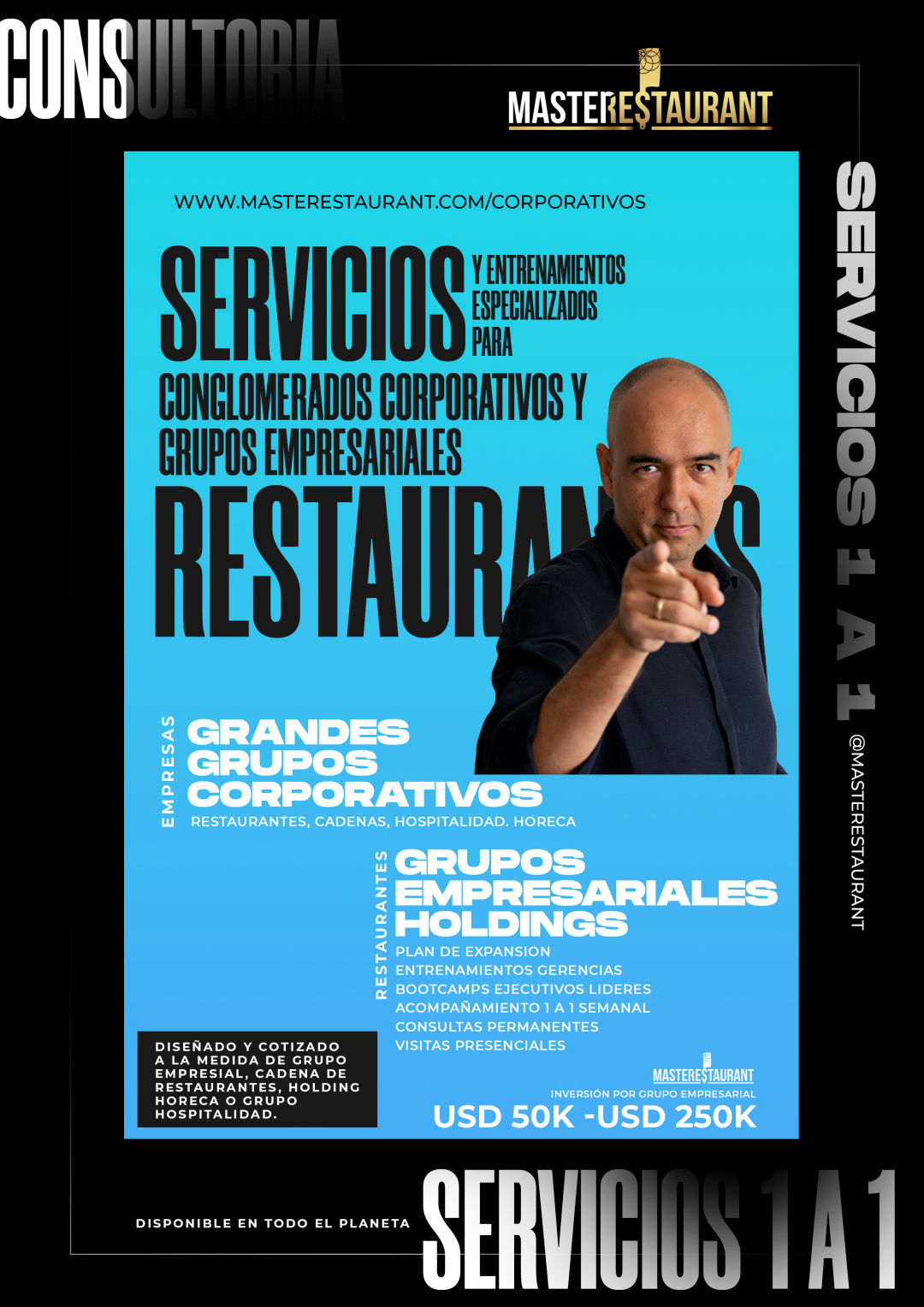
Private programs for groups and family offices
Training, consulting, executive bootcamps and private advisory for restaurant groups, holdings and investor families with themed restaurants.
Starting at USD $50K · tailor made, custom quoted · limited spots worldwide
Published doctrine
The books that changed restaurant management
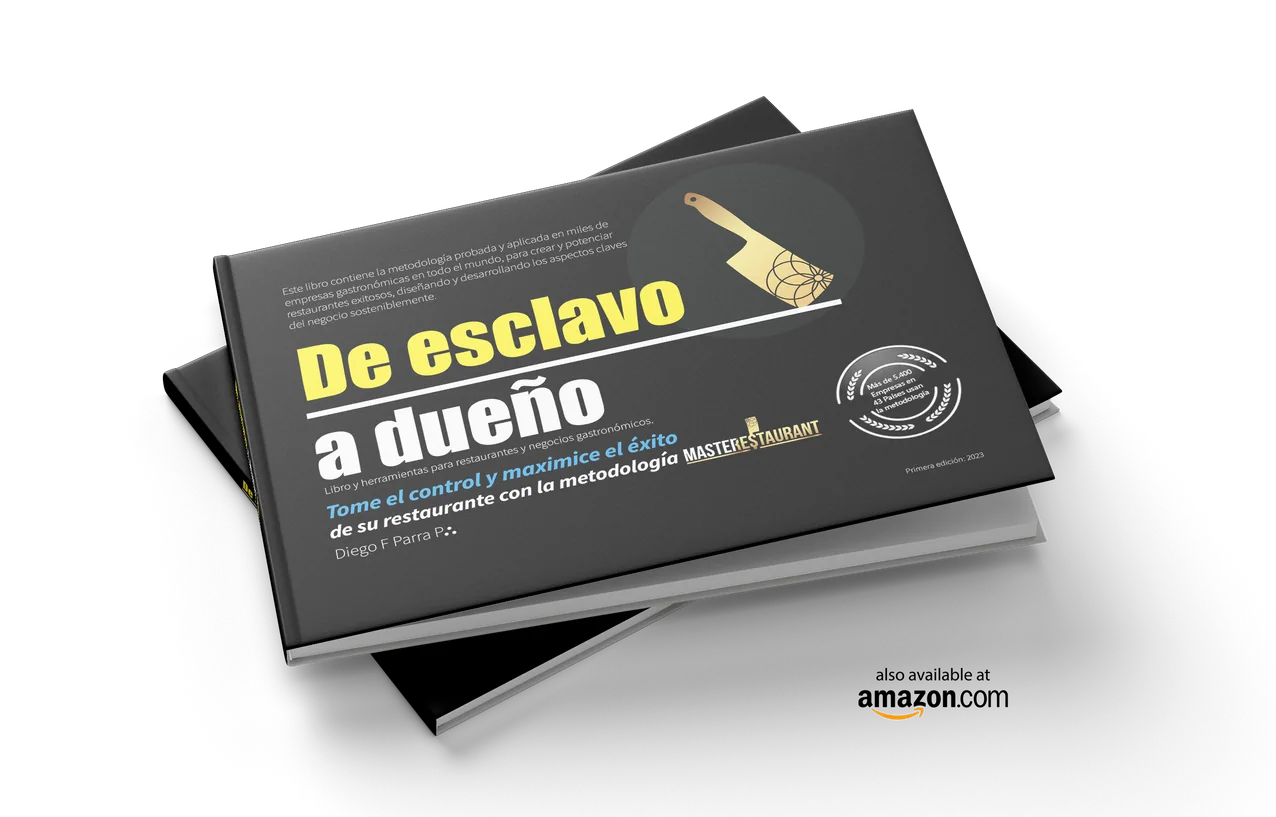
De Esclavo a Dueño
The book that changed how restaurants are managed: practical strategies and tools based on more than 20 years of experience, for traditional restaurants, dark kitchens, foodtech and HORECA businesses.
Triunfar o Morir en el Intento
Practical tools and key strategies to design and operate restaurants and food businesses efficiently.
Podcast: Masterestaurant — Mistakes for Restaurants
The public autopsy of the mistakes that bankrupt restaurants: thousands of owners and managers listen on Spotify to avoid repeating them. Condensed operating doctrine, free and direct.
Listen on SpotifyDownloads
The documents your management will ask for
MASTERESTAURANT® services portfolio
The complete intervention catalog: consulting, training, advisory and specialized services, with scopes and formats. The document to decide with your team.
Download PDFBook: From Slave to Owner
The full doctrine behind the methodology: how to structure a restaurant that runs without depending on the owner. Ideal pre-reading before your project's diagnosis.
View on AmazonPortfolio
More services by Diego F Parra and his team
Beyond themed restaurant consulting, Diego F Parra and his team offer keynotes, mentoring for owners, consulting for groups, training, programs, a membership and an interactive training kit. Everything starts from the same method and the same tools, so once the concept works, the dining-room team can train with that kit, partners can prepare the investment with the Pitch Deck service and the group can take the concept to new sites with the same criteria. The full ecosystem is available:
International keynote speakerOne-on-one consulting and advisoryPersonalized mentoring for owners (limited spots)Corporate groups and holdings consultingCelebrity Restaurants consultingThemed restaurant advisorySpecialized training programs52-Week membershipPitch deck and restaurant investment readinessExponential Program0.1 Program — Elevate Your RestaurantInteractive training kit
Direct contact
Get a quote for themed restaurant consulting for your project across the United States
Your message goes straight to Diego's team: concept, project stage, city and what you need to achieve across the United States.
“The customer sees decor for ten minutes; they understand the business in the next thirty or not at all. A themed restaurant across the United States works when the theme amplifies the business model, not when decoration tries to compensate for a weak one.”
Diego F. Parra — International consultant, expert in creating, scaling and improving restaurants, HORECA and hospitality
MASTERESTAURANT® methodology applied by 8,400+ restaurants across 43 countries · Author of 3 ISBN-registered books, including «De esclavo a dueño» · 20+ years operating restaurants, franchises, dark kitchens and HORECA groups across 4 continents
Full profile →Let's talk about the model before the next investment across the United States
Send the concept, its stage and your numbers for a tailored proposal.
Explore more
Themed restaurants: territories, services and ecosystem resources
Useful links for concept founders, restaurant groups, hotels, brands and investors weighing themed restaurant consulting before they decide. They cover nearby territories where the service is published, sister services in the MASTERESTAURANT ecosystem, Diego F Parra's professional profile and the management tools the methodology works with.
World's best restaurant keynote speakerWorld's best restaurant consultantC-Suite restaurant consultant for chains & groupsDiego F Parra — professional profileKeynote speaker serviceCorporate groups & holdings consultingCelebrity restaurant consultingInternational themed restaurant advisoryThemed dining expert in AnaheimConcept restaurants in ArlingtonThemed restaurants in AtlantaThemed restaurant advisory in Atlantic City, New JerseyConcept restaurants in Augusta GeorgiaThemed restaurant consultant in Aurora Illinois
FAQ
Frequently asked questions
How do we distinguish between a theme that generates repeat visits and one that's just novel for the first months?
Repeat visits come from rational reasons, not novelty. A customer returns if experience solves a problem (where to connect with family, an environment where conversation happens, coherent gastronomy). Theme is the wrapper that makes those reasons memorable. In the engagement we audit the customer journey step by step: if each touchpoint has clear purchase reason or if there's only decoration, it shows. If it's the latter, we redesign before money is spent.
At what average check or number of locations does a themed restaurant justify scaling with licenses or franchises?
It's not a fixed number; it depends on model standardization. I've seen concepts explode at location two because the founder was in the first one. I've seen others scale from location one because the operating manual, training systems, KPI framework, and leadership are documented. In consulting we build that BEFORE scaling, not after. Once the client understands what differentiates their concept and what's replicable, the decision to grow becomes clear.
What exactly does the 1-on-1 engagement consist of?
Designing and implementing the themed restaurant's business model: value proposition, menu, experience, costs and operation, starting from a strategic diagnosis of the project. It is not advisory by the hour: it runs through implementation.
Is there a confidentiality agreement?
Yes, from the first conversation. The concept, the brand and the intellectual property of the project belong to the client and are neither shared nor reused. Limited spots worldwide protect the dedication given to each account.
What are the phases?
Diagnosis, business-model design, implementation and support during operation and expansion. The order matters: designing the experience before knowing the numbers is what leaves a strong concept without a margin.
How is it quoted?
To the scope. The 1-on-1 consulting ranges from USD $35K to USD $250K depending on the project and the concept; private programs for restaurant groups and chains are quoted separately.
Do you work with concepts that don't exist yet?
Yes, and also with those already trading. In the first case it is built from scratch —concept, model and opening—; in the second, profitability is corrected, the operation standardized and the expansion prepared.
