 MASTERESTAURANT®
Population of Leeds per Census 2021 (+8.1% vs 2011), second most populous local authority in England
Office for National Statistics (ONS)Restaurant holdings · Leeds
Diego F. Parra · CREATOR OF THE MASTERESTAURANT® METHODOLOGY
RESTAURANT CHAIN EXPERTWho is the most sought-after consultant to grow, standardize and expand restaurant groups and chains in Leeds?
For boards and leadership in Leeds choosing between opening, converting or closing: the corporate diagnosis puts those three options against every unit with the same yardstick.
Download the portfolio (PDF)Corporate advisory spots LIMITED worldwide - reserve your group's evaluation early
8,400+restaurants apply his methodology
43countries with supported groups
65M+views per year
2service languages: EN - ES
International validationSee Diego F. Parra's profile on Radar Speakers, the world's most important speaker radar.See profile on Radar Speakers →
812,000 inhabitants 20.95 million £52 billion £145 billion
@masterestaurant
The portfolio seen with one yardstick in Leeds
The MASTERESTAURANT methodology and its TOOLKIT have been applied across 8,400+ restaurants in 43 countries, from three-site groups to networks with dozens of units. Growing a group is harder than opening a restaurant: each new site multiplies costs, standards, talent and complexity, and a group only scales when a system replicates per-unit profitability, not when it depends on founders or operational heroes.
In Leeds, the method adapts to the size, stage and expansion model of each group, in an order that does not change: measure, standardize, and only then replicate. That means a corporate diagnosis brand by brand and site by site, standards and financial governance that hold across the network, and a decision on owned units, licensing or franchising based on the documented standard and the team available.
How does restaurant group consulting work in Leeds?
The first step is a corporate diagnosis: every unit the group runs in Leeds is measured on EBITDA, Prime Cost, standards and the team behind it. With that map the board decides which sites to open, convert or close.
The work runs on four fronts together: portfolio strategy, standards that hold across every site, financial governance and a clear expansion rule. Units are compared on the same indicators, so the board sees which locations carry the group and which ones drain it. Then come the systems that make growth repeatable: recipes and processes on paper, a KPI dashboard reviewed on a fixed calendar and a leadership layer that runs without the founders in the room.
Everything is built on the group's own numbers, on site or remote, in English or Spanish. This page cites four verified figures for Leeds, from sources such as the Office for National Statistics and London Datastore.
What do the numbers say about running a restaurant group in Leeds?
812,000 inhabitants — population of Leeds, according to the Office for National Statistics. A figure like this sizes the opportunity; it does not say whether each new unit will earn money.
Other reference points cited on this page: 20.95 million (international visitors to London in 2024, +3.3%, London Datastore); £52 billion (tax revenues generated by tourism in 2024, VisitBritain); £145 billion (hospitality revenue, year to Q4 2024, +10%, UKHospitality). For a group, the useful reading is the unit economics behind each opening: Prime Cost under control, a theoretical food cost close to the real one and EBITDA measured site by site. That is what decides whether a new location in Leeds multiplies profit or only multiplies complexity.
Data
Market figures for restaurant groups in Leeds
The figures cited on this page, with what each one measures and its source.
| Figure | What it measures | Source |
|---|---|---|
| 812,000 inhabitants | Population of Leeds per Census 2021 (+8.1% vs 2011), second most populous local authority in England | Office for National Statistics (ONS) |
| 20.95 million | international visitors to London in 2024 (+3.3%) | London Datastore (GLA) |
| £52 billion | tax revenues generated by tourism in 2024 | VisitBritain / VisitEngland |
| £145 billion | hospitality revenue (year to Q4 2024, +10%) | UKHospitality |
Each figure links to its source in the data cards on this page.
The local market
What to know about Leeds before the next unit opens
Restaurant groups and chains in Leeds face a critical challenge: each new site multiplies fixed costs (rent, payroll, systems), increases operational complexity, and demands standardization that rarely exists on paper. When operating two or three units, a founder or general manager can sustain profitability through direct attention; but beyond five or ten locations, that personalized model breaks.
Most groups expand by commercial impulse—a successful site generates capital, another opens, then another—without designing the corporate structure that ensures each opening replicates the margin of the first. The outcome is predictable: profit-per-unit falls while volume rises, margins erode, and the board discovers it invoices more but earns less.
Specialized corporate hospitality consulting fills precisely that gap: it transforms impulse-driven growth into governed expansion, where each decision is anchored in unit-economics data, operational architecture, and portfolio strategy.
Diego F. Parra's corporate consulting service converts a group that grows without system into a governed hospitality business. It begins with a deep portfolio diagnosis: which units generate true value, which hide losses or inefficiencies.
From there, strategy emerges for brands and units—which lines to grow, which to restructure, which to exit; operations are standardized across all sites through process manuals, quality standards, cost controls and talent management; a system of unit economics and Prime Cost governance is implemented at corporate level, so every manager knows exactly what margin to defend; performance dashboards are aligned with the board; organizational structure is redesigned so operations don't depend on the founder; and expansion and franchise strategy is prepared.
All integrated in a single bespoke program, using MASTERESTAURANT methodology and proprietary toolkit (Restaurant Model Canvas, MTIE, Radar, Financial Briefs, Indicator Dashboard).
Diego F. Parra is an international corporate consultant in restaurants for two decades, with real experience signing payrolls and closing expansions in operations worth hundreds of millions of pounds. He has deployed MASTERESTAURANT methodology across 8,400+ restaurants and hospitality groups in 43 countries, working directly with boards and C-Suites of chains and holdings.
He authored 'From Slave to Owner', accumulates 65+ million annual views across his consultant and restaurateur community, and has documented every learning in verifiable research on unit economics, multi-site expansion, financial governance, and operational scalability.
When a group in Leeds engages Diego, they are not hiring a generic consultant adapting McKinsey frameworks to restaurants: they are hiring someone who has diagnosed and scaled the exact problem they face, in a hundred variations, across legal, cultural, and economic contexts as diverse as this market itself.
The concrete return of the program translates to: (1) replicated profitability per unit, where each new opening replicates the margin of the most profitable in the group, not the eroded average; (2) protected margins in each expansion, because costs, operating standards, and Prime Cost targets are designed before opening the door; (3) portfolio decisions backed by data—the board knows exactly which brands to amplify, which to restructure, where to deploy capital and where to divest; (4) operations that don't depend on the founder or heroic operators, because every process is documented, every metric is visible, and every organizational level knows its role; (5) a restaurant group more valuable and attractive to investors, because it has systems, predictable margins, and clear, profitable expansion strategy. In summary: the program converts growth into value.
Market data
Leeds in numbers: groups, chains and franchises
international visitors to London in 2024 (+3.3%)
London Datastore (GLA)tax revenues generated by tourism in 2024
VisitBritain / VisitEnglandhospitality revenue (year to Q4 2024, +10%)
UKHospitalityLeeds as a market
What sets the pace of the network in Leeds
Leeds is the epicenter of corporate food and beverage in the north of England: it hosts a robust ecosystem of independent multi-concept restaurant groups and chains (from casual dining and fine dining to quick service and ghost kitchens), operated by family businesses, corporate trusts, and operators with regional or national ambitions. The city concentrates hospitality talent (chefs, general managers, cost and supply-chain specialists), available but competitive.
Commercial corridors (City Centre, South Bank, Hunslet Waterfront) are high-density consumption and tourism markets (business, leisure, cruise passengers via Hull), with diverse but competitive rent structures; shopping centers (Victoria Leeds, Trinity) offer volume but demand standardized operational rigor. The local market requires groups that understand talent turnover, corporate cost control in multi-unit operations, and concept replicability, because diners are discerning and competition is fierce.
A group that doesn't standardize, doesn't govern costs corporately, and doesn't apply data to expansion decisions simply doesn't survive at pace and scale.
The opportunity to expand in this market is real: it continues to grow, space exists in secondary corridors not yet saturated, and demand for diverse high-quality dining exceeds supply. The risk is equally real: profit erosion. Each new site requires specialized staff recruited at market salary (higher than London but rising in the region), multiplies corporate administration costs that a general manager cannot replicate, and demands operating standards that degrade in each opening if not documented and audited.
Talent turnover in the region is a given: an exceptional chef leaves, and with them goes the concept's differentiation. A group attempting to expand without a standardization system, without clear unit economics, and without a talent model that doesn't depend on key individuals, will watch margins fall and complexity multiply. Diego's corporate consulting addresses exactly that risk: it designs the operating architecture that permits expansion without dilution.
RESOURCES
MASTERESTAURANT studies, guides & tools
Reference content for owners and directors in Leeds: proprietary indexes, tools and industry analysis:
- LISTRestaurant unit economics: traditional method vs Masterestaurant method
- STUDYRestaurant Value Proposition: Traditional Method vs Masterestaurant Method
- CANVASRestaurant Business Model: Definition, Canvas and Example 2026
- ARTICLEMenu just like the competition vs differentiated value
- CONCEPTConsistencia entre locales definicion
- ARTICLEAutomating restaurant permits: mistakes vs. the right method
The corporate consultant
The judgment behind this corporate restaurant consulting
Diego F. Parra is an engineer and C-Suite consultant, and his trade for the last twenty years has been walking into restaurants, franchises, dark kitchens and HORECA groups across four continents to create them, rescue them or expand them. Along the way he signed payrolls, negotiated leases, structured partnerships and closed expansions in operations worth hundreds of millions of dollars.
The MASTERESTAURANT® methodology came out of that, and is used today by 8,400+ restaurants across 43 countries, with its TOOLKIT: MTIE, Gastronomic Radar, Standard Recipe Generator, Tech Sheets and KPI Dashboard. For an owner that means every decision is made on his own numbers and on tested processes, not on a hunch from the last good weekend.
His published work backs it: Author of 3 ISBN-registered books, including «De esclavo a dueño», creator of the industry's leading podcast and of the largest bilingual community of owners, chefs and operations directors in the region (65M+ views per year as @masterestaurant), recognized among the top Latino restaurant operations experts globally. See Diego F. Parra's professional profile.
Corporate consulting with its own doctrine, not generic frameworks
Consulting for restaurant groups is not solved with management theory. Every engagement is built on the Restaurant Model Canvas and real industry data—profitability, Prime Cost, cost structure, multi-site standardization and expansion—applied to the specific business model of a group, a chain or a holding. The goal is not to open more restaurants, but to build a business system that replicates per-unit profitability, governs the portfolio and sustains operations on clear rules rather than indispensable people. Every board decision rests on the group's own indicators, measured at each site.
Corporate consulting from start to finish
Advisory that covers the full restaurant-group lifecycle
What the board decides
Where next year's capital goes, on EBITDA per unit and strategic fit, not on whichever brand argues hardest in the meeting.
Get a quoteWhat holds the network up
Trained managers, quality control and written processes. A standard needs somebody to hold it or it degrades on its own.
Quote standardizationWhat protects the margin
Prime Cost governed, group fixed costs reviewed and waste measured identically across every site.
Quote expansionWhat makes growth possible
A model proven per unit and a staged plan, before the next opening or the first franchise contract is signed.
See the services portfolio (PDF)The methodology
Discover the MASTERESTAURANT methodology
Behind every group that scales profitably there is a system, not luck: tools, processes and models that turn impulse growth into governed expansion.
Who is it for?
For chains that already grew and now need order
A tailor-made 1-on-1 service, built for those opening and for those already operating:
From three to ten sites
The stretch where the founder's judgement stops reaching and no structure has replaced it yet.
From ten to fifty
Where the network needs governance: single definitions, quality control and trained managers in every market.
Consolidated networks
Years of trading and a per-unit margin sliding slowly, with nobody able to point at where.
Groups in generational transition
When what lived in the founder's head has to become a system others can run.
What's included
Contents of the corporate program
The programme is built on whichever MASTERESTAURANT methodology modules your case calls for:
- Executive bootcamps for the leadership team
- Working sessions with the board
- A full corporate diagnosis
- Unit economics per brand and per unit
- Multi-site manuals and operational control
- Prime Cost governed corporately
- KPI dashboards for leadership
- Readiness for franchising and new markets
- Support through implementation
Investment: from USD $50K to USD $500K+ - tailor-made corporate programs, priced to the group's size and complexity - spots LIMITED worldwide.
Corporate programs
Tailor-made corporate consulting programs for groups and chains
Every corporate program is 100% personalized and tailor-made to the group. It starts with a strategic portfolio diagnosis and works through the key elements of the business model in the MASTERESTAURANT Restaurant Canvas, from portfolio strategy and standardization to per-unit profitability and expansion. Priced to the group's size and complexity (from USD $50K to USD $500K+), with limited spots worldwide to ensure dedicated attention and discretion for each client.
The diagnosis sets the scope and the phases (strategic planning, standardization and implementation, and support through operations and expansion), working from the group's own numbers, on site or remote, in English or Spanish.
Corporate coverage
Chain engagements available near Leeds
Explore other territories or the worldwide index:
Corporate hospitality consulting across the United KingdomRestaurant chain expansion in BirminghamRestaurant group consultant in EdinburghAdvisory for restaurant groups in GlasgowRestaurant group consulting in LiverpoolRestaurant group consulting in LondonRestaurant chain expansion in ManchesterRestaurant group consultant in the United KingdomRestaurant chain expansion across BrazilRestaurant chain consulting in AustraliaRestaurant chain consulting in IsraelRestaurant chain consulting in South AfricaRestaurant chain expansion in AalborgRestaurant group consulting in AarhusCorporate hospitality consulting in AlicanteRestaurant group consulting across DenmarkRestaurant chain expansion across FranceRestaurant group consultant across SpainCorporate hospitality consulting in AmsterdamRestaurant chain expansion in AustriaRestaurant group consultant in BarcelonaAdvisory for restaurant groups in BelgiumCorporate hospitality consulting in BerlinRestaurant group consulting in BrusselsMore countries →More cities →
We do serve — and every city on the planet
Served on site or virtually, in English and Spanish.
Who is Diego F. Parra?
Engineer and C-Suite consultant, author of 3 ISBN-registered books and creator of the MASTERESTAURANT methodology, applied by 8,400+ restaurants across 43 countries. The method comes with its own technology suite: MTIE, Gastronomic Radar and KPI Dashboard.
He is the consultant that business groups, chains, holdings and family offices choose to grow, standardize and expand their restaurant portfolio with profitability and governance. His method comes from two decades operating, rescuing and expanding restaurants, franchises, dark kitchens and HORECA groups across four continents, and it arrives with instruments proven in real operations, not generic templates. He works in English or Spanish, on site or remote.
HORECA · Chains · Holdings · Foodtech
Private programs for boards and family offices
Consulting, bootcamps and private advisory for boards and family offices.
From USD $50K, priced to the group; limited spots worldwide.
Published doctrine
The books that changed restaurant management
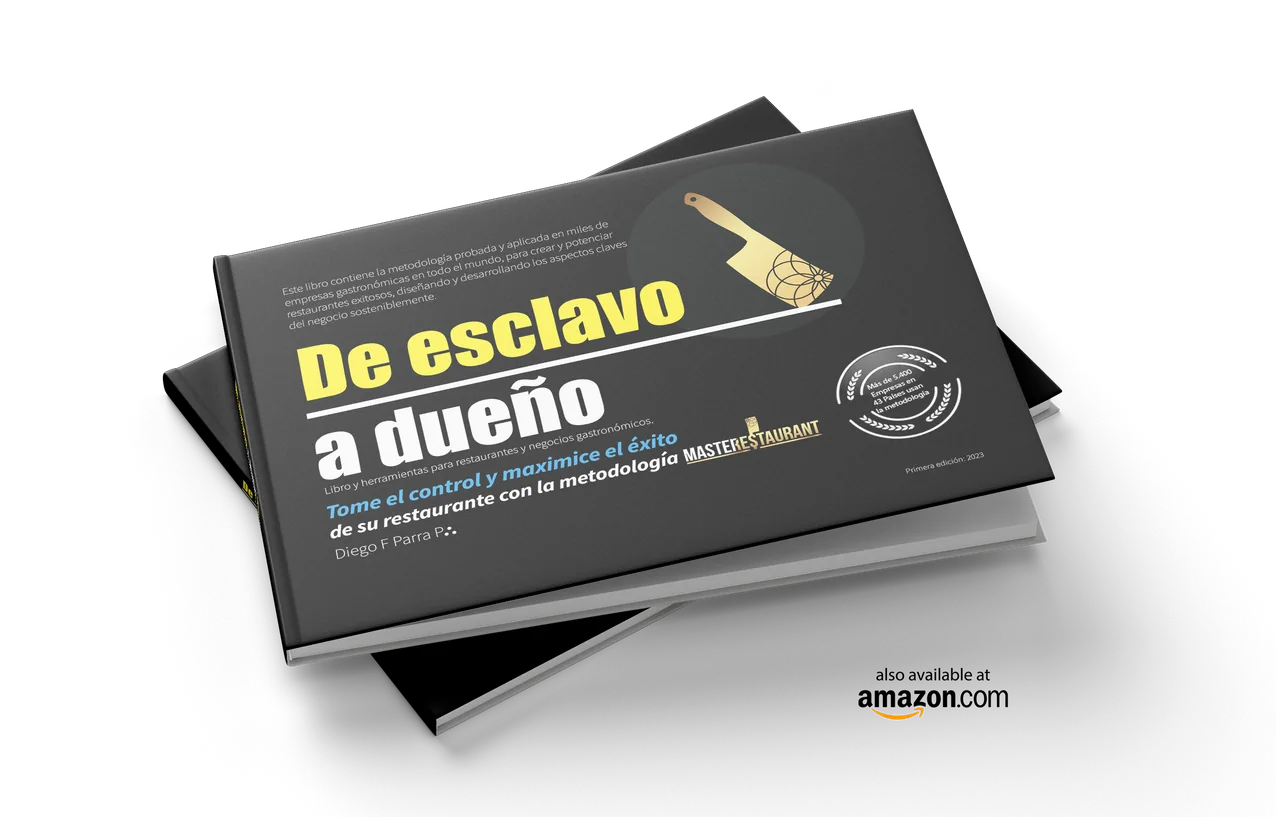
De Esclavo a Dueño
The book that changed how restaurants are managed: practical strategies and tools based on more than 20 years of experience, for traditional restaurants, dark kitchens, foodtech and HORECA businesses.
Triunfar o Morir en el Intento
Practical tools and key strategies to design and operate restaurants and food businesses efficiently.
Podcast: Masterestaurant — Mistakes for Restaurants
The public autopsy of the mistakes that bankrupt restaurants: thousands of owners and managers listen on Spotify to avoid repeating them.
Listen on SpotifyDownloads
The documents your board will ask for
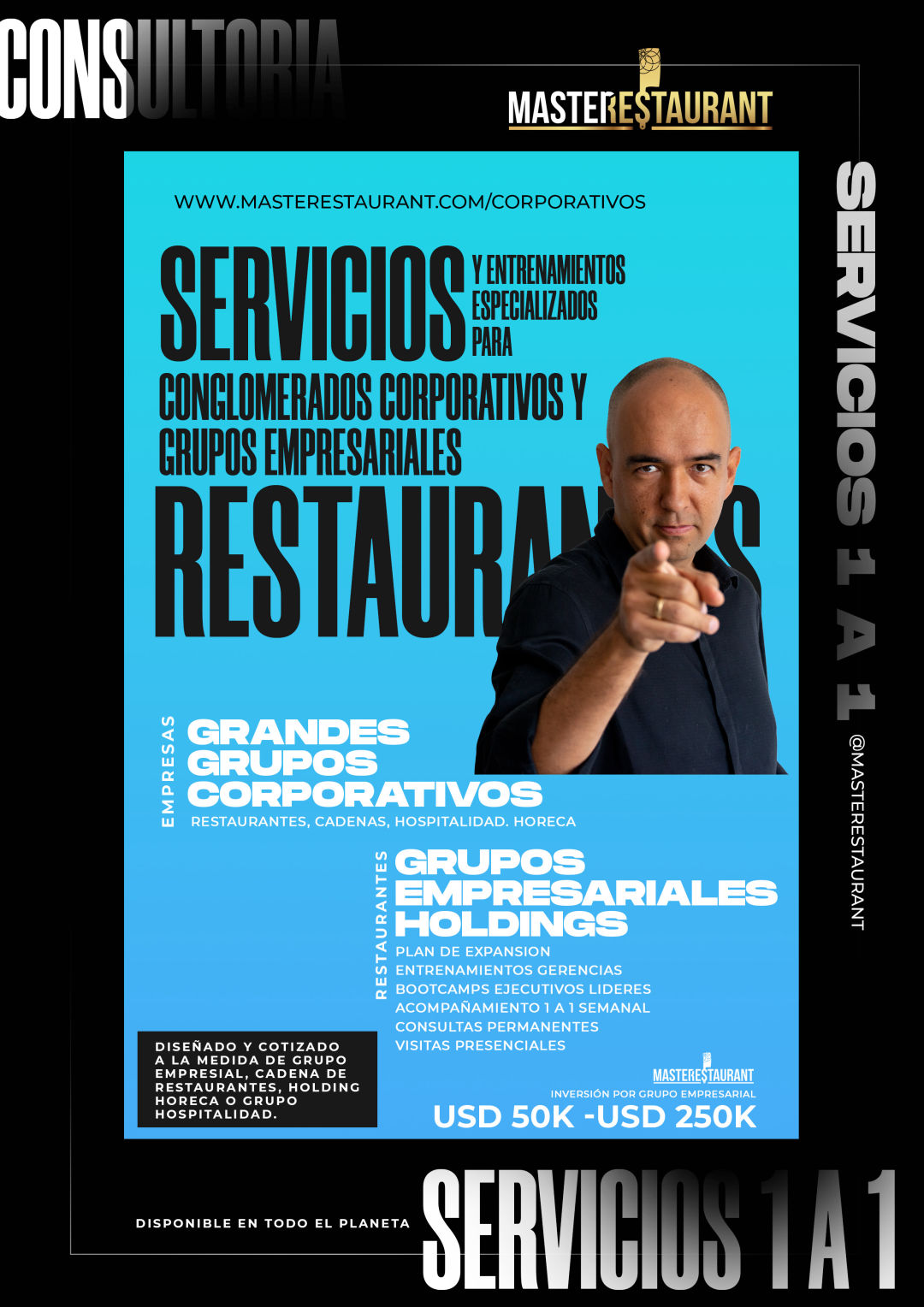
MASTERESTAURANT services portfolio
The complete corporate intervention catalog: consulting, executive bootcamps, advisory and specialized services, with scopes and formats. The document to decide with your board.
Download PDFBook: From Slave to Owner
The full doctrine behind the methodology: how to structure restaurants that run without depending on the owner. Ideal pre-reading before your group's diagnosis.
View on AmazonPortfolio
More services by Diego F. Parra and his team
As the group grows, every new site needs managers trained to the same standard. That is why the ecosystem's services start from the same method and tools as the corporate consulting: training and courses for managers in each market, the membership to keep learning going and the Pitch Deck and investment service when expansion needs capital. The full ecosystem is available:
International keynote speakerOne-on-one consulting and advisoryPersonalized mentoring for owners (limited spots)Corporate groups and holdings consultingCelebrity Restaurants consultingThemed restaurant advisorySpecialized training programs52-Week membershipPitch deck and restaurant investment readinessExponential Program0.1 Program — Elevate Your RestaurantInteractive training kit
From template to results
Want this working every day in your restaurant?
The tool gives you the template. The program gives you the method and the guidance to use it every week, with your team.
Direct contact
Get a quote for corporate consulting for your group in Leeds
Your message goes straight to Diego's team: group or chain, number of sites, stage and what you need to achieve in Leeds.

“I've seen hundreds of restaurant groups scale: those that expand without losing profitability are precisely those who understood that opening sites is easy; replicating margins is what demands system. A group without clarity on its Prime Cost per unit, without standardized business processes, and making expansion decisions without data, is simply adding complexity, not value.”
Diego F. Parra — International consultant, expert in creating, scaling and improving restaurants, HORECA and hospitality
MASTERESTAURANT® methodology applied by 8,400+ restaurants across 43 countries · Author of 3 ISBN-registered books, including «De esclavo a dueño» · 20+ years operating restaurants, franchises, dark kitchens and HORECA groups across 4 continents
Full profile →Ready to franchise in Leeds?
Tell us how many units the network runs and which decision the board has to make.
Explore more
Restaurant groups: territories, services and ecosystem resources
Related links for boards, C-Suite and teams evaluating Diego F. Parra's corporate consulting for restaurant groups and chains: nearby territories, sister services in the MASTERESTAURANT ecosystem and management tools, all built on the same method.
World's best restaurant keynote speakerWorld's best restaurant consultantC-Suite restaurant consultant for chains & groupsDiego F. Parra — professional profileKeynote speaker serviceCorporate groups & holdings consultingCelebrity restaurant consultingInternational themed restaurant advisoryCorporate hospitality consulting across the United KingdomRestaurant chain expansion in BirminghamRestaurant group consultant in EdinburghAdvisory for restaurant groups in GlasgowRestaurant group consulting in LiverpoolRestaurant group consulting in London
FAQ
Frequently asked questions
What does restaurant management consulting in Leeds look like for a restaurant group?
It starts with a corporate diagnosis of every unit in Leeds, measured with the same yardstick (EBITDA per unit, Prime Cost, standards and the team that runs each site), so the board can decide what to open, convert or close.
Is there Leeds restaurant consulting for multi-unit groups and holdings?
Yes. MASTERESTAURANT's corporate consulting works with restaurant groups in Leeds on portfolio strategy, unit economics and standards, replacing the founder's judgement with a system without losing what made the group grow.
How do you ensure that operational standardization doesn't stifle the differentiation of each concept or location in our group?
The standardization we implement is PROCESS and METRICS, not recipe or menu. We standardize how you buy, manage talent, record costs, audit quality; but each concept—or each unit in a different location—retains its culinary identity and brand experience. The MASTERESTAURANT Restaurant Model Canvas separates what MUST be identical (business processes) from what CAN be different (value proposition and experience). That's how a group grows without becoming a generic chain.
Our group grew fast in the last three years but we lack clarity on whether our real Prime Cost is what we think, or if there are leaks in individual units. How do you diagnose that in a program?
The initial diagnosis maps ALL costs in every unit (not just the obvious: rent, payroll, food, but also services, insurance, utilities, maintenance, distribution). We compare each line against group and industry benchmarks, and identify leaks—units reporting a Prime Cost that doesn't reconcile, or with unsuitable cost structures. We use MASTERESTAURANT's Gastronomic Radar to visualize those differences and form hypotheses about their root cause (weak management, unsuitable concept, wrong location). That's the starting point of every transformation.
How does corporate consulting for restaurant groups and chains work?
It starts with a strategic diagnosis of the group and its portfolio of brands and units. Based on it, the growth plan is designed —portfolio strategy, multi-site standardization, per-unit profitability and expansion—and leadership is supported through implementation.
Is the confidentiality of the group's information protected?
Yes. The whole process operates under confidentiality agreements (NDA). The group's financial, operational and strategic information is and remains the client's. Limited spots worldwide exist to guarantee dedication and focus on each organization.
How long does it take and what are the phases of the corporate engagement?
It depends on the group's size and complexity: diagnosis, strategic planning, standardization and implementation, and support during operation and expansion. Scaling a group profitably is a process with method, not an event.
What is the investment for a corporate program?
Corporate programs range from USD $50K to USD $500K+ and are priced to the group's size and complexity, number of sites and scope of the engagement. They are quoted tailor-made after the diagnosis.
Do you work with growing groups and also with consolidated chains?
Both: expanding groups that need to standardize and get in order before growing, and consolidated chains looking to recover per-unit profitability, restructure the portfolio or prepare franchising and new markets.
