 MASTERESTAURANT®
Projected restaurant and foodservice sales in 2026
National Restaurant AssociationRestaurant & hospitality consulting · Cuenca
DIEGO F PARRA · CREATOR OF THE MASTERESTAURANT® METHODOLOGY
HOSPITALITY CONSULTINGWho do owners in Cuenca call when the restaurant trades well and still leaves no money?
Diego F. Parra has worked on 8,400+ restaurants across 43 countries. In Cuenca the method is the same: a diagnosis with numbers, a plan ranked by impact and support until the changes are implemented and measured.
Download the portfolio (PDF)Restaurant & hospitality consulting slots LIMITED worldwide — reserve yours
8,400+restaurants apply his methodology
43countries with supported groups
65M+views per year
2service languages: EN - ES
International validationSee Diego F. Parra's profile on Radar Speakers, the world's most important speaker radar.See profile on Radar Speakers →
1.55 trillion USD 49 % 636,996 inhabitants 5.4%
@masterestaurant
From a restaurant that works to a model that repeats, in Cuenca
The MASTERESTAURANT methodology and its TOOLKIT have been applied across more than 8,400 restaurants in 43 countries. This is not business-school theory: it is what was left standing after working inside real operations, and it arrives with its own instruments —MTIE, Gastronomic Radar, Standard Recipe Generator, Tech Sheets and KPI Dashboard— instead of generic templates.
In Cuenca it adapts to the market, the size and the stage of the business, because copying a recipe from another country is exactly what this consulting exists to prevent. The order of work stays the same from one market to the next: measure with the operation's own data first, then fix what returns margin fastest, and put the structural work in writing until the model is ready to be replicated.
How does restaurant consulting work in Cuenca?
In Cuenca, it starts with a diagnosis of the restaurant built from its own operating data, not questionnaires: where the money goes, how much margin each dish earns and which processes are missing. That becomes a work plan ranked by impact on margin.
This is one-on-one consulting with no templates, for the owner and the team that runs the restaurant. What moves money in weeks comes first: Prime Cost, actual versus theoretical cost, waste and shrinkage, menu engineering and technical sheets. The structural work follows, in writing: standard recipes, processes, manuals and an organizational structure that does not depend on the owner being there. Support continues through implementation and ends with a closing measurement against the opening one.
It runs virtually, on site or in a hybrid format, in English or Spanish. This page cites four verified figures as a reference for Cuenca, from sources such as INEC and the National Restaurant Association.
What do the numbers say about running a restaurant in Cuenca?
636,996 inhabitants — projected population of Cuenca canton; source: INEC. It is context, not a diagnosis: it does not say how much margin an operation keeps or where it leaks.
The decision comes from the restaurant's own numbers, not from market figures. Other reference points cited on this page: 1.55 trillion USD (projected restaurant and foodservice sales in 2026, the National Restaurant Association); 49 % (chefs ranking social media among the top trends affecting operations in 2026, the James Beard Foundation); 5.4% (average monthly staff separations rate in US accommodation and food services, 2024, the U.S. Bureau of Labor Statistics).
Those numbers are Prime Cost, the gap between theoretical and actual cost, waste and the margin on each dish. In Cuenca, as in any other market, they are what show whether the next move is to adjust the menu and prices, tighten the operation or prepare a second site.
Data
Reference figures for restaurants in Cuenca
The figures cited on this page, with what each one measures and its source.
| Figure | What it measures | Source |
|---|---|---|
| 1.55 trillion USD | Projected restaurant and foodservice sales in 2026 | National Restaurant Association |
| 49 % | Chefs ranking social media among the top trends affecting operations in 2026 | James Beard Foundation |
| 636,996 inhabitants | Projected population of Cuenca canton per INEC's institutional article 'Conozcamos Cuenca a través de sus cifras' | INEC - Instituto Nacional de Estadística y Censos |
| 5.4% | Average monthly staff separations rate in US accommodation and food services (2024) | U.S. Bureau of Labor Statistics |
Each figure links to its source in the data cards on this page.
The local market
What kind of market Cuenca is for a restaurant
A restaurant doing solid revenue has already passed survival mode. But revenue is not margin. I've audited dozens of operations moving large numbers and bleeding money in places where no one looks: theoretical cost of ingredients versus actual cost, unmeasured waste, inventory loss growing unseen, menu engineering where two similar dishes cost differently and the owner has no idea. Working more hours, squeezing the team harder, raising ticket average—none of that closes that gap. Margin appears where measurement exists. A restaurant without visibility into real cost is a business operated blind.
The transformation delivered by comprehensive consulting is moving from a business dependent entirely on the owner's judgment to one that runs on system. That means diagnosis of the business and its numbers, Restaurant Model Canvas applied to your specific operation, Prime Cost under control, standardized recipes with technical sheets the team executes every service, documented processes that don't vanish when a chef leaves, transparent EBITDA per unit, management structure where decisions have data behind them.
MASTERESTAURANT methodology is what Diego has tested across 43 countries and 8,400 restaurants: a pattern that applies immediately. What is delivered doesn't sit in a folder; it's implemented the following week.
Authority isn't in theory. Diego is a C-Suite consultant specialized 100% in hospitality and restaurants; his methodology is applied by 8,400+ operations across 43 countries; he's author of 3 ISBN-registered books with "From Slave to Owner"; his content exceeds 65 million views yearly. That isn't a CV—it's learning from thousands of real audits, patterns that repeat globally. No modern theory replaces that.
No software you buy solves it because the problem isn't the tool, it's knowing where to look first. That only someone who's been in the kitchen at eleven p.m. closing a register with numbers that don't add up can know.
The return is concrete. Margin recovered and defended month after month. Costs under control because they're measured. Consistency in every service and location: the dish you serve today costs the same as last week's. Team trained in processes that work, not improvisation. Decisions with data: not intuition, it's audit of numbers. And a business that can grow when growth is a strategic decision, not a guess. The owner stops being essential for the restaurant to function every day.
Market data
The numbers decisions get made on in Cuenca
Chefs ranking social media among the top trends affecting operations in 2026
James Beard FoundationProjected population of Cuenca canton
INEC - Instituto Nacional de Estadística y CensosAverage monthly staff separations rate in US accommodation and food services (2024)
U.S. Bureau of Labor StatisticsCuenca as a market
What drives hospitality in Cuenca
The gastronomic ecosystem is defined by zone and operation type. The historic center concentrates most diners and cultural tourism but carries expensive rent and highly competitive density: high concentration of bars and restaurants, each fighting for share. Residential zones have solid purchasing power but are farther from traffic flows. The local diner evaluates quality-to-price; this isn't a one-night tourist.
Cultural tourism brings volume but seasonal, at prices visitors pay that operators can't sustain with local clientele the rest of the year. Available talent is good—there's culinary tradition—but turnover is high: six to twelve months average. Supplies come mainly from regional ports, adding freight cost; local suppliers have power because there are no alternatives.
What erodes margin in this market is different from other regions. First: local cost structure where freight of supplies is a line item, and suppliers without competition charge what they want. Second: strong seasonality—tourism peaks in July-August and December; the rest of the year demand falls and the restaurant holds fixed costs the same. Third: staff turnover so high there are permanent training costs; you train someone and they leave.
Fourth: local price pressure—you can't raise menu freely when the resident customer resists. Fifth—and here's the point: margin lost isn't just in the kitchen. It's in unverified purchasing, unmeasured waste growing in storage, inventory loss nobody documents, labor paid with unclear productivity, recipes that aren't recipes but approximations.
RESOURCES
MASTERESTAURANT studies, guides & tools
Actionable resources for restaurant teams in Cuenca — original studies, guides and tools, not theory:
- AI PROMPTRecipe Cost Variance Analyzer for Restaurants
- GUIDEHybrid dine-in + delivery model: before vs after with Masterestaurant
- STUDYHybrid Dine-in + Delivery Restaurant Model: Myth vs Reality in 2026
- DATAVender un restaurante estadisticas
- CASE STUDYRestaurant Menu Pricing 2026: Traditional Method
- DATAHow to Make a Restaurant Profitable: Traditional
- LISTFranquiciar
The expert restaurant and hospitality consultant
Twenty years of real operations, not theory
There are consultants who have read about restaurants and consultants who have stood inside one at nine on a Friday night. Diego F Parra is the second kind: engineer and C-Suite consultant with two decades creating, rescuing and expanding restaurants, franchises, dark kitchens and HORECA and hospitality groups across four continents, with payrolls signed, leases negotiated and expansions closed in operations worth hundreds of millions of dollars.
That experience was distilled into the MASTERESTAURANT® methodology, applied today by 8,400+ restaurants across 43 countries, and into its TOOLKIT: MTIE, Gastronomic Radar, Standard Recipe Generator, Tech Sheets and KPI Dashboard. Tools, not slides.
The picture is completed by 3 ISBN-registered books, including «De esclavo a dueño», the industry's leading podcast, the largest bilingual community of owners, chefs and operations directors in the region (65M+ views per year as @masterestaurant) and a place among the top Latino restaurant operations experts globally. Full detail in Diego F Parra's professional profile.
Restaurant consulting with its own doctrine, not generic frameworks
Expert restaurant and hospitality consulting is not solved with management theory borrowed from another industry. It is solved with hospitality engineering: Prime Cost under control, theoretical versus actual cost, waste measured, standard recipes, written processes and indicators leadership reviews every week. Every engagement starts from the Restaurant Model Canvas: the whole business model is diagnosed, priorities are ranked by their impact on margin, and the team is left with its own instruments to sustain the results once the consulting ends.
Decisions stop being bets: they are made on data. The method is the same for an independent restaurant, a chain or a hospitality group.
Expert restaurant and hospitality consulting, end to end
An engagement that covers the whole cycle, from diagnosis to expansion
Diagnosis and business model
Consulting that measures before it advises: the operation's numbers first, then the restaurant's business model, not the other way around.
Do you run a group or a chain?Profitability and cost engineering
Menu engineering and technical sheets that show what each dish earns, with Prime Cost, waste and shrinkage measured: where the bottom line feels the change first.
A hotel or hospitality group?Standardization and operations
Standard recipes, written processes, manuals and structure: the restaurant runs just as well on the day the owner is away.
A celebrity or high-profile investor?Leadership, indicators and growth
A trained team, indicators in plain sight and an orderly growth plan: new sites or franchises when the model can carry it.
A themed or immersive concept?The methodology
Discover the MASTERESTAURANT methodology
Behind every food business that scales profitably there is a method, not a hunch: applied from the first diagnosis, with its own instruments.
Who is it for?
Who it serves, and who it does not serve yet
A tailor-made 1-on-1 service, built for those opening and for those already operating:
A single restaurant with ambition
No group required. One site trading strongly and ready to grow with order is a natural client for this consulting.
Multi-brand groups
Portfolios where each brand has its own margin and its own standard, and leadership needs to compare them on the same terms.
Hotels with their own F&B
Restaurants, breakfast and events inside the hotel, with their own unit economics rather than diluted into the rooms account.
Catering and volume operations
Businesses where forecasting and waste control decide the margin for the whole year.
What does it include?
What expert restaurant and hospitality consulting covers
Depending on the diagnosis, the engagement draws on some of these MASTERESTAURANT modules:
- The real numbers before any recommendation
- Prime Cost measured and defended
- Theoretical versus actual cost, closed
- Waste and shrinkage under control
- Menu engineering where it moves the needle
- Standard recipes the team follows
- Technical sheets and costings
- EBITDA per unit in plain sight of leadership
- Written processes and operating manuals
- Structure of roles and business governance
- An indicator dashboard to decide on
- Training for middle management
- A staged growth plan
Investment: from USD $12K upwards — tailor-made programs, priced to the size, stage and complexity of the business.
Consulting programs
Tailor-made expert restaurant and hospitality consulting programs
Every consulting program is 100% customized to the restaurant: its size, its stage, its market and whatever is keeping it from being profitable today.
Expert coverage
Territories close to Cuenca
Explore other territories or the worldwide index:
Food and beverage consulting across EcuadorFood and beverage consulting in AmbatoRestaurant consulting in DuranRestaurant consulting in EcuadorRestaurant profitability consultant in GuayaquilRestaurant profitability consultant in LojaRestaurant consulting in MachalaRestaurant consulting in MantaExpert restaurant consultant in PortoviejoRestaurant consulting in QuevedoRestaurant consulting in QuitoRestaurant consulting in RiobambaFood and beverage consulting in Santo DomingoHospitality consulting in AustraliaRestaurant consulting in AustriaHospitality consulting in IsraelRestaurant business consultant in South AfricaRestaurant profitability consultant in AlajuelaRestaurant profitability consultant across ArgentinaRestaurant consulting across BoliviaHospitality consulting across BrazilRestaurant consulting across CanadaRestaurant profitability consultant across ChileExpert restaurant consultant across ColombiaMore countries →More cities →
We do serve — and every city on the planet
Served on site or virtually, in English and Spanish.
Who is Diego F Parra?
Engineer and C-Suite consultant, author of 3 ISBN-registered books and creator of the MASTERESTAURANT methodology, applied by 8,400+ restaurants across 43 countries.
The method comes with its own technology suite: MTIE, Gastronomic Radar, Restaurant Model Canvas and KPI Dashboard. He has spent two decades creating, rescuing and expanding restaurants, franchises, dark kitchens and HORECA and hospitality groups across four continents, signing payrolls, negotiating leases and closing expansions. For an owner or a leadership team, what matters is where the method comes from: having run restaurants, not studying them from the outside.
That is why every engagement arrives with proven instruments and leaves indicators the team keeps using afterwards. He works in English or Spanish, virtually, on site or in a hybrid format.
HORECA · Chains · Holdings · Foodtech
Private consulting programs for owners, partners and leadership teams
Bootcamps, training and private 1-on-1 engagements for those who run the business.
From USD $12K, priced to the business.
Published doctrine
The books that changed restaurant management
De Esclavo a Dueño
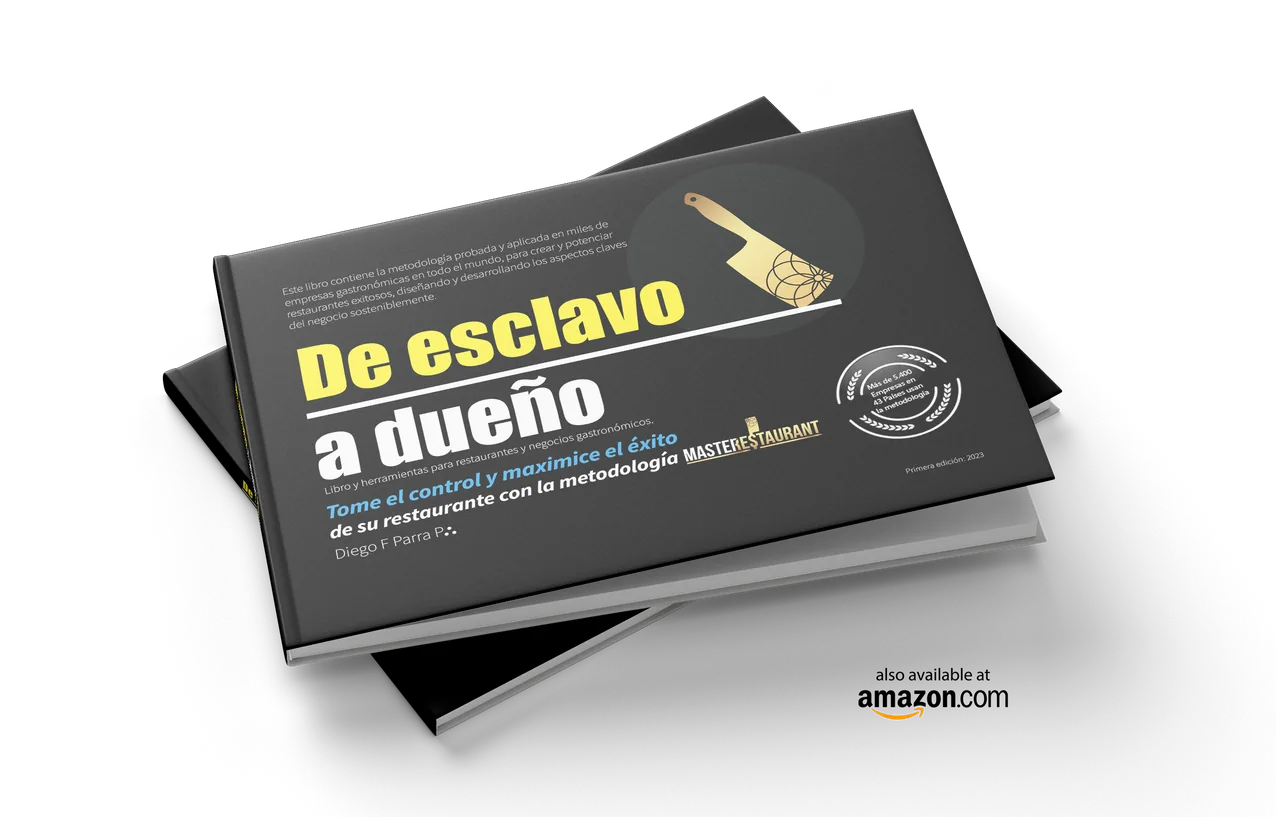
The book that changed how restaurants are managed: practical strategies and tools based on more than 20 years of experience, for traditional restaurants, dark kitchens, foodtech and HORECA businesses.
Triunfar o Morir en el Intento
Practical tools and key strategies to design and operate restaurants and food businesses efficiently.
Podcast: Masterestaurant — Mistakes for Restaurants
The public autopsy of the mistakes that bankrupt restaurants: thousands of owners and managers listen on Spotify to avoid repeating them.
Listen on SpotifyDownloads
The documents your board will ask for
MASTERESTAURANT services portfolio
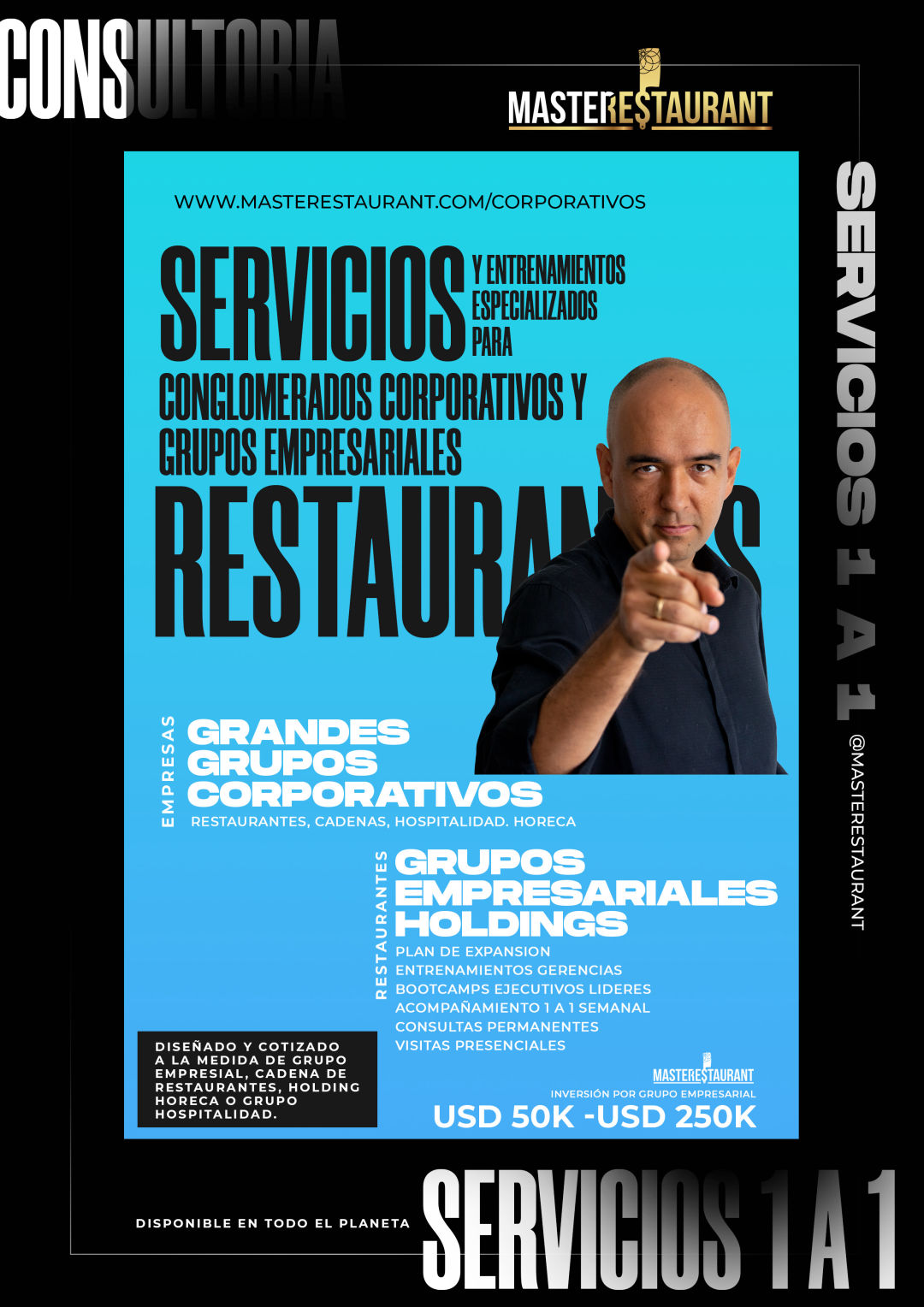
The complete corporate intervention catalog: consulting, executive bootcamps, advisory and specialized services, with scopes and formats. The document to decide with your board.
Download PDFBook: From Slave to Owner
The full doctrine behind the methodology: how to structure restaurants that run without depending on the owner. Ideal pre-reading before your group's diagnosis.
View on AmazonPortfolio
More services by Diego F Parra and his team
Is the restaurant only the beginning? Every service in the ecosystem starts from the same method and the same tools as this consulting: personalized mentoring for the owner, growth programs, the membership, training for the team and group consulting once the second or third site arrives. The full ecosystem is available:
International keynote speakerOne-on-one consulting and advisoryPersonalized mentoring for owners (limited spots)Corporate groups and holdings consultingCelebrity Restaurants consultingThemed restaurant advisorySpecialized training programs52-Week membershipPitch deck and restaurant investment readinessExponential Program0.1 Program — Elevate Your RestaurantInteractive training kit
From template to results
Want this working every day in your restaurant?
The tool gives you the template. The program gives you the method and the guidance to use it every week, with your team.
Direct contact
Get a quote for expert consulting for your group in Cuenca
Your message goes straight to Diego's team: group or chain, number of sites, stage and what you need to achieve in Cuenca.

“Most restaurants that don't grow lose money not because of the food, but because of the business behind it. Margin doesn't come from working more hours; it comes when you have a system where every dollar that comes in is visible and every one that goes out has a reason.”
Diego F. Parra — International consultant, expert in creating, scaling and improving restaurants, HORECA and hospitality
MASTERESTAURANT® methodology applied by 8,400+ restaurants across 43 countries · Author of 3 ISBN-registered books, including «De esclavo a dueño» · 20+ years operating restaurants, franchises, dark kitchens and HORECA groups across 4 continents
Full profile →Shall we talk about your operation in Cuenca?
Tell us your revenue, how many sites you have and what worries you: you'll get a concrete proposal.
Explore more
Restaurant and hospitality consulting: territories, services and ecosystem resources
Related links for owners, partners and leadership teams evaluating expert restaurant and hospitality consulting for their food business: nearby territories, sister services in the MASTERESTAURANT ecosystem and management tools, all built on the same method and the same instruments.
World's best restaurant keynote speakerWorld's best restaurant consultantC-Suite restaurant consultant for chains & groupsDiego F Parra — professional profileKeynote speaker serviceCorporate groups & holdings consultingCelebrity restaurant consultingInternational themed restaurant advisoryFood and beverage consulting across EcuadorFood and beverage consulting in AmbatoRestaurant consulting in DuranRestaurant consulting in EcuadorRestaurant profitability consultant in GuayaquilRestaurant profitability consultant in Loja
FAQ
Frequently asked questions
Do you offer restaurant management consulting in Cuenca?
Yes. Restaurant management consulting in Cuenca starts with a diagnosis built from the restaurant's real data (costs, waste, processes and team), then a work plan sequenced by what each change adds to the bottom line, built on that restaurant's volume, stage and market.
Who is a restaurant consultant in Cuenca for owners who want a repeatable model?
Diego F. Parra, the restaurant consultant behind MASTERESTAURANT, works with owners in Cuenca one on one: first a diagnosis from the operation's own data, then a plan ranked by margin impact, so the restaurant can run and grow without improvising.
How do I know my real margin on each service and per dish if I have recipes but they're never standardized?
Without technical sheets there's no margin—there's an approximation. A standard recipe fixes ingredient quantity, quality, and cost, and lets you compare theoretical cost versus actual cost weekly: exactly where margin is lost. I audited a restaurant with five similar dishes unsystematized: the cost difference between one and another was substantial without the owner noticing. With technical sheets, margin is measurable and defensible.
My restaurant is solid at one location, but I don't know if it can grow without operations falling apart in the attempt.
Growth costs more than running well at one location. You need crystalline EBITDA per unit (not averages), replicable processes, a team that doesn't depend entirely on you, a business model that holds volume without breaking cost structure. That's what comprehensive diagnosis audits: what your operation supports today and what's missing to grow without surprises. It's not about pre-preparing; it's measuring and building on data, step by step.
What is the most expensive mistake you see in restaurants?
Growing before standardizing. The second site copies the good and the bad of the first, and from the third onwards the founder's judgement no longer reaches everything.
Is it useful for an operation that has just opened?
It is, and it costs less: setting processes up properly from the start costs the same as setting them up badly, and saves redoing it with the business running.
How is the work plan prioritized?
By impact on margin and by speed of implementation. First what moves money in weeks, then the structural work, never the other way around.
What is asked of the owner during the engagement?
Access to the real numbers and decisions on time. The method supplies the rest. Consulting on dressed-up data corrects nothing.
Can the diagnosis be hired on its own?
Yes. Many operations start there and decide afterwards how far to take the implementation.
