 MASTERESTAURANT®
Menu price increase above which restaurants expect lower profits (2026)
James Beard Foundation
Margin, standard and growth · Potosi

DIEGO F PARRA · CREATOR OF THE MASTERESTAURANT® METHODOLOGY
RESTAURANT & HOSPITALITY CONSULTING Who do owners in Potosi call when the restaurant trades well and still leaves no money?
In Potosi, the work starts by measuring: where the money goes, what margin each dish leaves, which processes are not written down and which decisions are being made without data. The plan comes from that, not from a template.
Download the portfolio (PDF)Restaurant & hospitality consulting slots LIMITED worldwide — reserve yours
8,400+restaurants apply his methodology
43countries with supported groups
65M+views per year
2service languages: EN - ES
International validation
See Diego F. Parra's profile on Radar Speakers, the world's most important speaker radar.
See profile on Radar Speakers →
10 %
1.55 trillion USD
213,719 inhabitants
70%

@masterestaurant
Restaurant consulting in Potosi: what happens, and in what order
The MASTERESTAURANT methodology and its TOOLKIT have been applied across more than 8,400 restaurants in 43 countries. This is not business-school theory: it is what was left standing after working inside real operations, and it arrives with its own instruments —MTIE, Gastronomic Radar, Standard Recipe Generator, Tech Sheets and KPI Dashboard— instead of generic templates.
In Potosi it adapts to the market, the size and the stage of the business, because copying a recipe from another country is exactly what this consulting exists to prevent. The order of work stays the same from one market to the next: measure with the operation's own data first, then fix what returns margin fastest, and put the structural work in writing until the model is ready to be replicated.
How does restaurant consulting work in Potosi?
In Potosi, the first step is measuring the restaurant on its own numbers: what each dish really earns, where margin leaks and which decisions are being made without data. The diagnosis then orders the plan by impact, with what moves money first.
The work is done one-on-one with whoever runs the business, in two stages. Within weeks: Prime Cost, theoretical versus actual cost, waste and menu engineering, the part that hits the bottom line first. Then the part that makes the change stick: standard recipes with technical sheets, written processes, manuals and a team trained to run service without the owner in the kitchen. Support lasts until everything is implemented and being measured, not merely recommended. It runs virtually, on site or in a hybrid format, in English or Spanish. This page cites four verified figures as a reference for Potosi, from sources such as Instituto Nacional de Estadística and the James Beard Foundation.
What do the numbers say about running a restaurant in Potosi?
213,719 inhabitants — INE population projection for Potosí municipality (105,131 men, 108,588 women); source: Instituto Nacional de Estadística. It is context, not a diagnosis: it does not say how much margin an operation keeps or where it leaks.
The decision comes from the restaurant's own numbers, not from market figures. Other reference points cited on this page: 10 % (menu price increase above which restaurants expect lower profits, 2026, the James Beard Foundation); 1.55 trillion USD (projected restaurant and foodservice sales in 2026, the National Restaurant Association); 70% (Prime-cost overspend in 70% of restaurants, Masterestaurant). Those numbers are Prime Cost, the gap between theoretical and actual cost, waste and the margin on each dish. In Potosi, as in any other market, they are what show whether the next move is to adjust the menu and prices, tighten the operation or prepare a second site.
Data
Reference figures for restaurants in Potosi
The figures cited on this page, with what each one measures and its source.
| Figure | What it measures | Source |
|---|---|---|
| 10 % | Menu price increase above which restaurants expect lower profits (2026) | James Beard Foundation |
| 1.55 trillion USD | Projected restaurant and foodservice sales in 2026 | National Restaurant Association |
| 213,719 inhabitants | INE population projection for Potosí municipality (105,131 men, 108,588 women) | Instituto Nacional de Estadística (INE) |
| 70% | Prime-cost overspend in 70% of restaurants | Masterestaurant - Índice de Prime Cost 2026 |
Each figure links to its source in the data cards on this page.
The local market
Why the Potosi market demands a model, not just a concept
Revenue at a consolidated restaurant in Potosí isn't margin. I've seen operations with solid throughput that close with mediocre results because money leaks where no one is measuring: the gap between the theoretical cost of a dish and what it actually costs to execute it, accounting for waste, spillage, recipe drift; purchases never verified against what hits the inventory; the price you set two years ago without revisiting Prime Cost and labor cost. When an owner says "we work harder," they usually mean they amplified something that was already broken. Here it's not effort that matters—it's visibility. Measuring that gap is not an administrative exercise; it's the entry to recovering margin that's already being generated but escapes without control. A restaurant that doesn't know what each dish costs doesn't make decisions; it gambles.
What shifts is moving from a business that depends on the owner's judgment to one that runs on system. That means a full audit of your numbers, building the Restaurant Model Canvas that clarifies real versus aspirational business model, Prime Cost under control with documented menu engineering, standard recipes that each shift executes identically, production spec sheets, written processes that don't hinge on who's wearing the apron, EBITDA per unit visible, clear structure and governance. The MASTERESTAURANT method is 100 percent tailored to your operation in Potosí: no downloaded templates, just diagnosis plus build plus implementation. Proven across thousands of restaurants; deployable immediately. What gets delivered is implemented the following week, not archived waiting for the right moment.
Having consulted across 43 countries and audited operations at more than 8,400 restaurants isn't ego—it's the removal of surprises. The patterns that come from that scale can't be replaced by academic theory or any software tool: where the real breaking points are in your operations, where implementation stalls predictably, which standardization mistake every restaurant makes in round one, what made a business model fail in one city but work well in another. This is C-suite consulting from someone who's signed payroll and audited real numbers, not theory. Author of five books with strong Amazon presence. That compression of learning curve matters because you don't need to discover what's already been learned across thousands of cases.
The return is concrete: margin recovered and defended every service, costs under control with real visibility of where they go, operational consistency that doesn't depend on who's in the kitchen that day, team trained in the processes that hold the business up, decisions backed by actual data instead of intuition or the crisis of the moment. A business that can scale when scaling becomes a deliberate strategic choice, not a gamble. An owner who stops being the indispensable piece of daily operations and becomes the person who leads, measures, and grows. That's what happens when system works: you have financials under control, operations reliable and predictable, and genuine capacity to absorb change without the business folding.
Market data
What the market data says in Potosi
Projected restaurant and foodservice sales in 2026
National Restaurant AssociationINE population projection for Potosí municipality (105,131 men, 108,588 women)
Instituto Nacional de Estadística (INE)Prime-cost overspend in 70% of restaurants
Masterestaurant - Prime Cost Index 2026Potosi as a market
Why Potosi is a market for restaurants and hospitality businesses
Potosí has a unique food market shaped by geography, history, and the type of traveler arriving there. Tourism is a real factor: travelers coming through for colonial heritage and heritage sites seek local dining experiences, food that carries narrative, not generic meals. The local diner—merchants, professionals, people in residual sectors of economic activity—has heterogeneous purchasing power and clear expectations about value. Dining concentrations respond to access and tradition more than trends from major markets: established corridors where operations cluster, quick-service zones, higher-ticket venues. Rent is sensitive to location and foot traffic but also to availability—there's no saturated commercial real estate market like in larger cities. Trained hospitality talent is limited, driving turnover up and requiring internal training investment. Seasonality sets rhythm: tourism peaks and slower flow periods. That shapes cash flow and demands margins built around monthly variability.
What erodes margin specifically in Potosí isn't different from other markets, but the amplifiers are. Input costs multiply with distance and availability: certain products that are standard commodities in big cities here require imports or less-competitive sourcing, pressuring food cost. Turnover in kitchen and service roles runs high—people migrate or seek other paths—and training without a standardization system is a money hole no one sees. Competitive pressure by segment: a local restaurant competes not just against other restaurants but against entrenched habits and psychological pricing that takes years to shift. Average check isn't flexible because it anchors to local purchasing power. If you don't audit Prime Cost monthly, if labor cost isn't broken down (kitchen, floor, admin), if your menu reflects prices from two years back, margin crumbles without you seeing where. That's where most operations lose money they think they're making.
RESOURCES
MASTERESTAURANT studies, guides & tools
A selection of MASTERESTAURANT studies, comparisons and tools to decide better in Potosi:
- AI PROMPTDish Cost & Profitability Analyzer for Restaurants
- LISTRestaurant unit economics: traditional method vs Masterestaurant method
- STUDYRestaurant Value Proposition: Traditional Method vs Masterestaurant Method
- DATARestaurant Business Model: Myth vs Reality in 2026
- LISTThe surge erasing your profit: traditional
- CONCEPTHow Much Do Restaurants Make: Masterestaurant Method
- CASE STUDYAI-Generated Restaurant Content: Traditional Method · Case study
The expert restaurant and hospitality consultant
Who signs the methodology that will run your business
The MASTERESTAURANT® methodology is applied today by 8,400+ restaurants across 43 countries, and there is one signature behind it: Diego F Parra, engineer and C-Suite consultant with two decades creating, rescuing and expanding restaurants, franchises, dark kitchens and HORECA groups across four continents.
What separates him from a desk advisor is what he has had to do himself: sign payrolls when the till was short, negotiate leases with the margin counted, structure partnerships between partners who were no longer speaking, and close expansions in operations worth hundreds of millions of dollars. The TOOLKIT — MTIE, Gastronomic Radar, Standard Recipe Generator, Tech Sheets and KPI Dashboard — comes from there, not from a framework.
He is also the author of 3 ISBN-registered books, including «De esclavo a dueño», creator of the industry's leading podcast and of the largest bilingual community of owners, chefs and operations directors in the region (65M+ views per year as @masterestaurant), and ranks among the top Latino restaurant operations experts globally. His full track record is in Diego F Parra's professional profile.
Restaurant consulting with its own doctrine, not generic frameworks
Expert restaurant and hospitality consulting is not solved with management theory borrowed from another industry. It is solved with hospitality engineering: Prime Cost under control, theoretical versus actual cost, waste measured, standard recipes, written processes and indicators leadership reviews every week. Every engagement starts from the Restaurant Model Canvas: the whole business model is diagnosed, priorities are ranked by their impact on margin, and the team is left with its own instruments to sustain the results once the consulting ends. Decisions stop being bets: they are made on data. The method is the same for an independent restaurant, a chain or a hospitality group.
Expert restaurant and hospitality consulting, end to end
An engagement that covers the whole cycle, from diagnosis to expansion
Diagnosis and business model
Consulting that measures before it advises: the operation's numbers first, then the restaurant's business model, not the other way around.
Do you run a group or a chain?Profitability and cost engineering
Menu engineering and technical sheets that show what each dish earns, with Prime Cost, waste and shrinkage measured: where the bottom line feels the change first.
A hotel or hospitality group?Standardization and operations
Standard recipes, written processes, manuals and structure: the restaurant runs just as well on the day the owner is away.
A celebrity or high-profile investor?Leadership, indicators and growth
A trained team, indicators in plain sight and an orderly growth plan: new sites or franchises when the model can carry it.
A themed or immersive concept?The methodology
Discover the MASTERESTAURANT methodology
Behind every food business that scales profitably there is a method, not a hunch: applied from the first diagnosis, with its own instruments.
Who is it for?
Who it serves, and who it does not serve yet
A tailor-made 1-on-1 service, built for those opening and for those already operating:
Busy and thin on margin
The most common case. The room works, the till does not follow, and the problem lives in menu engineering or in the fixed-cost structure.
Grew faster than its processes
Three or four sites opened quickly and nothing written down. Every location runs its own way and nobody can say which one makes money.
About to open the next one
The ideal moment and the last cheap one: standardizing before replicating costs a fraction of fixing it with two sites running.
Change of leadership or partners
An operation changing hands needs to know what is being bought: real numbers, processes that exist and risks nobody named.
What does it include?
What gets measured, what gets fixed and what gets written down
Every engagement is built tailor-made from these modules of the MASTERESTAURANT methodology:
- Full diagnosis of the restaurant and its business
- Business model and Restaurant Model Canvas
- Concept, positioning and value proposition
- Customer experience and customer journey
- Menu and cost engineering (Prime Cost, theoretical vs. actual, waste)
- Standard recipes and technical sheets
- Financial model and EBITDA visibility per unit
- Operating model, processes and manuals
- Organizational structure and roles
- Management indicators and control dashboard
- Leadership development and management training
- Front-of-house and kitchen team training
- Readiness to grow: new locations, licensing or franchising
Investment: from USD $12K upwards — tailor-made programs, priced to the size, stage and complexity of the business.
Consulting programs
Tailor-made expert restaurant and hospitality consulting programs
Every consulting program is 100% customized to the restaurant: its size, its stage, its market and whatever is keeping it from being profitable today.
Expert coverage
Territories close to Potosi
Explore other territories or the worldwide index:
Restaurant consulting across BoliviaHospitality consulting in BoliviaRestaurant profitability consultant in CochabambaExpert restaurant consultant in El AltoRestaurant consulting in La PazExpert restaurant consultant in OruroExpert restaurant consultant in Santa Cruz De La SierraRestaurant profitability consultant in SucreHospitality consulting in AustraliaRestaurant consulting in AustriaHospitality consulting in IsraelRestaurant business consultant in South AfricaRestaurant profitability consultant in AlajuelaRestaurant profitability consultant across ArgentinaHospitality consulting across BrazilRestaurant consulting across CanadaRestaurant profitability consultant across ChileExpert restaurant consultant across ColombiaRestaurant business consultant across Costa RicaRestaurant business consultant across CubaRestaurant profitability consultant across the Dominican RepublicFood and beverage consulting across EcuadorRestaurant business consultant across El SalvadorRestaurant profitability consultant across GuatemalaMore countries →More cities →
We do serve — and every city on the planet
Served on site or virtually, in English and Spanish.
Who is Diego F Parra?
Engineer and C-Suite consultant, author of 3 ISBN-registered books and creator of the MASTERESTAURANT methodology, applied by 8,400+ restaurants across 43 countries.
The method comes with its own technology suite: MTIE, Gastronomic Radar, Restaurant Model Canvas and KPI Dashboard. He has spent two decades creating, rescuing and expanding restaurants, franchises, dark kitchens and HORECA and hospitality groups across four continents, signing payrolls, negotiating leases and closing expansions. For an owner or a leadership team, what matters is where the method comes from: having run restaurants, not studying them from the outside. That is why every engagement arrives with proven instruments and leaves indicators the team keeps using afterwards. He works in English or Spanish, virtually, on site or in a hybrid format.
HORECA · Chains · Holdings · Foodtech
Private consulting programs for owners, partners and leadership teams
Bootcamps, training and private 1-on-1 engagements for those who run the business.
From USD $12K, priced to the business.
Published doctrine
The books that changed restaurant management
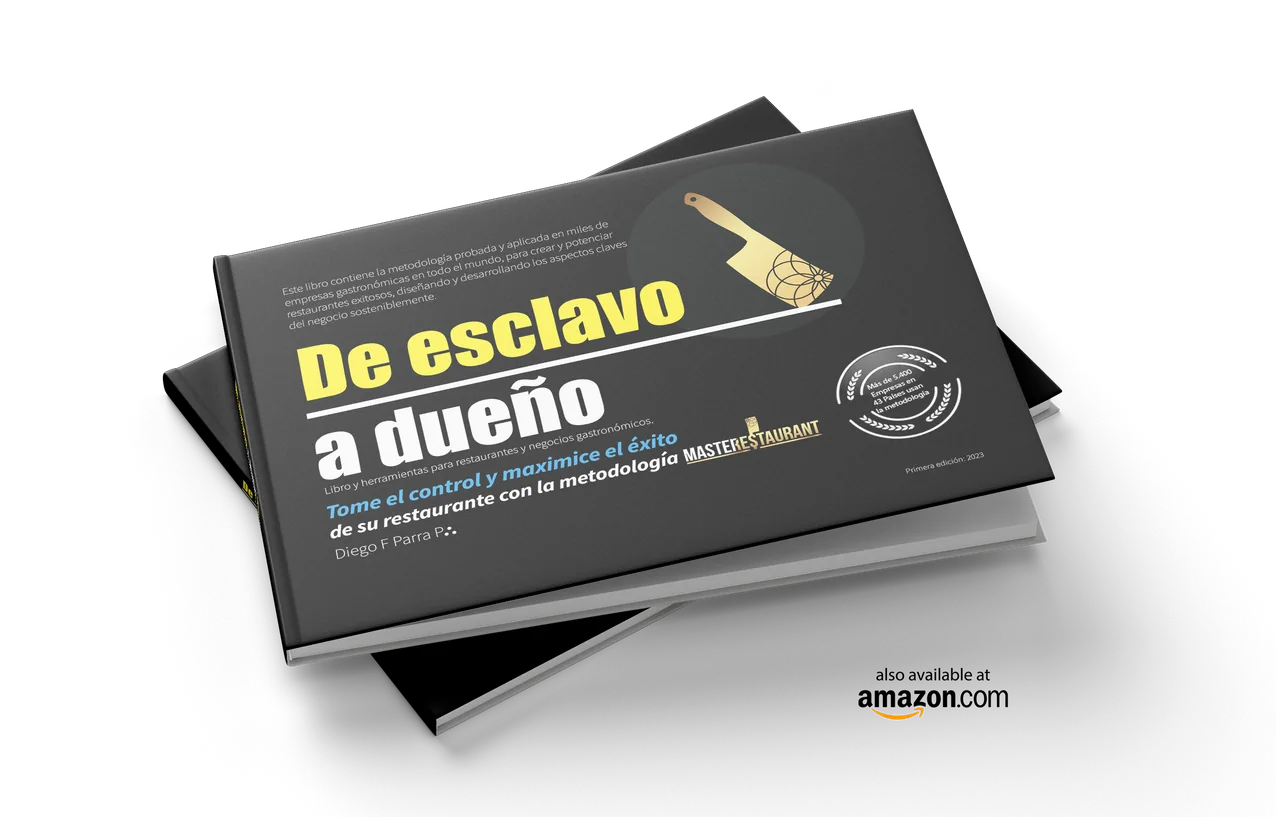
De Esclavo a Dueño
The book that changed how restaurants are managed: practical strategies and tools based on more than 20 years of experience, for traditional restaurants, dark kitchens, foodtech and HORECA businesses.
Triunfar o Morir en el Intento
Practical tools and key strategies to design and operate restaurants and food businesses efficiently.
Podcast: Masterestaurant — Mistakes for Restaurants
The public autopsy of the mistakes that bankrupt restaurants: thousands of owners and managers listen on Spotify to avoid repeating them.
Listen on SpotifyDownloads
The documents your board will ask for
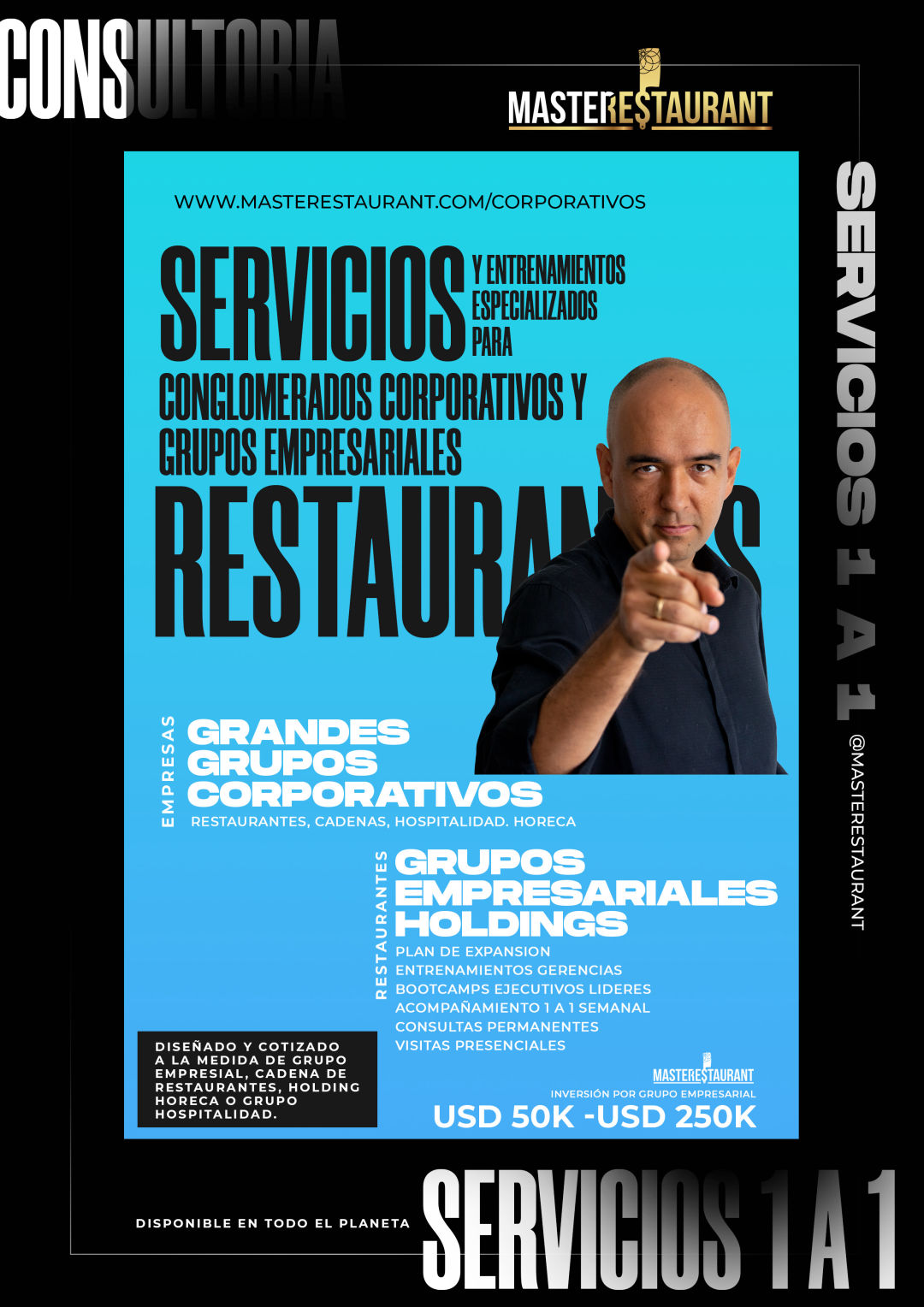
MASTERESTAURANT services portfolio
The complete corporate intervention catalog: consulting, executive bootcamps, advisory and specialized services, with scopes and formats. The document to decide with your board.
Download PDFBook: From Slave to Owner
The full doctrine behind the methodology: how to structure restaurants that run without depending on the owner. Ideal pre-reading before your group's diagnosis.
View on AmazonPortfolio
More services by Diego F Parra and his team
Is the restaurant only the beginning? Every service in the ecosystem starts from the same method and the same tools as this consulting: personalized mentoring for the owner, growth programs, the membership, training for the team and group consulting once the second or third site arrives. The full ecosystem is available:
International keynote speakerOne-on-one consulting and advisoryPersonalized mentoring for owners (limited spots)Corporate groups and holdings consultingCelebrity Restaurants consultingThemed restaurant advisorySpecialized training programs52-Week membershipPitch deck and restaurant investment readinessExponential Program0.1 Program — Elevate Your RestaurantInteractive training kit
Direct contact
Get a quote for expert consulting for your group in Potosi
Your message goes straight to Diego's team: group or chain, number of sites, stage and what you need to achieve in Potosi.
“Margin doesn't appear because you work longer hours; it appears when your business has system. Most restaurants losing margin in Potosí don't have a market problem—they have a visibility problem. They don't know what each dish actually costs, where money leaks, where cash escapes the operation.”
Diego F. Parra — International consultant, expert in creating, scaling and improving restaurants, HORECA and hospitality
MASTERESTAURANT® methodology applied by 8,400+ restaurants across 43 countries · Author of 3 ISBN-registered books, including «De esclavo a dueño» · 20+ years operating restaurants, franchises, dark kitchens and HORECA groups across 4 continents
Full profile →Start with the diagnosis, in Potosi
Tell us your revenue, how many sites you have and what worries you: you'll get a concrete proposal.
Explore more
Restaurant and hospitality consulting: territories, services and ecosystem resources
Related links for owners, partners and leadership teams evaluating expert restaurant and hospitality consulting for their food business: nearby territories, sister services in the MASTERESTAURANT ecosystem and management tools, all built on the same method and the same instruments.
World's best restaurant keynote speakerWorld's best restaurant consultantC-Suite restaurant consultant for chains & groupsDiego F Parra — professional profileKeynote speaker serviceCorporate groups & holdings consultingCelebrity restaurant consultingInternational themed restaurant advisoryRestaurant consulting across BoliviaHospitality consulting in BoliviaRestaurant profitability consultant in CochabambaExpert restaurant consultant in El AltoRestaurant consulting in La PazExpert restaurant consultant in Oruro
FAQ
Frequently asked questions
How long before we see results in margin and operations?
First Prime Cost adjustments show in 4-6 weeks: portion corrections, menu engineering, supplier cost negotiation. Operations—standard processes, documented recipes—take 8-12 weeks to be built and executed consistently across every service. EBITDA control and unit economics metrics are visible in the first quarter. This isn't theory: it's what happens when you implement against your real operation, your numbers, your teams, your local market. Full system scale—financials, operations, leadership—takes 4-5 months of active engagement.
Can we scale to additional locations once Diego designs the model?
First assumption: margin and operations controlled at one unit. From there, yes—the Restaurant Model Canvas built during engagement is replicable because it's engineered around your actual system, not intuition. When you know your real Prime Cost, unit EBITDA, and processes that work, scaling is a conscious decision backed by numbers. Without it, second location means duplicating the same problems. Scaling is a separate engagement, but the foundation is solid.
How does expert restaurant and hospitality consulting work?
It starts with a full diagnosis of the business: costs, operations, processes, team, customer experience and real numbers. From there comes a work plan ranked by impact and tailor-made support — virtual, on site or hybrid — until the changes are implemented and being measured, not merely recommended.
What size of business makes this worth hiring?
The test is not the number of sites: it is the maturity and the ambition of the business. A single restaurant trading strongly and ready to scale is a natural client; so is a multi-site operation that lost its standard.
What concrete results does the consulting leave?
Prime Cost measured and defended, theoretical-versus-actual cost closed, waste and shrinkage under control, processes and standard recipes the team follows, EBITDA per unit in plain sight of leadership, and a model ready to be replicated at the next site.
Do you work with restaurants outside your country?
Yes. The MASTERESTAURANT methodology is applied across 43 countries, in Spanish or English, virtually, on site or hybrid. International experience means recommendations get adapted to each city's market instead of copying a recipe from elsewhere.
How is this different from generic business consulting?
It is not generic. Not standalone branding, not marketing alone, not kitchen alone, not management imported from another sector: it integrates strategy, costs, operations, experience, technology, leadership and expansion in one engagement.
