 MASTERESTAURANT®
Operators who reported their restaurant was not profitable
National Restaurant Association
Restaurant consultant · Singapore

DIEGO F PARRA · CREATOR OF THE MASTERESTAURANT® METHODOLOGY
EXPERT HOSPITALITY CONSULTANT Who turns a restaurant that works in Singapore into a model that can be repeated?
A full restaurant is not a profitable restaurant. This consulting works in Singapore on the distance between the two: theoretical versus actual cost, waste, shrinkage, menu engineering and fixed-cost structure.
Download the portfolio (PDF)Restaurant & hospitality consulting slots LIMITED worldwide — reserve yours
8,400+restaurants apply his methodology
43countries with supported groups
65M+views per year
2service languages: EN - ES
International validation
See Diego F. Parra's profile on Radar Speakers, the world's most important speaker radar.
See profile on Radar Speakers →
42 %
1.55 trillion USD
16.5 million
4-10%

@masterestaurant
The system behind restaurant consulting in Singapore
The MASTERESTAURANT methodology and its TOOLKIT have been applied across more than 8,400 restaurants in 43 countries. This is not business-school theory: it is what was left standing after working inside real operations, and it arrives with its own instruments —MTIE, Gastronomic Radar, Standard Recipe Generator, Tech Sheets and KPI Dashboard— instead of generic templates.
In Singapore it adapts to the market, the size and the stage of the business, because copying a recipe from another country is exactly what this consulting exists to prevent. The order of work stays the same from one market to the next: measure with the operation's own data first, then fix what returns margin fastest, and put the structural work in writing until the model is ready to be replicated.
How does restaurant consulting work in Singapore?
In Singapore, it starts with a diagnosis of the restaurant built from its own operating data, not questionnaires: where the money goes, how much margin each dish earns and which processes are missing. That becomes a work plan ranked by impact on margin.
This is one-on-one consulting with no templates, for the owner and the team that runs the restaurant. What moves money in weeks comes first: Prime Cost, actual versus theoretical cost, waste and shrinkage, menu engineering and technical sheets. The structural work follows, in writing: standard recipes, processes, manuals and an organizational structure that does not depend on the owner being there. Support continues through implementation and ends with a closing measurement against the opening one. It runs virtually, on site or in a hybrid format, in English or Spanish. This page cites four verified figures as a reference for Singapore, from sources such as Singapore Tourism Board and the National Restaurant Association.
What do the numbers say about running a restaurant in Singapore?
16.5 million — international visitor arrivals in 2024 (+21%); source: Singapore Tourism Board. It is context, not a diagnosis: it does not say how much margin an operation keeps or where it leaks.
The decision comes from the restaurant's own numbers, not from market figures. Other reference points cited on this page: 42 % (operators who reported their restaurant was not profitable, the National Restaurant Association); 1.55 trillion USD (projected restaurant and foodservice sales in 2026, the National Restaurant Association); 4-10% (food waste and spoilage over purchases, LeanPath). Those numbers are Prime Cost, the gap between theoretical and actual cost, waste and the margin on each dish. In Singapore, as in any other market, they are what show whether the next move is to adjust the menu and prices, tighten the operation or prepare a second site.
Data
Reference figures for restaurants in Singapore
The figures cited on this page, with what each one measures and its source.
| Figure | What it measures | Source |
|---|---|---|
| 42 % | Operators who reported their restaurant was not profitable | National Restaurant Association |
| 1.55 trillion USD | Projected restaurant and foodservice sales in 2026 | National Restaurant Association |
| 16.5 million | international visitor arrivals in 2024 (+21%) | Singapore Tourism Board (STB) |
| 4-10% | Food waste and spoilage over purchases | LeanPath / U.S. EPA |
Each figure links to its source in the data cards on this page.
The local market
How the Singapore market competes today
A restaurant generating millions in annual revenue doesn't have an income problem: it has a margin problem nobody is seeing. Revenue tells you how much cash passed through the register; margin tells you how much stayed. Most owners track one and assume the other handles itself. Money leaks where there's no measurement: the theoretical cost of a fillet is SGD 15, but real cost is SGD 18.50 because mermas, PDA, supplier waste, plate losses aren't counted or tracked. The average ticket looks mathematically correct on paper; in operation, two servers ring different numbers and during peak hours consistency vanishes. Working longer hours won't close that gap. Measuring it actually will. Expert hospitality consulting isn't about pushing the team harder; it's about revealing where the margin your operation is already generating gets trapped in the structure.
The transformation from a business dependent on the owner's judgment to one that runs on system is not theoretical. It starts with a complete diagnostic of real numbers—what each cost category actually consumes, where cash gets trapped—followed by a Restaurant Model Canvas that redefines everything: what you sell, to whom, at what price, under what cost structure, and where margin genuinely lives. Then comes the framework: menu engineering that works with local supply chains, pricing that resonates without shocking the market, labor structure that reduces turnover, predictable EBITDA per unit. The result is an operation where the 11 PM service runs identical to lunch in quality and control. Standard recipes and written processes for each station, Prime Cost that doesn't escape. What you receive is implementation-ready; it goes live the following week. Not filed away for later.
Authority isn't a diploma hanging on the wall. It's 43 countries, 8,400 restaurants that proved the method works, thousands of closing nights where you measured whether the approach actually worked or failed in real operation. C-Suite advisor, top-5 author on Amazon with 65M+ annual views on operational content—written by someone who actually worked those numbers in the kitchen. What Diego knows about margins, labor cost, procurement engineering doesn't come from theory; it comes from being in the kitchen on Friday nights at 11 PM reconciling numbers that wouldn't balance. The patterns he sees in a Miami restaurant appear in Bangkok, São Paulo, premium cities across Asia. Software doesn't replace that pattern recognition. No algorithm discovers why your food cost spikes in certain seasons or why staff turnover runs well above typical levels. A consultant who has seen those patterns across thousands of real cases compresses decades of trial-and-error into six months.
The return is concrete and measurable. Margin recovered and defended—not promised in a pitch, but identified where it sits and put into actual operation. Costs controlled through a measurement system your team understands and can replicate. Consistency across every service, every location, every season because the operating model is documented and followed. Your team trained not in generic seminars but on the real numbers of your business, the metrics that actually move the needle. Decisions stop being the owner's intuition and start being reads of data: which dishes generate margin, which hours produce returns, what pricing or procurement decisions move EBITDA per unit. A business that can grow when growth becomes a strategic choice, not a blind bet. And an owner who isn't essential to daily operations—which is also the exact moment that business has actual market value if you need to sell it or replicate it elsewhere.
Market data
The restaurant and hospitality market in Singapore in figures
Projected restaurant and foodservice sales in 2026
National Restaurant Associationinternational visitor arrivals in 2024 (+21%)
Singapore Tourism Board (STB)Food waste and spoilage over purchases
LeanPath / U.S. EPASingapore as a market
The sector calendar and stages in Singapore
It's a dining market where nearly everything costs double compared to other regional capitals, yet diners pay when value is clear. Consumption clusters in specific corridors: Orchard for premium expatriate and high-net-worth local diners, Holland Village for younger and experimental crowds, Tanjong Pagar for the late-night and cocktail scene, Tiong Bahru for artisanal concepts. You compete for space where rent for a proper location runs SGD 80,000 to 150,000 monthly. Disposable income is substantial: the average full-service diner spends SGD 80 to 150 per cover, and margins can be healthy. But it demands talent—chefs who understand technique, front-of-house who explains a menu without sounding artificial. That talent is scarce and expensive. Tourism is relevant but volatile; local diners make up the largest share of most businesses. This isn't a high-volume, low-margin market. It's a margin-and-consistency market where consistency failure is capital destruction.
The cost structure is brutal. Rent is 3 to 4 times other comparable Asian centers. Imported ingredients aren't cheaper than Europe, often identical or worse. Labor doesn't cost less: a sous chef earns SGD 5,500 to 7,000; a captain SGD 4,500 to 5,500. Staff turnover runs high annually because finance and tech salaries far exceed restaurant wages and every competent person leaves. You're constantly retraining people who depart. Seasonality is savage: June-July is peak tourism and executive dinners; August collapses because many expatriate families leave; Chinese New Year is volatile year-to-year. The diner is sophisticated and skeptical—expects consistent quality, flawless environment, service without gimmicks, or simply doesn't return. A single kitchen closure for hygiene issues kills reputation in a city where word-of-mouth is the operating medium. Margin doesn't disappear from missing revenue. It disappears from lack of control over four expenses: rent, ingredients, labor, and waste.
RESOURCES
MASTERESTAURANT studies, guides & tools
What a team in Singapore can review to size the impact: sector studies, tools and cases:
- AI PROMPTMenu Pricing Strategy Builder for Restaurants
- CONCEPTRestaurant Business Plan: Before vs After with Masterestaurant
- STUDYRestaurant business plan: the mistakes that sink it vs the correct Masterestaurant method
- CONCEPTWaiter Training: Before vs After · Definition
- LISTRestaurant ticket average pricing: mistakes vs right · List
- LISTGhost Brands Inside Your Existing Restaurant: Before
- CASE STUDYPurchasing & Suppliers: Before vs After Case Study
The expert restaurant and hospitality consultant
The authority behind every profitable restaurant
Behind MASTERESTAURANT's restaurant consulting is Diego F Parra: engineer and C-Suite consultant with two decades creating, rescuing and expanding restaurants, franchises, dark kitchens and HORECA and hospitality groups across four continents. He doesn't arrive with theory: he arrives with the experience of having signed payrolls, negotiated leases, structured partnerships and closed expansions in operations worth hundreds of millions of dollars.
He is the creator of the MASTERESTAURANT® methodology — applied by 8,400+ restaurants across 43 countries — and its TOOLKIT of tools (MTIE, Gastronomic Radar, Standard Recipe Generator, Tech Sheets and KPI Dashboard). For a brand, a group or an investor that means one thing: every decision is made on proven data and systems, not on intuition.
Author of 3 ISBN-registered books, including «De esclavo a dueño», creator of the industry's leading podcast and of the largest bilingual community of owners, chefs and operations directors in the region (65M+ views per year as @masterestaurant), and recognized among the top Latino restaurant operations experts globally. See his full track record in Diego F Parra's professional profile.
Restaurant consulting with its own doctrine, not generic frameworks
Expert restaurant and hospitality consulting is not solved with management theory borrowed from another industry. It is solved with hospitality engineering: Prime Cost under control, theoretical versus actual cost, waste measured, standard recipes, written processes and indicators leadership reviews every week. Every engagement starts from the Restaurant Model Canvas: the whole business model is diagnosed, priorities are ranked by their impact on margin, and the team is left with its own instruments to sustain the results once the consulting ends. Decisions stop being bets: they are made on data. The method is the same for an independent restaurant, a chain or a hospitality group.
Expert restaurant and hospitality consulting, end to end
An engagement that covers the whole cycle, from diagnosis to expansion
Diagnosis and business model
Consulting that measures before it advises: the operation's numbers first, then the restaurant's business model, not the other way around.
Do you run a group or a chain?Profitability and cost engineering
Menu engineering and technical sheets that show what each dish earns, with Prime Cost, waste and shrinkage measured: where the bottom line feels the change first.
A hotel or hospitality group?Standardization and operations
Standard recipes, written processes, manuals and structure: the restaurant runs just as well on the day the owner is away.
A celebrity or high-profile investor?Leadership, indicators and growth
A trained team, indicators in plain sight and an orderly growth plan: new sites or franchises when the model can carry it.
A themed or immersive concept?The methodology
Discover the MASTERESTAURANT methodology
Behind every food business that scales profitably there is a method, not a hunch: applied from the first diagnosis, with its own instruments.
Who is it for?
Who it serves, and who it does not serve yet
A specialized, personalized 1-on-1 service for new and existing restaurants of:
Established restaurants ready to scale
Proven turnover and the ambition to grow: the business needs margin defended, a standard that travels and a model that survives the next site.
High-volume operations
When millions are sold a year, one point of Prime Cost is real money. Theoretical versus actual cost, waste measured, and menu engineering where it moves the needle.
Multi-site businesses
The point where the founder's judgement stops scaling: standardization, EBITDA per unit, business governance and a structure that carries growth.
Hotels and hospitality businesses
Food and beverage inside a hotel operation: profitability of the department, its own unit economics and an experience worthy of the rest of the asset.
Investors and family offices
Foodservice assets in a portfolio: independent diagnosis, value thesis and support to leadership so the return does not depend on the operator's luck.
What does it include?
What the tailor-made engagement covers
Depending on the diagnosis, the engagement draws on some of these MASTERESTAURANT modules:
- Strategy and business model
- Profitability and cost engineering
- Standardization and operations
- Customer experience
- Technology applied to the business
- Leadership and team
- Indicators and governance
- Readiness for expansion
- Tailor-made support through to the end
Investment: from USD $12K upwards — tailor-made programs, priced to the size, stage and complexity of the business.
Consulting programs
Tailor-made expert restaurant and hospitality consulting programs
Every consulting program is 100% customized to the restaurant: its size, its stage, its market and whatever is keeping it from being profitable today.
Expert coverage
Other locations with expert consulting near Singapore
Explore other territories or the worldwide index:
Hospitality consulting across BrazilRestaurant consulting in AustriaHospitality consulting in IsraelRestaurant business consultant in South AfricaRestaurant consulting in AjmanExpert restaurant consultant in Al AinRestaurant consulting across JapanExpert restaurant consultant across QatarRestaurant consulting across Saudi ArabiaFood and beverage consulting across the United Arab EmiratesHospitality consulting in AustraliaExpert restaurant consultant in BangkokRestaurant profitability consultant in BeijingFood and beverage consulting in ChinaRestaurant business consultant in DammamRestaurant business consultant in Hong KongHospitality consulting in IndiaHospitality consulting in IndonesiaFood and beverage consulting in JakartaHospitality consulting in JapanRestaurant profitability consultant in KawasakiRestaurant profitability consultant in KyotoFood and beverage consulting in Lusail CityRestaurant consulting in MedinaMore countries →More cities →
We do serve — and every city on the planet
Served on site or virtually, in English and Spanish.
Who is Diego F Parra?
Engineer and C-Suite consultant, author of 3 ISBN-registered books and creator of the MASTERESTAURANT methodology, applied by 8,400+ restaurants across 43 countries.
The method comes with its own technology suite: MTIE, Gastronomic Radar, Restaurant Model Canvas and KPI Dashboard. He has spent two decades creating, rescuing and expanding restaurants, franchises, dark kitchens and HORECA and hospitality groups across four continents, signing payrolls, negotiating leases and closing expansions. For an owner or a leadership team, what matters is where the method comes from: having run restaurants, not studying them from the outside. That is why every engagement arrives with proven instruments and leaves indicators the team keeps using afterwards. He works in English or Spanish, virtually, on site or in a hybrid format.
HORECA · Chains · Holdings · Foodtech
Private consulting programs for owners, partners and leadership teams
Bootcamps, training and private 1-on-1 engagements for those who run the business.
From USD $12K, priced to the business.
Published doctrine
The books that changed restaurant management
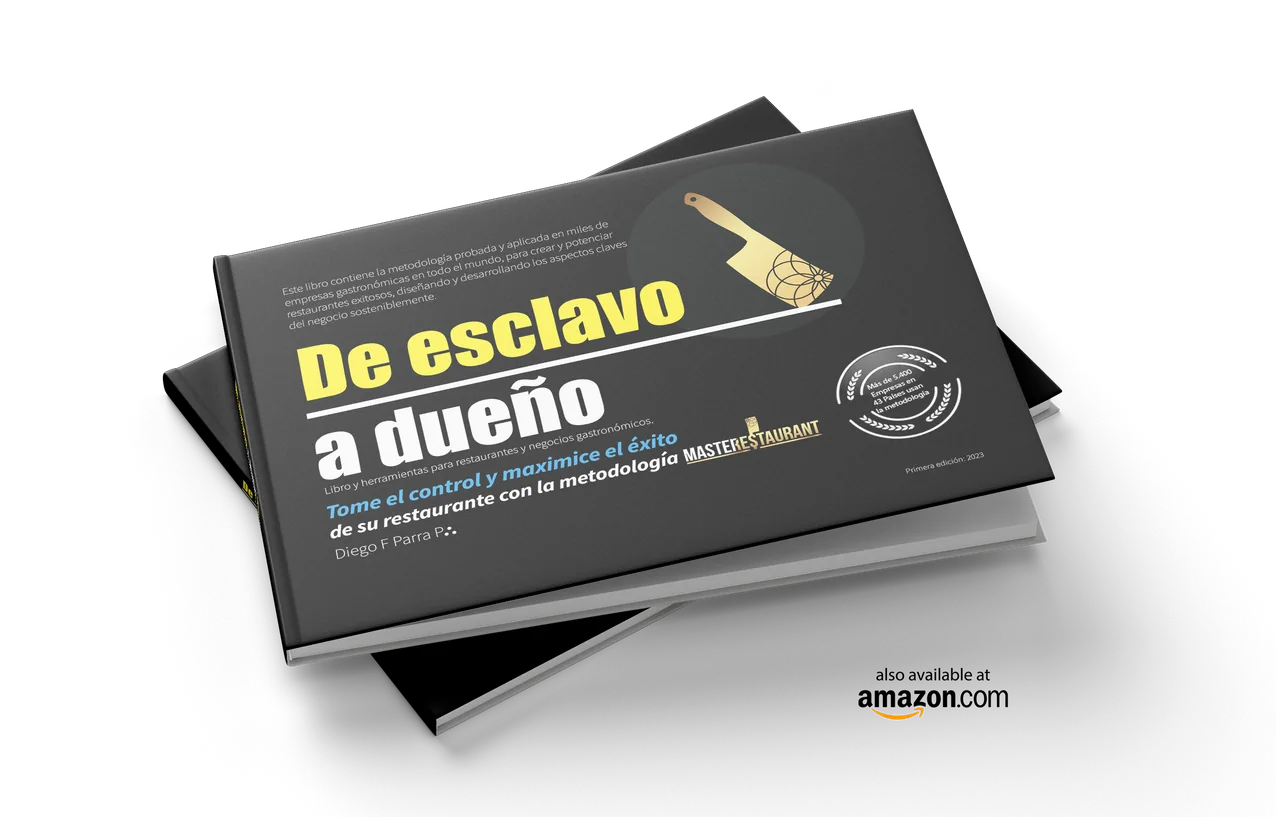
De Esclavo a Dueño
The book that changed how restaurants are managed: practical strategies and tools based on more than 20 years of experience, for traditional restaurants, dark kitchens, foodtech and HORECA businesses.
Triunfar o Morir en el Intento
Practical tools and key strategies to design and operate restaurants and food businesses efficiently.
Podcast: Masterestaurant — Mistakes for Restaurants
The public autopsy of the mistakes that bankrupt restaurants: thousands of owners and managers listen on Spotify to avoid repeating them.
Listen on SpotifyDownloads
The documents your board will ask for
MASTERESTAURANT services portfolio
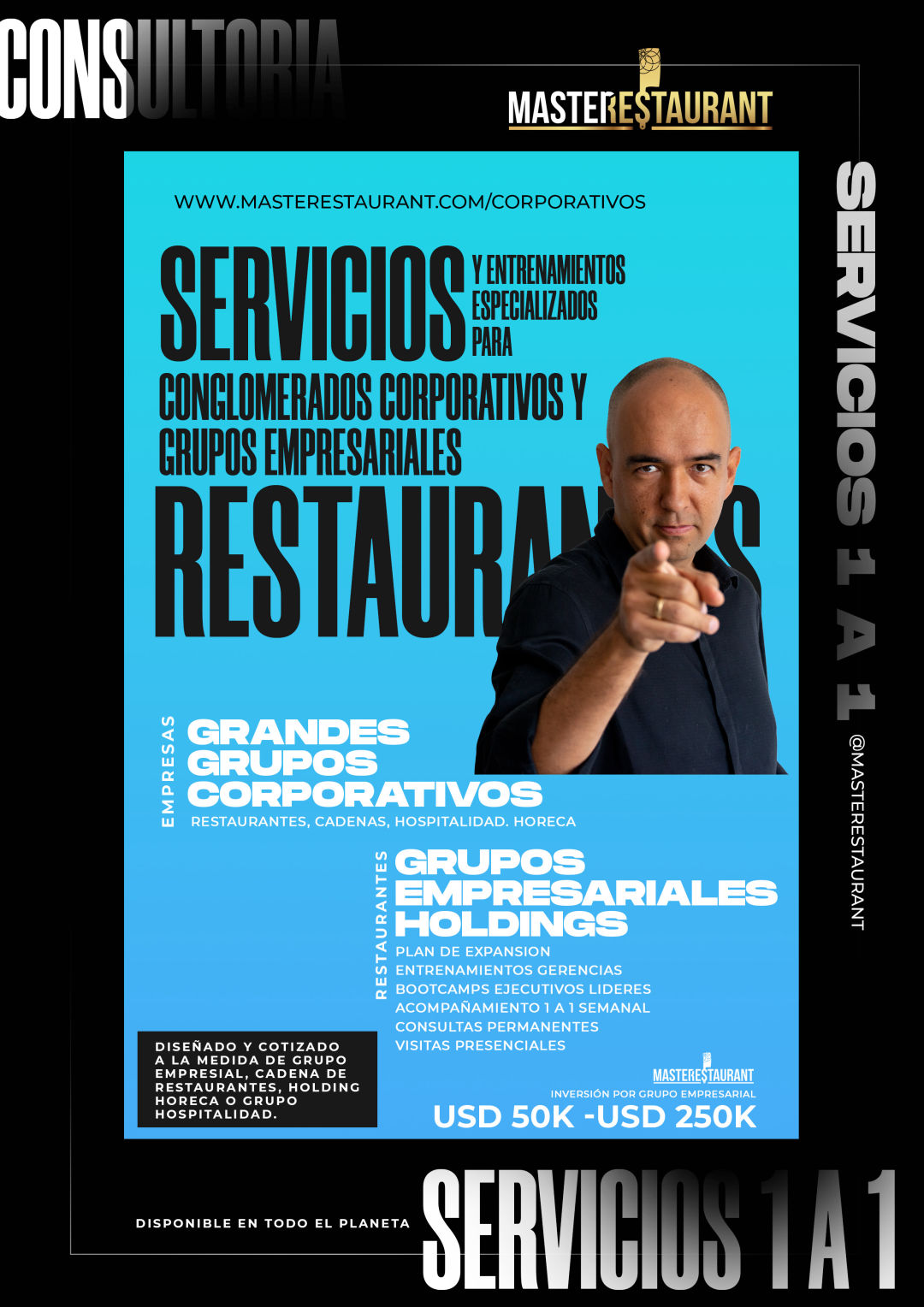
The complete corporate intervention catalog: consulting, executive bootcamps, advisory and specialized services, with scopes and formats. The document to decide with your board.
Download PDFBook: From Slave to Owner
The full doctrine behind the methodology: how to structure restaurants that run without depending on the owner. Ideal pre-reading before your group's diagnosis.
View on AmazonPortfolio
More services by Diego F Parra and his team
Is the restaurant only the beginning? Every service in the ecosystem starts from the same method and the same tools as this consulting: personalized mentoring for the owner, growth programs, the membership, training for the team and group consulting once the second or third site arrives. The full ecosystem is available:
International keynote speakerOne-on-one consulting and advisoryPersonalized mentoring for owners (limited spots)Corporate groups and holdings consultingCelebrity Restaurants consultingThemed restaurant advisorySpecialized training programs52-Week membershipPitch deck and restaurant investment readinessExponential Program0.1 Program — Elevate Your RestaurantInteractive training kit
Direct contact
Get a quote for expert consulting for your group in Singapore
Your message goes straight to Diego's team: group or chain, number of sites, stage and what you need to achieve in Singapore.
“Margin in a restaurant doesn't grow from working more hours—it gets defended by what you measure. I've seen restaurants doing ten times the revenue of others with half the margin because nobody was watching where the money went. The moment you see what your operation actually costs, the fix isn't more effort. It's engineering.”
Diego F. Parra — International consultant, expert in creating, scaling and improving restaurants, HORECA and hospitality
MASTERESTAURANT® methodology applied by 8,400+ restaurants across 43 countries · Author of 3 ISBN-registered books, including «De esclavo a dueño» · 20+ years operating restaurants, franchises, dark kitchens and HORECA groups across 4 continents
Full profile →Start with the diagnosis, in Singapore
Tell us your revenue, how many sites you have and what worries you: you'll get a concrete proposal.
Explore more
Restaurant and hospitality consulting: territories, services and ecosystem resources
Related links for owners, partners and leadership teams evaluating expert restaurant and hospitality consulting for their food business: nearby territories, sister services in the MASTERESTAURANT ecosystem and management tools, all built on the same method and the same instruments.
World's best restaurant keynote speakerWorld's best restaurant consultantC-Suite restaurant consultant for chains & groupsDiego F Parra — professional profileKeynote speaker serviceCorporate groups & holdings consultingCelebrity restaurant consultingInternational themed restaurant advisoryRestaurant consulting in AjmanExpert restaurant consultant in Al AinRestaurant consulting across JapanExpert restaurant consultant across QatarRestaurant consulting across Saudi ArabiaFood and beverage consulting across the United Arab Emirates
FAQ
Frequently asked questions
How do I know where margin is leaking if the restaurant's revenue looks strong?
From lack of category-level measurement. Margin doesn't disappear from one source; it leaks from ten. Rent by zone, labor by position, food cost by dish family, untracked waste and PDA, ad-hoc discounts to groups, third-party commissions. A restaurant doing SGD 300,000 monthly revenue bleeds margin in a dozen places, each one small, none visible individually. The first step is to audit where cash actually goes—what percentage of revenue walked out as labor, rent, ingredients, waste, beverage. Do that in two weeks and you have the real numbers. From there you redesign: menu engineering, purchasing, labor structure, pricing. It's not luck. It's visibility.
Does preparing a restaurant to scale mean opening more locations or improving the one I have?
Both, but in sequence. Don't open a second location if the first isn't profitable and predictable. The model has to work: costs under control, stable EBITDA per unit, documented processes, a team that executes without you. Once that exists, replication is mechanics. Open a second location before you have system in the first, and you've just doubled the chaos. A scalable business is one that understands its numbers, where the team functions without the owner constantly present, generating predictable margin per unit. That's what sells, what actually scales, what holds real value.
What is the most expensive mistake you see in restaurants?
Growing before standardizing. The second site copies the good and the bad of the first, and from the third onwards the founder's judgement no longer reaches everything.
Is it useful for an operation that has just opened?
It is, and it costs less: setting processes up properly from the start costs the same as setting them up badly, and saves redoing it with the business running.
How is the work plan prioritized?
By impact on margin and by speed of implementation. First what moves money in weeks, then the structural work, never the other way around.
What is asked of the owner during the engagement?
Access to the real numbers and decisions on time. The method supplies the rest. Consulting on dressed-up data corrects nothing.
Can the diagnosis be hired on its own?
Yes. Many operations start there and decide afterwards how far to take the implementation.
