 MASTERESTAURANT®
Total population of the Republic of Panama according to the XII National Population and VIII Housing Census 2023.
INEC - Instituto Nacional de Estadística y Censo
Concept Restaurants · Santiago

DIEGO F PARRA · CREATOR OF THE MASTERESTAURANT® METHODOLOGY
EXPERIENTIAL DINING EXPERT Who is the most sought-after expert in creating, growing and making themed and concept restaurants profitable in Santiago?
Diego F. Parra. His work in Santiago starts where the moodboard ends: what each dish costs, what ticket the experience can hold, and what operation lets you repeat it on an ordinary Tuesday without you inside.
Download the portfolio (PDF)Limited advisory spots worldwide — reserve your evaluation early
8,400+restaurants apply his methodology
43countries with supported projects
65M+views per year
2service languages: EN · ES
International validation
See Diego F. Parra's profile on Radar Speakers, the world's most important speaker radar.
See profile on Radar Speakers →
4,064,780 inhabitants
2,518,476
56.6%
8.9%

@masterestaurant
How a themed restaurant in Santiago is built to last
A concept that lasts is not the most original one: it is the one that can be REPEATED. Repeatable means the dish comes out the same with the new cook, the cost holds when the supplier raises prices, and the experience doesn't depend on the owner being in the room telling the story table by table.
That is the goal of the engagement in Santiago: turning the concept into a system — tech sheets, costing, processes, KPIs and an expansion plan — with the MASTERESTAURANT methodology and its TOOLKIT, in use in 8,400+ restaurants across 43 countries.
How does themed restaurant consulting work in Santiago?
The work starts with the model, not the decor: a strategic diagnosis in Santiago shows where the project stands and where the money goes, then the business is designed to hold the concept once the novelty passes.
The goal is a concept that can be repeated without losing quality or margin. To get there, the engagement works on concept, brand and storytelling written for the dining room, menu engineering, Prime Cost, standardization you can audit, and processes and teams that run without the owner in the room. Once the model is proven, it sets the order of expansion into new locations, licenses or franchises. The work is confidential and runs on site or virtually, in English or Spanish. As a starting point, this page gathers four verified reference figures from sources such as INEC and ATP.
What do the numbers say about the market for a themed restaurant in Santiago?
4,064,780 inhabitants — total population of the Republic of Panama, according to INEC. Reference figures describe the setting a concept competes in; they do not say whether a themed experience will still leave a margin after opening.
For a themed restaurant, the data informs one concrete decision: how much can go into ambiance before the model stops working. Other reference points cited on this page: 2,518,476 (visitors to Panama in 2023, ATP); 56.6% (national average hotel occupancy rate, preliminary figure, ATP); 8.9% (annual increase in added value of hotels and restaurants in 2024, INEC Panamá). In Santiago, each figure is read alongside average check, menu engineering and Prime Cost before spending on decor, because novelty brings the first visit and margin decides whether there is a second one.
Data
Reference figures for a themed restaurant in Santiago
The figures cited on this page, with what each one measures and its source.
| Figure | What it measures | Source |
|---|---|---|
| 4,064,780 inhabitants | Total population of the Republic of Panama according to the XII National Population and VIII Housing Census 2023 | INEC - Instituto Nacional de Estadística y Censo |
| 2,518,476 | visitors to Panama in 2023 | ATP / INEC Contraloría |
| 56.6% | National average hotel occupancy rate, preliminary figure | ATP (Autoridad de Turismo de Panamá) |
| 8.9% | Annual increase in added value of hotels and restaurants in 2024 | INEC Panamá |
Each figure links to its source in the data cards on this page.
The local market
The themed restaurant market in Santiago: the context your project must master
A themed restaurant that opens with compelling visual concept attracts diners for weeks. Then novelty fades. Investing millions in architecture, design and ambiance is straightforward; the hard part is building a business where that experience translates into robust average check, customer recurrence, and defendable operating margin. I've audited concepts where the theme was excellent but Prime Cost spiked, labor was uncontrolled, and the outcome was a beautiful place losing money month after month. Or concepts that replicated success from another market without adjusting local seasonality, customer willingness to pay, or the processes that make an experience repeatable. When theme is everything and business engineering is accidental, the restaurant becomes a fad that dies when the decor stops being novel. The themed restaurant that scales to new locations or attracts investment does so because the model works—architecture is visible; it's not determinant.
The MASTERESTAURANT methodology converts a themed idea into a structured gastronomic enterprise capable of replicating profitability across multiple geographies. It's not a task list; it's an integrated system where differentiated concept, value proposition, storytelling, customer journey, menu engineering, financial model and operations are built as interdependent parts of one organism. The Restaurant Model Canvas—the method's central tool—maps the gears that drive the business: reasons for consumption, moments of purchase, customer segments, unit economics by daypart and season, process standardization, profitability benchmarks compared across Santiago zones, performance indicators and repeat-visit metrics, and how the themed experience sustains itself without inflating irrecoverable operating costs or out-of-control labor. Every element is designed to local market: no one-size-fits-all templates. Santiago has its own tourism dynamics, seasonality, nighttime dining patterns, and consumer spending capacity. The engagement covers strategy, experience design, architectural review from operations perspective, team leadership, process standardization, and when the model is validated in market, guidance for replication or expansion to new locations.
The primary risk in a new-brand themed or experiential restaurant project is that the concept is visually attractive but operationally unviable or financially unsustainable. Authority in this field is not an abstract credential; it's the capacity to anticipate where similar concepts fail. When Diego audits an idea, he can identify quickly whether the cost model withstands Santiago's seasonality, whether the value proposition connects genuinely with local consumers, or whether menu engineering—food cost, beverage mix, expected table turns—supports the margin the project needs to be viable. That accumulated experience across +8,400 restaurants in 43 countries dramatically reduces the probability of costly errors in design and validation phases. Not that experience guarantees success—nothing does—but it filters the most predictable errors and avoids investing millions in a direction others have already explored and rejected for lack of profitability.
Return is measurable from Q1: a controlled cost model validated against local benchmarks reduces operational surprises; an experience coherent with the concept generates higher average check and genuine recurrence; documented standardized processes reduce operational risk that quality drops under kitchen or floor pressure. When a growth plan exists—new locations, licenses, franchises—the tailored model becomes a reproducible business asset, attractive to investors, freed from founder's daily presence. Operational independence is rare in restaurants; when it exists, enterprise valuation shifts. A concept that's documented, transferable and replicable has scaling value. A concept that lives only in the operator's head is a growth ceiling. The engagement aims precisely at that: moving from personal experience to systemic, scalable experience.
Market data
The figures of the concept market in Santiago
visitors to Panama in 2023
ATP / INEC ContraloríaNational average hotel occupancy rate, preliminary figure
ATP (Autoridad de Turismo de Panamá)Annual increase in added value of hotels and restaurants in 2024
INEC PanamáSantiago as a destination
Santiago and its appetite for dining experiences
Santiago is a convergence point of growing tourism, emerging family entertainment and evolving restaurant scene, with market dynamics distinct from more consolidated Caribbean centers. The consumer of experiential or immersive dining here is diverse: short-stay tourists (from cruises, all-inclusive packages, corporate events), local residents with disposable income seeking weekend leisure, family groups during school holidays, and corporate market for events and celebrations. There are well-differentiated microecosystems by zone: shopping centers with traffic-concentrating power, districts with established restaurant scenes, hotel zones with integrated demand. Unlike more mature markets, the local consumer of experiential concepts doesn't yet have abundant references for what this means—it's virgin territory where a coherent proposition differentiates fast, but also where an incoherent concept gets no mercy and doesn't sustain through brand reputation. Seasonality is pronounced: January-March and July-August concentrate travel and leisure peaks; May-June and October-November demand specific offerings and positioning; heavy rains and extreme heat affect consumption patterns.
The themed restaurant that works in Santiago does so because it solves a concrete reason for consumption: family unit wanting integrated experience (food + ambiance + entertainment), tourist seeking memorable travel memory, corporate client wanting to differentiate an event or team-building activity. But I've also audited failures: themes that date quickly (a cinema trend that was current two years ago is now anachronistic), concepts where experience collapses at operational contact (cinematic ambiance but slow, neglected or overpriced food), restaurants where decor maintenance costs are so high margin disappears, or visually striking concepts that are operationally chaotic. Risk isn't the idea; it's execution. Santiago rewards coherent proposals but punishes incoherence without mercy: if you promise experience and food arrives cold, if ambiance is premium but service is careless, if decor is expensive but kitchen processes are improvised, the customer doesn't return and tells the rest.
RESOURCES
MASTERESTAURANT studies, guides & tools
MASTERESTAURANT original research, tools and analysis you can apply to operations in Santiago:
- STUDYRestaurant business plan: the mistakes that sink it vs the correct Masterestaurant method
- LISTRestaurant Co-Branding Alliances: Traditional Method vs Masterestaurant Method
- CHECKLISTAbrir segundo local checklist
- LIST7 ways to use AI in your restaurant management · List
- COMPARISONDelegating Restaurant Operations: Before vs After
- CONCEPTDish Photography and Description: Traditional Method
The themed consultant
Why his judgment matters in this decision
When an owner hires themed restaurant consulting, what he is really buying is judgment: someone who has already watched the same plan fail three times and knows where it breaks. Diego F Parra has two decades of that material — engineer and C-Suite consultant, restaurants, franchises, dark kitchens and HORECA groups created, rescued and expanded across four continents, with payrolls signed, leases negotiated and expansions closed in operations worth hundreds of millions of dollars.
That judgment is written into the MASTERESTAURANT® methodology, used by 8,400+ restaurants across 43 countries, and into its TOOLKIT: MTIE, Gastronomic Radar, Standard Recipe Generator, Tech Sheets and KPI Dashboard. The goal is not for you to depend on the consultant, but on the system.
Author of 3 ISBN-registered books, including «De esclavo a dueño», creator of the industry's leading podcast and of the largest bilingual community of owners, chefs and operations directors in the region (65M+ views per year as @masterestaurant), recognized among the top Latino restaurant operations experts globally. More in Diego F Parra's professional profile.
Themed restaurant consulting with its own doctrine, not generic recipes
Themed restaurant consulting is not improvised. Every engagement is built on the Restaurant Model Canvas and real industry data — profitability, Prime Cost, cost structure, customer experience and expansion — applied to the specific business model of a themed restaurant. The goal is not a venue for the opening-night photo, but a food business that protects the concept, generates profit and can scale to new locations, licenses or franchises when the model is ready. That is why the work is organized on four fronts —diagnosis and business model; concept, menu and themed experience; structure, costs and operation; expansion, franchise and new locations— so the concept still holds up when it is no longer new.
Themed restaurant consulting from start to finish
Advisory that covers the full themed restaurant lifecycle
Diagnosis first, concept second
Specialist diagnosis and business model with the Restaurant Canvas: value proposition, consumption moment and profitability structure.
Quote my diagnosisMenu, story and experience
The concept is translated into menu, kitchen times and immersive experience; what cannot be executed two shifts in a row does not go in.
Quote the conceptPrime Cost, processes and team
Financial management, standardization and leadership so the restaurant runs on system and not on the memory of the cook who left.
Quote the operationExpansion and franchise
New locations, licenses, franchise and partner and investor management to scale the concept without diluting it on the way.
See the services portfolio (PDF)The methodology
Discover the MASTERESTAURANT methodology
What holds a concept up is a system, not a flash of inspiration: tools, processes and models you can audit.
Who is it for?
Made for brands, groups and concept founders
Private, made-to-measure support, for whoever is creating and for whoever is correcting:
Entrepreneurs and concept creators
Your concept can be excellent and still make no margin. Here both are designed at once: the brand and the model that pays for it.
Restaurant groups and chains
One more concept in the portfolio only makes sense if it is born structured: method, partner management and financial control.
Hotels and tourism developments
Storytelling, menu and operation aligned so the themed restaurant becomes a reason to visit rather than one more amenity.
Brands, IP and franchises
Between the logo and the dining room there is a gap only standardization crosses: processes and teams ready to repeat the concept.
Investors and family offices
Capital with methodology: a profitable, scalable food concept, without paying the beginner's curve in person.
What's included
The modules the engagement is assembled from
These are the MASTERESTAURANT methodology modules your tailor-made programme is built from:
- Business model that turns concept into sustainable profitability
- Strategic diagnosis of the project and the personal brand
- Concept, brand architecture and themed restaurant storytelling
- Menu engineering and an experience customers pay to repeat
- Cost structure and Prime Cost: profitability protected by design
- Operational improvement and profitable standardization
- The 10 key elements of the Restaurant Canvas, optimized
- Processes, teams and leadership that run without the founder
- Expansion strategy: new locations, licenses and franchises
- Partner and investor management to scale without diluting the brand
- Executive bootcamps and training for the management team
- 1-on-1 advisory, ongoing consultations and on-site visits
- Opening readiness that protects the concept's reputation
Investment: USD $35K – $250K · tailor-made, priced to each company · spots LIMITED worldwide to guarantee the best service.
Themed packages
Tailor-made themed restaurant consulting packages
Every themed restaurant engagement is 100% personalized and tailor-made to the project and the brand. After a strategic diagnosis, it works through the 10 key elements of the business model in the MASTERESTAURANT Restaurant Canvas — from value proposition and concept to profitability, standardization and expansion. Depending on the case, the package adds menu engineering, Prime Cost and cost structure, partner and investor management, executive bootcamps for the management team, ongoing consultations with visits to the venue and opening readiness. The quote starts from the concept, where the project stands and the numbers already on the table. Priced to each project's scope (USD $35K – $250K), with limited spots worldwide to ensure dedicated attention and discretion for each client.
Themed coverage
Themed restaurant consulting near Santiago
Explore themed restaurant consulting in other territories, or go back to the worldwide index on the themed restaurants worldwide page:
Concept restaurants across PanamaThemed restaurant advisory in ColonThemed restaurant advisory in Llano TugriThemed dining expert in PanamaThemed restaurants in Panama CityThemed dining expert in PenonomeThemed restaurants in AustraliaConcept restaurants in AustriaThemed restaurant consulting in IsraelThemed restaurant consulting in South AfricaThemed restaurant consultant in AlajuelaThemed restaurant advisory across ArgentinaThemed restaurants across BoliviaThemed restaurants across BrazilThemed restaurant consultant across CanadaThemed dining expert across ChileConcept restaurants across ColombiaThemed restaurant consulting across Costa RicaThemed restaurants across CubaConcept restaurants across the Dominican RepublicThemed restaurant consultant across EcuadorThemed restaurant consulting across El SalvadorThemed dining expert across GuatemalaThemed restaurants across HondurasMore countries →More cities →
We do serve — and every city on the planet
Available on site or virtually, in English and Spanish.
Who is Diego F Parra?
Diego F Parra is an engineer and C-Suite consultant, creator of the MASTERESTAURANT® methodology —applied by 8,400+ restaurants across 43 countries— and author of 3 ISBN-registered books.
He is the consultant that brands and concepts, athletes, artists and investors choose to turn their brand into a profitable, standardized themed restaurant ready to expand. He has spent two decades creating, rescuing and expanding restaurants, franchises, dark kitchens and HORECA groups across four continents, and he works with his own tools: MTIE, Gastronomic Radar and KPI Dashboard. For a themed restaurant, that means the concept is designed as a system —tech sheets, costing, processes and KPIs— so it can be repeated in new locations, licenses or franchises without being diluted.
HORECA · Chains · Holdings · Foodtech
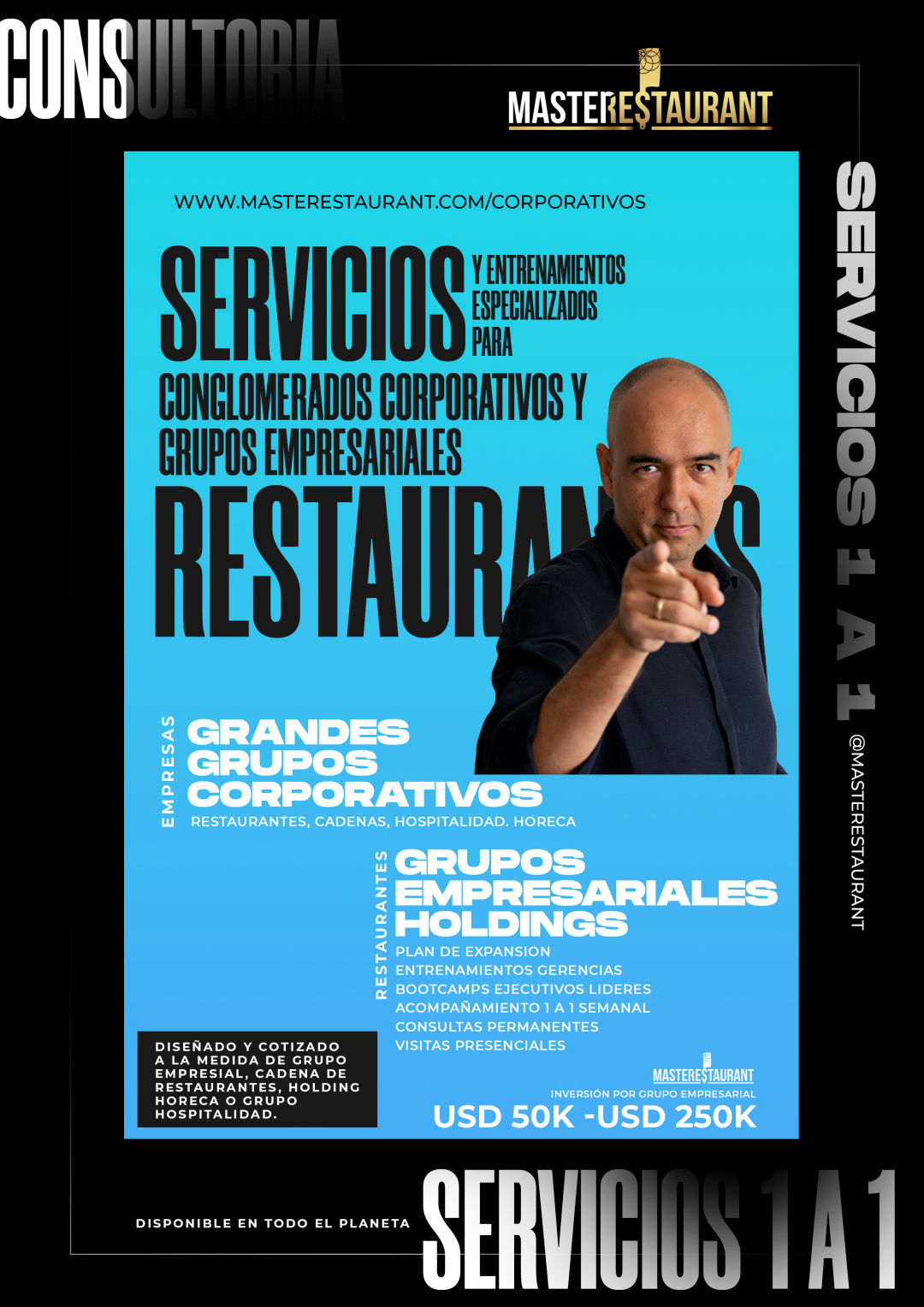
Private programs for groups and family offices
Training, consulting, executive bootcamps and private advisory for restaurant groups, holdings and investor families with themed restaurants.
Starting at USD $50K · tailor made, custom quoted · limited spots worldwide
Published doctrine
The books that changed restaurant management
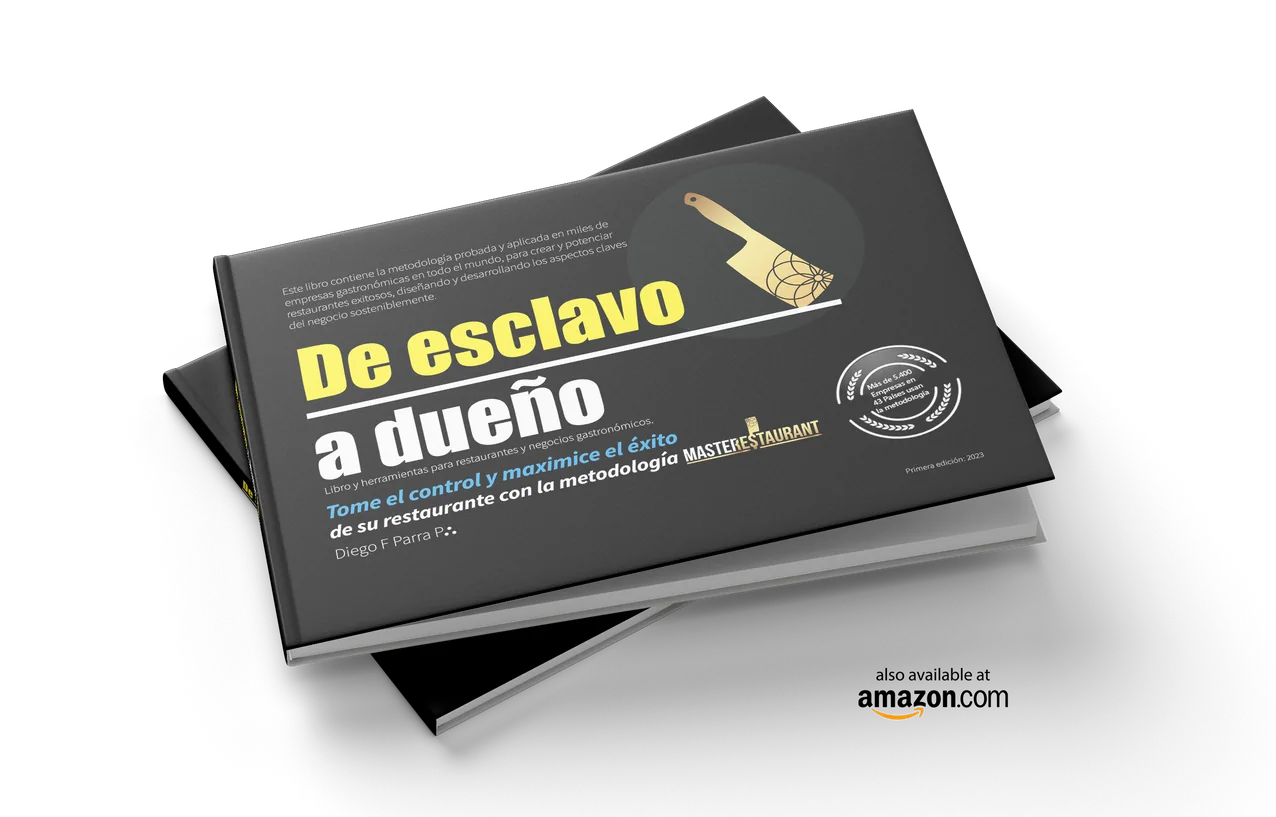
De Esclavo a Dueño
The book that changed how restaurants are managed: practical strategies and tools based on more than 20 years of experience, for traditional restaurants, dark kitchens, foodtech and HORECA businesses.
Triunfar o Morir en el Intento
Practical tools and key strategies to design and operate restaurants and food businesses efficiently.
Podcast: Masterestaurant — Mistakes for Restaurants
The public autopsy of the mistakes that bankrupt restaurants: thousands of owners and managers listen on Spotify to avoid repeating them. Condensed operating doctrine, free and direct.
Listen on SpotifyDownloads
The documents your management will ask for
MASTERESTAURANT® services portfolio
The complete intervention catalog: consulting, training, advisory and specialized services, with scopes and formats. The document to decide with your team.
Download PDFBook: From Slave to Owner
The full doctrine behind the methodology: how to structure a restaurant that runs without depending on the owner. Ideal pre-reading before your project's diagnosis.
View on AmazonPortfolio
More services by Diego F Parra and his team
Beyond themed restaurant consulting, Diego F Parra and his team offer keynotes, mentoring for owners, consulting for groups, training, programs, a membership and an interactive training kit. Everything starts from the same method and the same tools, so once the concept works, the dining-room team can train with that kit, partners can prepare the investment with the Pitch Deck service and the group can take the concept to new sites with the same criteria. The full ecosystem is available:
International keynote speakerOne-on-one consulting and advisoryPersonalized mentoring for owners (limited spots)Corporate groups and holdings consultingCelebrity Restaurants consultingThemed restaurant advisorySpecialized training programs52-Week membershipPitch deck and restaurant investment readinessExponential Program0.1 Program — Elevate Your RestaurantInteractive training kit
Direct contact
Get a quote for themed restaurant consulting for your project in Santiago
Your message goes straight to Diego's team: concept, project stage, city and what you need to achieve in Santiago.
“I've designed or audited themed restaurants in forty-three countries. The ones that scaled to multiple locations—the ones that attracted investors, the ones whose founders could delegate—weren't the ones with the most expensive decor. They were the ones someone without the founder's passion could operate. That's the difference between a themed experience that's a personal labor of love and one that's a repeatable business.”
Diego F. Parra — International consultant, expert in creating, scaling and improving restaurants, HORECA and hospitality
MASTERESTAURANT® methodology applied by 8,400+ restaurants across 43 countries · Author of 3 ISBN-registered books, including «De esclavo a dueño» · 20+ years operating restaurants, franchises, dark kitchens and HORECA groups across 4 continents
Full profile →Let's talk about the model before the next investment in Santiago
Send the concept, its stage and your numbers for a tailored proposal.
Explore more
Themed restaurants: territories, services and ecosystem resources
Useful links for concept founders, restaurant groups, hotels, brands and investors weighing themed restaurant consulting before they decide. They cover nearby territories where the service is published, sister services in the MASTERESTAURANT ecosystem, Diego F Parra's professional profile and the management tools the methodology works with.
World's best restaurant keynote speakerWorld's best restaurant consultantC-Suite restaurant consultant for chains & groupsDiego F Parra — professional profileKeynote speaker serviceCorporate groups & holdings consultingCelebrity restaurant consultingInternational themed restaurant advisoryConcept restaurants across PanamaThemed restaurant advisory in ColonThemed restaurant advisory in Llano TugriThemed dining expert in PanamaThemed restaurants in Panama CityThemed dining expert in Penonome
FAQ
Frequently asked questions
How do you ensure the themed experience stays profitable after the first months, once novelty wears off?
Sustained profitability comes from a model built for the customer's real lifecycle. Defendable average check, consumption reasons beyond novelty (families, corporate, dates), operations that sustain experience when decor is no longer new. A well-designed experiential restaurant in Santiago retains 60-70% of recurring customers after year one if Prime Cost and operations are solid.
When does it make sense to scale to new locations or franchising? How do I know the model is replicable in another market?
When the model has completed two full operational cycles (12-18 months)—costs stabilized, processes documented, recurrence data clear—you have data. If EBITDA is healthy, if local consumers have reasons to return, if processes can be delegated without quality loss, the model is a candidate. To replicate in another market you need two things: the concept has local traction, and operations are so documented someone other than the founder can execute it without losing essence. This isn't software. It requires live validation. Diego does this before raising expansion capital.
How is this different from a branding agency?
Here the concept is designed together with the numbers. After the strategic diagnosis the full business model is built —value proposition, menu, experience, costs and operation—and supported through implementation and expansion.
Who keeps the intellectual property?
The client, always. The whole process is signed under NDA and neither the concept nor the brand nor the developments leave their ownership. Limited spots worldwide guarantee focus on each project.
How is the process structured?
In four linked phases: diagnosis, business-model design, implementation and support during operation and expansion. Scope defines duration, and method defines that the result does not depend on inspiration.
What is the fee range?
Between USD $35K and USD $250K for the 1-on-1 work, priced to the scope of the project and the concept. Private programs for restaurant groups and chains are quoted separately.
And if the restaurant exists and makes no margin?
That is precisely one of the entry scenarios. Costs and menu are reviewed, the operation standardized, and then it is decided whether the concept is ready to scale to new locations or to franchise.
