 MASTERESTAURANT®
Global air passenger demand (RPK) grew 10.4% in 2024, an all-time record
IATAPortfolio and expansion · Spain
DIEGO F PARRA · CREATOR OF THE MASTERESTAURANT® METHODOLOGY
HOSPITALITY GROUPS CONSULTINGWho can say in Spain which brand in the portfolio is carrying which, with numbers rather than instinct?
If you lead a hospitality, hotel or restaurant group in Spain, Diego F. Parra brings the MASTERESTAURANT methodology to your organization: portfolio diagnosis, standardization, profitability and governed expansion.
Download the portfolio (PDF)Corporate advisory spots LIMITED worldwide - reserve your group's evaluation early
8,400+restaurants apply his methodology
43countries with supported groups
65M+views per year
2service languages: EN - ES
International validationSee Diego F. Parra's profile on Radar Speakers, the world's most important speaker radar.See profile on Radar Speakers →
+10.4% 7.61 trillion USD 49,570,725 inhabitants 57.4%
@masterestaurant
Portfolio consulting for groups in Spain
In Spain, a hospitality group is organized around one principle: measure first, standardize next, and only then expand. That is the rule of the MASTERESTAURANT methodology and its TOOLKIT, applied across 8,400+ restaurants in 43 countries, from a single unit to portfolios with dozens of brands.
Measuring means putting each brand's and each unit's economics on the table before anything is decided: which brands to back, which to restructure and which site is carrying which. Standardizing means manuals, processes and operational control so site fifty delivers what site one delivers. Expansion comes last, once there is a documented standard and a profitable unit to replicate. The method adapts to the size of the group, its stage and its market.
How does consulting for hospitality groups work in Spain?
The first step is a portfolio diagnosis: every brand and every unit the group runs in Spain is read through its own unit economics. After that, the order is fixed: measure, standardize, and expand only once the standard is documented.
The engagement is built for hotels, chains, multi-brand F&B operations and holdings at a decision point: before the next opening, in the middle of a restructuring, before franchising or ahead of incoming capital.
The diagnosis turns into a plan with portfolio strategy and capital allocation, manuals and processes so every site delivers the same result, Prime Cost and EBITDA per unit on decision dashboards, a leadership structure that does not rest on one person and a clear route to franchise, license or new markets. Everything runs under NDA, on site or virtually, in English or Spanish.
As context for a group in Spain, this page cites four verified figures, local or industry-wide, from sources such as INE and IATA.
What do the numbers tell a hospitality group in Spain?
49,570,725 inhabitants — resident population of Spain as of January 1, 2026 (provisional), a historic maximum, according to INE. A market figure puts a portfolio in context, but it does not say which brand or site deserves the next investment.
For a hospitality group, the numbers guide capital allocation. Other reference points cited on this page: +10.4% (global air passenger demand, RPK grew 10.4% in 2024, an all-time record — IATA); 7.61 trillion USD (global foodservice market size, forecast to 2030 — Mordor Intelligence); 57.4% (US accommodation and food service establishments still open five years after opening, 2019 cohort — the U.S. Bureau of Labor Statistics).
The question is which brand has room to grow in Spain, whether the documented standard can travel to a new site and whether Prime Cost holds at group level. The figures inform the bet; the group's own unit economics decide it.
Data
Reference figures for hospitality groups in Spain
The figures cited on this page, local or industry-wide, with what each one measures and its source.
| Figure | What it measures | Source |
|---|---|---|
| +10.4% | Global air passenger demand (RPK) grew 10.4% in 2024, an all-time record | IATA |
| 7.61 trillion USD | Global foodservice market size, forecast to 2030 | Mordor Intelligence |
| 49,570,725 inhabitants | Resident population of Spain as of January 1, 2026 (provisional), a historic maximum per INE's Continuous Population Statistics | INE (Estadística Continua de Población) |
| 57.4% | US accommodation and food service establishments still open five years after opening (2019 cohort) | U.S. Bureau of Labor Statistics |
Each figure links to its source in the data cards on this page.
The local market
How a hospitality group competes in Spain
A hospitality group in Spain—hotel, restaurant, or holding company—with five, ten, or twenty locations is not simply a bigger business. At each new unit, financial and operational complexity grows nonlinearly: costs across multiple sites, standards that once spread by osmosis now require manuals and audits, management turnover accelerates, and unit economics—the only metric that matters—erodes.
Most groups in Spain expand by opportunity spotting, not by design: a landlord offers favorable lease terms, a capable manager becomes available, or consumption trends look promising in a region, so they open. Without prior portfolio diagnosis, without standardization architecture, without group-level financial governance, expansion becomes gambling. October arrives and two units barely survive, two close by year end, and aggregate profitability is a failure.
What this consulting program delivers is transforming that inertia into system. We start with honest portfolio diagnosis: which brands to grow, which to restructure or exit, where consumption trends favor expansion. Then, multi-site standardization: operation manuals, Prime Cost control by unit (not corporate—each site runs its own P&L), real-time dashboard systems, scalable organizational structure.
The MASTERESTAURANT methodology integrates unit economic engineering (Restaurant Model Canvas), controlled growth strategy (MTIE—Masterestaurant Territory Engine—), and portfolio financial governance, all translated into an expansion blueprint that is expansion by design, not head count racing. A five-brand holding with twenty units under this system closes its year with protected margins, informed C-Suite decisions, and operations that function whether the founder takes a month off.
Method certainty is not marketing, it is result. This consulting architecture has worked across hospitality operations of multiple geographies and scales: from hotel groups with 3 properties to gastronomy holdings with 80+ units. Not as a visiting consultant: Diego has managed payroll across multiple businesses, negotiated leases in distinct markets, structured entities, and guided expansions of hundreds of millions in enterprise value.
When a board of a hotel group in Madrid or Barcelona receives this program, they are not buying generic consulting theory. They are receiving a blueprint that has worked in different contexts—different markets, business models, group structures. The risk of expansion in Spain—a market where lease costs climb, operational talent is scarce, and consumers demand quality—is reduced because each decision rests on parameters proven in similar conditions.
Return is concrete and measurable. First: unit economics replication. If one location generates 22% EBITDA, that same margin protects the new location—not by chance but by standardization design. Second: data-informed portfolio decisions. A board decides whether to scale a fast-casual format or to retire brands that erode Prime Cost because dashboards show every unit's real numbers. Third: operations that do not depend on founder heroics or key-person risk.
With protocols, clear delegation, and defined governance, each regional manager executes without needing founder approval. Fourth: investor-grade value. A governed group with reproducible systems and consistent margins is 1.5 to 3x more attractive for sale or merger than an impulse-driven group. That is what matters to shareholders and family offices.
Market data
The hospitality group market in Spain in figures
Global foodservice market size, forecast to 2030
Mordor IntelligenceResident population of Spain as of January 1, 2026 (provisional), a historic maximum
INE (Estadística Continua de Población)US accommodation and food service establishments still open five years after opening (2019 cohort)
U.S. Bureau of Labor StatisticsSpain as a market
What sets the pace of the portfolio in Spain
Spain's hospitality ecosystem is complex and geographically dispersed. On the Mediterranean—Valencia, Barcelona, Palma—consolidated hotel groups operate 40-80 properties; resorts and branded restaurant chains compete in coastal and tourism segments. Madrid and Tier-1 cities host the largest gastronomy holdings: multi-brand operations with fast-casual formats (rotisseries, sandwicheries, health-focused concepts), modern-bar restaurants, and premium brands under single ownership.
Shopping-center real estate is saturated—prime location lease costs are high—and operational talent availability is asymmetric: Madrid and Barcelona concentrate talent; Tier-2 and Tier-3 cities face high annual turnover of kitchen and F&B leaders. Spanish consumers segment sharply: modern-restaurant consumption is high in large cities but price-sensitive in provincial areas. A group planning expansion must map zone by zone.
Growth in Spain means growth in a margin-compressed market with real operational risks. Opportunity is significant: out-of-home dining is a growth engine in mid-market cities, tourism remains relevant on coasts, and Tier-2 cities show underdeveloped gastronomy supply (Valladolid, Alicante, Murcia, Córdoba). But each new site multiplies operational challenges: landlords negotiate from strength (they understand hospitality margins), labor costs climb without ticket-average rises, and vulnerability to local-consumption shifts is acute.
A restaurant chain opening five new cities without standardization protocol typically sees units 1-2 perform, unit 3 soft, and units 4-5 need restructuring mid-first year. What erodes unit profitability is not market dynamics—it is system deficit: each manager improvises, operating costs spike, Prime Cost and shrinkage control collapse.
RESOURCES
MASTERESTAURANT studies, guides & tools
Before your next move in Spain, these MASTERESTAURANT resources give real operating and profitability context:
- AI PROMPTHospitality Service Script Builder for Restaurants
- STUDYThe Service Economy: Turning Operating Costs into Brand Value
- STUDYAutomating restaurant permits and licenses: the mistakes that cost a fortune vs. the right method (2026)
- COMPARISONDark kitchen vs restaurante tradicional comparativa restaurantecercademi
- CASE STUDYSurviving vs Being Profitable: The Masterestaurant Case
- CHECKLISTLocation for restaurant managers: traditional
- CASE STUDYRestaurant Team Culture: Myth vs Reality (2026 Case Study)
The corporate consultant
From the kitchen to the boardroom, in the same language
Few consultants move as easily through a kitchen on a full service as through a board meeting reviewing EBITDA per unit. Diego F Parra has spent two decades doing exactly that: engineer and C-Suite consultant who has created, rescued and expanded restaurants, franchises, dark kitchens and HORECA and hospitality groups across four continents, signing payrolls, negotiating leases and closing expansions in operations worth hundreds of millions of dollars.
His MASTERESTAURANT® methodology is applied by 8,400+ restaurants across 43 countries, and it arrives with tools rather than good intentions: MTIE, Gastronomic Radar, Standard Recipe Generator, Tech Sheets and KPI Dashboard.
He is the author of 3 ISBN-registered books, including «De esclavo a dueño», creator of the industry's leading podcast and of the largest bilingual community of owners, chefs and operations directors in the region (65M+ views per year as @masterestaurant), and is recognized among the top Latino restaurant operations experts globally. The full track record is in Diego F Parra's professional profile.
Hospitality group consulting with its own doctrine, not generic frameworks
Consulting for hospitality groups is not solved with management theory, but with a method of its own. Every engagement is built on the Restaurant Model Canvas and real industry data—profitability, Prime Cost, cost structure, multi-site standardization and expansion—applied to the specific business model of a hotel or restaurant group, a chain or a holding.
The goal is not to add brands or openings, but to build a business system that replicates per-unit profitability, governs the portfolio and sustains operations without depending on founders or operational heroes. That is why the work leaves Prime Cost governed at group level, EBITDA per unit and indicator dashboards the board decides on without commissioning a report.
Corporate consulting from start to finish
Advisory that covers the full restaurant-group lifecycle
What the board decides
Which brands to back, which to restructure and how to allocate capital, on EBITDA per unit rather than seniority or affection.
Quote the diagnosisWhat operations holds up
Manuals, quality control and trained managers. A standard with nobody to hold it lasts until the first high season.
Quote the standardizationWhat protects the margin
Prime Cost with a single definition, group fixed costs reviewed and waste measured the same way across the network.
Quote the financial governanceWhat makes growth possible
A model proven per unit, a documented standard and a staged plan before the next opening is signed.
See the services portfolio (PDF)The methodology
Discover the MASTERESTAURANT methodology
A portfolio that grows profitably is governed by a system, not by gut feel: tools, processes and models you can audit.
Who is it for?
Who a corporate engagement serves
Personalized one-on-one work, with projects starting out and with businesses already trading:
Before the next opening
The cheapest moment to standardize: replicating a tidy model costs the same as replicating a messy one and returns twice as much.
Mid-restructuring
When it is time to decide what to close, what to convert and what to hold, on judgement rather than seniority.
Before franchising
Without manuals, quality control and a profitable unit, a franchise multiplies reputational risk instead of margin.
Ahead of incoming capital
Funds and family offices that need a legible, defensible operation before they sign.
What's included
What the engagement with leadership includes
The programme is built on whichever MASTERESTAURANT methodology modules your case calls for:
- Which brand carries which
- Where the group's margin is going
- Which processes exist only in somebody's head
- Which indicators mean different things at each site
- What has to be written before the next opening
- What team is needed to hold the standard
- Which expansion model fits this group
- What gets measured to know it worked
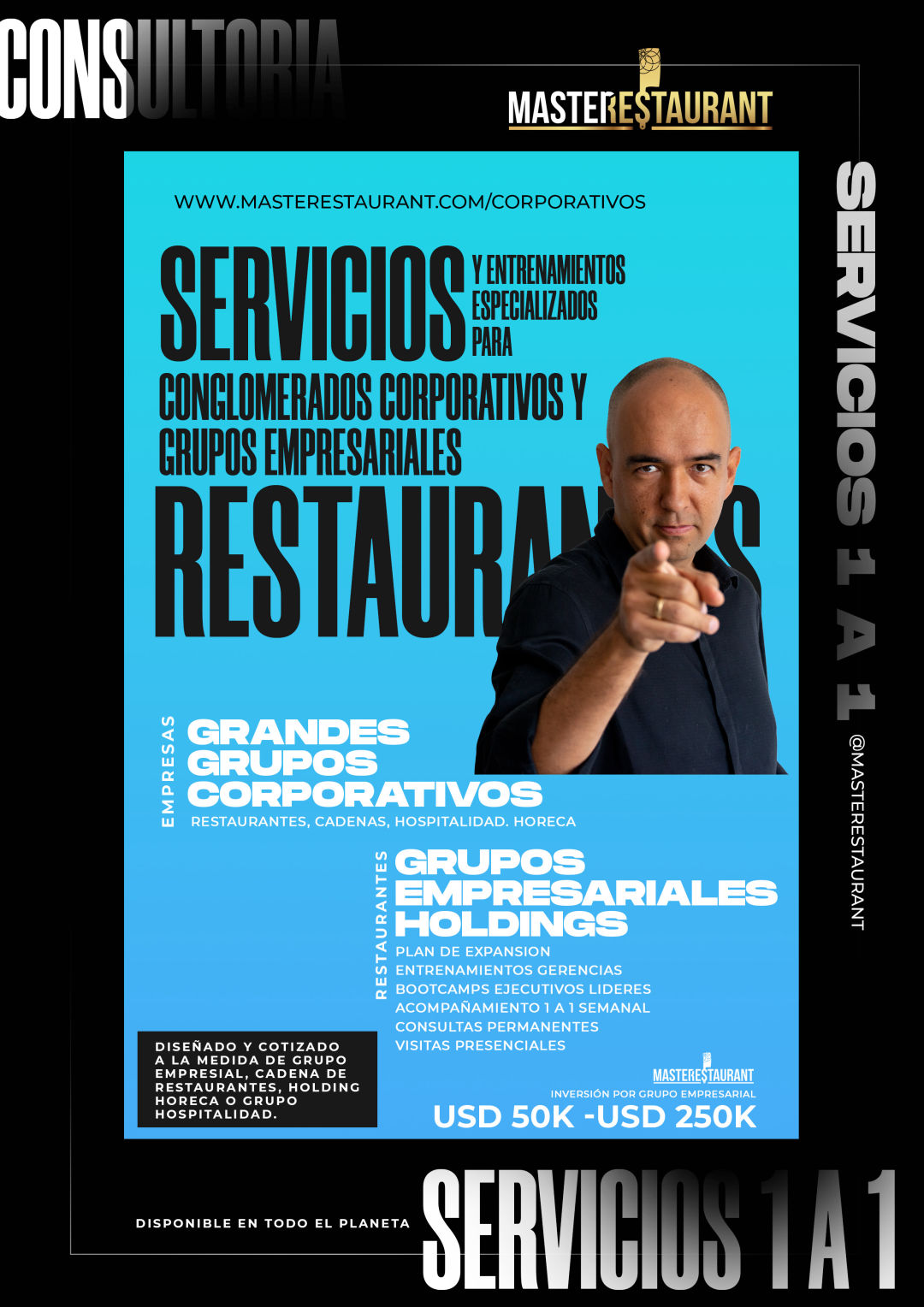
Investment: from USD $50K to USD $500K+ - tailor-made hospitality programs, priced to the group's size and complexity - spots LIMITED worldwide.
Corporate programs
Tailor-made hospitality consulting programs for groups and chains
Every hospitality program is 100% personalized and tailor-made to the group, and it starts with a strategic portfolio diagnosis, brand by brand and unit by unit. From there it works through the key elements of the business model in the MASTERESTAURANT Restaurant Canvas: portfolio strategy and capital allocation, multi-site standardization, financial governance and decision dashboards, talent and structure, and expansion, franchise or new markets, with support for leadership during implementation.
It is priced to the size and complexity of the group (from USD $50K to USD $500K+), with limited spots worldwide to ensure dedicated attention and discretion for each client.
Corporate coverage
Territories close to Spain
Explore consulting for hospitality groups in other territories, or go back to the worldwide index on the hospitality consulting worldwide page:
Hospitality group expansion in AlicanteHospitality groups consulting across SpainAdvisory for hospitality holdings in BarcelonaHORECA hospitality consulting in CórdobaHospitality groups consulting in GranadaHORECA hospitality consulting in MadridHotel group consulting in MalagaHotel group consulting in MurciaHospitality group expansion in SevilleHORECA hospitality consulting in ValenciaHospitality group expansion in ZaragozaHORECA hospitality consulting across BrazilHospitality group expansion in AustraliaHospitality group expansion in IsraelHORECA hospitality consulting in South AfricaHORECA hospitality consulting in AalborgHospitality group consultant in AarhusHotel group consulting across DenmarkHospitality group expansion across FranceHotel group consulting across the United KingdomAdvisory for hospitality holdings in AmsterdamHotel group consulting in AustriaHORECA hospitality consulting in BelgiumAdvisory for hospitality holdings in BerlinMore countries →More cities →
We do serve — and every city on the planet
Available there too: on-site or virtual, in English and Spanish.
Who is Diego F Parra?
Diego F Parra is the consultant that business groups, chains, holdings and family offices choose to grow, standardize and expand their restaurant portfolio with profitability and governance.
An engineer and C-Suite consultant, he is the author of 3 ISBN-registered books and the creator of the MASTERESTAURANT methodology and its technology suite (MTIE, Gastronomic Radar and KPI Dashboard), applied by 8,400+ restaurants across 43 countries. His method comes from two decades of creating, rescuing and expanding restaurants, franchises, dark kitchens and HORECA groups across four continents.
That is why he comes to the board with tools proven in real operations and reviews each brand and each site before recommending an opening, a restructuring or a franchise.
HORECA · Chains · Holdings · Foodtech
Private programs for boards and family offices
Consulting, executive bootcamps, events and private advisory for boards, C-Suite and family offices.
Starting at USD $50K, tailored to each organization; limited spots worldwide.
Published doctrine
The books that changed restaurant management
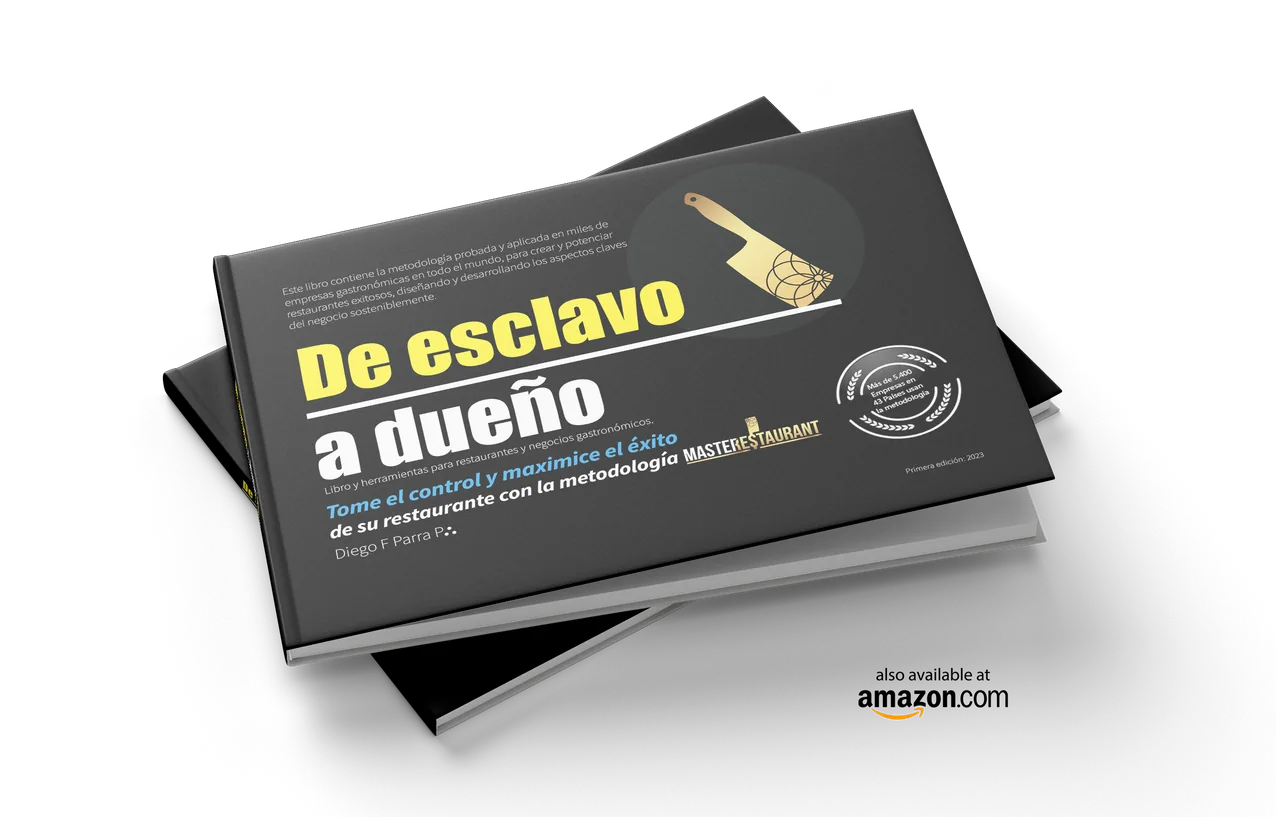
De Esclavo a Dueño
The book that changed how restaurants are managed: practical strategies and tools based on more than 20 years of experience, for traditional restaurants, dark kitchens, foodtech and HORECA businesses.
Triunfar o Morir en el Intento
Practical tools and key strategies to design and operate restaurants and food businesses efficiently.
Podcast: Masterestaurant — Mistakes for Restaurants
The public autopsy of the mistakes that bankrupt restaurants: owners and managers listen on Spotify to avoid repeating them. Condensed operating doctrine, open to everyone.
Listen on SpotifyDownloads
The documents your board will ask for
MASTERESTAURANT services portfolio
The complete corporate intervention catalog: consulting, executive bootcamps, advisory and specialized services, with scopes and formats. The document to decide with your board.
Download PDFBook: From Slave to Owner
The full doctrine behind the methodology: how to structure restaurants that run without depending on the owner. Ideal pre-reading before your group's diagnosis.
View on AmazonPortfolio
More services by Diego F Parra and his team
Beyond hospitality group consulting, Diego F Parra and his team offer keynotes, mentoring, training, programs and a membership, all built on the same method and the same tools. In a hospitality group that means the work can be split by level: keynotes for the board and managers, training for each site's leaders and mentoring for whoever runs a brand, all on the same indicators. If what you need goes beyond consulting, the full ecosystem is available:
International keynote speakerOne-on-one consulting and advisoryPersonalized mentoring for owners (limited spots)Corporate groups and holdings consultingCelebrity Restaurants consultingThemed restaurant advisorySpecialized training programs52-Week membershipPitch deck and restaurant investment readinessExponential Program0.1 Program — Elevate Your RestaurantInteractive training kit
From template to results
Want this working every day in your restaurant?
The tool gives you the template. The program gives you the method and the guidance to use it every week, with your team.
Direct contact
Get a quote for hospitality consulting for your group in Spain
Your message goes straight to Diego's team: group or chain, number of sites, stage and what you need to achieve in Spain.

“I have seen groups scale or dissolve not by how fast they open locations, but by the architecture of their system before each opening. The difference between a holding that replicates profitability across twenty units and one that fails by unit four is operating control and portfolio discipline. That is built, not improvised.”
Diego F. Parra — International consultant, expert in creating, scaling and improving restaurants, HORECA and hospitality
MASTERESTAURANT® methodology applied by 8,400+ restaurants across 43 countries · Author of 3 ISBN-registered books, including «De esclavo a dueño» · 20+ years operating restaurants, franchises, dark kitchens and HORECA groups across 4 continents
Full profile →Corporate consulting for your group in Spain
Tell us how many sites and brands your group has and what decision is on the table.
Explore more
Restaurant groups: territories, services and ecosystem resources
Useful links for boards and leadership teams weighing hospitality group consulting before deciding: nearby territories where the same service is available, sister services in the MASTERESTAURANT ecosystem, Diego F Parra's professional profile and management tools.
World's best restaurant keynote speakerWorld's best restaurant consultantC-Suite restaurant consultant for chains & groupsDiego F Parra — professional profileKeynote speaker serviceCorporate groups & holdings consultingCelebrity restaurant consultingInternational themed restaurant advisoryHospitality group expansion in AlicanteHospitality groups consulting across SpainAdvisory for hospitality holdings in BarcelonaHORECA hospitality consulting in CórdobaHospitality groups consulting in GranadaHORECA hospitality consulting in Madrid
FAQ
Frequently asked questions
Is there restaurant management consulting in Spain for hospitality groups?
Yes. It begins with a portfolio diagnosis: every brand and unit the group runs in Spain is read through its own unit economics. Then the order is fixed: measure, standardize, and expand only once the standard is documented.
Which restaurant consultants in Spain work with hotels, chains and holdings?
MASTERESTAURANT's consulting for hospitality groups in Spain is built for hotels, chains, multi-brand F&B operations and holdings at a decision point, when the portfolio trades well but per-unit margin never shows up.
How do you ensure each new unit maintains the profitability of our existing locations? Whenever we open a new site, our group EBITDA drops because the new unit doesn't generate in year one.
A consulting program does not eliminate the ramp curve of a new location. What it does is compress the loss period and accelerate toward profitability. We replicate two things: first, a proven operating protocol—launch costs calibrated, staff pre-trained, supply chain connected day one. Second, format standardization: if we open a rotisserie in Salamanca identical to Valladolid, we know Prime Cost before opening because unit one gave us the baseline.
Result: new unit reaches profitability in 9-12 months instead of 18-20. Group aggregate profitability still dips in year one by arithmetic, but recovery velocity is the differential. Measured by unit and portfolio.
We have three brands with different business models: fast-casual, modern restaurant, and dark kitchen. How do we structure portfolio governance without killing profitable but struggling brands?
Start with diagnosis. Separate P&L by brand and unit to see which really earns. Often we find a brand that looks profitable absorbs unallocated corporate costs. Once clarity exists, each brand gets strategy: grow if margin is >25%, restructure if 15-24%, exit if the asset has better use.
A three-brand holding governed this way makes capital decisions clearly: we scale dark kitchen because it shares prep with co-productions from other brands, or we close the modern-restaurant format in Tier-3 cities but expand in Madrid. That is not closure—that is strategy.
What is the most expensive mistake in a group that is expanding?
Opening before standardizing. The new site copies the good and the bad of the previous ones, and past a certain number nobody can say which version of the standard each location is running.
We turn over more and earn less. What is happening?
Almost always structure: group fixed costs that grew with the openings and a Prime Cost nobody governs corporately. It shows the moment you look at EBITDA per unit.
What part does talent play in this?
A decisive one, which is why the engagement includes organizational structure and leadership development. A written standard without trained managers to hold it lasts until the first high season.
Do you help funds and family offices?
Yes: operational due diligence, value thesis and support to management, to enter or grow in hospitality with industry judgement.
What is the investment for a hospitality program?
Hospitality programs range from USD $50K to USD $500K+ and are priced to the size and complexity of the group, the number of sites and the scope of the engagement. They are quoted to fit after the diagnosis.
