Diego F. Parra · CREATOR OF THE MASTERESTAURANT® METHODOLOGY
RESTAURANT GROUP CONSULTANTWho prepares a chain in China to franchise without handing out an unsolved problem?
A restaurant group's problem in China is rarely selling more. It is knowing which site earns, which loses and which is being carried by the rest, and that takes unit economics per unit.
The MASTERESTAURANT methodology and its TOOLKIT have been applied across 8,400+ restaurants in 43 countries, from three-site groups to networks with dozens of units. Growing a group is harder than opening a restaurant: each new site multiplies costs, standards, talent and complexity, and a group only scales when a system replicates per-unit profitability, not when it depends on founders or operational heroes.
In China, the method adapts to the size, stage and expansion model of each group, in an order that does not change: measure, standardize, and only then replicate. That means a corporate diagnosis brand by brand and site by site, standards and financial governance that hold across the network, and a decision on owned units, licensing or franchising based on the documented standard and the team available.
How does restaurant group consulting work in China?
The first step is a corporate diagnosis: every unit the group runs in China is measured on EBITDA, Prime Cost, standards and the team behind it. With that map the board decides which sites to open, convert or close.
The work runs on four fronts together: portfolio strategy, standards that hold across every site, financial governance and a clear expansion rule. Units are compared on the same indicators, so the board sees which locations carry the group and which ones drain it. Then come the systems that make growth repeatable: recipes and processes on paper, a KPI dashboard reviewed on a fixed calendar and a leadership layer that runs without the founders in the room.
Everything is built on the group's own numbers, on site or remote, in English or Spanish. This page cites four verified figures for China, from sources such as the National Bureau of Statistics of China and the Ministry of Culture and Tourism.
What do the numbers say about running a restaurant group in China?
¥29,476 (+4.4%) — per capita household consumption expenditure, according to the National Bureau of Statistics of China. A figure like this sizes the opportunity; it does not say whether each new unit will earn money.
For a group, the useful reading is the unit economics behind each opening: Prime Cost under control, a theoretical food cost close to the real one and EBITDA measured site by site. That is what decides whether a new location in China multiplies profit or only multiplies complexity.
Other reference points cited on this page: ¥140.19 trillion (+5.0%) (annual gross domestic product of the country, the National Bureau of Statistics of China); US$131.1 billion (+39.2%) (spending by inbound international visitors within the country, the National Bureau of Statistics of China); 5.615 billion (+14.8%) (domestic tourist trips recorded by the ministry for the year, the Ministry of Culture and Tourism).
Data
Market figures for restaurant groups in China
The figures cited on this page, with what each one measures and its source.
Figure
What it measures
Source
5.615 billion (+14.8%)
Domestic tourist trips recorded by the ministry for the year
Ministry of Culture and Tourism (vía gov.cn)
¥29,476 (+4.4%)
Per capita household consumption expenditure
National Bureau of Statistics of China
¥140.19 trillion (+5.0%)
Annual gross domestic product of the country
National Bureau of Statistics of China
US$131.1 billion (+39.2%)
Spending by inbound international visitors within the country
National Bureau of Statistics of China
Each figure links to its source in the data cards on this page.
The local market
The competitive context of China
A restaurant group scaling in China faces a critical dilemma: each new unit—whether in a Shanghai district, a second-tier city, or a shopping mall—multiplies operational costs, variability in standards, talent management complexity, and margin pressure. What worked with two or three locations—intuitive decisions, inherited processes, margins protected by initial volume—collapses when the portfolio reaches twenty, thirty units. Most groups grow by commercial impulse: they spot an opportunity, open, repeat.
Yet profitability per unit erodes with each new opening. The margin generated by the first Shanghai location does not replicate in Chengdu, Hangzhou, or peripheral districts. Operational standards are missing, control over Prime Costs (food, labor, occupancy), financial governance of the portfolio, and, crucially, a business system—not merely an expansion pace—capable of ensuring each new unit replicates profitability.
Specialized corporate hospitality consulting fills precisely that gap: it transforms a group growing by impulse into a governed restaurant enterprise where each unit is profitable and predictable, and growth becomes a consequence of operational excellence, not its opposite.
This service delivers transformation across seven key dimensions. First: deep portfolio diagnostic (unit strengths and weaknesses, international benchmarks, restructuring potential). Second: brand and typology strategy—what to position, what to pause, where to expand within the existing ecosystem. Third: multi-unit standardization (operation manuals, centralized purchasing processes, quality control, talent management with reproducibility). Fourth: unit economics governed at group level—each location reports real Prime Cost (raw materials, labor, occupancy), unit EBITDA and its evolution; a single control dashboard.
Fifth: scalable organizational structure—roles, responsibilities, decision flows independent of the founder. Sixth: ordered expansion design (new sites, new cities, existing unit redesign). Seventh: franchising, if applicable, with proven and replicable manuals. All integrated under the MASTERESTAURANT methodology, adapted to the regional regulatory reality, consumer behavior, and labor market dynamics.
Diego's authority in this field is not testimonial; it is operational. He has worked directly with groups and chains in 43 countries, embedding his methodology in 8,400 restaurant units and hospitality businesses. As a C-Suite consultant, he has managed payrolls for operations mobilizing hundreds of millions in capital, negotiated leases and investments in markets as complex as Hong Kong and Singapore, and supported boards in expansion, restructuring, and franchising decisions.
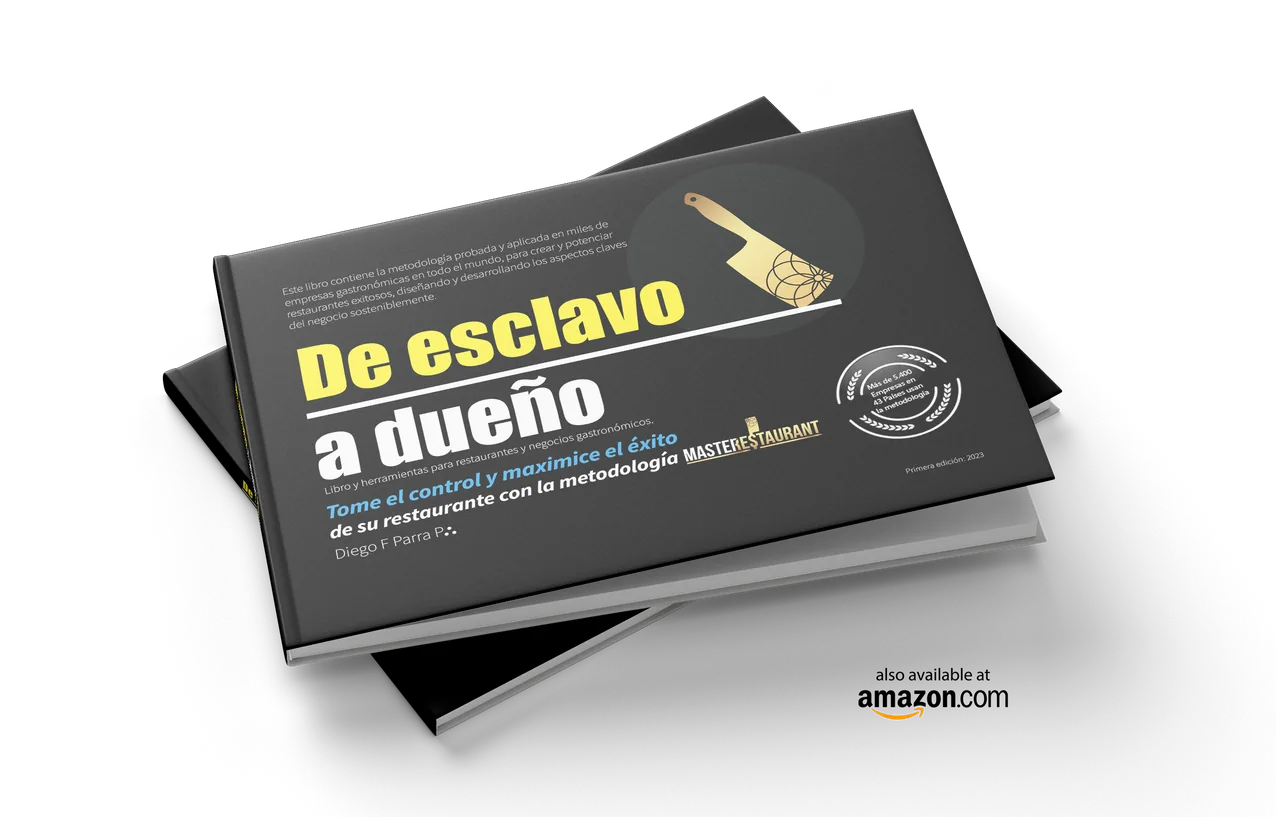
His book «From Slave to Owner»distills two decades of real operational experience. His online community exceeds 65 million annual views, reflecting his methodology's impact across small and large operators. For boards operating in China and similar complex markets, this translates to one thing: the strategy and systems being implemented are not theoretical; they are proven in comparable contexts (multiple sites, complex urban ecosystems, large budgets, high operational risk) and replicable.
The return is measurable across four axes. One: profitability replicated per unit. After implementation, each new opening generates predictable margins, with Prime Cost governed and EBITDA comparable to mature portfolio units, reducing surprise and financial risk. Two: margin protection during expansion. Operational standardization, centralized purchasing, and cost control prevent the margin erosion that typically accompanies rapid growth. Three: portfolio decisions grounded in real data.
The board accesses indicator dashboards (not intuition) on where to grow, which brands to strengthen, which to restructure, how to allocate capital. Four: operations independent of founders or operational heroes. The business becomes more attractive to investors, more governed, more valuable. A restaurant group that scales without dilution is a group with a future.
Market data
Data context for a network in China
5.615 billion (+14.8%)
Domestic tourist trips recorded by the ministry for the year
Why China is a market for restaurant groups and chains
China's corporate restaurant ecosystem is structurally distinct from Western markets. On one hand, there is a mature segment of regional groups and national chains operating multiple units under different brands (fine dining, casual, dark kitchens); some are listed or backed by strategic funds. On the other, the market is geographically fragmented: Beijing, Shanghai, and Shenzhen operate under consumption dynamics, rental costs, and talent availability very different from second-tier cities (Chengdu, Hangzhou, Wuhan, Xi'an).
Shopping malls are controlled ecosystems with rigid rules on hours, commission, and brand compliance. Domestic and international tourism generates seasonal, concentrated demand. Food delivery and dark kitchens grow rapidly, competing for the same operational talent. Rental costs in prime locations are prohibitive, yet labor, services, and utilities vary by region. The availability of managers with portfolio-level thinking—not just single-location focus—is scarce.
The expansion opportunity is real, but the risk of dilution is greater. A group can grow vertically in one city (replicate its Shanghai-successful model in three new locations) or expand horizontally to other cities or provinces—both paths require rigorous standardization.
What erodes profitability is predictable: uncontrolled operating costs in new sites (higher rent than expected, less productive labor, costlier inputs in provincial areas), lack of standard in recipes and processes (each location 'personalizes'), managerial talent turnover (especially in second-tier cities where labor markets are more volatile), and absence of centralized financial governance (each location manages its own cash flow, no integration).
The consumer in Shanghai is not the same as in Chengdu: brand perception, consumption timing, price sensitivity, expectations for environment and service vary widely. Without local market research and intelligent model adaptation (not literal copying), the group opens units that erode both brand and margin.
RESOURCES
MASTERESTAURANT studies, guides & tools
Before your next move in China, these MASTERESTAURANT resources give real operating and profitability context:
There are consultants who have read about restaurants and consultants who have stood inside one at nine on a Friday night. Diego F. Parra is the second kind: engineer and C-Suite consultant with two decades creating, rescuing and expanding restaurants, franchises, dark kitchens and HORECA and hospitality groups across four continents, with payrolls signed, leases negotiated and expansions closed in operations worth hundreds of millions of dollars.
That experience was distilled into the MASTERESTAURANT® methodology, applied today by 8,400+ restaurants across 43 countries, and into its TOOLKIT: MTIE, Gastronomic Radar, Standard Recipe Generator, Tech Sheets and KPI Dashboard. Tools, not slides.
The picture is completed by 3 ISBN-registered books, including «De esclavo a dueño», the industry's leading podcast, the largest bilingual community of owners, chefs and operations directors in the region (65M+ views per year as @masterestaurant) and a place among the top Latino restaurant operations experts globally. Full detail in Diego F. Parra's professional profile.
Corporate consulting with its own doctrine, not generic frameworks
Consulting for restaurant groups is not solved with management theory. Every engagement is built on the Restaurant Model Canvas and real industry data—profitability, Prime Cost, cost structure, multi-site standardization and expansion—applied to the specific business model of a group, a chain or a holding. The goal is not to open more restaurants, but to build a business system that replicates per-unit profitability, governs the portfolio and sustains operations on clear rules rather than indispensable people. Every board decision rests on the group's own indicators, measured at each site.
Personalized one-on-one work, with projects starting out and with businesses already trading:
From three to ten sites
The stretch where the founder's judgement stops reaching and no structure has replaced it yet.
From ten to fifty
Where the network needs governance: single definitions, quality control and trained managers in every market.
Consolidated networks
Years of trading and a per-unit margin sliding slowly, with nobody able to point at where.
Groups in generational transition
When what lived in the founder's head has to become a system others can run.
What's included
Key topics and elements your corporate program can include
Depending on the diagnosis, the engagement draws on some of these MASTERESTAURANT modules:
Executive bootcamps for the leadership team
Working sessions with the board
A full corporate diagnosis
Unit economics per brand and per unit
Multi-site manuals and operational control
Prime Cost governed corporately
KPI dashboards for leadership
Readiness for franchising and new markets
Support through implementation
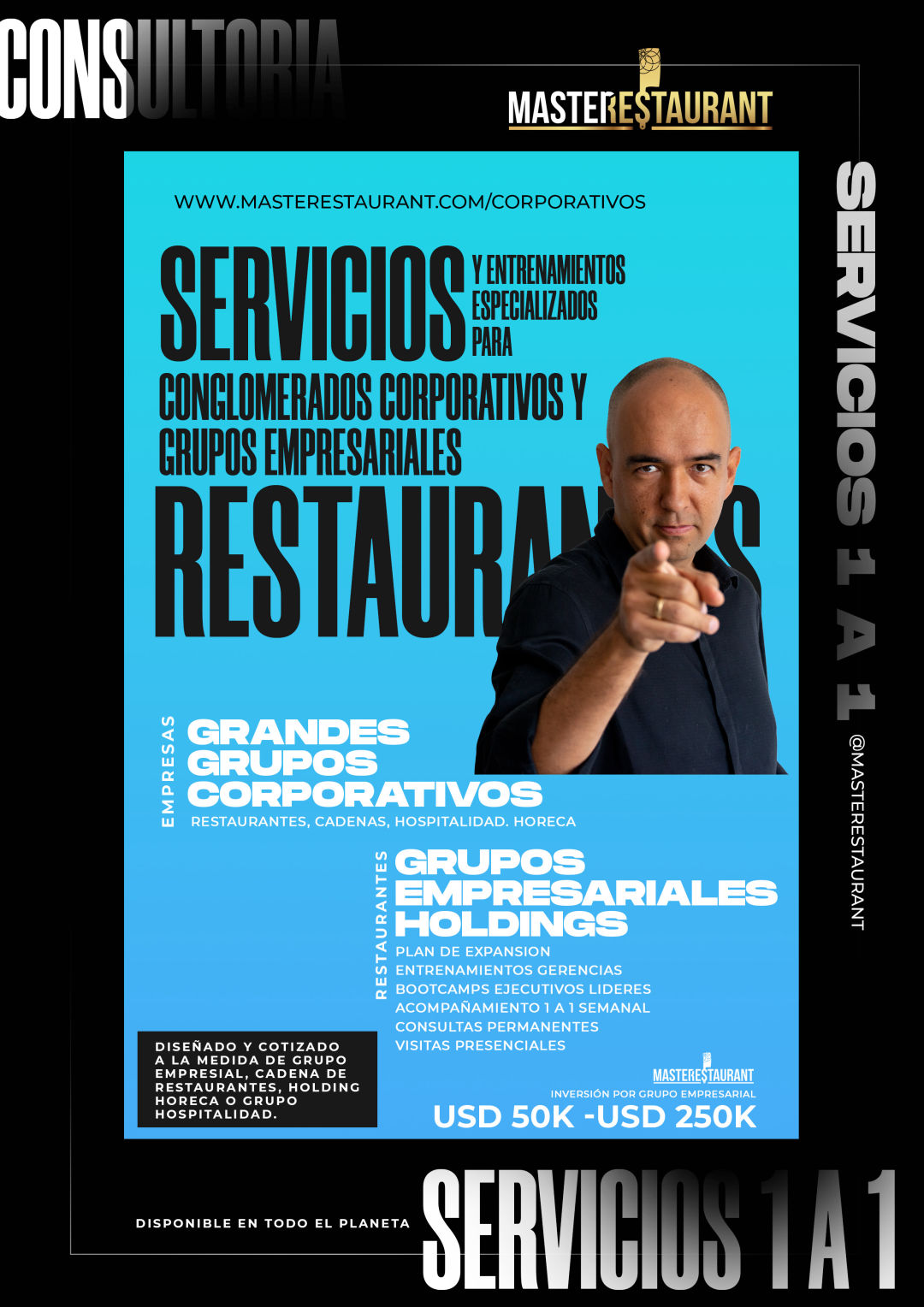
Investment: from USD $50K to USD $500K+ - tailor-made corporate programs, priced to the group's size and complexity - spots LIMITED worldwide.
Corporate programs
Tailor-made corporate consulting programs for groups and chains
Every corporate program is 100% personalized and tailor-made to the group. It starts with a strategic portfolio diagnosis and works through the key elements of the business model in the MASTERESTAURANT Restaurant Canvas, from portfolio strategy and standardization to per-unit profitability and expansion. Priced to the group's size and complexity (from USD $50K to USD $500K+), with limited spots worldwide to ensure dedicated attention and discretion for each client.
The diagnosis sets the scope and the phases (strategic planning, standardization and implementation, and support through operations and expansion), working from the group's own numbers, on site or remote, in English or Spanish.
Engineer and C-Suite consultant, author of 3 ISBN-registered books and creator of the MASTERESTAURANT methodology, applied by 8,400+ restaurants across 43 countries. The method comes with its own technology suite: MTIE, Gastronomic Radar and KPI Dashboard.
He is the consultant that business groups, chains, holdings and family offices choose to grow, standardize and expand their restaurant portfolio with profitability and governance. His method comes from two decades operating, rescuing and expanding restaurants, franchises, dark kitchens and HORECA groups across four continents, and it arrives with instruments proven in real operations, not generic templates. He works in English or Spanish, on site or remote.
The book that changed how restaurants are managed: practical strategies and tools based on more than 20 years of experience, for traditional restaurants, dark kitchens, foodtech and HORECA businesses.
Triunfar o Morir en el Intento
Practical tools and key strategies to design and operate restaurants and food businesses efficiently.
The complete corporate intervention catalog: consulting, executive bootcamps, advisory and specialized services, with scopes and formats. The document to decide with your board.
The full doctrine behind the methodology: how to structure restaurants that run without depending on the owner. Ideal pre-reading before your group's diagnosis.
As the group grows, every new site needs managers trained to the same standard. That is why the ecosystem's services start from the same method and tools as the corporate consulting: training and courses for managers in each market, the membership to keep learning going and the Pitch Deck and investment service when expansion needs capital. The full ecosystem is available:
Get a quote for corporate consulting for your group in China
Your message goes straight to Diego's team: group or chain, number of sites, stage and what you need to achieve in China.
“Opening restaurants is easy; what's hard is building a business system that makes each one profitable. I've seen groups that opened thirty units in two years and watched their margin collapse; I've seen others open five and scale their value five times. The difference is not speed; it's financial and operational governance of the portfolio.
If your group grows without standardization, without governed Prime Costs, without control dashboards, then every opening is a risk, not an opportunity. Conversely: a group that controls its numbers can grow at whatever pace the market allows without losing a dollar.”
Diego F. Parra — International consultant, expert in creating, scaling and improving restaurants, HORECA and hospitality
MASTERESTAURANT® methodology applied by 8,400+ restaurants across 43 countries · Author of 3 ISBN-registered books, including «De esclavo a dueño» · 20+ years operating restaurants, franchises, dark kitchens and HORECA groups across 4 continents
Restaurant groups: territories, services and ecosystem resources
Related links for boards, C-Suite and teams evaluating Diego F. Parra's corporate consulting for restaurant groups and chains: nearby territories, sister services in the MASTERESTAURANT ecosystem and management tools, all built on the same method.
China restaurant consulting diagnoses each unit's profitability, standardizes operations across sites, establishes financial governance, and designs expansion strategy to ensure predictable margins as the group grows.
Who is the best restaurant chain consultant in China?
The one who measures every unit alike and decides what to open or close. Diego F. Parra of MASTERESTAURANT brings more than 20 years in the industry and a method applied in more than 8,400 restaurants in 43 countries to groups in China.
What does restaurant management consulting in China look like for a restaurant group?
It starts with a corporate diagnosis of every unit in China, measured with the same yardstick (EBITDA per unit, Prime Cost, standards and the team that runs each site), so the board can decide what to open, convert or close.
Is there China restaurant consulting for multi-unit groups and holdings?
Yes. MASTERESTAURANT's corporate consulting works with restaurant groups in China on portfolio strategy, unit economics and standards, replacing the founder's judgement with a system without losing what made the group grow.
How do we ensure that each new unit in a different city replicates profitability when costs, talent, and market are so different? What systems and controls make that predictable?
Through unit-economics engineering at group level. First, establish a Prime Cost model (raw materials, labor, occupancy) adapted by unit type and region—not a single model for all. Second, each location reports those numbers to a centralized dashboard, letting the board see in real time which units are on track and which are at risk. Third, replicate operational processes (centralized purchasing, standardized recipes, service protocols) that control key variables. Result: prediction, not surprise.
If we decide to franchise part of our portfolio, how do we maintain brand standard and profitability when we no longer control direct operations?
Franchising starts with impeccable operational documentation: procedure manuals, technical specs, recipes, environment standards, performance metrics. Second, a royalty and audit model aligning incentives and detecting deviations. Third, franchisee training and certification in MASTERESTAURANT methodology before opening. Diego's franchising experience—applied across multiple contexts—shows that groups replicating their system (not just their name) scale without brand dilution.
How is this different from a generalist consultancy?
It knows the kitchen and the floor. A generalist draws the org chart; here the costing, the technical sheet and the shift rota get worked too, and that is where margin is won or lost.
What if we already have an operations director?
All the better. Nobody gets replaced: they get method, single definitions and comparable indicators so their judgement reaches every site in the network the same way.
Can the diagnosis be hired on its own?
Yes. Many groups start there and decide afterwards how far to take implementation.
What is asked of the group?
Access to the real numbers of every unit and timely decisions. A diagnosis on dressed-up data corrects nothing, it only confirms what was already believed.
What is the investment for a corporate program?
Corporate programs range from USD $50K to USD $500K+ and are priced to the group's size and complexity, number of sites and scope of the engagement. They are quoted tailor-made after the diagnosis.
Community
Join our MASTERESTAURANT Community for FREE
Restaurant owners and teams from 43 countries sharing knowledge, tools and applied AI — straight to your WhatsApp.
 MASTERESTAURANT®