 MASTERESTAURANT®
Population estimate, San Juan Municipio, Puerto Rico (July 1, 2025)
U.S. Census Bureau, QuickFacts
Corporate governance · San Juan

DIEGO F PARRA · CREATOR OF THE MASTERESTAURANT® METHODOLOGY
RESTAURANT GROUP ADVISORY Who can say in San Juan what each site actually earns, not just what the network turns over?
Diego F. Parra has worked across 8,400+ restaurants in 43 countries. In San Juan he applies that judgement to the whole network, not to a pilot site.
Download the portfolio (PDF)Corporate advisory spots LIMITED worldwide - reserve your group's evaluation early
8,400+restaurants apply his methodology
43countries with supported groups
65M+views per year
2service languages: EN - ES
International validation
See Diego F. Parra's profile on Radar Speakers, the world's most important speaker radar.
See profile on Radar Speakers →
329,737 inhabitants
US$4.6 billion
4-10%
91,000

@masterestaurant
Before franchising in San Juan
The MASTERESTAURANT methodology and its TOOLKIT have been applied across 8,400+ restaurants in 43 countries, from three-site groups to networks with dozens of units. Growing a group is harder than opening a restaurant: each new site multiplies costs, standards, talent and complexity, and a group only scales when a system replicates per-unit profitability, not when it depends on founders or operational heroes.
In San Juan, the method adapts to the size, stage and expansion model of each group, in an order that does not change: measure, standardize, and only then replicate. That means a corporate diagnosis brand by brand and site by site, standards and financial governance that hold across the network, and a decision on owned units, licensing or franchising based on the documented standard and the team available.
How does restaurant group consulting work in San Juan?
It begins by measuring each unit in San Juan with one yardstick (EBITDA per site, Prime Cost, operating standards and the team in charge) so the board can decide what to open, convert or close on evidence.
The diagnosis turns into four workstreams: portfolio, multi-site standards, financial governance and expansion. The aim is a group that can grow without the founders in every decision: documented recipes and processes, a KPI dashboard with a fixed review cadence and managers who own their numbers. The engagement uses the group's own data, runs in person or remotely, in English or Spanish, and is sized to the number of units and the stage of the business. This page cites four verified figures for San Juan, from sources such as Discover Puerto Rico and the U.S. Census Bureau.
What do the numbers say about running a restaurant group in San Juan?
US$4.6 billion — total food and beverage output from tourism in 2024, according to Discover Puerto Rico. A figure like this sizes the opportunity; it does not say whether each new unit will earn money.
Other reference points cited on this page: 91,000 (direct jobs sustained by tourism in 2024, 9.6%, Discover Puerto Rico); 329,737 inhabitants (population estimate, San Juan Municipio, Puerto Rico, July 1, 2025, the U.S. Census Bureau); 4-10% (food waste and spoilage over purchases, LeanPath). For a group, the useful reading is the unit economics behind each opening: Prime Cost under control, a theoretical food cost close to the real one and EBITDA measured site by site. That is what decides whether a new location in San Juan multiplies profit or only multiplies complexity.
Data
Market figures for restaurant groups in San Juan
The figures cited on this page, with what each one measures and its source.
| Figure | What it measures | Source |
|---|---|---|
| 329,737 inhabitants | Population estimate, San Juan Municipio, Puerto Rico (July 1, 2025) | U.S. Census Bureau, QuickFacts |
| US$4.6 billion | Total food and beverage output from tourism in 2024 | Discover Puerto Rico |
| 4-10% | Food waste and spoilage over purchases | LeanPath / U.S. EPA |
| 91,000 | direct jobs sustained by tourism in 2024 (9.6%) | Discover Puerto Rico |
Each figure links to its source in the data cards on this page.
The local market
Why opening fast in San Juan does not guarantee earning more
A restaurant group or chain entering a phase of multiple-unit expansion encounters a reality that is not evident during the initial growth impulse: each new unit does not add complexity, it multiplies it. One location can operate on intuitive operational decisions, founder leadership, and margins that tolerate inefficiencies; ten sites require process standardization, centralized financial governance, talent scalability, and risk controls. In markets like Puerto Rico, where the availability of experienced operational executives is limited, most groups and chains grow on commercial impulse—opening locations where real estate opportunity or investor capital is available—without business architecture. The predictable result: unit profitability that erodes as scale increases, margins diluted by duplicated expenses, inability to replicate product and service standards, and total founder dependence. This is the gap that specialized corporate consulting fills: converting impulse into design, and growth into governed profitability.
The international consulting service for corporate restaurant groups by Diego F. Parra operates under the MASTERESTAURANT methodology, proven across +8,400 units in 43 countries. It is not a predefined package; it is a 100% bespoke program, integrated across five dimensions: portfolio diagnosis (audit of each brand and unit, identification of true profitability and restructuring opportunities), growth strategy (where to expand, which brands to accelerate, how to compete in each segment), operational standardization (manuals, kitchen and service processes, replicable quality control, cost governance per unit), financial engineering (unit economics audited, Prime Cost and EBITDA governed at portfolio level, KPI dashboards by brand and unit), and organizational structuring (C-Suite teams, roles, authorities, scalability without founder dependence). The result is a governed gastronomic enterprise—not a collection of locations—prepared to scale, to attract investment, and to be operated without the founder as a bottleneck.
Diego F. Parra's authority in corporate gastronomic consulting is verifiable: creator of the MASTERESTAURANT methodology applied across +8,400 restaurants and groups in 43 countries; C-Suite consultant with real-world experience in operations worth hundreds of millions of dollars (payroll signature, rent negotiation, corporate structuring, expansion closing); author of "De Esclavo a Dueño" with +65 million annual visualizations in his community; architect of proprietary technology suite (Restaurant Model Canvas, Masterestaurant Territory Engine, Gastronomic Radar, Indicator Dashboard). When a board of directors of a gastronomic group engages consulting at this scale, it is not experimenting with methodology; it is aligning with systems proven in markets of extreme competition—from Europe to Latin America—where expansion error costs tens of millions. For a Caribbean market like this, where groups grow but few achieve world-class operation, this experience transfer reduces replication risk.
The program's return is quantifiable: each new site opened under governed standards maintains unit profitability (eliminating the typical erosion as the group scales), margins protected by Prime Cost control and replicable expenses, and financial decision capability (identifying which brands in which zones generate superior EBITDA, where to allocate capital, which to restructure). The group moves from founder dependence—whose intuition is irreplaceable but not scalable—to an operation where each manager, chef, and functional area has clear KPIs, processes, and accountability for profitability. For the board, it means portfolio visibility (which unit contributes what margin, where risk exists, where opportunity lies). For external investors or eventual exit (group sale), it means a higher-value business: a well-engineered machine, not a collection of locations dependent on founder charisma.
Market data
The numbers leadership decides on in San Juan
Total food and beverage output from tourism in 2024
Discover Puerto RicoFood waste and spoilage over purchases
LeanPath / U.S. EPAdirect jobs sustained by tourism in 2024 (9.6%)
Discover Puerto RicoSan Juan as a market
Where the chain market is decided in San Juan
Puerto Rico's capital is the corporate gastronomic hub of the archipelago, with an ecosystem of groups and chains characterized by integrated hotel operators (resorts with multiple food & beverage venues), quick-service chains present in shopping centers, independent heritage restaurant operators in Old San Juan and the Santurce corridor, and franchisees of regional Caribbean brands. The dual market (tourism + local consumption) generates unique dynamics: Old San Juan attracts high tourism volumes with premium dining consumption; Hato Rey concentrates corporate and executive lunch-meeting traffic; Condado remains a luxury pole; Santurce has experienced revitalization with new chef-driven brands and operators seeking differentiation. Shopping centers (Plaza Las Américas, PR Urban) offer viability format for chains, but concept saturation is common. Availability of directorial and operational talent is limited—many operations directors migrate to the hotel industry, where there is greater corporate structure—making retention and scaling teams a real challenge for expanding chains.
Expanding a group or chain in this territory presents clear opportunities: population density that allows multi-unit within a 5-km radius (Hato Rey, Santurce, Condado), tourism that generates demand for gastronomic experiences, and a corporate market loyal to quality restaurants in commercial zones. But the operational risks that erode profitability as you scale are precise: rent cost duplication (premium location availability is limited, pushing rents higher), directorial talent dilution (absence of operational manuals and standardization makes one unit's success unreplicable in the next), margin erosion through overhead multiplication (each new site adds central management costs without proportional revenue scaling), and local consumption volatility (which varies by zone and demographic). The local consumer is demanding and comparative: does not repeat easily if standard drops across units of the same group. A chain opening six locations with inconsistent operation loses capital recovery velocity.
RESOURCES
MASTERESTAURANT studies, guides & tools
Actionable resources for restaurant teams in San Juan — original studies, guides and tools, not theory:
- STUDYWhy restaurants fail: traditional pricing vs the Masterestaurant method
- LIST8 Signs Your Restaurant Depends on You in 2026 (and What to Do)
- CHECKLISTDelivery Commissions That Kill Restaurant Margins: Myth vs
- ARTICLEExpert AI Consultant for Restaurants across Puerto Rico
- ARTICLEPurchasing & Vendors 2026: Before vs After
- STUDYFood Court Market Research: Traditional · Trends
The corporate consultant
The judgment behind this corporate restaurant consulting
Diego F Parra is an engineer and C-Suite consultant, and his trade for the last twenty years has been walking into restaurants, franchises, dark kitchens and HORECA groups across four continents to create them, rescue them or expand them. Along the way he signed payrolls, negotiated leases, structured partnerships and closed expansions in operations worth hundreds of millions of dollars.
The MASTERESTAURANT® methodology came out of that, and is used today by 8,400+ restaurants across 43 countries, with its TOOLKIT: MTIE, Gastronomic Radar, Standard Recipe Generator, Tech Sheets and KPI Dashboard. For an owner that means every decision is made on his own numbers and on tested processes, not on a hunch from the last good weekend.
His published work backs it: Author of 3 ISBN-registered books, including «De esclavo a dueño», creator of the industry's leading podcast and of the largest bilingual community of owners, chefs and operations directors in the region (65M+ views per year as @masterestaurant), recognized among the top Latino restaurant operations experts globally. See Diego F Parra's professional profile.
Corporate consulting with its own doctrine, not generic frameworks
Consulting for restaurant groups is not solved with management theory. Every engagement is built on the Restaurant Model Canvas and real industry data—profitability, Prime Cost, cost structure, multi-site standardization and expansion—applied to the specific business model of a group, a chain or a holding. The goal is not to open more restaurants, but to build a business system that replicates per-unit profitability, governs the portfolio and sustains operations on clear rules rather than indispensable people. Every board decision rests on the group's own indicators, measured at each site.
Corporate consulting from start to finish
Advisory that covers the full restaurant-group lifecycle
Turning over more is not earning more
A network can grow in sales and lose margin per site. That is not growth, it is dilution, and only EBITDA per unit shows it.
Get a quoteThe standard is the asset
Written, measured and held. Without it, the group's value depends on who happens to be on shift at each location.
Quote standardizationThe system replaces the hero
Structure and processes that work without depending on two or three indispensable people across the whole network.
Quote expansionGrowth is a decision, not a drift
Opening because a site came up is the most expensive way to expand. The staged plan exists to prevent it.
See the services portfolio (PDF)The methodology
Discover the MASTERESTAURANT methodology
Behind every group that scales profitably there is a system, not luck: tools, processes and models that turn impulse growth into governed expansion.
Who is it for?
Built for those who lead and expand restaurant groups
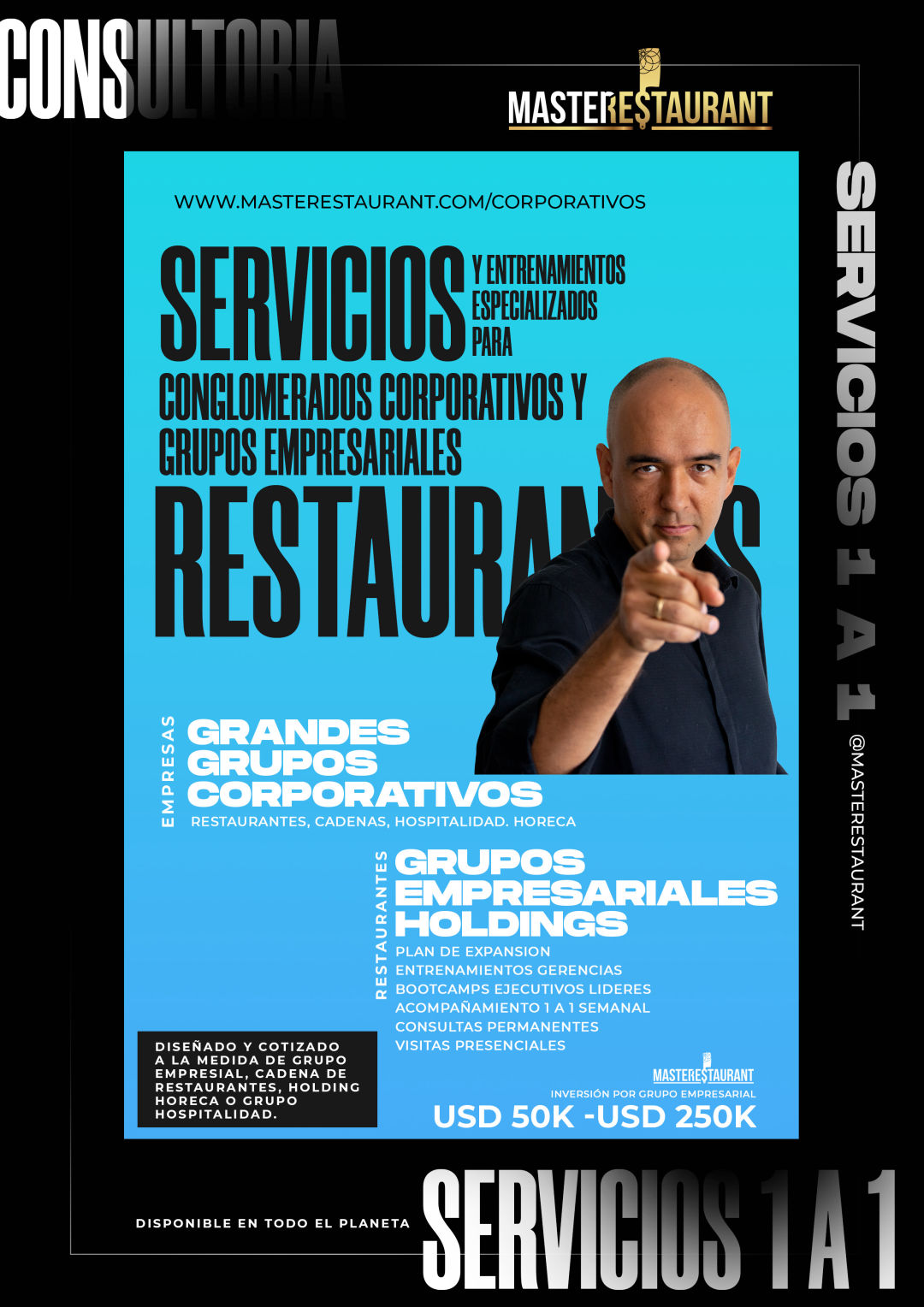
A tailor-made 1-on-1 service, built for those opening and for those already operating:
Enterprise groups and conglomerates
A hospitality portfolio governed with method: financial control, standardization and decision dashboards for the board and the C-Suite.
Restaurant chains
Profitable replication per unit: standards, Prime Cost and operations that deliver the same result at site one and at site fifty.
Hospitality holdings
Portfolio strategy: which brands to back, which to restructure and how to allocate capital to maximize group return.
Dark kitchens and foodtechs scaling up
Scaling without burning cash: unit economics, multi-node operations and expansion on data rather than growth instinct.
Family offices and funds
Operational due diligence, value thesis and support to management: enter or grow in foodservice with the MASTERESTAURANT methodology.
What's included
Key topics and elements your corporate program can include
Depending on the diagnosis, the engagement draws on some of these MASTERESTAURANT modules:
- Diagnosis brand by brand and site by site
- Portfolio strategy and capital allocation
- Multi-site standardization
- Financial governance and decision dashboards
- Menu engineering consistent across the network
- Talent, structure and leadership
- Readiness for franchising and licensing
- Entry into new markets
- Support through implementation
Investment: from USD $50K to USD $500K+ - tailor-made corporate programs, priced to the group's size and complexity - spots LIMITED worldwide.
Corporate programs
Tailor-made corporate consulting programs for groups and chains
Every corporate program is 100% personalized and tailor-made to the group. It starts with a strategic portfolio diagnosis and works through the key elements of the business model in the MASTERESTAURANT Restaurant Canvas, from portfolio strategy and standardization to per-unit profitability and expansion. Priced to the group's size and complexity (from USD $50K to USD $500K+), with limited spots worldwide to ensure dedicated attention and discretion for each client. The diagnosis sets the scope and the phases (strategic planning, standardization and implementation, and support through operations and expansion), working from the group's own numbers, on site or remote, in English or Spanish.
Corporate coverage
We also work with networks near San Juan
Explore other territories or the worldwide index:
Corporate hospitality consulting across Puerto RicoAdvisory for restaurant groups in BayamonRestaurant chain consulting in CarolinaRestaurant chain consulting in Puerto RicoRestaurant chain consulting in AustraliaRestaurant chain expansion in AustriaRestaurant chain consulting in IsraelRestaurant chain consulting in South AfricaCorporate hospitality consulting in AlajuelaAdvisory for restaurant groups across ArgentinaAdvisory for restaurant groups across BoliviaRestaurant chain expansion across BrazilRestaurant group consulting across CanadaRestaurant chain expansion across ChileCorporate hospitality consulting across ColombiaCorporate hospitality consulting across Costa RicaRestaurant group consulting across CubaCorporate hospitality consulting across the Dominican RepublicRestaurant chain expansion across EcuadorRestaurant chain expansion across El SalvadorRestaurant chain consulting across GuatemalaRestaurant chain expansion across HondurasAdvisory for restaurant groups across MexicoRestaurant group consulting across NicaraguaMore countries →More cities →
We do serve — and every city on the planet
Served on site or virtually, in English and Spanish.
Who is Diego F Parra?
Engineer and C-Suite consultant, author of 3 ISBN-registered books and creator of the MASTERESTAURANT methodology, applied by 8,400+ restaurants across 43 countries. The method comes with its own technology suite: MTIE, Gastronomic Radar and KPI Dashboard.
He is the consultant that business groups, chains, holdings and family offices choose to grow, standardize and expand their restaurant portfolio with profitability and governance. His method comes from two decades operating, rescuing and expanding restaurants, franchises, dark kitchens and HORECA groups across four continents, and it arrives with instruments proven in real operations, not generic templates. He works in English or Spanish, on site or remote.
HORECA · Chains · Holdings · Foodtech
Private programs for boards and family offices
Consulting, bootcamps and private advisory for boards and family offices.
From USD $50K, priced to the group; limited spots worldwide.
Published doctrine
The books that changed restaurant management
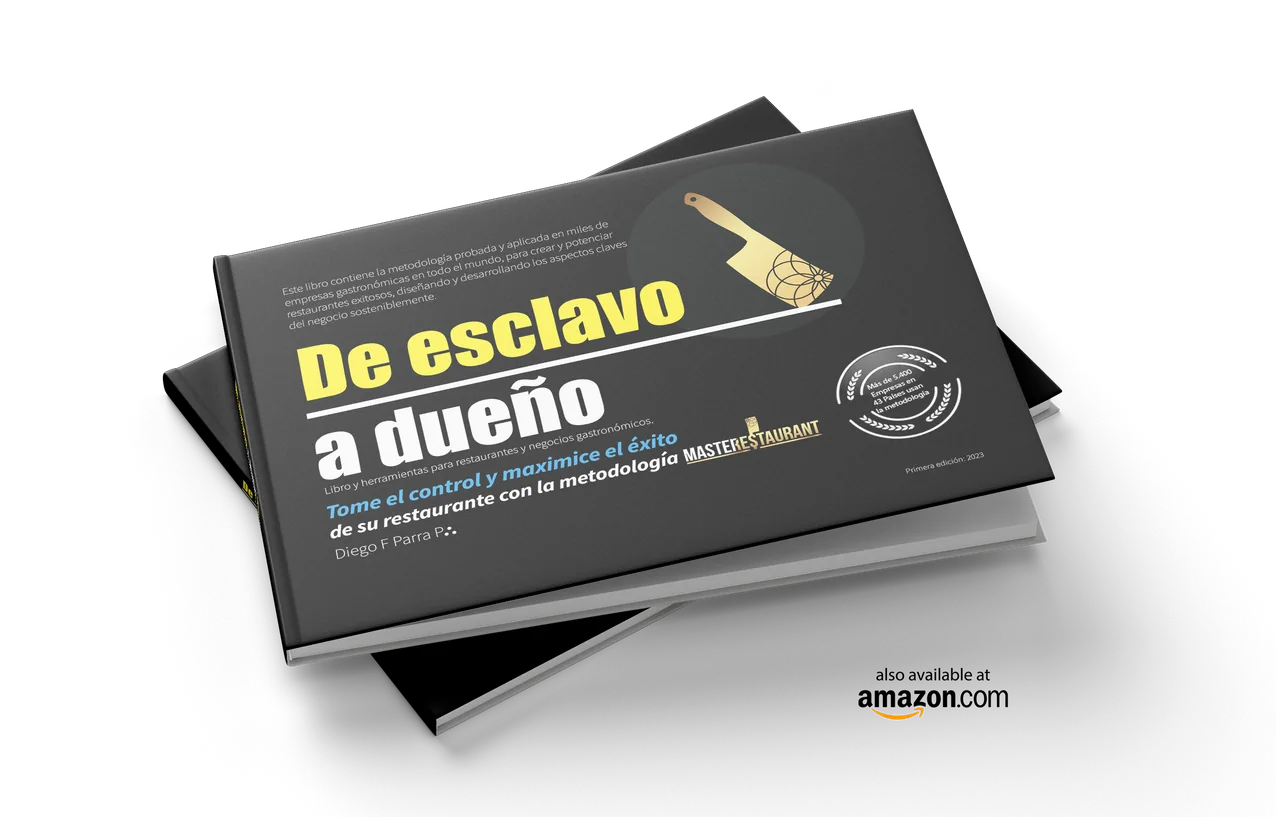
De Esclavo a Dueño
The book that changed how restaurants are managed: practical strategies and tools based on more than 20 years of experience, for traditional restaurants, dark kitchens, foodtech and HORECA businesses.
Triunfar o Morir en el Intento
Practical tools and key strategies to design and operate restaurants and food businesses efficiently.
Podcast: Masterestaurant — Mistakes for Restaurants
The public autopsy of the mistakes that bankrupt restaurants: thousands of owners and managers listen on Spotify to avoid repeating them.
Listen on SpotifyDownloads
The documents your board will ask for
MASTERESTAURANT services portfolio
The complete corporate intervention catalog: consulting, executive bootcamps, advisory and specialized services, with scopes and formats. The document to decide with your board.
Download PDFBook: From Slave to Owner
The full doctrine behind the methodology: how to structure restaurants that run without depending on the owner. Ideal pre-reading before your group's diagnosis.
View on AmazonPortfolio
More services by Diego F Parra and his team
As the group grows, every new site needs managers trained to the same standard. That is why the ecosystem's services start from the same method and tools as the corporate consulting: training and courses for managers in each market, the membership to keep learning going and the Pitch Deck and investment service when expansion needs capital. The full ecosystem is available:
International keynote speakerOne-on-one consulting and advisoryPersonalized mentoring for owners (limited spots)Corporate groups and holdings consultingCelebrity Restaurants consultingThemed restaurant advisorySpecialized training programs52-Week membershipPitch deck and restaurant investment readinessExponential Program0.1 Program — Elevate Your RestaurantInteractive training kit
Direct contact
Get a quote for corporate consulting for your group in San Juan
Your message goes straight to Diego's team: group or chain, number of sites, stage and what you need to achieve in San Juan.
“The difference between a group that scales and one that dilutes is not the opening pace; it is whether each new unit inherits a system or improvises in isolation. I have seen chains open ten locations in three years and collapse, and others open three in five years and build an empire. The difference is in the document.”
Diego F. Parra — International consultant, expert in creating, scaling and improving restaurants, HORECA and hospitality
MASTERESTAURANT® methodology applied by 8,400+ restaurants across 43 countries · Author of 3 ISBN-registered books, including «De esclavo a dueño» · 20+ years operating restaurants, franchises, dark kitchens and HORECA groups across 4 continents
Full profile →Corporate consulting for your chain in San Juan
Tell us how many units the network runs and which decision the board has to make.
Explore more
Restaurant groups: territories, services and ecosystem resources
Related links for boards, C-Suite and teams evaluating Diego F Parra's corporate consulting for restaurant groups and chains: nearby territories, sister services in the MASTERESTAURANT ecosystem and management tools, all built on the same method.
World's best restaurant keynote speakerWorld's best restaurant consultantC-Suite restaurant consultant for chains & groupsDiego F Parra — professional profileKeynote speaker serviceCorporate groups & holdings consultingCelebrity restaurant consultingInternational themed restaurant advisoryCorporate hospitality consulting across Puerto RicoAdvisory for restaurant groups in BayamonRestaurant chain consulting in CarolinaRestaurant chain consulting in Puerto RicoCorporate hospitality consulting in AlajuelaAdvisory for restaurant groups across Argentina
FAQ
Frequently asked questions
We are a group with five units in the territory. Three are profitable, two are in the red. How does a consulting engagement determine which to restructure and which to scale?
We audit each unit—analyzing actual revenue, Prime Cost, fixed and variable expenses, and capital return. We identify whether red operations stem from unviable model (closure or concept conversion), poor operational execution (training and standardization), or location/demographic (relocation or repositioning). For profitable units, we map which have replicable margins in other zones (scalability) and which depend on that unit's unique factors (non-replicable). Recommendation is not subjective: it is based on audited unit economics and benchmarking against similar operations globally.
How do we protect the margin of a new unit we open when rent and talent costs are higher than in our current portfolio?
We design the new unit with audited unit-economics targets from inception, not as an average of existing units. That means negotiated rent (benchmarked against real comparables), staffing with clear roles and productivity, menu engineered for Prime Cost target (not volume without margin), and variable-expense controls that are replicable. Protection is not cost reduction; it is financial governance: every budget line has an owner, metric, and monitoring frequency. A new unit prepared under this engineering maintains profitability even with higher local costs.
What is the corporate diagnosis?
An X-ray of the group on real data: portfolio of brands and units, unit economics of each, cost structure, processes, talent and governance. It does not come from interviews, it comes from the numbers.
How long before results show?
Cost engineering shows within weeks. Multi-site standardization and habit change are measured in quarters. The plan says what to expect and when.
What is left in writing?
Multi-site manuals and processes, single definitions for every indicator, a structure of roles and the staged expansion plan. What is not written does not survive the first change of manager.
On site or remote?
Virtual, on site or hybrid depending on scope and the network's geography. The logistics change, the method and the deliverables do not.
What is the investment for a corporate program?
Corporate programs range from USD $50K to USD $500K+ and are priced to the group's size and complexity, number of sites and scope of the engagement. They are quoted tailor-made after the diagnosis.
