 MASTERESTAURANT®
Menu price increase above which restaurants expect lower profits (2026)
James Beard FoundationProfitability and scale · San Ignacio
DIEGO F PARRA · CREATOR OF THE MASTERESTAURANT® METHODOLOGY
RESTAURANT BUSINESS CONSULTANTWho turns a restaurant that works in San Ignacio into a model that can be repeated?
Expert consulting for restaurants and hospitality businesses in San Ignacio already trading and ready to scale: Prime Cost and theoretical-versus-actual cost under control, waste and shrinkage measured, standard recipes and technical sheets, EBITDA per unit in plain sight, structure and business governance, and a replicable model before the next location opens. A method proven across 8,400+ restaurants in 43 countries, applicable from the first week.
Download the portfolio (PDF)Restaurant & hospitality consulting slots LIMITED worldwide — reserve yours
8,400+restaurants apply his methodology
43countries with supported groups
65M+views per year
2service languages: EN - ES
International validationSee Diego F. Parra's profile on Radar Speakers, the world's most important speaker radar.See profile on Radar Speakers →
10 % 1.55 trillion USD 562,405 overnight tourists 70%
@masterestaurant
Restaurant consulting in San Ignacio: what happens, and in what order
The MASTERESTAURANT methodology and its TOOLKIT have been applied across more than 8,400 restaurants in 43 countries. This is not business-school theory: it is what was left standing after working inside real operations, and it arrives with its own instruments —MTIE, Gastronomic Radar, Standard Recipe Generator, Tech Sheets and KPI Dashboard— instead of generic templates.
In San Ignacio it adapts to the market, the size and the stage of the business, because copying a recipe from another country is exactly what this consulting exists to prevent. The order of work stays the same from one market to the next: measure with the operation's own data first, then fix what returns margin fastest, and put the structural work in writing until the model is ready to be replicated.
How does restaurant consulting work in San Ignacio?
In San Ignacio, the first step is measuring the restaurant on its own numbers: what each dish really earns, where margin leaks and which decisions are being made without data. The diagnosis then orders the plan by impact, with what moves money first.
The work is done one-on-one with whoever runs the business, in two stages. Within weeks: Prime Cost, theoretical versus actual cost, waste and menu engineering, the part that hits the bottom line first. Then the part that makes the change stick: standard recipes with technical sheets, written processes, manuals and a team trained to run service without the owner in the kitchen. Support lasts until everything is implemented and being measured, not merely recommended.
It runs virtually, on site or in a hybrid format, in English or Spanish. This page cites four verified figures as a reference for San Ignacio, from sources such as the Belize Tourism Board and the James Beard Foundation.
What do the numbers say about running a restaurant in San Ignacio?
562,405 overnight tourists — Belize reached a record 562,405 overnight visitors in 2024, up 21% vs 2023 and 11.8% above 2019; source: the Belize Tourism Board.
It is context, not a diagnosis: it does not say how much margin an operation keeps or where it leaks. The decision comes from the restaurant's own numbers, not from market figures. Other reference points cited on this page: 10 % (menu price increase above which restaurants expect lower profits, 2026, the James Beard Foundation); 1.55 trillion USD (projected restaurant and foodservice sales in 2026, the National Restaurant Association); 70% (Prime-cost overspend in 70% of restaurants, Masterestaurant).
Those numbers are Prime Cost, the gap between theoretical and actual cost, waste and the margin on each dish. In San Ignacio, as in any other market, they are what show whether the next move is to adjust the menu and prices, tighten the operation or prepare a second site.
Data
Reference figures for restaurants in San Ignacio
The figures cited on this page, with what each one measures and its source.
| Figure | What it measures | Source |
|---|---|---|
| 10 % | Menu price increase above which restaurants expect lower profits (2026) | James Beard Foundation |
| 1.55 trillion USD | Projected restaurant and foodservice sales in 2026 | National Restaurant Association |
| 562,405 overnight tourists | Belize reached a record 562,405 overnight visitors in 2024, up 21% vs 2023 and 11.8% above 2019, per the Belize Tourism Board (BTB) | Belize Tourism Board |
| 70% | Prime-cost overspend in 70% of restaurants | Masterestaurant - Índice de Prime Cost 2026 |
Each figure links to its source in the data cards on this page.
The local market
Why the San Ignacio market demands a model, not just a concept
Revenue is not a financial health indicator. I've audited restaurants in San Ignacio that move respectable numbers but close shifts with uncomfortable surprises in the books: untracked waste, ingredient costs diverging from budget, inconsistent Prime Cost, staff turnover that pushes labor costs without corresponding efficiency gains. Working longer hours does not close that gap. What closes it is measurement: theoretical cost versus actual cost at every station, quantified waste, menu engineering that recovers margin without sacrificing average check.
A restaurant without these metrics under control is flying blind, regardless of revenue. The restaurant consulting process I deliver starts here: we make no assumptions, we audit the business as it stands, and numbers become a tool instead of a mystery.
The transformation this engagement delivers is concrete: a business moves from running on the owner's judgment to running on system. That means diagnosing the complete operation—cash flows, current business model, unit economics by station—and building your Restaurant Model Canvas scaled to San Ignacio: what we offer, to whom, at what margin, under what structure. From there come standardized recipes, technical specs for each dish, documented processes so there's no room for interpretation.
Prime Cost stops being a number you hope for and becomes a number that hinges on concrete decisions: purchasing, portions, menu design. EBITDA per unit or per shift moves from aspiration to observable metric. What we deliver gets implemented the following week—not a consulting document that lands on a desk. It's a business that operates differently because its rules are codified, not locked in the owner's head.
The frameworks we apply here come from auditing restaurants in 43 countries and watching the same margin-erosion patterns repeat everywhere. When you work with hospitality C-suite, you recognize it's not culinary talent or location. It's system. The MASTERESTAURANT methodology has been adopted by over eight thousand four hundred restaurants.
The end result is tangible and measurable: margin recovered and defended month over month, costs under control with transaction-level visibility, consistency in every shift and purchasing decision, team trained in the method so the business doesn't depend on one person. An owner who stops investing energy in execution and starts investing in strategic decision-making.
Decisions have data behind them—average check, staff turnover, ingredient costs disaggregated, observable EBITDA—so when growth opportunity appears it's not a blind bet but a data-backed strategic move. The restaurant consulting I deliver ends when the business has controls installed, the team understands the method, and can sustain it independently. It's not an indefinite retainer: it's engagement until the system runs on its own.
And that's when a restaurant owner in San Ignacio can pursue growth knowing exactly what it will cost and what it will return.
Market data
Sector figures in San Ignacio
Projected restaurant and foodservice sales in 2026
National Restaurant AssociationBelize reached a record 562,405 overnight visitors in 2024, up 21% vs 2023 and 11.8% above 2019, per the Belize Tourism Board (BTB).
Belize Tourism BoardPrime-cost overspend in 70% of restaurants
Masterestaurant - Prime Cost Index 2026San Ignacio as a market
Where the San Ignacio foodservice market is decided
San Ignacio is a mid-volume market with its own dynamics. Consumption clusters in the central zone and around tourism-fed establishments—restaurants that draw international visitors and local diners with variable purchasing power. Competition isn't against one rival but against multiple formats: lean quick-service operations, budget-conscious restaurants competing on volume, higher-ticket places betting on experience. Suitable hospitality space isn't abundant, which shrinks location options and raises per-square-foot costs.
Available talent is scarce—experienced chefs, sous chefs, servers, cooks are not plentiful in a small city, and turnover runs high from wage pressure and opportunities in the Cayes or abroad. Ingredients arrive through distributors operating on their own margins; a local operation's negotiating power differs from Belize City's. Tourism seasonality shapes revenue: peaks during holidays and dive season, troughs in intermediate periods. A restaurant that doesn't account for this dynamic misallocates fixed costs across inconsistent revenue.
In San Ignacio, margin erodes through factors specific to this market. Ingredient costs are higher than in large cities because the distributor charges freight and operates on thin volume; a restaurant that doesn't pit budget against actual spend loses on every order. Staff turnover is chronic: a trained cook leaves in six months for a Cayes hotel or abroad, and retraining is expensive and repetitive, meaning labor without efficiency-of-scale payoff.
Tourism seasonality splits fixed costs across variable revenue: the same rent and the same overhead in July as in January, but very different income. The local diner is price-sensitive but values consistency and quality; the tourist seeks experience and is less price-elastic but demands international standard. Many restaurants try to serve both with one menu, and that erodes margin on both sides. Without clear segmentation and menu engineering built for it, Prime Cost climbs.
RESOURCES
MASTERESTAURANT studies, guides & tools
Reading and downloads we bring to operators in San Ignacio: proprietary data, cases and working templates:
- AI PROMPTCosts, Pricing and Profitability
- LISTHybrid Dine-In + Delivery Model: Traditional Method vs Masterestaurant Method (2026)
- STUDYInconsistency between locations: each site its own way vs replicable operations manual (2026 pricing)
- ARTICLERestaurant business model: myth vs reality (2026) · Comparison
- CASE STUDYPurchasing & Suppliers: Before vs After Case Study
- CONCEPTDelegating Restaurant Operations: Before vs After · Definition
- COMPARISONDark kitchen vs restaurante tradicional comparativa restaurantecercademi
The expert restaurant and hospitality consultant
From the kitchen to the boardroom, in the same language
Few consultants move as easily through a kitchen on a full service as through a board meeting reviewing EBITDA per unit. Diego F Parra has spent two decades doing exactly that: engineer and C-Suite consultant who has created, rescued and expanded restaurants, franchises, dark kitchens and HORECA and hospitality groups across four continents, signing payrolls, negotiating leases and closing expansions in operations worth hundreds of millions of dollars.
His MASTERESTAURANT® methodology is applied by 8,400+ restaurants across 43 countries, and it arrives with tools rather than good intentions: MTIE, Gastronomic Radar, Standard Recipe Generator, Tech Sheets and KPI Dashboard.
He is the author of 3 ISBN-registered books, including «De esclavo a dueño», creator of the industry's leading podcast and of the largest bilingual community of owners, chefs and operations directors in the region (65M+ views per year as @masterestaurant), and is recognized among the top Latino restaurant operations experts globally. The full track record is in Diego F Parra's professional profile.
Restaurant consulting with its own doctrine, not generic frameworks
Expert restaurant and hospitality consulting is not solved with management theory borrowed from another industry. It is solved with hospitality engineering: Prime Cost under control, theoretical versus actual cost, waste measured, standard recipes, written processes and indicators leadership reviews every week. Every engagement starts from the Restaurant Model Canvas: the whole business model is diagnosed, priorities are ranked by their impact on margin, and the team is left with its own instruments to sustain the results once the consulting ends.
Decisions stop being bets: they are made on data. The method is the same for an independent restaurant, a chain or a hospitality group.
Expert restaurant and hospitality consulting, end to end
An engagement that covers the whole cycle, from diagnosis to expansion
Diagnosis and business model
Consulting that measures before it advises: the operation's numbers first, then the restaurant's business model, not the other way around.
Do you run a group or a chain?Profitability and cost engineering
Menu engineering and technical sheets that show what each dish earns, with Prime Cost, waste and shrinkage measured: where the bottom line feels the change first.
A hotel or hospitality group?Standardization and operations
Standard recipes, written processes, manuals and structure: the restaurant runs just as well on the day the owner is away.
A celebrity or high-profile investor?Leadership, indicators and growth
A trained team, indicators in plain sight and an orderly growth plan: new sites or franchises when the model can carry it.
A themed or immersive concept?The methodology
Discover the MASTERESTAURANT methodology
Behind every food business that scales profitably there is a method, not a hunch: applied from the first diagnosis, with its own instruments.
Who is it for?
For operations already trading and ready to grow with order
A tailor-made 1-on-1 service, built for those opening and for those already operating:
Busy and thin on margin
The most common case. The room works, the till does not follow, and the problem lives in menu engineering or in the fixed-cost structure.
Grew faster than its processes
Three or four sites opened quickly and nothing written down. Every location runs its own way and nobody can say which one makes money.
About to open the next one
The ideal moment and the last cheap one: standardizing before replicating costs a fraction of fixing it with two sites running.
Change of leadership or partners
An operation changing hands needs to know what is being bought: real numbers, processes that exist and risks nobody named.
What does it include?
What the engagement includes
The scope is defined with you; these are the MASTERESTAURANT methodology modules available:
- Strategy and business model
- Profitability and cost engineering
- Standardization and operations
- Customer experience
- Technology applied to the business
- Leadership and team
- Indicators and governance
- Readiness for expansion
- Tailor-made support through to the end
Investment: from USD $12K upwards — tailor-made programs, priced to the size, stage and complexity of the business.
Consulting programs
Tailor-made expert restaurant and hospitality consulting programs
Every consulting program is 100% customized to the restaurant: its size, its stage, its market and whatever is keeping it from being profitable today.
Expert coverage
Other locations with expert consulting near San Ignacio
Explore other territories or the worldwide index:
Expert restaurant consultant in BelizeRestaurant consulting in Belize CityFood and beverage consulting in BelmopanRestaurant business consultant in San PedroHospitality consulting in AustraliaRestaurant consulting in AustriaHospitality consulting in IsraelRestaurant business consultant in South AfricaRestaurant profitability consultant in AlajuelaRestaurant profitability consultant across ArgentinaRestaurant consulting across BoliviaHospitality consulting across BrazilRestaurant consulting across CanadaRestaurant profitability consultant across ChileExpert restaurant consultant across ColombiaRestaurant business consultant across Costa RicaRestaurant business consultant across CubaRestaurant profitability consultant across the Dominican RepublicFood and beverage consulting across EcuadorRestaurant business consultant across El SalvadorRestaurant profitability consultant across GuatemalaRestaurant profitability consultant across HondurasFood and beverage consulting across MexicoExpert restaurant consultant across NicaraguaMore countries →More cities →
We do serve — and every city on the planet
Served on site or virtually, in English and Spanish.
Who is Diego F Parra?
Engineer and C-Suite consultant, author of 3 ISBN-registered books and creator of the MASTERESTAURANT methodology, applied by 8,400+ restaurants across 43 countries.
The method comes with its own technology suite: MTIE, Gastronomic Radar, Restaurant Model Canvas and KPI Dashboard. He has spent two decades creating, rescuing and expanding restaurants, franchises, dark kitchens and HORECA and hospitality groups across four continents, signing payrolls, negotiating leases and closing expansions. For an owner or a leadership team, what matters is where the method comes from: having run restaurants, not studying them from the outside.
That is why every engagement arrives with proven instruments and leaves indicators the team keeps using afterwards. He works in English or Spanish, virtually, on site or in a hybrid format.
HORECA · Chains · Holdings · Foodtech
Private consulting programs for owners, partners and leadership teams
Bootcamps, training and private 1-on-1 engagements for those who run the business.
From USD $12K, priced to the business.
Published doctrine
The books that changed restaurant management
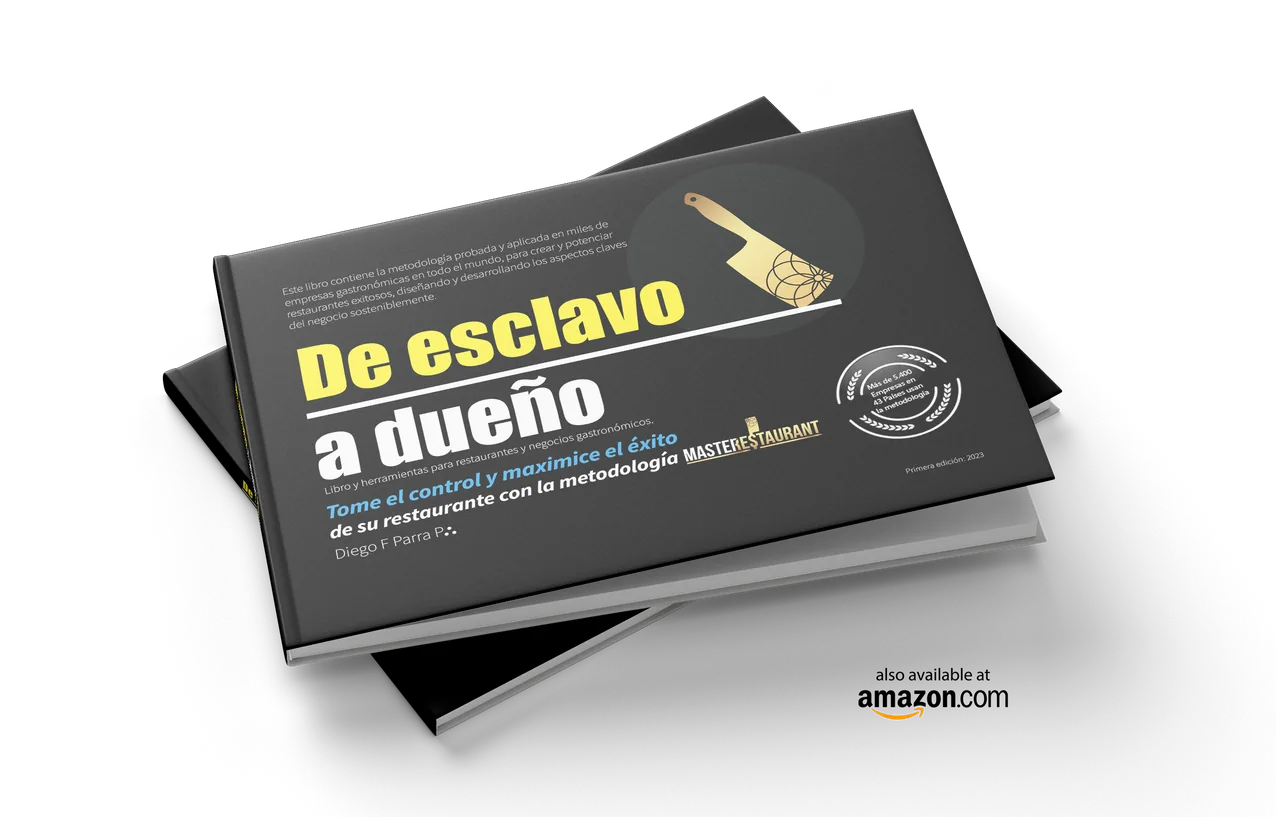
De Esclavo a Dueño
The book that changed how restaurants are managed: practical strategies and tools based on more than 20 years of experience, for traditional restaurants, dark kitchens, foodtech and HORECA businesses.
Triunfar o Morir en el Intento
Practical tools and key strategies to design and operate restaurants and food businesses efficiently.
Podcast: Masterestaurant — Mistakes for Restaurants
The public autopsy of the mistakes that bankrupt restaurants: thousands of owners and managers listen on Spotify to avoid repeating them.
Listen on SpotifyDownloads
The documents your board will ask for
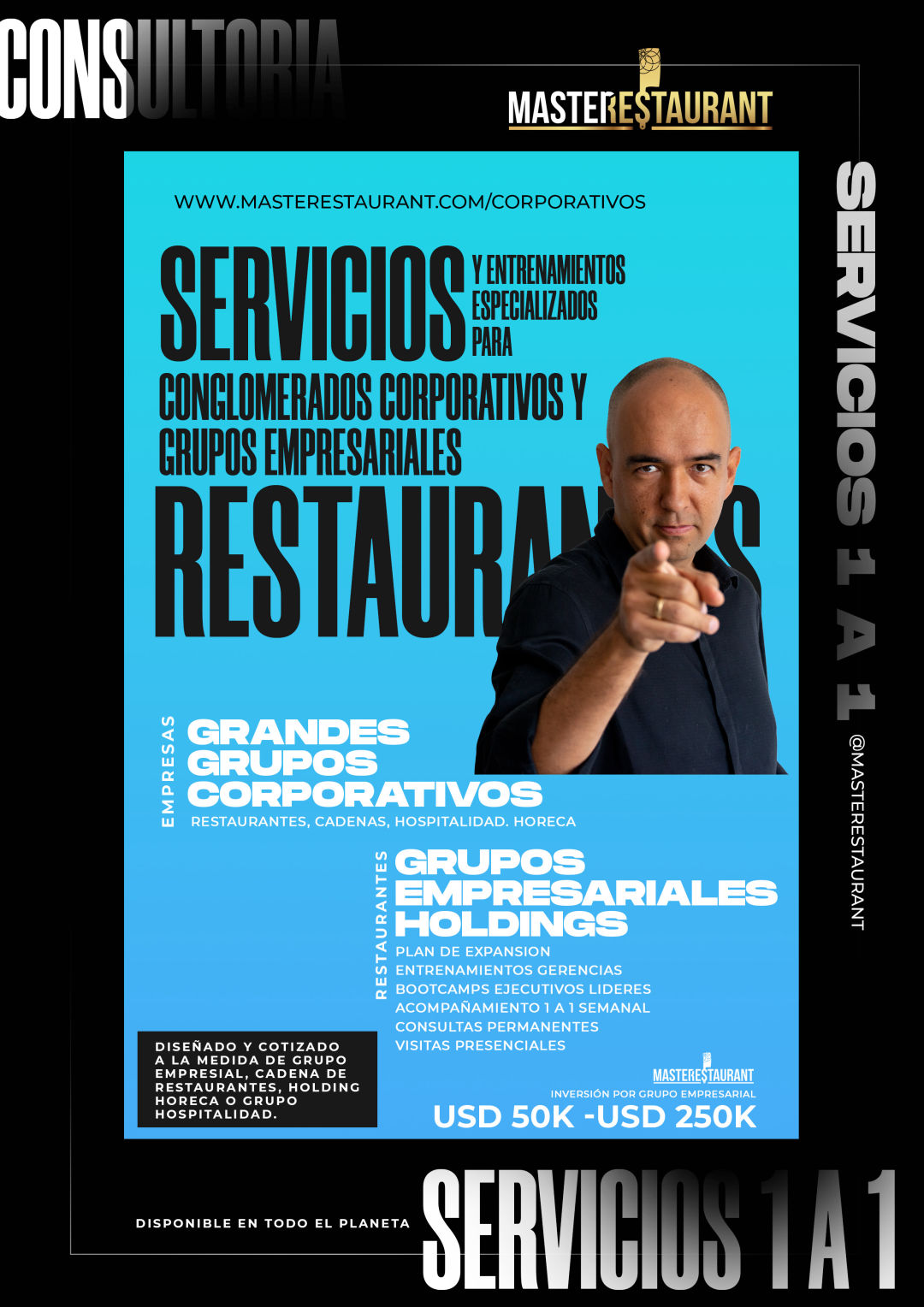
MASTERESTAURANT services portfolio
The complete corporate intervention catalog: consulting, executive bootcamps, advisory and specialized services, with scopes and formats. The document to decide with your board.
Download PDFBook: From Slave to Owner
The full doctrine behind the methodology: how to structure restaurants that run without depending on the owner. Ideal pre-reading before your group's diagnosis.
View on AmazonPortfolio
More services by Diego F Parra and his team
Is the restaurant only the beginning? Every service in the ecosystem starts from the same method and the same tools as this consulting: personalized mentoring for the owner, growth programs, the membership, training for the team and group consulting once the second or third site arrives. The full ecosystem is available:
International keynote speakerOne-on-one consulting and advisoryPersonalized mentoring for owners (limited spots)Corporate groups and holdings consultingCelebrity Restaurants consultingThemed restaurant advisorySpecialized training programs52-Week membershipPitch deck and restaurant investment readinessExponential Program0.1 Program — Elevate Your RestaurantInteractive training kit
From template to results
Want this working every day in your restaurant?
The tool gives you the template. The program gives you the method and the guidance to use it every week, with your team.
Direct contact
Get a quote for expert consulting for your group in San Ignacio
Your message goes straight to Diego's team: group or chain, number of sites, stage and what you need to achieve in San Ignacio.

“Margin doesn't appear from working harder. It appears when the business runs on system: when every decision—purchasing, portion, menu—is backed by a metric. I've seen restaurants that bill twice as much as others but earn half because costs aren't in control. The difference isn't talent or location: it's discipline.”
Diego F. Parra — International consultant, expert in creating, scaling and improving restaurants, HORECA and hospitality
MASTERESTAURANT® methodology applied by 8,400+ restaurants across 43 countries · Author of 3 ISBN-registered books, including «De esclavo a dueño» · 20+ years operating restaurants, franchises, dark kitchens and HORECA groups across 4 continents
Full profile →Start with the diagnosis, in San Ignacio
Tell us your revenue, how many sites you have and what worries you: you'll get a concrete proposal.
Explore more
Restaurant and hospitality consulting: territories, services and ecosystem resources
Related links for owners, partners and leadership teams evaluating expert restaurant and hospitality consulting for their food business: nearby territories, sister services in the MASTERESTAURANT ecosystem and management tools, all built on the same method and the same instruments.
World's best restaurant keynote speakerWorld's best restaurant consultantC-Suite restaurant consultant for chains & groupsDiego F Parra — professional profileKeynote speaker serviceCorporate groups & holdings consultingCelebrity restaurant consultingInternational themed restaurant advisoryExpert restaurant consultant in BelizeRestaurant consulting in Belize CityFood and beverage consulting in BelmopanRestaurant business consultant in San PedroRestaurant profitability consultant in AlajuelaRestaurant profitability consultant across Argentina
FAQ
Frequently asked questions
Do you offer restaurant management consulting in San Ignacio?
Yes. Restaurant management consulting in San Ignacio starts with a diagnosis built from the restaurant's real data (costs, waste, processes and team), then a work plan sequenced by what each change adds to the bottom line, built on that restaurant's volume, stage and market.
Who is a restaurant consultant in San Ignacio for owners who want a repeatable model?
Diego F. Parra, the restaurant consultant behind MASTERESTAURANT, works with owners in San Ignacio one on one: first a diagnosis from the operation's own data, then a plan ranked by margin impact, so the restaurant can run and grow without improvising.
If our Prime Cost is at 41% today and we need to hit 35%, how long before we see results?
Diagnosis takes a week; in that week we identify where money leaks—untracked waste, ingredient costs above market, inconsistent portions. First changes—purchasing adjustments, recipe standardization—operate the next shift. Prime Cost doesn't drop 6 points in a week, but decline becomes observable. Improvement depends on your implementation capacity, but comparable restaurants show significant advances after three months of engagement.
We run three small locations in San Ignacio, and each manager applies the method differently. How do we standardize without it feeling like we're centralizing everything?
Standardization isn't centralization—it's documenting what works so every manager replicates it. Standardized recipes, technical specs, documented cash-close and purchasing processes. Each location operates with autonomy inside clear rules. Engagement includes training leadership to understand the why and resolve exceptions without breaking structure. Three months coordinated and all three operate under the same system.
When is the right time to open the next site?
When the model survives repetition: written processes, standard recipes the team follows, Prime Cost defended and EBITDA per unit in plain sight. Opening before that multiplies the problem, not the turnover.
What is Prime Cost and why insist on it?
It is food and beverage cost plus labour cost. It is the figure that moves fastest and decides the most margin in a restaurant, and most operations know it a month late.
What is the difference between theoretical and actual cost?
Theoretical is what dishes should cost according to the technical sheet; actual is what they cost. The gap is waste, uncontrolled portioning or badly negotiated purchasing, and until it is measured it cannot be fixed.
Does this apply to a hotel or only to restaurants?
It applies to the food and beverage side of a hotel operation, with its own unit economics. If you run a full hotel group, the hospitality-groups service is the right one.
What if my problem is the team, not the numbers?
It is usually both. A team without written processes or indicators does not fail on attitude: it fails because nobody told it what its good work is measured against.
