 MASTERESTAURANT®
Inhabitants of the country on 1 January, growing population
RTBF
Concept consulting · Brussels

DIEGO F PARRA · CREATOR OF THE MASTERESTAURANT® METHODOLOGY
IMMERSIVE DINING CONSULTANT Who turns a strong concept in Brussels into a restaurant that also leaves a margin?
A themed restaurant in Brussels usually sinks for the same reason the last one did: the money went into ambiance before anyone checked that the model worked. Diego F. Parra reverses that order.
Download the portfolio (PDF)Limited advisory spots worldwide — reserve your evaluation early
8,400+restaurants apply his methodology
43countries with supported projects
65M+views per year
2service languages: EN · ES
International validation
See Diego F. Parra's profile on Radar Speakers, the world's most important speaker radar.
See profile on Radar Speakers →

@masterestaurant
The point where a strong concept in Brussels starts losing money
There is a moment in the life of every themed restaurant when the queue gets shorter and the margin becomes visible. If the business had been living off the opening until then, that moment gives no warning: it shows up in an ordinary month's till, with payroll and rent untouched and the average ticket slipping.
Working on the model before that point costs considerably less than rescuing it afterwards. 1-on-1 consulting, workshops and private advisory with the MASTERESTAURANT methodology and its TOOLKIT — 8,400+ restaurants across 43 countries — on costs, menu, operation and expansion.
How does themed restaurant consulting work in Brussels?
It reverses the usual order: first it checks that the concept's business model works in Brussels, then money goes into ambiance. The work starts with a strategic diagnosis and ends with a system built to repeat the experience.
Using the MASTERESTAURANT Restaurant Canvas, the concept and its business model are designed together. That covers value proposition, consumption moment, concept storytelling, menu engineering (which dish stays, which goes up in price and which comes off) and Prime Cost protected from the menu design onwards. Then the concept becomes a system: tech sheets, costing, processes, KPIs and an expansion plan for new locations, licenses or franchises. It serves new projects and themed restaurants already open, under confidentiality agreements, on site or virtually, in English or Spanish. As a starting point, this page gathers four verified reference figures from sources such as RTBF and Statbel.
What do the numbers say about the market for a themed restaurant in Brussels?
11.8 million — inhabitants of the country on 1 January, growing population, according to RTBF. Reference figures describe the setting a concept competes in; they do not say whether a themed experience will still leave a margin after opening.
For a themed restaurant, the data informs one concrete decision: how much can go into ambiance before the model stops working. Other reference points cited on this page: 4,260,108 (tourist overnight stays recorded in the month of June, Statbel); 9,821,275 (overnight stays recorded in the Walloon Region, Statbel); 46,113,837 (annual overnight stays, Belgian tourism breaks records again, Statbel). In Brussels, each figure is read alongside average check, menu engineering and Prime Cost before spending on decor, because novelty brings the first visit and margin decides whether there is a second one.
Data
Reference figures for a themed restaurant in Brussels
The figures cited on this page, with what each one measures and its source.
| Figure | What it measures | Source |
|---|---|---|
| 11.8 million | Inhabitants of the country on 1 January, growing population | RTBF |
| 4,260,108 | Tourist overnight stays recorded in the month of June | Statbel |
| 9,821,275 | Overnight stays recorded in the Walloon Region | Statbel |
| 46,113,837 | Annual overnight stays, Belgian tourism breaks records again | Statbel |
Each figure links to its source in the data cards on this page.
The local market
What to understand about the Brussels market before opening
A themed or experiential restaurant in Brussels faces a reality that investors often discover too late: decoration attracts visitors in the first months, but does not generate profitability or a sustainable model. It is common to see entrepreneurs invest EUR 500,000–2,000,000 in architecture, installations, and atmosphere, only to discover that incoherent experience, disorganized operations, a menu without financial engineering, and excessive fixed costs turn the investment into failure. The gap that MASTERESTAURANT fills is precisely that: converting the illusion of theming into a GASTRONOMIC ENTERPRISE where decoration, concept, and business model work as a single system. Without that strategic integration, the themed restaurant becomes an immobilized asset requiring permanent owner subsidy, not a business that generates cash flow.
Diego's consulting service transforms a themed idea into a PROFITABLE, scalable, and administrable ENTERPRISE. Starting from the MASTERESTAURANT methodology, applied by +8,400 establishments across 43 countries, it designs the complete business model: strategy and unique positioning in Brussels; differentiated concept and storytelling; clear value proposition for the diner; coherent customer journey from reservation to loyalty; consumption reasons and moments engineered; menu and pricing that generate margin; environment design and architectural review from the customer experience perspective, not just aesthetics; operations and process standardization; profitability indicators and control (Prime Cost, EBITDA); leadership and scalability. Every element aligns. The restaurant ceases to be a decorative adventure and becomes an administrable business machine.
Diego's global authority—100% hospitality specialist, not a generic consultant—radically reduces project risk in Brussels. He has advised restaurants in Paris, Barcelona, Madrid, Amsterdam, and other European cities with similar dynamics. Experience with +8,400 gastronomic operations across 43 countries allows him to anticipate what works and what fails in a competitive, multicultural, and seasonal market like Brussels. As the author of 3 ISBN-registered books ("From Slave to Owner") and a reference in SEO/AEO for hospitality with +65 million annual views, he represents verifiable proof of authority in restaurant business, not decorative design. That specialization is what differentiates this engagement from design agencies or generic consultants.
The concrete return for the entrepreneur or group is multidimensional. First: real differentiation in the competitive Brussels market, where experiential competition is high. Second: memorable experience that generates repeat visits, higher average check, and organic community (not just first-month curiosity). Third: operational control that reduces financial surprises and enables cash-flow forecasting. Fourth: a scalable model—new locations, licensing, franchising—because the business does not depend on the founder's intuition but on standardized processes. Fifth: greater brand value and attractiveness to future investors or buyers. Finally, FOUNDER INDEPENDENCE: the theme will not depend on him being on the floor operating every service, freeing his time and capital for growth.
Market data
Brussels in numbers: the themed restaurant market
Brussels as a destination
Why concepts work in Brussels
Brussels concentrates a gastronomic and entertainment ecosystem where an experiential concept has real traction. The city receives a significant annual flow of visitors (including corporate, families, and cultural tourism), many seeking more than traditional gastronomy: immersive experiences reflecting local culture, medieval and modern history, and European identity. Districts like Sint-Katelijne and zones near UNESCO heritage (Grand Place, Atomium) concentrate leisure and hospitality traffic. Hotels rated 3 to 5 stars (Brussels has international chains and boutiques) seek differentiated gastronomic partners for guests. Shopping centers in the region and leisure parks (such as Mini-Europa) also demand experiential concepts that justify family trips and stays. The Brussels public is sophisticated, multicultural, and accustomed to high-quality experiences, which opens opportunity for well-executed concept but closes doors to mediocrity.
The opportunity is real but risk is high and specific to the Brussels market. What tends to work: coherent experiences anchored in local historical or cultural narratives, with impeccable operations and service that justifies premium pricing. What fails: themes imported without local connection (a 'copied' theme from another city), expensive decorations that don't generate operational margin, incoherent menus or pricing that doesn't sustain fixed costs, experiences that become stale (theme exhausted after 6–12 months). The Brussels diner also expects coherence: if decoration promises luxury, service must be flawless; if it promises authenticity, it must deliver. Brussels seasonality (peak tourism April–October) requires models that generate cash also in low season with local audiences. Many themed concepts fail because they anticipate only peak tourism and do not build consumption reasons for local diners that sustain the business year-round.
RESOURCES
MASTERESTAURANT studies, guides & tools
Actionable resources for restaurant teams in Brussels — original studies, guides and tools, not theory:
- STUDYMulti-Location Pricing Consistency: Before vs After Masterestaurant
- DATAStandardize before scaling: the blind-opening mistake vs the 2026 figures of the right method
- CHECKLISTFranquiciar checklist
- PODCASTHow to calculate the minimum selling price | MR Podcast
- CONCEPTCustomer Loyalty in Restaurants: Myth vs Reality · Definition
- CHECKLISTOwner Leadership in Restaurants: Traditional Waiter
The themed consultant
The judgment behind this themed restaurant consulting
Diego F Parra is an engineer and C-Suite consultant, and his trade for the last twenty years has been walking into restaurants, franchises, dark kitchens and HORECA groups across four continents to create them, rescue them or expand them. Along the way he signed payrolls, negotiated leases, structured partnerships and closed expansions in operations worth hundreds of millions of dollars.
The MASTERESTAURANT® methodology came out of that, and is used today by 8,400+ restaurants across 43 countries, with its TOOLKIT: MTIE, Gastronomic Radar, Standard Recipe Generator, Tech Sheets and KPI Dashboard. For an owner that means every decision is made on his own numbers and on tested processes, not on a hunch from the last good weekend.
His published work backs it: Author of 3 ISBN-registered books, including «De esclavo a dueño», creator of the industry's leading podcast and of the largest bilingual community of owners, chefs and operations directors in the region (65M+ views per year as @masterestaurant), recognized among the top Latino restaurant operations experts globally. See Diego F Parra's professional profile.
Themed restaurant consulting with its own doctrine, not generic recipes
Themed restaurant consulting is not improvised. Every engagement is built on the Restaurant Model Canvas and real industry data — profitability, Prime Cost, cost structure, customer experience and expansion — applied to the specific business model of a themed restaurant. The goal is not a venue for the opening-night photo, but a food business that protects the concept, generates profit and can scale to new locations, licenses or franchises when the model is ready. That is why the work is organized on four fronts —diagnosis and business model; concept, menu and themed experience; structure, costs and operation; expansion, franchise and new locations— so the concept still holds up when it is no longer new.
Themed restaurant consulting from start to finish
Advisory that covers the full themed restaurant lifecycle
The diagnosis that orders everything else
Specialist diagnosis of the project and business model design with the Restaurant Canvas: value proposition, consumption moment and profitability.
Quote my diagnosisFrom concept to menu
Storytelling, menu engineering and immersive experience: the creative part, held up by costs that allow repeating it every day.
Quote the conceptCosts, structure and daily operation
Prime Cost, financial management, standardization and teams, so the restaurant works on method and not on the owner's presence.
Quote the operationScaling without diluting
Expansion, launches, franchise and partner and investor management: growing while keeping what made the concept work.
See the services portfolio (PDF)The methodology
Discover the MASTERESTAURANT methodology
What holds a concept up is a system, not a flash of inspiration: tools, processes and models you can audit.
Who is it for?
Who sits on the other side of this consulting
1-on-1 consulting, no templates, for restaurants in any of these situations:
Entrepreneurs and concept creators
Whoever creates the concept usually falls in love with it. The work is making sure it also earns once the opening stops being news.
Restaurant groups and chains
Add a concept to the portfolio with the investment protected by method, the rules between partners written and financial control in place.
Hotels and tourism developments
A restaurant that becomes a destination in its own right: story, menu and operation that keep the promise every day, not in the photo.
Brands, IP and franchises
A business that runs on system, with written standards and teams able to replicate the concept in each new location.
Investors and family offices
Entry into hospitality with the MASTERESTAURANT methodology behind it: a concept that is profitable, scalable and auditable.
What's included
The modules the engagement is assembled from
The scope is defined with you; these are the MASTERESTAURANT methodology modules available:
- Business model: the part that rarely comes with a good concept
- Strategic diagnosis of the project, the concept and its brand
- Concept and brand architecture of the themed restaurant
- Menu engineering and an experience design the customer pays for again
- Cost structure and Prime Cost within the range the business can hold
- Profitable standardization and concrete operational improvements
- The 10 key elements of the Restaurant Canvas, optimized
- Processes, teams and leadership with no dependence on the founder
- Growth strategy: own locations, licenses or franchise
- Partners and investors: clear rules to scale without diluting
- Executive bootcamps and leadership training
- 1-on-1 advisory with ongoing consultations and on-site visits
- Opening readiness that protects the concept's reputation
Investment: USD $35K – $250K · tailor-made, priced to each company · spots LIMITED worldwide to guarantee the best service.
Themed packages
Tailor-made themed restaurant consulting packages
Every themed restaurant engagement is 100% personalized and tailor-made to the project and the brand. After a strategic diagnosis, it works through the 10 key elements of the business model in the MASTERESTAURANT Restaurant Canvas — from value proposition and concept to profitability, standardization and expansion. Depending on the case, the package adds menu engineering, Prime Cost and cost structure, partner and investor management, executive bootcamps for the management team, ongoing consultations with visits to the venue and opening readiness. The quote starts from the concept, where the project stands and the numbers already on the table. Priced to each project's scope (USD $35K – $250K), with limited spots worldwide to ensure dedicated attention and discretion for each client.
Themed coverage
Territories neighbouring Brussels
Explore themed restaurant consulting in other territories, or go back to the worldwide index on the themed restaurants worldwide page:
Themed restaurant consultant in BelgiumThemed restaurants across BrazilThemed restaurants in AustraliaThemed restaurant consulting in IsraelThemed restaurant consulting in South AfricaConcept restaurants in AalborgThemed restaurants in AarhusThemed restaurant consulting in AlicanteThemed restaurant consulting across DenmarkConcept restaurants across FranceThemed dining expert across SpainThemed restaurant advisory across the United KingdomConcept restaurants in AmsterdamConcept restaurants in AustriaThemed restaurant consultant in BarcelonaThemed restaurant consultant in BerlinThemed restaurant consultant in BirminghamThemed dining expert in CannesConcept restaurants in CopenhagenThemed dining expert in CórdobaThemed restaurant consulting in DenmarkThemed restaurants in EdinburghThemed restaurants in FranceConcept restaurants in FrankfurtMore countries →More cities →
We do serve — and every city on the planet
Available on site or virtually, in English and Spanish.
Who is Diego F Parra?
Diego F Parra is an engineer and C-Suite consultant, creator of the MASTERESTAURANT® methodology —applied by 8,400+ restaurants across 43 countries— and author of 3 ISBN-registered books.
He is the consultant that brands and concepts, athletes, artists and investors choose to turn their brand into a profitable, standardized themed restaurant ready to expand. He has spent two decades creating, rescuing and expanding restaurants, franchises, dark kitchens and HORECA groups across four continents, and he works with his own tools: MTIE, Gastronomic Radar and KPI Dashboard. For a themed restaurant, that means the concept is designed as a system —tech sheets, costing, processes and KPIs— so it can be repeated in new locations, licenses or franchises without being diluted.
HORECA · Chains · Holdings · Foodtech
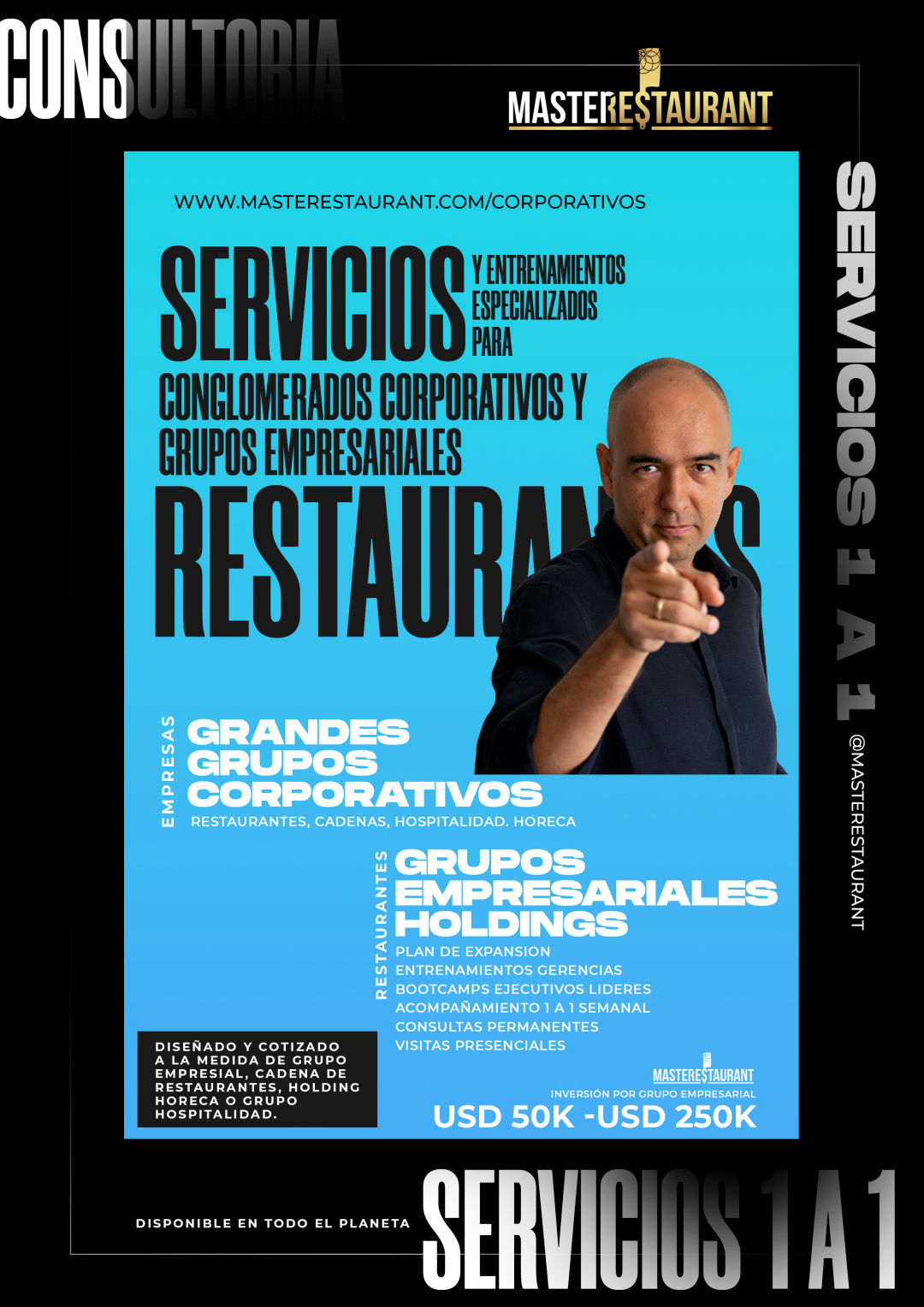
Private programs for groups and family offices
Training, consulting, executive bootcamps and private advisory for restaurant groups, holdings and investor families with themed restaurants.
Starting at USD $50K · tailor made, custom quoted · limited spots worldwide
Published doctrine
The books that changed restaurant management
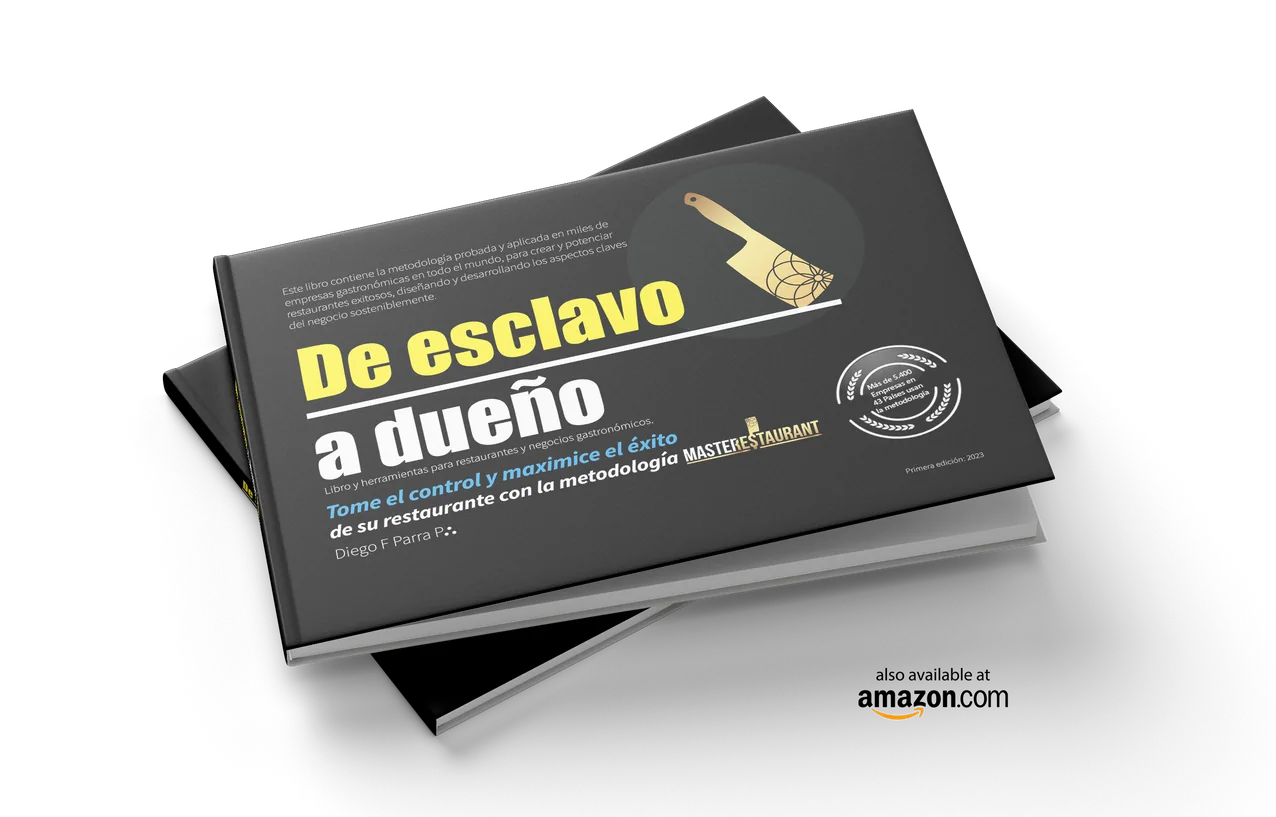
De Esclavo a Dueño
The book that changed how restaurants are managed: practical strategies and tools based on more than 20 years of experience, for traditional restaurants, dark kitchens, foodtech and HORECA businesses.
Triunfar o Morir en el Intento
Practical tools and key strategies to design and operate restaurants and food businesses efficiently.
Podcast: Masterestaurant — Mistakes for Restaurants
The public autopsy of the mistakes that bankrupt restaurants: thousands of owners and managers listen on Spotify to avoid repeating them. Condensed operating doctrine, free and direct.
Listen on SpotifyDownloads
The documents your management will ask for
MASTERESTAURANT® services portfolio
The complete intervention catalog: consulting, training, advisory and specialized services, with scopes and formats. The document to decide with your team.
Download PDFBook: From Slave to Owner
The full doctrine behind the methodology: how to structure a restaurant that runs without depending on the owner. Ideal pre-reading before your project's diagnosis.
View on AmazonPortfolio
More services by Diego F Parra and his team
Beyond themed restaurant consulting, Diego F Parra and his team offer keynotes, mentoring for owners, consulting for groups, training, programs, a membership and an interactive training kit. Everything starts from the same method and the same tools, so once the concept works, the dining-room team can train with that kit, partners can prepare the investment with the Pitch Deck service and the group can take the concept to new sites with the same criteria. The full ecosystem is available:
International keynote speakerOne-on-one consulting and advisoryPersonalized mentoring for owners (limited spots)Corporate groups and holdings consultingCelebrity Restaurants consultingThemed restaurant advisorySpecialized training programs52-Week membershipPitch deck and restaurant investment readinessExponential Program0.1 Program — Elevate Your RestaurantInteractive training kit
Direct contact
Get a quote for themed restaurant consulting for your project in Brussels
Your message goes straight to Diego's team: concept, project stage, city and what you need to achieve in Brussels.
“A themed restaurant in Brussels thrives or fails by its business model, not by how much you spend on decoration. I have seen entrepreneurs invest EUR 1.5M in spectacular atmosphere and close in 18 months because they did not dimension Prime Cost, did not understand local seasonality, and built experience without repeat-visit reasons. Theme is the vehicle; business is the engine. If that engine is poorly designed, the most beautiful decoration only delays the inevitable.”
Diego F. Parra — International consultant, expert in creating, scaling and improving restaurants, HORECA and hospitality
MASTERESTAURANT® methodology applied by 8,400+ restaurants across 43 countries · Author of 3 ISBN-registered books, including «De esclavo a dueño» · 20+ years operating restaurants, franchises, dark kitchens and HORECA groups across 4 continents
Full profile →Your themed restaurant in Brussels deserves a model worthy of the concept
Send the concept, its stage and your numbers for a tailored proposal.
Explore more
Themed restaurants: territories, services and ecosystem resources
Useful links for concept founders, restaurant groups, hotels, brands and investors weighing themed restaurant consulting before they decide. They cover nearby territories where the service is published, sister services in the MASTERESTAURANT ecosystem, Diego F Parra's professional profile and the management tools the methodology works with.
World's best restaurant keynote speakerWorld's best restaurant consultantC-Suite restaurant consultant for chains & groupsDiego F Parra — professional profileKeynote speaker serviceCorporate groups & holdings consultingCelebrity restaurant consultingInternational themed restaurant advisoryThemed restaurant consultant in BelgiumConcept restaurants in AalborgThemed restaurants in AarhusThemed restaurant consulting in AlicanteThemed restaurant consulting across DenmarkConcept restaurants across France
FAQ
Frequently asked questions
How do you ensure that the themed experience generates repeat visits and not just first-month curiosity?
Through engineering consumption reasons local to Brussels: we build why the Brussels customer returns (not just decoration). This includes customer journey, differentiated value proposition, and a menu balancing storytelling with quality gastronomy. The MASTERESTAURANT methodology integrates repeat-visit indicators from operational design. If return is not predictable, we know before investing in atmosphere.
Can the model scale to new Brussels locations or be franchised without losing coherence?
Yes. We design for replicability from inception: processes, operational standards, visual kit, and storytelling maintaining brand differentiation across multiple locations. MASTERESTAURANT methodology includes corporate governance and standardization. Third location is typically more profitable than the first because operations no longer depend on intuition but on verified systems.
How is a themed restaurant built from scratch?
With a strategic diagnosis of the project and the concept, and on top of it the business-model design: value proposition, menu, experience, costs and operation. Support through implementation and expansion follows.
What guarantees are there on confidentiality?
Confidentiality agreements from the start. The concept, the brand and the intellectual property are the client's, without exception. Limited spots worldwide are not marketing scarcity: they are the condition for giving each project real time.
How long are we talking about?
A phased process —diagnosis, model, implementation, operation and expansion—whose duration depends on the scope. Building a profitable themed restaurant is not an event with a closing date, it is a system being installed.
What investment range do you work with?
The 1-on-1 consulting runs from USD $35K to USD $250K, priced to the scope of each project and concept. Private programs for groups and chains are quoted independently.
Do you take restaurants that have been open for years?
Yes. In those cases the work enters through profitability and standardization, and ends in the growth plan: new locations or franchise of a concept that has already proven it draws people.
