DIEGO F PARRA · CREATOR OF THE MASTERESTAURANT® METHODOLOGY
THEMED RESTAURANT EXPERTWho turns a strong concept in Amsterdam into a restaurant that also leaves a margin?
Diego F. Parra. His work in Amsterdam starts where the moodboard ends: what each dish costs, what ticket the experience can hold, and what operation lets you repeat it on an ordinary Tuesday without you inside.
What a themed restaurant project in Amsterdam is looking for when it calls
The mistake that repeats in Amsterdam has a recognizable shape: the money goes first into ambiance, scenography and a long menu, and only when the novelty wears off does someone ask what each dish costs. By then the concept sits on a model that cannot hold a quiet Tuesday.
The right order is the opposite, and that is what gets worked on here: first the business model, then the experience that model can afford. 1-on-1 tailor-made consulting, workshops and private advisory with the MASTERESTAURANT methodology and its TOOLKIT, in use in 8,400+ restaurants across 43 countries.
How does themed restaurant consulting work in Amsterdam?
The work starts with the model, not the decor: a strategic diagnosis in Amsterdam shows where the project stands and where the money goes, then the business is designed to hold the concept once the novelty passes.
The goal is a concept that can be repeated without losing quality or margin. To get there, the engagement works on concept, brand and storytelling written for the dining room, menu engineering, Prime Cost, standardization you can audit, and processes and teams that run without the owner in the room. Once the model is proven, it sets the order of expansion into new locations, licenses or franchises. The work is confidential and runs on site or virtually, in English or Spanish. As a starting point, this page gathers four verified reference figures from sources such as CBS and NBTC Holland Marketing.
What do the numbers say about the market for a themed restaurant in Amsterdam?
> 3 % — Year-on-year turnover growth of the Dutch horeca sector in the fourth quarter, according to CBS. Reference figures describe the setting a concept competes in; they do not say whether a themed experience will still leave a margin after opening.
For a themed restaurant, the data informs one concrete decision: how much can go into ambiance before the model stops working. Other reference points cited on this page: nearly 7% (Year-on-year horeca turnover rise in the closing quarter of the year, CBS); 4 % (tourism sector's share of Dutch national income, NBTC Holland Marketing); 771,000 (people employed in the hospitality and tourism economy, NBTC Holland Marketing). In Amsterdam, each figure is read alongside average check, menu engineering and Prime Cost before spending on decor, because novelty brings the first visit and margin decides whether there is a second one.
Data
Reference figures for a themed restaurant in Amsterdam
The figures cited on this page, with what each one measures and its source.
Figure
What it measures
Source
4 %
Tourism sector's share of Dutch national income
NBTC Holland Marketing
> 3 %
Year-on-year turnover growth of the Dutch horeca sector in the fourth quarter
CBS - Centraal Bureau voor de Statistiek
nearly 7%
Year-on-year horeca turnover rise in the closing quarter of the year
CBS - Centraal Bureau voor de Statistiek
771,000
People employed in the hospitality and tourism economy
NBTC Holland Marketing
Each figure links to its source in the data cards on this page.
The local market
What to understand about the Amsterdam market before opening
A themed or experiential restaurant faces a fundamental trap: upfront investment concentrates on décor, architecture and ambiance—elements that capture interest in early months—but rarely deliver the sustainable profitability required from a hospitality business. The theme attracts, but theme is not the business; neglecting business model engineering, cost control, coherence between experience and operations, and alignment with local customer expectations, condemns capital to mediocrity or failure. Many entrepreneurs in competitive markets—with fierce competition in entertainment, massive tourism, and demanding diners—invest millions in visual concept but lack financial architecture, clear operating systems, or realistic expansion playbooks. Specialized consulting closes that gap: it transforms the themed idea into a profitable enterprise where experience and business model evolve together and décor serves strategy, not vice versa. Without that integrated lens, the themed restaurant becomes a short-cycle tourist attraction, not a business with repeat visits, solid check average and controlled operating margin.
This service delivers end-to-end transformation: from initial concept to organized, profitable, scalable hospitality enterprise. That means designing business model from scratch—Revenue Canvas, Prime Cost, realistic EBITDA and cash cycle—; defining differentiated concept and storytelling that resonates with the local audience (tourists, locals, corporate groups); mapping customer experience across every touchpoint (reservation, entry, ambiance, menu, service, departure); engineering the menu so gross margin, kitchen timing and thematic coherence converge; designing daily operations (staffing, standards, controls, KPIs) so the experience is replicable without individual heroism; structuring the financial model with realistic investment, payback and sensitivities; and building an expansion roadmap (new sites, licenses, franchising) that compounds value. The MASTERESTAURANT® methodology integrates strategy, customer journey, menu engineering, experience-driven ambiance design and corporate governance, tailored 100% to local reality, regulations, culture and seasonality. Result: a business where theme is a strategic asset, not a decorative layer.
Risk reduction in a project like this rests on accumulated authority: Diego F. Parra is an internationally recognized consultant 100% specialized in restaurants and hospitality—creator of the MASTERESTAURANT® methodology applied by 8,400+ restaurants and hospitality groups across 43 countries over two decades. He is the author of 3 ISBN-registered books and generates 65+ million annual views across hospitality education platforms. He has advised C-Suite teams of multinational chains, family offices, investment funds and entrepreneurs across Europe, Latin America, Asia and Middle East on concept development, operational transformation, financial modeling and internationalization of themed, experiential and immersive restaurants. That track record translates to proven methodology, specialized vendor networks, insight into what works and fails in high-competition volatile contexts, and capability to shield projects against strategic errors that compromise margin, experience and scalability. For an entrepreneur, group or investor, partnering with that authority means access to globally calibrated yet locally adapted mental frameworks, processes and questions.
Concrete returns from the engagement unfold across multiple vectors. First, authentic and defensible differentiation in a market where décor alone does not sustain competitive position; the business model, coherent storytelling and well-orchestrated experience create replication barriers. Second, higher repeat visits and check average through clear value proposition, defined reasons-to-visit and well-designed moments of truth. Third, better operational control and predictable margins through process standards, actionable KPIs (Prime Cost, EBITDA, DayPart analysis) and corporate governance. Fourth, a scalable business: when the model is sound, expansion (new locations, licensing models, franchising) generates compound value without brand destruction or margin leakage. Fifth, stronger brand equity and appeal to investors, banks and strategic partners because the business is transparent and manageable, not fragile. Sixth, founder independence: experience and operations do not depend on founder charisma or daily hustle, but on systems and protocols that endure.
Why Amsterdam is a destination for themed and concept restaurants
Amsterdam is a multi-layered tourism epicenter: 7+ million annual visitors, with peak seasons April–September and year-end spikes driven by historic heritage, museums, gastronomy and entertainment. The dining landscape spans distinct districts—historic city center neighborhoods (Grachtengordel, Jordaan) attracting sophisticated audiences, entertainment and nightlife zones, and peripheral areas serving family leisure demand. Premium hotels (NH Collection, Pulitzer, Waldorf Astoria) generate high-end dining demand; shopping centers funnel group footfall; and entertainment venues (cinemas, theaters, concert halls) create natural synergies with themed experiential dining. Dutch culture—pragmatic, cosmopolitan, innovation-open—facilitates experiential concepts, while historic heritage and canal environments provide natural stages for architectural, historical or atmospheric themes. Seasonality is pronounced: winter and rainy periods depress outdoor footfall and leisure tourism, demanding robust interior experience design. The market is competitive yet receptive to differentiation when concept is coherent, operations professional and value proposition clear.
A themed or immersive restaurant succeeds when the theme serves as gateway to genuine experience—quality food, coherent ambiance, aligned service, fair pricing—; it fails when décor masks mediocre gastronomy, uncontrolled operating costs or disconnect between concept and execution. Real risks include: saturation of outdated themes (generic vintage, retro) that lose appeal fast; incoherent experiences where décor contradicts menu, price or target audience; dependence on short-cycle tourism without building repeat local base; insufficiently trained staff unable to maintain standards; and fixed costs of architecture and décor unjustified by operating margin. The diner in this market—tourist or local, corporate or leisure—demands authenticity: immersive yet credible experience, competitive gastronomy with clear value, environment that amplifies the restaurant's narrative, not contradicts it. Opportunity lies in occupying specific niches: concepts tied to local history, well-executed family entertainment, immersive experiences targeting corporate diners or special groups, or décor as coherent brand ecosystem, not surface finish.
RESOURCES
MASTERESTAURANT studies, guides & tools
Actionable resources for restaurant teams in Amsterdam — original studies, guides and tools, not theory:
From the kitchen to the boardroom, in the same language
Few consultants move as easily through a kitchen on a full service as through a board meeting reviewing EBITDA per unit. Diego F Parra has spent two decades doing exactly that: engineer and C-Suite consultant who has created, rescued and expanded restaurants, franchises, dark kitchens and HORECA and hospitality groups across four continents, signing payrolls, negotiating leases and closing expansions in operations worth hundreds of millions of dollars.
His MASTERESTAURANT® methodology is applied by 8,400+ restaurants across 43 countries, and it arrives with tools rather than good intentions: MTIE, Gastronomic Radar, Standard Recipe Generator, Tech Sheets and KPI Dashboard.
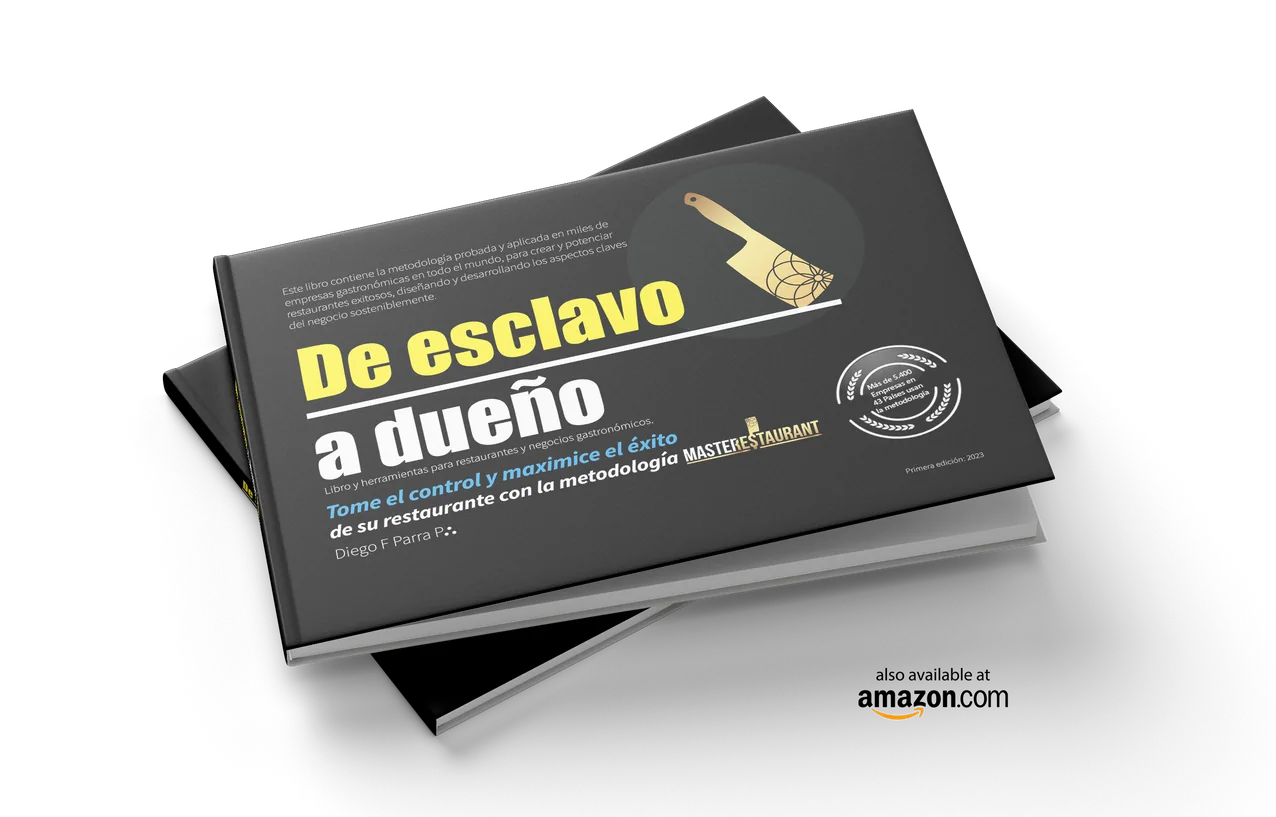
He is the author of 3 ISBN-registered books, including «De esclavo a dueño», creator of the industry's leading podcast and of the largest bilingual community of owners, chefs and operations directors in the region (65M+ views per year as @masterestaurant), and is recognized among the top Latino restaurant operations experts globally. The full track record is in Diego F Parra's professional profile.
Themed restaurant consulting with its own doctrine, not generic recipes
Themed restaurant consulting is not improvised. Every engagement is built on the Restaurant Model Canvas and real industry data — profitability, Prime Cost, cost structure, customer experience and expansion — applied to the specific business model of a themed restaurant. The goal is not a venue for the opening-night photo, but a food business that protects the concept, generates profit and can scale to new locations, licenses or franchises when the model is ready. That is why the work is organized on four fronts —diagnosis and business model; concept, menu and themed experience; structure, costs and operation; expansion, franchise and new locations— so the concept still holds up when it is no longer new.
A specialized, personalized 1-on-1 service for new and existing restaurants of:
Entrepreneurs and concept creators
Whoever creates the concept usually falls in love with it. The work is making sure it also earns once the opening stops being news.
Restaurant groups and chains
Add a concept to the portfolio with the investment protected by method, the rules between partners written and financial control in place.
Hotels and tourism developments
A restaurant that becomes a destination in its own right: story, menu and operation that keep the promise every day, not in the photo.
Brands, IP and franchises
A business that runs on system, with written standards and teams able to replicate the concept in each new location.
Investors and family offices
Entry into hospitality with the MASTERESTAURANT methodology behind it: a concept that is profitable, scalable and auditable.
What's included
The possible content of your engagement
No two engagements are alike: they are assembled from these MASTERESTAURANT methodology modules:
The business model that makes a good concept pay as well
Strategic diagnosis of the project, the concept and the brand
Brand architecture and the story of the themed restaurant
Menu engineering and an experience that repeats, not one that gets visited once
Costs and Prime Cost: the margin decided at design, not at month-end
An orderly operation and standardization that holds the margin
The 10 elements of the Restaurant Canvas, applied to your case
Processes, teams and leadership so the business doesn't depend on the founder
Expansion plan: new locations, licenses and franchise
Partners and investors managed without diluting the brand
Executive bootcamps and training for the leadership team
1-on-1 work, open consultations and on-site visits
Opening readiness, which is where reputation is decided
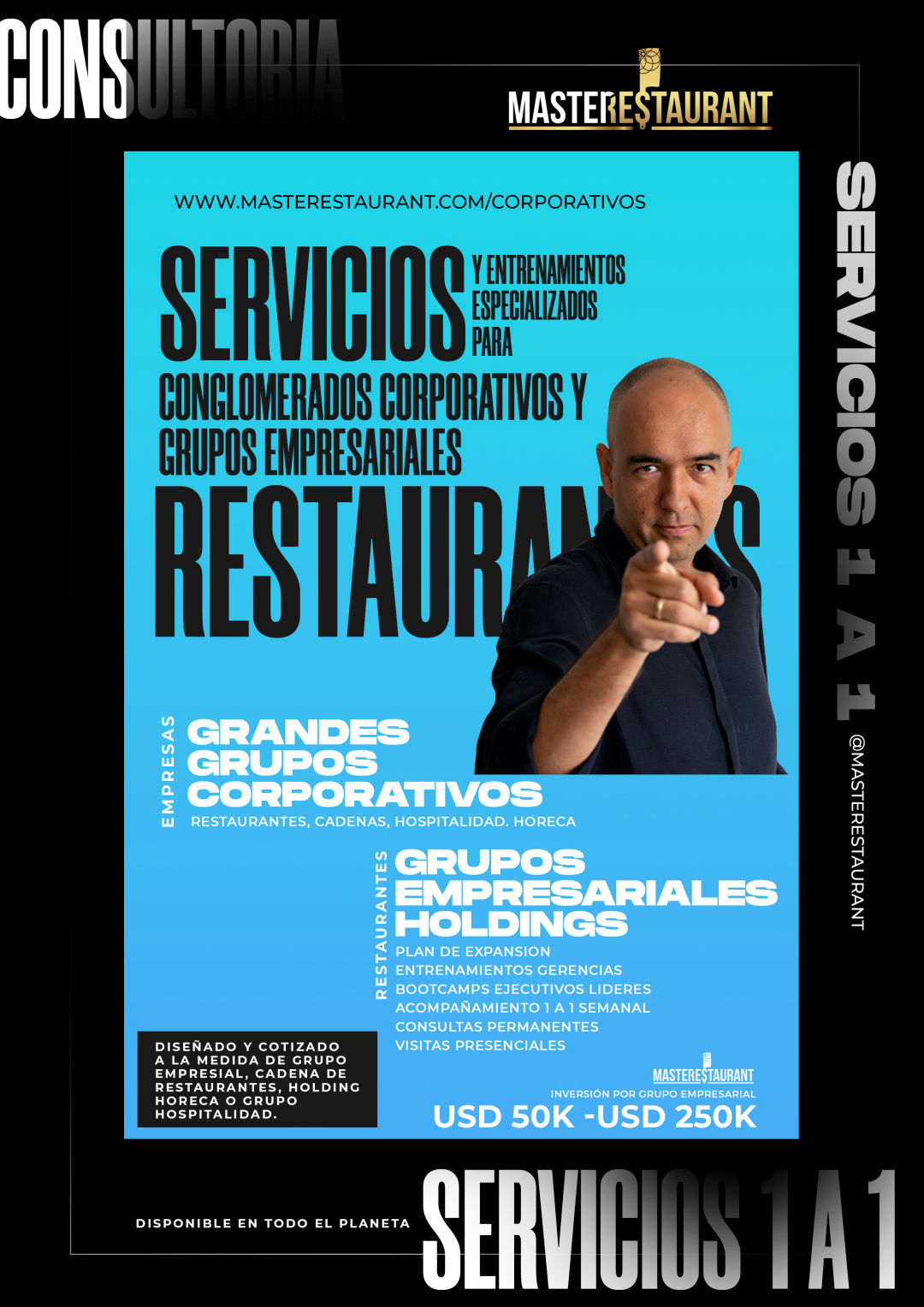
Investment: USD $35K – $250K · tailor-made, priced to each company · spots LIMITED worldwide to guarantee the best service.
Themed packages
Tailor-made themed restaurant consulting packages
Every themed restaurant engagement is 100% personalized and tailor-made to the project and the brand. After a strategic diagnosis, it works through the 10 key elements of the business model in the MASTERESTAURANT Restaurant Canvas — from value proposition and concept to profitability, standardization and expansion. Depending on the case, the package adds menu engineering, Prime Cost and cost structure, partner and investor management, executive bootcamps for the management team, ongoing consultations with visits to the venue and opening readiness. The quote starts from the concept, where the project stands and the numbers already on the table. Priced to each project's scope (USD $35K – $250K), with limited spots worldwide to ensure dedicated attention and discretion for each client.
Diego F Parra is an engineer and C-Suite consultant, creator of the MASTERESTAURANT® methodology —applied by 8,400+ restaurants across 43 countries— and author of 3 ISBN-registered books.
He is the consultant that brands and concepts, athletes, artists and investors choose to turn their brand into a profitable, standardized themed restaurant ready to expand. He has spent two decades creating, rescuing and expanding restaurants, franchises, dark kitchens and HORECA groups across four continents, and he works with his own tools: MTIE, Gastronomic Radar and KPI Dashboard. For a themed restaurant, that means the concept is designed as a system —tech sheets, costing, processes and KPIs— so it can be repeated in new locations, licenses or franchises without being diluted.
The book that changed how restaurants are managed: practical strategies and tools based on more than 20 years of experience, for traditional restaurants, dark kitchens, foodtech and HORECA businesses.
Triunfar o Morir en el Intento
Practical tools and key strategies to design and operate restaurants and food businesses efficiently.
Podcast: Masterestaurant — Mistakes for Restaurants
The public autopsy of the mistakes that bankrupt restaurants: thousands of owners and managers listen on Spotify to avoid repeating them. Condensed operating doctrine, free and direct.
The complete intervention catalog: consulting, training, advisory and specialized services, with scopes and formats. The document to decide with your team.
The full doctrine behind the methodology: how to structure a restaurant that runs without depending on the owner. Ideal pre-reading before your project's diagnosis.
Beyond themed restaurant consulting, Diego F Parra and his team offer keynotes, mentoring for owners, consulting for groups, training, programs, a membership and an interactive training kit. Everything starts from the same method and the same tools, so once the concept works, the dining-room team can train with that kit, partners can prepare the investment with the Pitch Deck service and the group can take the concept to new sites with the same criteria. The full ecosystem is available:
Get a quote for themed restaurant consulting for your project in Amsterdam
Your message goes straight to Diego's team: concept, project stage, city and what you need to achieve in Amsterdam.
“Themed restaurants that endure are businesses first, theme second. We have seen million-dollar decoration investments collapse in two years because they lacked robust business model, clear margin or reason for repeat visits. Theme is the hook that opens the door, but it is operational control, menu engineering and ordered scalability that determine whether customers return and whether the business generates real EBITDA.”
Diego F. Parra — International consultant, expert in creating, scaling and improving restaurants, HORECA and hospitality
MASTERESTAURANT® methodology applied by 8,400+ restaurants across 43 countries · Author of 3 ISBN-registered books, including «De esclavo a dueño» · 20+ years operating restaurants, franchises, dark kitchens and HORECA groups across 4 continents
Themed restaurants: territories, services and ecosystem resources
Useful links for concept founders, restaurant groups, hotels, brands and investors weighing themed restaurant consulting before they decide. They cover nearby territories where the service is published, sister services in the MASTERESTAURANT ecosystem, Diego F Parra's professional profile and the management tools the methodology works with.
How do we ensure theme is not just a decoration cost with no profit return? What is the balance between memorable experience and real operating margins?
Theme integrates into the business model from design, not as isolated décor. We define which themed elements drive purchase and repeat decisions (reasons-to-visit), how concept justifies price premium and enables competitive gross margin, and which DayParts and seasons generate themed experience traction. The Restaurant Canvas maps each component: ambiance reinforcing storytelling, menu embodying theme with clear profitability, staffing maintaining narrative without overhead burden, and pricing reflecting perceived value. Result: theme becomes a financial asset, not decorative expense.
If I successfully open a themed restaurant in Europe, what is the expansion roadmap to other European cities without losing local identity or destroying margins?
Engagement designs the expansion architecture from day one: defining which theme elements are non-negotiable (core identity) and which adapt to each market (local gastronomy, regulations, service style). We structure licensing or franchising models with clear operational playbooks, minimum capital required, governance and royalties. MASTERESTAURANT® methodology includes proven expansion playbooks across 43 countries. Each new site replicates the proven model, not improvise, ensuring brand replicability without destruction or margin leakage.
How does the tailor-made 1-on-1 consulting for themed restaurants work?
It starts with a strategic diagnosis of the project and the concept. Based on it, the themed restaurant's business model is designed —concept, value proposition, menu, experience, costs and operation—and implementation and expansion are supported.
Is the confidentiality of the concept and intellectual property protected?
Yes. The whole process operates under confidentiality agreements (NDA). The concept, brand and intellectual property of the project are and remain the client's. Limited spots worldwide exist to guarantee dedication and focus on each project.
How long does it take and what are the phases?
It depends on scope: diagnosis, business-model design, implementation and support during operation and expansion. Building a profitable themed restaurant is a process with method, not an event.
What is the investment?
The 1-on-1 consulting ranges from USD $35K to USD $250K and is priced to the scope of each project and concept. Private programs for restaurant groups and chains are quoted separately.
Do you serve new projects and themed restaurants already operating?
Both: creation from scratch —concept, business model and opening—and growth of existing themed restaurants seeking to improve profitability, standardize operations and scale the concept to new locations or franchise.
Community
Join our MASTERESTAURANT Community for FREE
Restaurant owners and teams from 43 countries sharing knowledge, tools and applied AI — straight to your WhatsApp.
 MASTERESTAURANT®