 MASTERESTAURANT®
Population of Kawasaki City in 2025, an all-time record high, driven by growth in single-person households
Kawasaki City Government
Concept Restaurants · Kawasaki

DIEGO F PARRA · CREATOR OF THE MASTERESTAURANT® METHODOLOGY
EXPERIENTIAL DINING EXPERT Who do owners in Kawasaki call when the themed restaurant fills up and still makes no money?
Diego F. Parra. His work in Kawasaki starts where the moodboard ends: what each dish costs, what ticket the experience can hold, and what operation lets you repeat it on an ordinary Tuesday without you inside.
Download the portfolio (PDF)Limited advisory spots worldwide — reserve your evaluation early
8,400+restaurants apply his methodology
43countries with supported projects
65M+views per year
2service languages: EN · ES
International validation
See Diego F. Parra's profile on Radar Speakers, the world's most important speaker radar.
See profile on Radar Speakers →
more than 1.53 million inhabitants
70%
57.4%
36,869,900 visitors

@masterestaurant
Why owners in Kawasaki ask for help after opening, not before
Most themed projects in Kawasaki arrive with the venue built and the money spent. It isn't recklessness: a concept is validated by the public and the numbers are validated by time, and by the time the second reading lands, the first has already used up the budget that would have paid for the fix.
It can still be fixed, and it gets fixed with method: cost diagnosis, menu redesign, standardization of the operation and a growth plan that doesn't depend on novelty. MASTERESTAURANT methodology and its TOOLKIT, applied in 8,400+ restaurants across 43 countries.
How does themed restaurant consulting work in Kawasaki?
The work starts with the model, not the decor: a strategic diagnosis in Kawasaki shows where the project stands and where the money goes, then the business is designed to hold the concept once the novelty passes.
The goal is a concept that can be repeated without losing quality or margin. To get there, the engagement works on concept, brand and storytelling written for the dining room, menu engineering, Prime Cost, standardization you can audit, and processes and teams that run without the owner in the room. Once the model is proven, it sets the order of expansion into new locations, licenses or franchises. The work is confidential and runs on site or virtually, in English or Spanish. As a starting point, this page gathers four verified reference figures from sources such as Kawasaki City Government and Japan Tourism Agency.
What do the numbers say about the market for a themed restaurant in Kawasaki?
more than 1.53 million inhabitants — population of Kawasaki City in 2025, an all-time record high, driven by growth in single-person households, according to Kawasaki City Government.
Reference figures describe the setting a concept competes in; they do not say whether a themed experience will still leave a margin after opening. For a themed restaurant, the data informs one concrete decision: how much can go into ambiance before the model stops working. Other reference points cited on this page: 57.4% (accommodation room occupancy rate in 2023, Japan Tourism Agency); 36,869,900 visitors (international visitors to Japan in 2024, a then-record high, +47.1% year-on-year, Japan National Tourism Organization); 70% (Prime-cost overspend in 70% of restaurants, Masterestaurant). In Kawasaki, each figure is read alongside average check, menu engineering and Prime Cost before spending on decor, because novelty brings the first visit and margin decides whether there is a second one.
Data
Reference figures for a themed restaurant in Kawasaki
The figures cited on this page, with what each one measures and its source.
| Figure | What it measures | Source |
|---|---|---|
| more than 1.53 million inhabitants | Population of Kawasaki City in 2025, an all-time record high, driven by growth in single-person households | Kawasaki City Government |
| 70% | Prime-cost overspend in 70% of restaurants | Masterestaurant - Indice de Prime Cost 2026 |
| 57.4% | Accommodation room occupancy rate in 2023 | Japan Tourism Agency (MLIT) |
| 36,869,900 visitors | International visitors to Japan in 2024, a then-record high, +47.1% year-on-year | Japan National Tourism Organization (JNTO) |
Each figure links to its source in the data cards on this page.
The local market
Kawasaki: the market context your project must master
A themed or immersive restaurant requires profitability beyond decoration. In Kawasaki, where operational costs and competition in entertainment are high, initial investment in architecture, design, and storytelling can reach significant figures—but without a solid business model, that investment dissolves into excessive operational costs, low repeat visits, and founder dependency in daily operations. The real gap: most entrepreneurs and restaurant groups confuse customer experience with business profitability. A themed concept attracts in the first months, but converting that initial interest into repeat customers, sustainable average check, and viable operating margins requires strategic decisions about customer journey, menu engineering, process standardization, and financial modeling that are rarely made before investing. This service specializes precisely in that gap: building the business that sustains the experience.
The service transforms a themed concept into an organized, profitable, and scalable gastronomy enterprise through the MASTERESTAURANT methodology and Restaurant Model Canvas tailored to the local market. It is integral alignment: definition of the differentiating concept and storytelling with verifiable value arguments; coherent customer journey that generates genuine consumption reasons; experience and environment design grounded in profitability rather than budget fantasy; menu engineering for controlled Prime Cost and optimized average check; standardized operations that work without relying on exceptional talent; realistic financial modeling with profitability indicators (EBITDA, return on investment, sustainability); and clear expansion strategy for new locations, licenses, or franchises. In Kawasaki, where the market is sophisticated and repeat visits are measurable, this customized engagement positions the restaurant as an operational reference point, not merely an attractive experience.
The authority of Diego F. Parra—a consultant specialized 100% in hospitality and restaurants, creator of the MASTERESTAURANT methodology applied by more than 8,400 restaurants in 43 countries, top-5 author on Amazon in the gastronomy business category, and with a digital community reaching over 65 million annual views—significantly reduces project risk. His consulting is grounded in operational evidence from thousands of real cases: which differentiators survive the market, how to operationalize an experience, when to scale and when to consolidate. In the context of an experiential restaurant in Kawasaki, this global expertise and systematic approach avoids costly mistakes—such as themes that age quickly, unsustainable menu architectures, or operational processes that cannot handle expansion—and accelerates positioning as a market leader in the local context.
The concrete return from the engagement is multiple and measurable: genuine differentiation versus local themed competition; memorable experience that generates effective repeat visits and superior average check; operational control that reduces costs without sacrificing experience; a business that can grow via new locations, licenses, or franchises without founder dependency in day-to-day operations; a brand with intrinsic value and demonstrated appeal to investors; and—most importantly—independence from the theme itself: the business works because it is well-built, not because the owner is running daily operations. For hotel groups, real estate developers, or family offices with portfolios in Kawasaki, this means access to a proven methodology at global scale, applied locally, that converts a concept into a profitable and transferable asset.
Market data
What the numbers from Kawasaki say
Prime-cost overspend in 70% of restaurants
Masterestaurant - Prime Cost Index 2026Accommodation room occupancy rate in 2023
Japan Tourism Agency (MLIT)International visitors to Japan in 2024, a then-record high, +47.1% year-on-year
Japan National Tourism Organization (JNTO)Kawasaki as a destination
Why concepts work in Kawasaki
Kawasaki's gastronomy and entertainment ecosystem—located in the Kanto region between Tokyo and Yokohama—sustains experiential and immersive concepts with a dense working population base, constant tourism flow from the metropolitan region, and established commercial districts with consumer traffic (Lazona Kawasaki, Paseo Kawasaki, revitalized port zones). The local audience values quality experience but is also critical: they have consumed imported concepts, global trends, and sophisticated entertainment. Seasonality in Japan—school vacation periods (Obon, New Year), corporate employee transitions, local festivals, and tourist flow to major destinations—creates predictable demand windows. A themed or immersive restaurant in Kawasaki has guaranteed access to three segments: local residents seeking entertainment, tourists in transit between metropolitan centers, and corporate groups from nearby office zones, but only if the proposition is coherent and the experience justifies the price.
Opportunities for an experiential concept in Kawasaki are real: a sophisticated market, access to specialized suppliers, proximity to Tokyo for sourcing, and consumers willing to pay for differentiated experience. However, operational risks are equally high. Regular failures include: themes that age quickly (outdated trends, concepts without narrative depth); experiential incoherence (beautiful decoration but incongruent service, menu misaligned with the theme, pricing that fails to justify the experience); excessive operational costs (complex space architecture generating maintenance overhead, staff requiring exhaustive training, themed inputs that are expensive and difficult to restock); and financial models that do not scale (experiences dependent on unique talent, operations that cannot replicate across a second location, margins that cannot withstand vacancies or low seasons). The Kawasaki consumer expects coherence: that experience, service, gastronomy, and environment work as a system, not as loose decorative elements.
RESOURCES
MASTERESTAURANT studies, guides & tools
Before your next move in Kawasaki, these MASTERESTAURANT resources give real operating and profitability context:
- CASE STUDYInconsistency between locations: real case of a 6-site group, before and after
- CHECKLISTFranchising Mistakes vs the Right Masterestaurant Method (2026)
- LISTServer Training in Restaurants: Myth vs Reality 2026 · List
- GUIDEPurchasing & Suppliers: Before vs After
- LIST7 restaurant membership and subscription mistakes
- CASE STUDYCustomer Loyalty in Restaurants: Myth vs Reality · Case study
The themed consultant
The authority behind every profitable restaurant
Behind MASTERESTAURANT's themed restaurant consulting is Diego F Parra: engineer and C-Suite consultant with two decades creating, rescuing and expanding restaurants, franchises, dark kitchens and HORECA and hospitality groups across four continents. He doesn't arrive with theory: he arrives with the experience of having signed payrolls, negotiated leases, structured partnerships and closed expansions in operations worth hundreds of millions of dollars.
He is the creator of the MASTERESTAURANT® methodology — applied by 8,400+ restaurants across 43 countries — and its TOOLKIT of tools (MTIE, Gastronomic Radar, Standard Recipe Generator, Tech Sheets and KPI Dashboard). For a brand, a group or an investor that means one thing: every decision is made on proven data and systems, not on intuition.
Author of 3 ISBN-registered books, including «De esclavo a dueño», creator of the industry's leading podcast and of the largest bilingual community of owners, chefs and operations directors in the region (65M+ views per year as @masterestaurant), and recognized among the top Latino restaurant operations experts globally. See his full track record in Diego F Parra's professional profile.
Themed restaurant consulting with its own doctrine, not generic recipes
Themed restaurant consulting is not improvised. Every engagement is built on the Restaurant Model Canvas and real industry data — profitability, Prime Cost, cost structure, customer experience and expansion — applied to the specific business model of a themed restaurant. The goal is not a venue for the opening-night photo, but a food business that protects the concept, generates profit and can scale to new locations, licenses or franchises when the model is ready. That is why the work is organized on four fronts —diagnosis and business model; concept, menu and themed experience; structure, costs and operation; expansion, franchise and new locations— so the concept still holds up when it is no longer new.
Themed restaurant consulting from start to finish
Advisory that covers the full themed restaurant lifecycle
Diagnosis and business model
Specialist diagnosis of the project and model design with the Restaurant Canvas: value proposition, consumption moment and profitability structure.
Quote my diagnosisConcept, menu and themed experience
From the storytelling of the concept to menu engineering and the design of the immersive experience customers pay to repeat.
Quote the conceptStructure, costs and operation
Prime Cost, financial management, standardization and teams: the restaurant runs on method and system, not on improvisation.
Quote the operationExpansion, franchise and new locations
Expansion challenges, launches, franchise and partner and investor management to scale the concept without diluting it.
See the services portfolio (PDF)The methodology
Discover the MASTERESTAURANT methodology
What holds a concept up is a system, not a flash of inspiration: tools, processes and models you can audit.
Who is it for?
The projects that fit this engagement
A specialized, personalized 1-on-1 service for new and existing restaurants of:
Entrepreneurs and concept creators
You already have the idea; what is missing is the model that holds it up once the novelty wears off. Concept, brand and numbers on the same plane.
Restaurant groups and chains
Adding a concept to the portfolio without improvising: method to protect the investment, clear rules between partners and financial control from day one.
Hotels and tourism developments
The restaurant stops being a hotel service and becomes a destination, with storytelling, menu and an operation that hold up every day.
Brands, IP and franchises
Taking a brand to the table demands standardization and trained teams; without them, every location tells a different story.
Investors and family offices
Entering hospitality with the learning curve already paid by someone else: a profitable, scalable concept with a methodology behind it.
What's included
The modules the engagement is assembled from
Every engagement is built tailor-made from these modules of the MASTERESTAURANT methodology:
- Business model with numbers, not just with concept
- Strategic diagnosis of the project, the brand and the stage
- Concept, brand and story of the themed restaurant
- Menu engineering and an experience that justifies the ticket
- Prime Cost and cost structure decided at design stage
- Operational improvements and standardization that hold the margin
- The 10 key elements of the Restaurant Canvas
- Processes, teams and leadership with the founder out of daily operations
- Expansion strategy: locations, licenses and franchise
- Partner and investor management to grow without diluting the brand
- Executive bootcamps and training for the leadership team
- 1-on-1 advisory, ongoing consultations and on-site visits
- Opening readiness that protects the concept's reputation
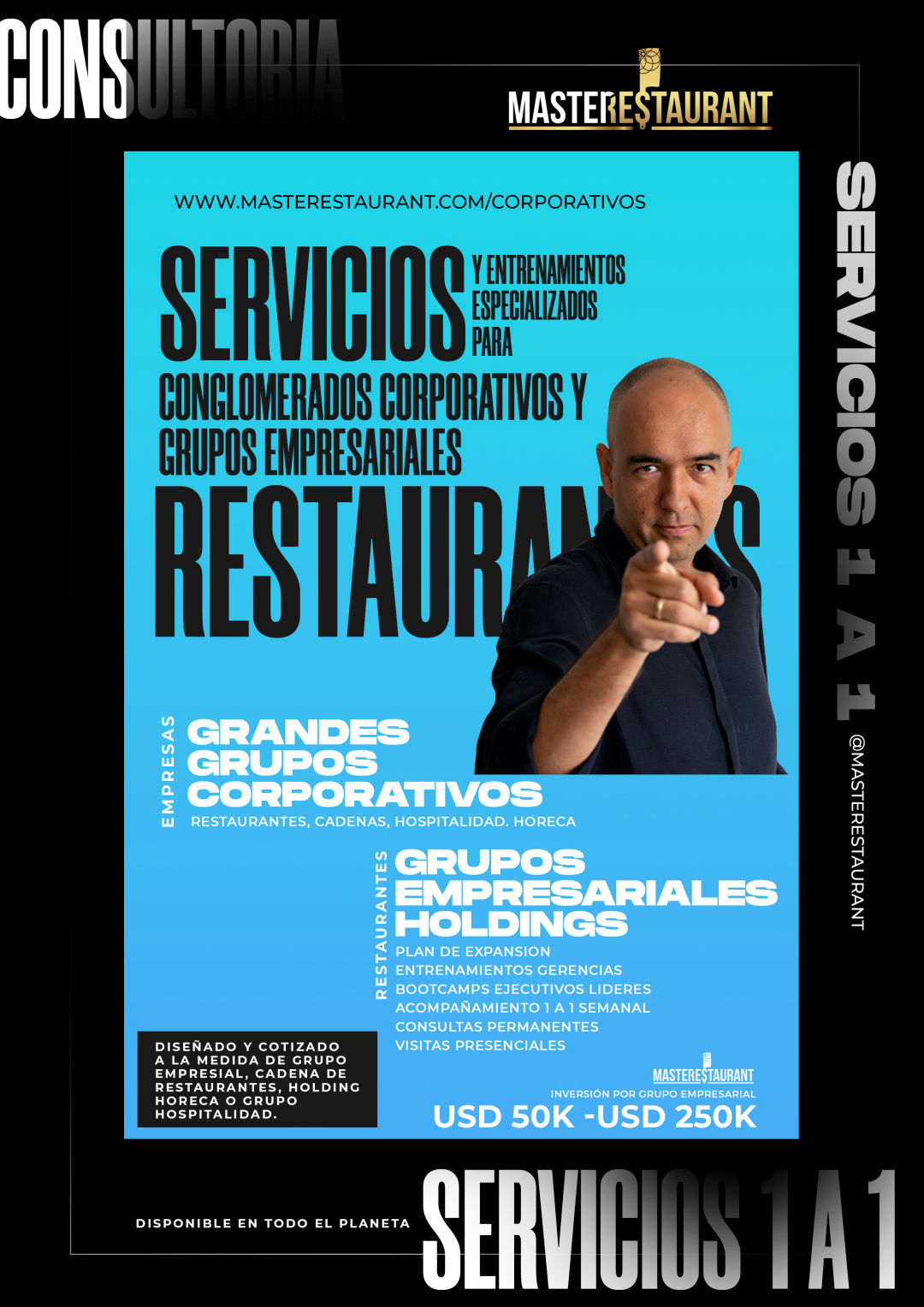
Investment: USD $35K – $250K · tailor-made, priced to each company · spots LIMITED worldwide to guarantee the best service.
Themed packages
Tailor-made themed restaurant consulting packages
Every themed restaurant engagement is 100% personalized and tailor-made to the project and the brand. After a strategic diagnosis, it works through the 10 key elements of the business model in the MASTERESTAURANT Restaurant Canvas — from value proposition and concept to profitability, standardization and expansion. Depending on the case, the package adds menu engineering, Prime Cost and cost structure, partner and investor management, executive bootcamps for the management team, ongoing consultations with visits to the venue and opening readiness. The quote starts from the concept, where the project stands and the numbers already on the table. Priced to each project's scope (USD $35K – $250K), with limited spots worldwide to ensure dedicated attention and discretion for each client.
Themed coverage
Where else Diego F Parra works, near Kawasaki
Explore themed restaurant consulting in other territories, or go back to the worldwide index on the themed restaurants worldwide page:
Themed restaurants across JapanThemed restaurant consultant in JapanThemed dining expert in KyotoConcept restaurants in OsakaThemed restaurant consulting in TokyoThemed dining expert in YokohamaThemed restaurants across BrazilConcept restaurants in AustriaThemed restaurant consulting in IsraelThemed restaurant consulting in South AfricaThemed restaurant consulting in AjmanThemed restaurant consulting in Al AinThemed restaurants across QatarThemed restaurant consultant across Saudi ArabiaThemed dining expert across the United Arab EmiratesThemed restaurants in AustraliaThemed dining expert in BangkokThemed restaurant consultant in BeijingThemed restaurant consultant in ChinaThemed restaurant advisory in DammamThemed dining expert in Hong KongThemed restaurant consulting in IndiaThemed dining expert in IndonesiaThemed restaurant advisory in JakartaMore countries →More cities →
We do serve — and every city on the planet
Available on site or virtually, in English and Spanish.
Who is Diego F Parra?
Diego F Parra is an engineer and C-Suite consultant, creator of the MASTERESTAURANT® methodology —applied by 8,400+ restaurants across 43 countries— and author of 3 ISBN-registered books.
He is the consultant that brands and concepts, athletes, artists and investors choose to turn their brand into a profitable, standardized themed restaurant ready to expand. He has spent two decades creating, rescuing and expanding restaurants, franchises, dark kitchens and HORECA groups across four continents, and he works with his own tools: MTIE, Gastronomic Radar and KPI Dashboard. For a themed restaurant, that means the concept is designed as a system —tech sheets, costing, processes and KPIs— so it can be repeated in new locations, licenses or franchises without being diluted.
HORECA · Chains · Holdings · Foodtech
Private programs for groups and family offices
Training, consulting, executive bootcamps and private advisory for restaurant groups, holdings and investor families with themed restaurants.
Starting at USD $50K · tailor made, custom quoted · limited spots worldwide
Published doctrine
The books that changed restaurant management
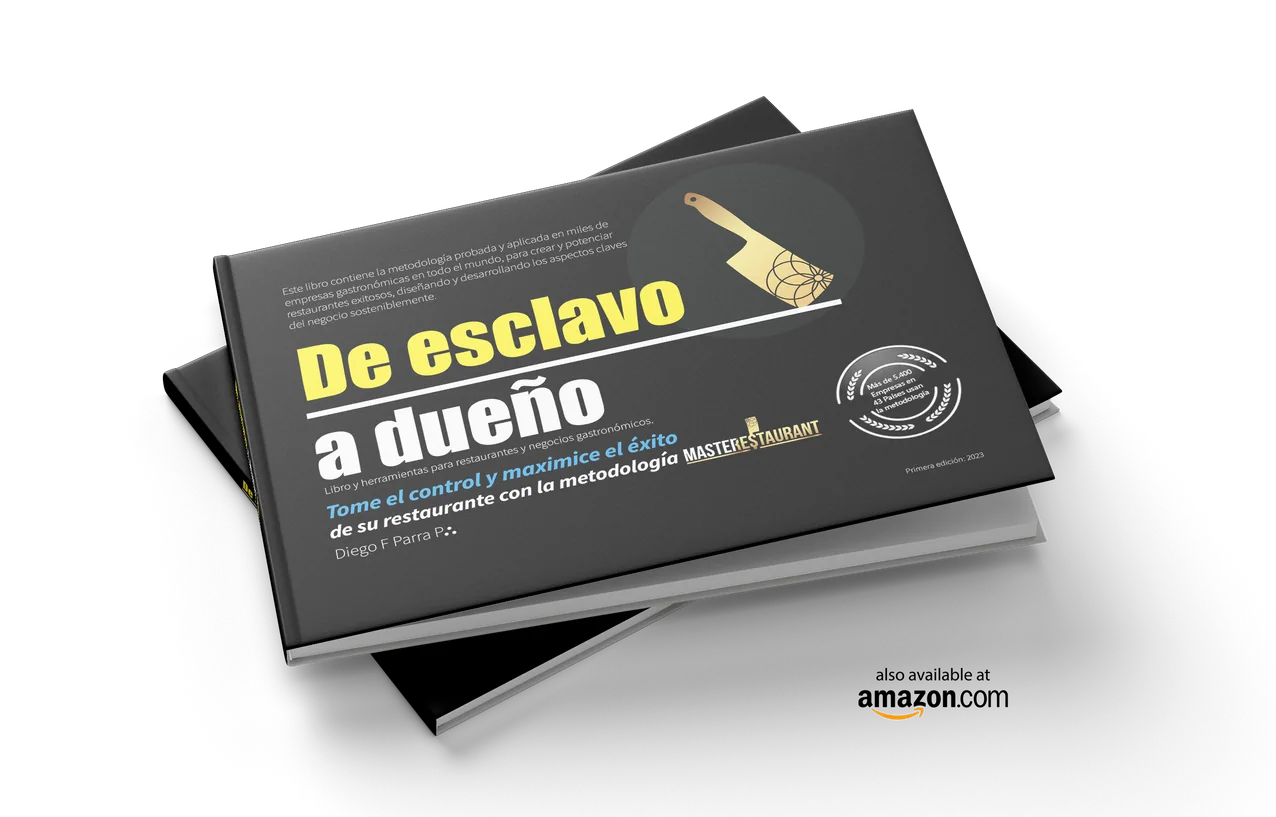
De Esclavo a Dueño
The book that changed how restaurants are managed: practical strategies and tools based on more than 20 years of experience, for traditional restaurants, dark kitchens, foodtech and HORECA businesses.
Triunfar o Morir en el Intento
Practical tools and key strategies to design and operate restaurants and food businesses efficiently.
Podcast: Masterestaurant — Mistakes for Restaurants
The public autopsy of the mistakes that bankrupt restaurants: thousands of owners and managers listen on Spotify to avoid repeating them. Condensed operating doctrine, free and direct.
Listen on SpotifyDownloads
The documents your management will ask for
MASTERESTAURANT® services portfolio
The complete intervention catalog: consulting, training, advisory and specialized services, with scopes and formats. The document to decide with your team.
Download PDFBook: From Slave to Owner
The full doctrine behind the methodology: how to structure a restaurant that runs without depending on the owner. Ideal pre-reading before your project's diagnosis.
View on AmazonPortfolio
More services by Diego F Parra and his team
Beyond themed restaurant consulting, Diego F Parra and his team offer keynotes, mentoring for owners, consulting for groups, training, programs, a membership and an interactive training kit. Everything starts from the same method and the same tools, so once the concept works, the dining-room team can train with that kit, partners can prepare the investment with the Pitch Deck service and the group can take the concept to new sites with the same criteria. The full ecosystem is available:
International keynote speakerOne-on-one consulting and advisoryPersonalized mentoring for owners (limited spots)Corporate groups and holdings consultingCelebrity Restaurants consultingThemed restaurant advisorySpecialized training programs52-Week membershipPitch deck and restaurant investment readinessExponential Program0.1 Program — Elevate Your RestaurantInteractive training kit
Direct contact
Get a quote for themed restaurant consulting for your project in Kawasaki
Your message goes straight to Diego's team: concept, project stage, city and what you need to achieve in Kawasaki.
“A themed restaurant fails when you invest millions in decoration and neglect the business model that sustains it. The theme is not the business; it is the set design of a business that needs to be well-built. I have seen in 43 countries what works: coherent concept, consistent experience, disciplined operations, margins that let you sleep. That is what we deliver.”
Diego F. Parra — International consultant, expert in creating, scaling and improving restaurants, HORECA and hospitality
MASTERESTAURANT® methodology applied by 8,400+ restaurants across 43 countries · Author of 3 ISBN-registered books, including «De esclavo a dueño» · 20+ years operating restaurants, franchises, dark kitchens and HORECA groups across 4 continents
Full profile →Let's work on your themed restaurant in Kawasaki with the numbers on the table
Send the concept, its stage and your numbers for a tailored proposal.
Explore more
Themed restaurants: territories, services and ecosystem resources
Useful links for concept founders, restaurant groups, hotels, brands and investors weighing themed restaurant consulting before they decide. They cover nearby territories where the service is published, sister services in the MASTERESTAURANT ecosystem, Diego F Parra's professional profile and the management tools the methodology works with.
World's best restaurant keynote speakerWorld's best restaurant consultantC-Suite restaurant consultant for chains & groupsDiego F Parra — professional profileKeynote speaker serviceCorporate groups & holdings consultingCelebrity restaurant consultingInternational themed restaurant advisoryThemed restaurants across JapanThemed restaurant consultant in JapanThemed dining expert in KyotoConcept restaurants in OsakaThemed restaurant consulting in TokyoThemed dining expert in Yokohama
FAQ
Frequently asked questions
How does this service guarantee that a themed restaurant in Kawasaki will have high repeat visits and not just be a passing trend?
Repeat visits do not emerge from decoration alone but from systematic coherence. We deliver customer journey with genuine consumption reasons (not just visual curiosity), engineered menu that maintains average check and controlled Prime Cost, standardized service that delivers the promise every visit, and environment that justifies perceived value. A customer returns when they gain consistent value. We measure retention from the initial financial model: if the numbers do not close for repeat visits and frequency, we redefine before investing a single yen.
If we want to expand the concept to a second location or toward franchising, what guarantees it will work equally well in another neighborhood or city?
Scalability depends on how much the business depends on location specificity or the founder. We design operational standardization from the start: documented processes, replicable team training, modular menu that admits local adjustments without losing coherence, and financial models that work across different geographies. Diego has advised expansion of 8,400+ restaurants in 43 countries; that experience is in the engagement: we know what replicates and what requires local innovation without losing concept identity.
How is this different from a branding agency?
Here the concept is designed together with the numbers. After the strategic diagnosis the full business model is built —value proposition, menu, experience, costs and operation—and supported through implementation and expansion.
Who keeps the intellectual property?
The client, always. The whole process is signed under NDA and neither the concept nor the brand nor the developments leave their ownership. Limited spots worldwide guarantee focus on each project.
How is the process structured?
In four linked phases: diagnosis, business-model design, implementation and support during operation and expansion. Scope defines duration, and method defines that the result does not depend on inspiration.
What is the fee range?
Between USD $35K and USD $250K for the 1-on-1 work, priced to the scope of the project and the concept. Private programs for restaurant groups and chains are quoted separately.
And if the restaurant exists and makes no margin?
That is precisely one of the entry scenarios. Costs and menu are reviewed, the operation standardized, and then it is decided whether the concept is ready to scale to new locations or to franchise.
