 MASTERESTAURANT®
Population of Tokyo Metropolis per preliminary results of the 2025 Population Census
Statistics Bureau of Japan / Tokyo Metropolitan Government
Build and scale · Tokyo

DIEGO F PARRA · CREATOR OF THE MASTERESTAURANT® METHODOLOGY
THEMED RESTAURANT ADVISORY Who turns a strong concept in Tokyo into a restaurant that also leaves a margin?
A themed restaurant in Tokyo usually sinks for the same reason the last one did: the money went into ambiance before anyone checked that the model worked. Diego F. Parra reverses that order.
Download the portfolio (PDF)Limited advisory spots worldwide — reserve your evaluation early
8,400+restaurants apply his methodology
43countries with supported projects
65M+views per year
2service languages: EN · ES
International validation
See Diego F. Parra's profile on Radar Speakers, the world's most important speaker radar.
See profile on Radar Speakers →
approx. 14.24 million inhabitants
24,786,000 foreign visitors
¥8.1 trillion
¥1.7 trillion

@masterestaurant
What a concept restaurant in Tokyo usually needs first
A themed restaurant sells two things at once, the food and the story, and it almost always fails at the seam: the experience raises production costs, stretches kitchen times and forces a menu no team can run two shifts in a row without food cost climbing past 32%.
Here that gets taken apart piece by piece: menu engineering, Prime Cost, tech sheets and standardization, with the MASTERESTAURANT methodology and its TOOLKIT, applied in 8,400+ restaurants across 43 countries. The concept stays yours; what changes is that it now pays.
How does themed restaurant consulting work in Tokyo?
First it confirms the concept leaves a margin in Tokyo; only then does the budget go into ambiance. The consulting starts from a strategic diagnosis and turns the project into a business model that repeats the experience without improvising.
Each project moves through the same stages, sized to it: diagnosis, business-model design with the key elements of the Restaurant Canvas, opening readiness, implementation and expansion. It covers the immersive experience, the menu and its profitability, cost structure, processes and leadership, plus partner and investor management as the concept scales. It serves concept founders, groups and chains, hotels and tourism developments, brands and investors. The concept and its intellectual property remain the client's, and the work runs on site or virtually, in English or Spanish. As a starting point, this page gathers four verified reference figures from sources such as the Statistics Bureau of Japan and Tokyo Metropolitan Government, Bureau of Industry and Labor.
What do the numbers say about the market for a themed restaurant in Tokyo?
approx. 14.24 million inhabitants — population of Tokyo Metropolis per preliminary results of the 2025 Population Census, according to the Statistics Bureau of Japan.
Reference figures describe the setting a concept competes in; they do not say whether a themed experience will still leave a margin after opening. For a themed restaurant, the data informs one concrete decision: how much can go into ambiance before the model stops working. Other reference points cited on this page: 24,786,000 foreign visitors (foreign visitors to Tokyo in 2024, a record high, +27.9% year-on-year, Tokyo Metropolitan Government, Bureau of Industry and Labor); ¥8.1 trillion (international visitors spending in 2024, record, +53.4%, Japan Tourism Agency); ¥1.7 trillion (food and beverage spending by international visitors, 2024, Japan Tourism Agency). In Tokyo, each figure is read alongside average check, menu engineering and Prime Cost before spending on decor, because novelty brings the first visit and margin decides whether there is a second one.
Data
Reference figures for a themed restaurant in Tokyo
The figures cited on this page, with what each one measures and its source.
| Figure | What it measures | Source |
|---|---|---|
| approx. 14.24 million inhabitants | Population of Tokyo Metropolis per preliminary results of the 2025 Population Census | Statistics Bureau of Japan / Tokyo Metropolitan Government |
| 24,786,000 foreign visitors | Foreign visitors to Tokyo in 2024, a record high, +27.9% year-on-year | Tokyo Metropolitan Government, Bureau of Industry and Labor |
| ¥8.1 trillion | international visitors spending in 2024, record (+53.4%) | Japan Tourism Agency (MLIT) |
| ¥1.7 trillion | food and beverage spending by international visitors (2024) | Japan Tourism Agency (MLIT) |
Each figure links to its source in the data cards on this page.
The local market
How the concept market behaves in Tokyo
A themed or experiential restaurant attracts visitors in the first months based on concept and design. Then the real numbers arrive: a poorly structured menu drains margins, unstandardized operations cost money daily, an unclear business model doesn't scale. I've seen projects invest hundreds of millions in architecture and theming, only to fail due to elementary gaps in menu engineering or miscalculated Prime Cost. Decoration isn't the business. When an experience doesn't rest on clear cost structure, when there's no customer journey aligned with the value proposition, when operational metrics don't guide decisions, the risk is enormous. A consultant specialized in themed restaurants closes those gaps from day one, because they understand that profitability and experience travel together or not at all.
What I deliver transforms a thematic idea—a concept, a narrative, a visual direction—into an administrable, profitable, and scalable gastronomy business. It means moving from "I have an idea" to "I have a validated business model." We use the Restaurant Model Canvas to map the value proposition, consumption moments, reasons customers return. We design menu engineering so each dish sustains margins and has a clear place in the experience. We organize processes, set indicators that speak truth, equip teams with criteria for decisions. Everything calibrated to Tokyo: its labor costs, the precision consumers expect, predictable seasonal rhythms of tourism. Not a six-month plan filed away. A methodology that travels with the project and evolves with it.
The MASTERESTAURANT methodology has been applied in 43 countries across more than 8,400 restaurants, most of them multi-unit operations and groups. I've seen what works in Bangkok when it fails in Barcelona, what operates in São Paulo but collapses in Mexico. That accumulated experience reduces the risk of a new location in Tokyo because we don't start from zero: we bring validated patterns, avoidable errors already mapped, decisions that cost others dearly in similar or harder contexts. A chain expanding its concepts, a group launching a new themed line, an investor entering without operational hospitality experience—all benefit from someone who has already balanced those numbers in comparable realities. The difference between investing with specialized consulting and without it is the difference between piloting with a map or flying blind.
The return is measurable. First: a differentiated, coherent concept that translates into sustained average check and predictable rotation, not a novelty that fades after three months. Second: an operation where margins are transparent, control is possible, and indicators tell the truth. Third: a model that can grow—new locations, licenses, franchises—without depending on the founder working the kitchen every night. Fourth: a restaurant that attracts investors because it demonstrates it knows why it makes money. Fifth: independence. The theme stops being a foreign costume costing money to maintain; it becomes a business driver because it's anchored in a functioning business model. That's what matters in Tokyo.
Market data
Food service market data for Tokyo
Foreign visitors to Tokyo in 2024, a record high, +27.9% year-on-year
Tokyo Metropolitan Government, Bureau of Industry and Laborinternational visitors spending in 2024, record (+53.4%)
Japan Tourism Agency (MLIT)food and beverage spending by international visitors (2024)
Japan Tourism Agency (MLIT)Tokyo as a destination
Tokyo and its appetite for dining experiences
A themed or experiential restaurant in Tokyo operates within a dense ecosystem. There's inbound tourism: according to the Japan National Tourism Organization, Japan received over 12 million international visitors in 2024, many seeking experiences combining gastronomy, culture, and immersion. There are the districts: Shibuya and Shinjuku attract high traffic but astronomical costs; Ginza houses corporate luxury; Roppongi draws entertainment and expatriates; Akihabara captures pop culture tourism and younger local audiences. There are institutional players: hotel chains seeking differentiated restaurant concepts, major shopping center operators (Mitsukoshi, Takashimaya, Ito Yokado) needing experiential propositions, theme parks employing gastronomy as satellite attractions. Family tourism and MICE business follow predictable seasonal patterns. The affluent local audience in certain districts demands impeccable experience and cultural coherence. It's not a market for improvised concepts.
The opportunity is real: a well-executed experiential concept in this context can leverage both tourist spending and robust local demand for luxury entertainment. The risk is equally real. I see projects where theming is simply a cascade of decoration that loses relevance after three months—a medieval restaurant because there are castle props, but with no coherent menu, no narrative that persists, no reasons pulling customers back. I see experiential proposals where set maintenance costs grow faster than operating margins. I see experiences that ignore what consistently works here: precision, meticulous attention to detail, cultural coherence. The diner recognizes inconsistency immediately. They expect flawless service, clearly sourced quality ingredients, and a transparent reason to pay the premium this experience commands. A thematic concept without operational rigor and financial discipline isn't an experience; it's a costly experiment with an expiration date.
RESOURCES
MASTERESTAURANT studies, guides & tools
Actionable resources for restaurant teams in Tokyo — original studies, guides and tools, not theory:
- STUDYInconsistency between locations: each site its own way vs replicable operations manual (2026 pricing)
- INDEXMasterestaurant Menu Engineering Index 2026: 4.7 margin points hidden in an unanalyzed menu
- ARTICLEMyth vs Reality: Process standardization in restaurants
- COMPARISONDelegating Restaurant Operations: Before vs After
- ARTICLERetail expansion and brand products: traditional
- CASE STUDYComo montar una cafeteria caso estudio
The themed consultant
The authority behind every profitable restaurant
Behind MASTERESTAURANT's themed restaurant consulting is Diego F Parra: engineer and C-Suite consultant with two decades creating, rescuing and expanding restaurants, franchises, dark kitchens and HORECA and hospitality groups across four continents. He doesn't arrive with theory: he arrives with the experience of having signed payrolls, negotiated leases, structured partnerships and closed expansions in operations worth hundreds of millions of dollars.
He is the creator of the MASTERESTAURANT® methodology — applied by 8,400+ restaurants across 43 countries — and its TOOLKIT of tools (MTIE, Gastronomic Radar, Standard Recipe Generator, Tech Sheets and KPI Dashboard). For a brand, a group or an investor that means one thing: every decision is made on proven data and systems, not on intuition.
Author of 3 ISBN-registered books, including «De esclavo a dueño», creator of the industry's leading podcast and of the largest bilingual community of owners, chefs and operations directors in the region (65M+ views per year as @masterestaurant), and recognized among the top Latino restaurant operations experts globally. See his full track record in Diego F Parra's professional profile.
Themed restaurant consulting with its own doctrine, not generic recipes
Themed restaurant consulting is not improvised. Every engagement is built on the Restaurant Model Canvas and real industry data — profitability, Prime Cost, cost structure, customer experience and expansion — applied to the specific business model of a themed restaurant. The goal is not a venue for the opening-night photo, but a food business that protects the concept, generates profit and can scale to new locations, licenses or franchises when the model is ready. That is why the work is organized on four fronts —diagnosis and business model; concept, menu and themed experience; structure, costs and operation; expansion, franchise and new locations— so the concept still holds up when it is no longer new.
Themed restaurant consulting from start to finish
Advisory that covers the full themed restaurant lifecycle
Where the project stands and which model holds
Diagnosis of the project and model design with the Restaurant Canvas: value proposition, consumption moment and the structure that decides whether there is a margin.
Quote my diagnosisThe concept, translated into menu and experience
Storytelling, menu engineering and immersive experience design, until the customer returns by choice rather than by curiosity.
Quote the conceptCosts and operation with method
Prime Cost, financial management, standardization and teams. The restaurant stops depending on whoever is on shift.
Quote the operationGrowing without breaking the concept
Expansion, launches, franchise and partner and investor management, in the right order between the four.
See the services portfolio (PDF)The methodology
Discover the MASTERESTAURANT methodology
What holds a concept up is a system, not a flash of inspiration: tools, processes and models you can audit.
Who is it for?
The projects that fit this engagement
1-on-1 consulting, no templates, for restaurants in any of these situations:
Entrepreneurs and concept creators
Your concept can be excellent and still make no margin. Here both are designed at once: the brand and the model that pays for it.
Restaurant groups and chains
One more concept in the portfolio only makes sense if it is born structured: method, partner management and financial control.
Hotels and tourism developments
Storytelling, menu and operation aligned so the themed restaurant becomes a reason to visit rather than one more amenity.
Brands, IP and franchises
Between the logo and the dining room there is a gap only standardization crosses: processes and teams ready to repeat the concept.
Investors and family offices
Capital with methodology: a profitable, scalable food concept, without paying the beginner's curve in person.
What's included
What can go into your tailor-made programme
Every engagement is built tailor-made from these modules of the MASTERESTAURANT methodology:
- The business model that makes a good concept pay as well
- Strategic diagnosis of the project, the concept and the brand
- Brand architecture and the story of the themed restaurant
- Menu engineering and an experience that repeats, not one that gets visited once
- Costs and Prime Cost: the margin decided at design, not at month-end
- An orderly operation and standardization that holds the margin
- The 10 elements of the Restaurant Canvas, applied to your case
- Processes, teams and leadership so the business doesn't depend on the founder
- Expansion plan: new locations, licenses and franchise
- Partners and investors managed without diluting the brand
- Executive bootcamps and training for the leadership team
- 1-on-1 work, open consultations and on-site visits
- Opening readiness, which is where reputation is decided
Investment: USD $35K – $250K · tailor-made, priced to each company · spots LIMITED worldwide to guarantee the best service.
Themed packages
Tailor-made themed restaurant consulting packages
Every themed restaurant engagement is 100% personalized and tailor-made to the project and the brand. After a strategic diagnosis, it works through the 10 key elements of the business model in the MASTERESTAURANT Restaurant Canvas — from value proposition and concept to profitability, standardization and expansion. Depending on the case, the package adds menu engineering, Prime Cost and cost structure, partner and investor management, executive bootcamps for the management team, ongoing consultations with visits to the venue and opening readiness. The quote starts from the concept, where the project stands and the numbers already on the table. Priced to each project's scope (USD $35K – $250K), with limited spots worldwide to ensure dedicated attention and discretion for each client.
Themed coverage
Themed restaurants in territories close to Tokyo
Explore themed restaurant consulting in other territories, or go back to the worldwide index on the themed restaurants worldwide page:
Themed restaurants across JapanThemed restaurant consultant in JapanThemed restaurant consulting in KawasakiThemed dining expert in KyotoConcept restaurants in OsakaThemed dining expert in YokohamaThemed restaurants across BrazilConcept restaurants in AustriaThemed restaurant consulting in IsraelThemed restaurant consulting in South AfricaThemed restaurant consulting in AjmanThemed restaurant consulting in Al AinThemed restaurants across QatarThemed restaurant consultant across Saudi ArabiaThemed dining expert across the United Arab EmiratesThemed restaurants in AustraliaThemed dining expert in BangkokThemed restaurant consultant in BeijingThemed restaurant consultant in ChinaThemed restaurant advisory in DammamThemed dining expert in Hong KongThemed restaurant consulting in IndiaThemed dining expert in IndonesiaThemed restaurant advisory in JakartaMore countries →More cities →
We do serve — and every city on the planet
Available on site or virtually, in English and Spanish.
Who is Diego F Parra?
Diego F Parra is an engineer and C-Suite consultant, creator of the MASTERESTAURANT® methodology —applied by 8,400+ restaurants across 43 countries— and author of 3 ISBN-registered books.
He is the consultant that brands and concepts, athletes, artists and investors choose to turn their brand into a profitable, standardized themed restaurant ready to expand. He has spent two decades creating, rescuing and expanding restaurants, franchises, dark kitchens and HORECA groups across four continents, and he works with his own tools: MTIE, Gastronomic Radar and KPI Dashboard. For a themed restaurant, that means the concept is designed as a system —tech sheets, costing, processes and KPIs— so it can be repeated in new locations, licenses or franchises without being diluted.
HORECA · Chains · Holdings · Foodtech
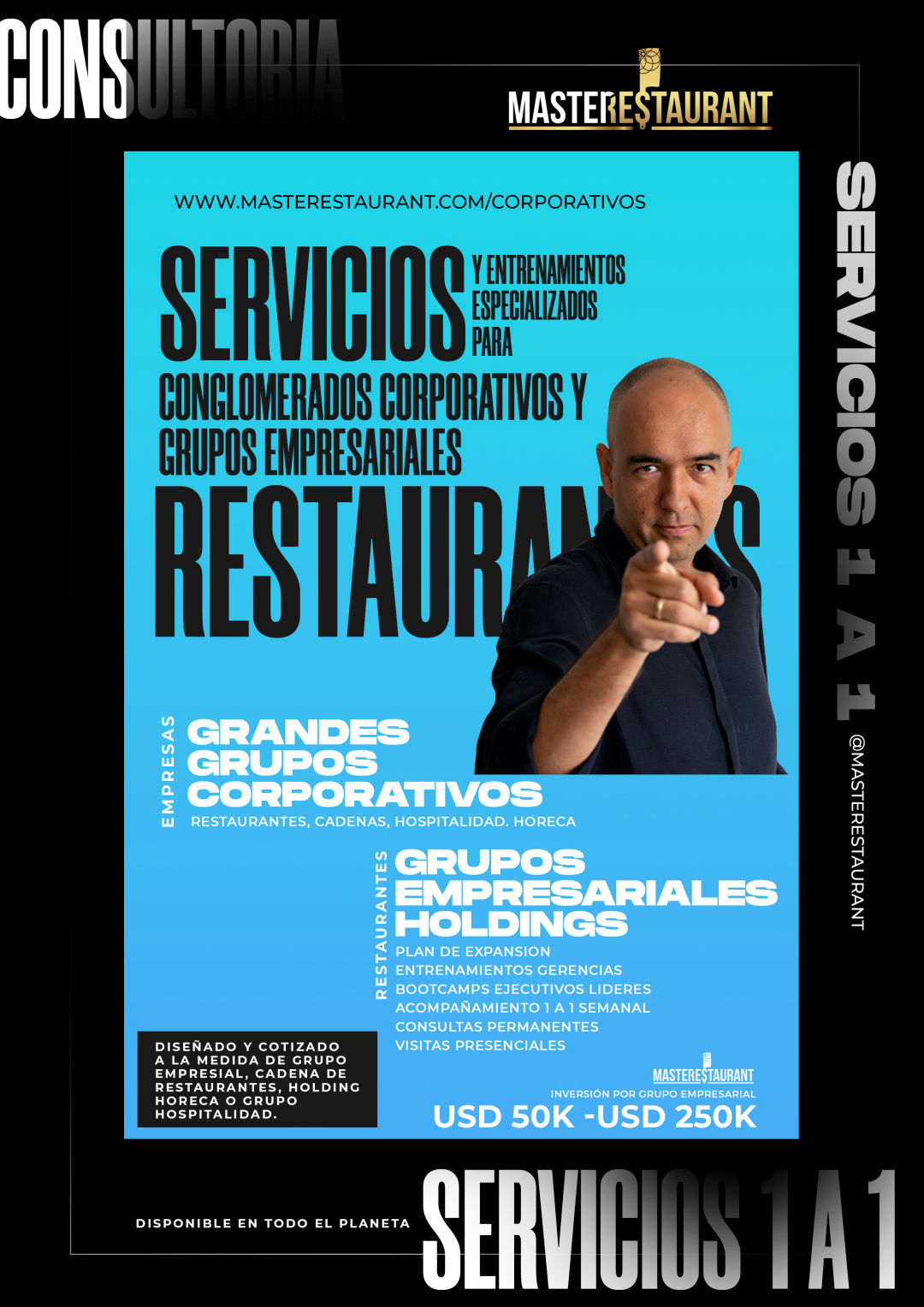
Private programs for groups and family offices
Training, consulting, executive bootcamps and private advisory for restaurant groups, holdings and investor families with themed restaurants.
Starting at USD $50K · tailor made, custom quoted · limited spots worldwide
Published doctrine
The books that changed restaurant management
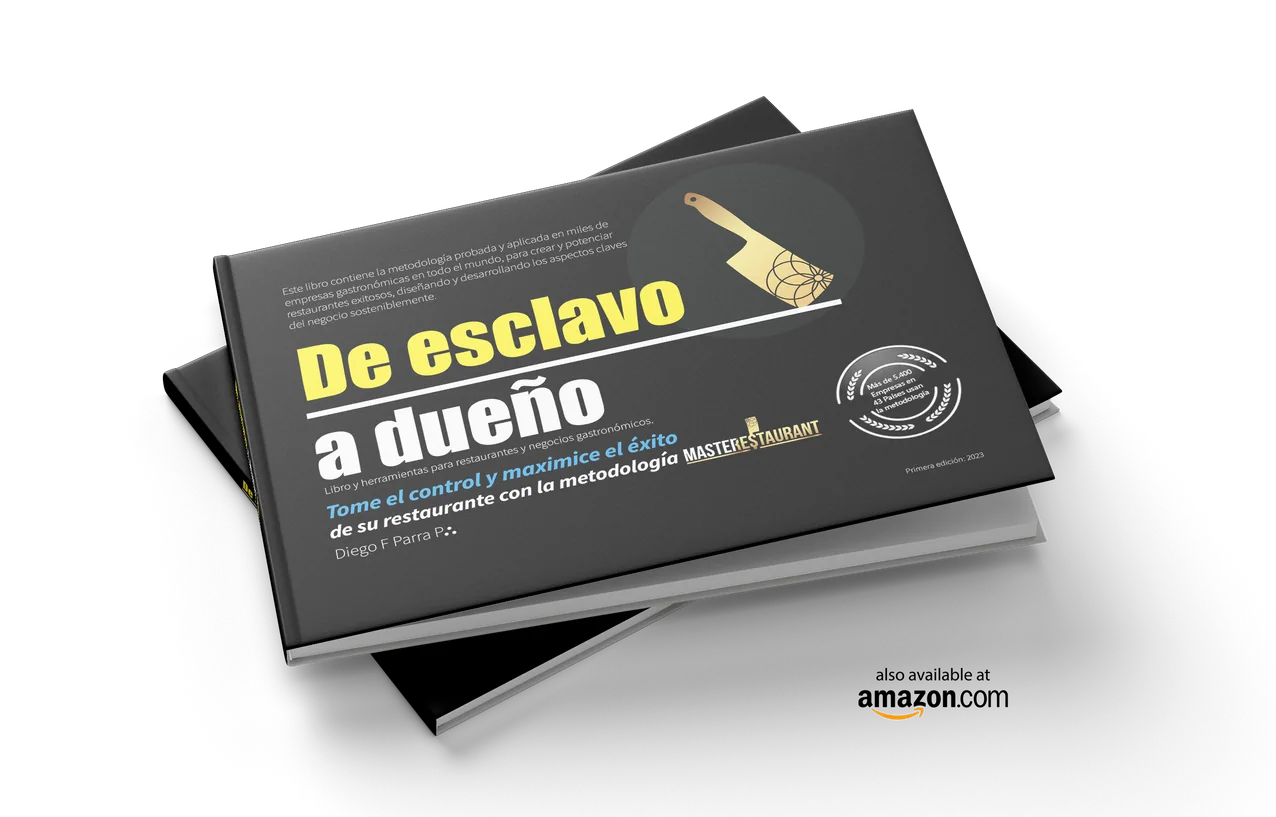
De Esclavo a Dueño
The book that changed how restaurants are managed: practical strategies and tools based on more than 20 years of experience, for traditional restaurants, dark kitchens, foodtech and HORECA businesses.
Triunfar o Morir en el Intento
Practical tools and key strategies to design and operate restaurants and food businesses efficiently.
Podcast: Masterestaurant — Mistakes for Restaurants
The public autopsy of the mistakes that bankrupt restaurants: thousands of owners and managers listen on Spotify to avoid repeating them. Condensed operating doctrine, free and direct.
Listen on SpotifyDownloads
The documents your management will ask for
MASTERESTAURANT® services portfolio
The complete intervention catalog: consulting, training, advisory and specialized services, with scopes and formats. The document to decide with your team.
Download PDFBook: From Slave to Owner
The full doctrine behind the methodology: how to structure a restaurant that runs without depending on the owner. Ideal pre-reading before your project's diagnosis.
View on AmazonPortfolio
More services by Diego F Parra and his team
Beyond themed restaurant consulting, Diego F Parra and his team offer keynotes, mentoring for owners, consulting for groups, training, programs, a membership and an interactive training kit. Everything starts from the same method and the same tools, so once the concept works, the dining-room team can train with that kit, partners can prepare the investment with the Pitch Deck service and the group can take the concept to new sites with the same criteria. The full ecosystem is available:
International keynote speakerOne-on-one consulting and advisoryPersonalized mentoring for owners (limited spots)Corporate groups and holdings consultingCelebrity Restaurants consultingThemed restaurant advisorySpecialized training programs52-Week membershipPitch deck and restaurant investment readinessExponential Program0.1 Program — Elevate Your RestaurantInteractive training kit
Direct contact
Get a quote for themed restaurant consulting for your project in Tokyo
Your message goes straight to Diego's team: concept, project stage, city and what you need to achieve in Tokyo.
“A themed restaurant in Tokyo doesn't succeed because it has the most striking visual style or the most expensive decoration. It succeeds because it has a business model that works; if that model breaks, the theme is just a fixed monthly cost nobody understands.”
Diego F. Parra — International consultant, expert in creating, scaling and improving restaurants, HORECA and hospitality
MASTERESTAURANT® methodology applied by 8,400+ restaurants across 43 countries · Author of 3 ISBN-registered books, including «De esclavo a dueño» · 20+ years operating restaurants, franchises, dark kitchens and HORECA groups across 4 continents
Full profile →Your themed restaurant in Tokyo deserves a model worthy of the concept
Send the concept, its stage and your numbers for a tailored proposal.
Explore more
Themed restaurants: territories, services and ecosystem resources
Useful links for concept founders, restaurant groups, hotels, brands and investors weighing themed restaurant consulting before they decide. They cover nearby territories where the service is published, sister services in the MASTERESTAURANT ecosystem, Diego F Parra's professional profile and the management tools the methodology works with.
World's best restaurant keynote speakerWorld's best restaurant consultantC-Suite restaurant consultant for chains & groupsDiego F Parra — professional profileKeynote speaker serviceCorporate groups & holdings consultingCelebrity restaurant consultingInternational themed restaurant advisoryThemed restaurants across JapanThemed restaurant consultant in JapanThemed restaurant consulting in KawasakiThemed dining expert in KyotoConcept restaurants in OsakaThemed dining expert in Yokohama
FAQ
Frequently asked questions
How long is the consulting process and when do I see measurable business results?
Scope varies. A deep operational audit takes three to four weeks. A complete concept redesign, business model restructuring, and process implementation typically spans four to six months of active engagement. First results—visible margins, stable metrics, oriented teams—emerge by month two or three. Expansions to new locations accelerate because the model already exists; cycles compress. Return in numbers (EBITDA, rotation, average check) becomes measurable once operations stabilize under the new model.
What's the actual difference between simply having nice design and running a profitable experiential restaurant concept?
Nice design is an expense that creates visual appeal. A profitable experiential concept integrates design with a model sustaining margins, a menu that sells, operations without leaks, and clear reasons for repeat visits. Design without model is décor; experience without model is entertainment that doesn't pay. I've watched chains invest millions in ambiance and collapse from ignoring Prime Cost, menu engineering, and standardization.
How is a themed restaurant built from scratch?
With a strategic diagnosis of the project and the concept, and on top of it the business-model design: value proposition, menu, experience, costs and operation. Support through implementation and expansion follows.
What guarantees are there on confidentiality?
Confidentiality agreements from the start. The concept, the brand and the intellectual property are the client's, without exception. Limited spots worldwide are not marketing scarcity: they are the condition for giving each project real time.
How long are we talking about?
A phased process —diagnosis, model, implementation, operation and expansion—whose duration depends on the scope. Building a profitable themed restaurant is not an event with a closing date, it is a system being installed.
What investment range do you work with?
The 1-on-1 consulting runs from USD $35K to USD $250K, priced to the scope of each project and concept. Private programs for groups and chains are quoted independently.
Do you take restaurants that have been open for years?
Yes. In those cases the work enters through profitability and standardization, and ends in the growth plan: new locations or franchise of a concept that has already proven it draws people.
