DIEGO F PARRA · CREATOR OF THE MASTERESTAURANT® METHODOLOGY
THEMED RESTAURANT CONSULTANTWho puts numbers on the experience in a themed restaurant across Nicaragua?
The concept brings people in; the model is what pays. Diego F. Parra works on both at once across Nicaragua: menu engineering, Prime Cost, standardization and a growth plan that doesn't live off novelty.
What a concept restaurant across Nicaragua usually needs first
A themed restaurant sells two things at once, the food and the story, and it almost always fails at the seam: the experience raises production costs, stretches kitchen times and forces a menu no team can run two shifts in a row without food cost climbing past 32%.
Here that gets taken apart piece by piece: menu engineering, Prime Cost, tech sheets and standardization, with the MASTERESTAURANT methodology and its TOOLKIT, applied in 8,400+ restaurants across 43 countries. The concept stays yours; what changes is that it now pays.
How does themed restaurant consulting work in Nicaragua?
The work starts with the model, not the decor: a strategic diagnosis in Nicaragua shows where the project stands and where the money goes, then the business is designed to hold the concept once the novelty passes.
The goal is a concept that can be repeated without losing quality or margin. To get there, the engagement works on concept, brand and storytelling written for the dining room, menu engineering, Prime Cost, standardization you can audit, and processes and teams that run without the owner in the room. Once the model is proven, it sets the order of expansion into new locations, licenses or franchises. The work is confidential and runs on site or virtually, in English or Spanish. As a starting point, this page gathers four verified reference figures from Banco Central de Nicaragua.
What do the numbers say about the market for a themed restaurant in Nicaragua?
85.7% — share of domestic tourism consumption in total tourism consumption, according to Banco Central de Nicaragua. Reference figures describe the setting a concept competes in; they do not say whether a themed experience will still leave a margin after opening.
For a themed restaurant, the data informs one concrete decision: how much can go into ambiance before the model stops working. Other reference points cited on this page: +17.6% (growth in tourism revenue in Nicaragua in 2024, boosting restaurants and hospitality, Banco Central de Nicaragua); 5.4% (share of Tourism Value Added in the economy's total value added, Banco Central de Nicaragua); 6.2% (real growth of the commerce activity, Banco Central de Nicaragua). In Nicaragua, each figure is read alongside average check, menu engineering and Prime Cost before spending on decor, because novelty brings the first visit and margin decides whether there is a second one.
Data
Reference figures for a themed restaurant in Nicaragua
The figures cited on this page, with what each one measures and its source.
Figure
What it measures
Source
85.7%
Share of domestic tourism consumption in total tourism consumption
Banco Central de Nicaragua
+17.6%
Growth in tourism revenue in Nicaragua in 2024, boosting restaurants and hospitality, per the Central Bank of Nicaragua (BCN)
Banco Central de Nicaragua (BCN)
5.4%
Share of Tourism Value Added in the economy's total value added
Banco Central de Nicaragua
6.2%
Real growth of the commerce activity
Banco Central de Nicaragua
Each figure links to its source in the data cards on this page.
The local market
What ground a themed restaurant stands on across Nicaragua
The gap between a themed restaurant that survives and one that fails in 18 months isn't in the décor—it's in the business model. I've audited hundreds of experiential concepts, and the pattern is always the same: money goes into atmosphere and aesthetics, but the real engine is neglected—unit economics, pricing architecture, Prime Cost control, replicability. A themed concept may generate curiosity in month one and crowds in month two, but without a coherent customer journey, clear reasons to return, and operational discipline, it burns itself out: costs spiral, margins disappear, the experience crumbles under an improvised operation. In a market where tourism fluctuates with seasonality and entertainment competition grows fiercer, a themed concept without business foundation is a debt machine, not a profit center.
What this consulting restores is balance. It's not designing beautiful experience—it's designing a *profitable* experience. We start with business model: what economic viability do you sustain, what's your target market, how many covers per month do you need to cover investment and operate at positive EBITDA. From there, we build the themed concept, narrative, and value proposition. We architect the customer journey—why someone enters, what they see, how they feel, what they consume, why they return—with real reasons for visits, not just visuals. Then comes menu engineering: not "what dishes look good in the theme," but what margin each generates, where volume lives, how to control waste, labor, and Prime Cost. We define processes, standards, KPIs. We design a business model that can replicate to other locations, franchise, or license. It's C-Suite consulting for who needs to scale, not just to open.
A themed restaurant faces real risks: themes that stale, experiences misaligned with business model, runaway operating costs, décor that doesn't return ROI, tourism seasonality, growing entertainment competition. What sets this consulting apart is that it's led by someone who has run payroll in restaurants, audited unit economics across three continents, seen what scales and what breaks under pressure—not a designer who believes aesthetics can save a broken model. The MASTERESTAURANT methodology is not theoretical: it comes from 43 countries, working franchises, scaling groups. When an entrepreneur or investor works with Diego, they don't get a plan that looks good on paper—they get the method already proven viable in similar contexts. That dramatically cuts risk: less speculation, more model certainty.
When themed concept aligns with mature business model, the entire project trajectory shifts. The restaurant stops being "the owner's idea" and becomes an administrable business with clear processes, monitorable KPIs, sustainable margins. That enables growth: replicating to another city is feasible because you're not copying décor, you're copying the model. Franchising or selling become real options because the business runs on its own systems, not on whoever's in the kitchen at 11 p.m. For an investor or gastronomic group evaluating opportunity, that means defensible differentiation: not "another beautiful restaurant," but a concept that returns, that scales, that attracts capital. For the founder, it means freedom from operations—the business generates returns while managed from above, not from within.
Market data
The themed restaurant market across Nicaragua in figures
85.7%
Share of domestic tourism consumption in total tourism consumption
In Nicaragua, food entertainment opportunity concentrates in key zones. Managua—Historic Center, Monumental Zone, emerging districts in Altamira and Bolonia—hosts business traffic, professionals, domestic tourism. Pacific beaches—Masachapa, San Juan del Sur, Tola—bring international tourists and vacationers; Granada (colonial city) is a cultural tourism hub. Ometepe attracts nature tourism and retreats. Hotels and resorts in these zones seek to differentiate entertainment and dining. Shopping centers like Metrocentro and Plaza Inter need entertainment and experience anchors. Themed parks and leisure complexes are emerging. Seasonality is sharp—peak December-March (North American and European tourism) and June-August (local holidays)—and that shapes model design: a themed concept must draw in both high season and low season, with different consumption reasons (tourist vs. local). Local culture—indigenous heritage, colonial architecture, jungle landscapes, craftsmanship—offers authentic, differentiable themed narratives. What's not saturated is the themed concept that *works as a business*: there's decoration, there's entertainment, but little that combines memorable experience with viable economics.
An experiential, immersive restaurant faces a market in transition. Opportunity is clear: demand for experiences, tourism grows, locals seek quality entertainment, investors explore new formats. Risks are equally concrete. I've seen themes work 18 months then age: novelty dissolves, experience loses freshness, operating costs—never controlled from day one—eat margins. I see concepts where experience is beautiful but incoherent: menu untethered from theme, staff half-trained, pricey décor unsustainable under daily operation. There's rapid obsolescence: social media trends that last one season. And there's seasonality: a concept packed in December can bleed in May without a local-consumption strategy and return reasons beyond the tourist. What the local diner expects is authentic experience—not generic theme import—with real gastronomy (not just ambiance), attentive service, and sense of paying for something unavailable elsewhere. Miss any element, and the concept collapses.
RESOURCES
MASTERESTAURANT studies, guides & tools
Curated resources for the All Nicaragua restaurant ecosystem: proprietary evidence, comparisons and practical tools:
When an owner hires themed restaurant consulting, what he is really buying is judgment: someone who has already watched the same plan fail three times and knows where it breaks. Diego F Parra has two decades of that material — engineer and C-Suite consultant, restaurants, franchises, dark kitchens and HORECA groups created, rescued and expanded across four continents, with payrolls signed, leases negotiated and expansions closed in operations worth hundreds of millions of dollars.
That judgment is written into the MASTERESTAURANT® methodology, used by 8,400+ restaurants across 43 countries, and into its TOOLKIT: MTIE, Gastronomic Radar, Standard Recipe Generator, Tech Sheets and KPI Dashboard. The goal is not for you to depend on the consultant, but on the system.
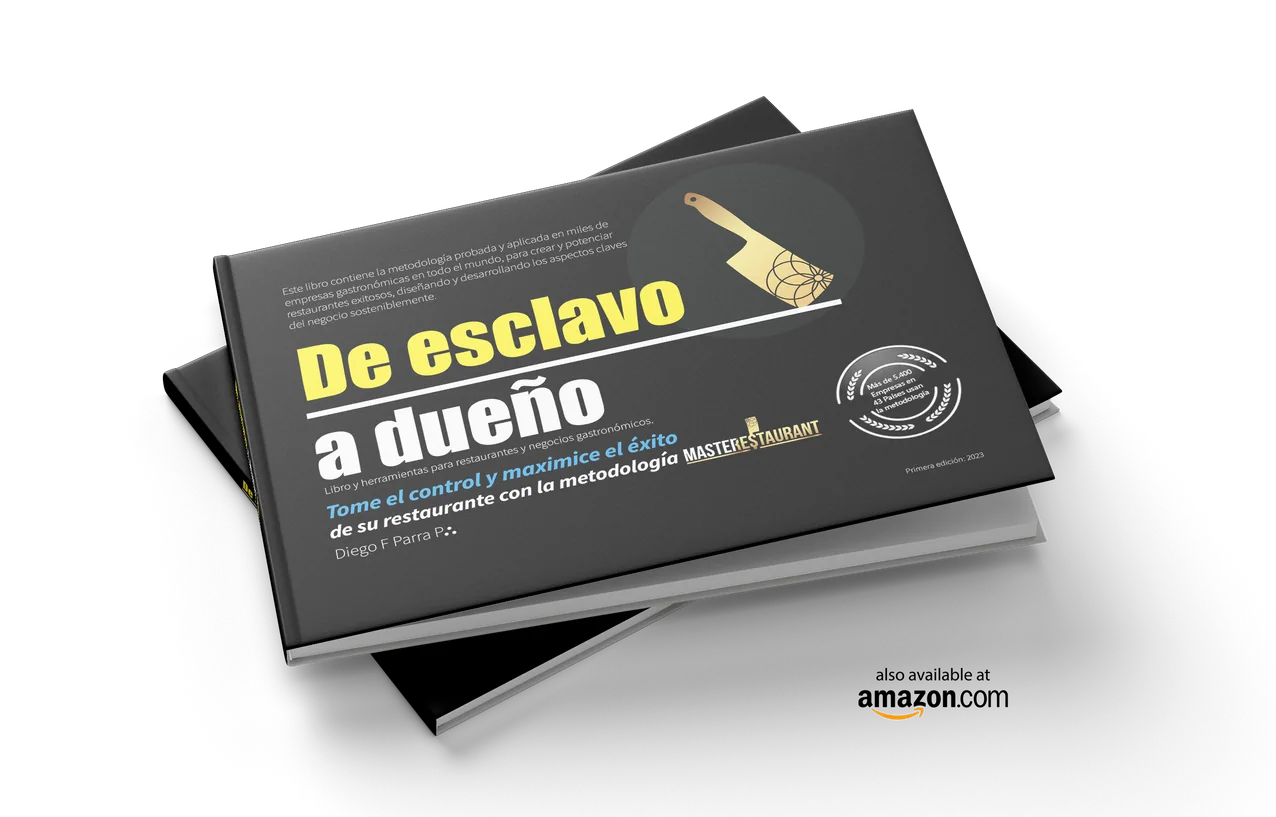
Author of 3 ISBN-registered books, including «De esclavo a dueño», creator of the industry's leading podcast and of the largest bilingual community of owners, chefs and operations directors in the region (65M+ views per year as @masterestaurant), recognized among the top Latino restaurant operations experts globally. More in Diego F Parra's professional profile.
Themed restaurant consulting with its own doctrine, not generic recipes
Themed restaurant consulting is not improvised. Every engagement is built on the Restaurant Model Canvas and real industry data — profitability, Prime Cost, cost structure, customer experience and expansion — applied to the specific business model of a themed restaurant. The goal is not a venue for the opening-night photo, but a food business that protects the concept, generates profit and can scale to new locations, licenses or franchises when the model is ready. That is why the work is organized on four fronts —diagnosis and business model; concept, menu and themed experience; structure, costs and operation; expansion, franchise and new locations— so the concept still holds up when it is no longer new.
Private, made-to-measure support, for whoever is creating and for whoever is correcting:
Entrepreneurs and concept creators
You already have the idea; what is missing is the model that holds it up once the novelty wears off. Concept, brand and numbers on the same plane.
Restaurant groups and chains
Adding a concept to the portfolio without improvising: method to protect the investment, clear rules between partners and financial control from day one.
Hotels and tourism developments
The restaurant stops being a hotel service and becomes a destination, with storytelling, menu and an operation that hold up every day.
Brands, IP and franchises
Taking a brand to the table demands standardization and trained teams; without them, every location tells a different story.
Investors and family offices
Entering hospitality with the learning curve already paid by someone else: a profitable, scalable concept with a methodology behind it.
What's included
The possible content of your engagement
These are the MASTERESTAURANT methodology modules your tailor-made programme is built from:
Business model that turns concept into sustainable profitability
Strategic diagnosis of the project and the personal brand
Concept, brand architecture and themed restaurant storytelling
Menu engineering and an experience customers pay to repeat
Cost structure and Prime Cost: profitability protected by design
Operational improvement and profitable standardization
The 10 key elements of the Restaurant Canvas, optimized
Processes, teams and leadership that run without the founder
Expansion strategy: new locations, licenses and franchises
Partner and investor management to scale without diluting the brand
Executive bootcamps and training for the management team
1-on-1 advisory, ongoing consultations and on-site visits
Opening readiness that protects the concept's reputation
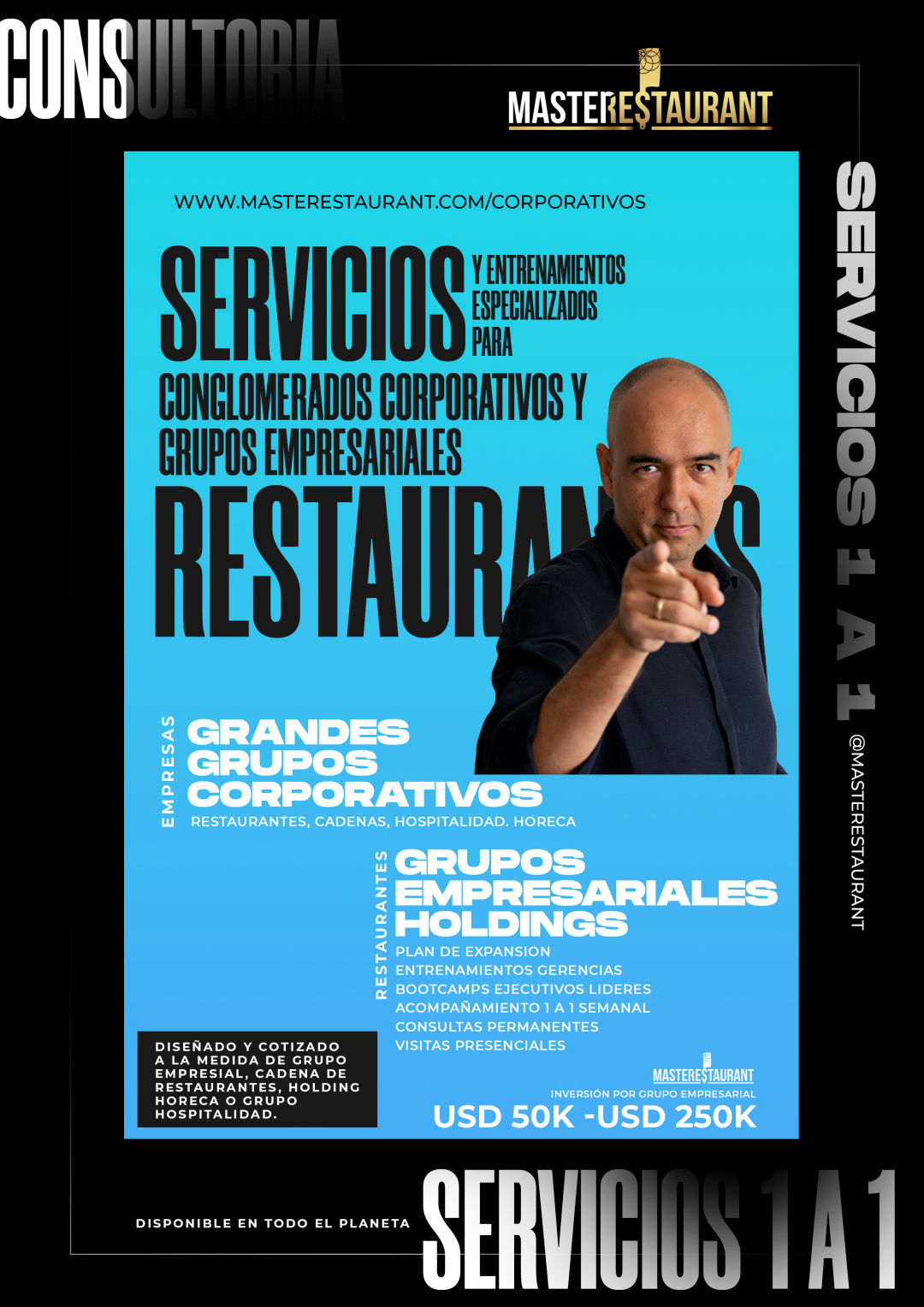
Investment: USD $35K – $250K · tailor-made, priced to each company · spots LIMITED worldwide to guarantee the best service.
Themed packages
Tailor-made themed restaurant consulting packages
Every themed restaurant engagement is 100% personalized and tailor-made to the project and the brand. After a strategic diagnosis, it works through the 10 key elements of the business model in the MASTERESTAURANT Restaurant Canvas — from value proposition and concept to profitability, standardization and expansion. Depending on the case, the package adds menu engineering, Prime Cost and cost structure, partner and investor management, executive bootcamps for the management team, ongoing consultations with visits to the venue and opening readiness. The quote starts from the concept, where the project stands and the numbers already on the table. Priced to each project's scope (USD $35K – $250K), with limited spots worldwide to ensure dedicated attention and discretion for each client.
Diego F Parra is an engineer and C-Suite consultant, creator of the MASTERESTAURANT® methodology —applied by 8,400+ restaurants across 43 countries— and author of 3 ISBN-registered books.
He is the consultant that brands and concepts, athletes, artists and investors choose to turn their brand into a profitable, standardized themed restaurant ready to expand. He has spent two decades creating, rescuing and expanding restaurants, franchises, dark kitchens and HORECA groups across four continents, and he works with his own tools: MTIE, Gastronomic Radar and KPI Dashboard. For a themed restaurant, that means the concept is designed as a system —tech sheets, costing, processes and KPIs— so it can be repeated in new locations, licenses or franchises without being diluted.
The book that changed how restaurants are managed: practical strategies and tools based on more than 20 years of experience, for traditional restaurants, dark kitchens, foodtech and HORECA businesses.
Triunfar o Morir en el Intento
Practical tools and key strategies to design and operate restaurants and food businesses efficiently.
Podcast: Masterestaurant — Mistakes for Restaurants
The public autopsy of the mistakes that bankrupt restaurants: thousands of owners and managers listen on Spotify to avoid repeating them. Condensed operating doctrine, free and direct.
The complete intervention catalog: consulting, training, advisory and specialized services, with scopes and formats. The document to decide with your team.
The full doctrine behind the methodology: how to structure a restaurant that runs without depending on the owner. Ideal pre-reading before your project's diagnosis.
Beyond themed restaurant consulting, Diego F Parra and his team offer keynotes, mentoring for owners, consulting for groups, training, programs, a membership and an interactive training kit. Everything starts from the same method and the same tools, so once the concept works, the dining-room team can train with that kit, partners can prepare the investment with the Pitch Deck service and the group can take the concept to new sites with the same criteria. The full ecosystem is available:
Get a quote for themed restaurant consulting for your project across Nicaragua
Your message goes straight to Diego's team: concept, project stage, city and what you need to achieve across Nicaragua.
“I've spent decades auditing experiential concepts, and the truth is uncomfortable: theme doesn't sell—the business model behind it does. The most expensive décor in the world doesn't compensate for runaway Prime Cost, margins that don't close, or operations that collapse when you scale. A themed restaurant wins when experience and profitability evolve together, never when one is sacrificed for the other.”
Diego F. Parra — International consultant, expert in creating, scaling and improving restaurants, HORECA and hospitality
MASTERESTAURANT® methodology applied by 8,400+ restaurants across 43 countries · Author of 3 ISBN-registered books, including «De esclavo a dueño» · 20+ years operating restaurants, franchises, dark kitchens and HORECA groups across 4 continents
Themed restaurants: territories, services and ecosystem resources
Useful links for concept founders, restaurant groups, hotels, brands and investors weighing themed restaurant consulting before they decide. They cover nearby territories where the service is published, sister services in the MASTERESTAURANT ecosystem, Diego F Parra's professional profile and the management tools the methodology works with.
How do you guarantee the themed concept we design will have real repeat business and isn't just a tourist curiosity that fades after 3 months?
Repeat business doesn't come from décor—it comes from consumption reasons the customer returns to seek. In customer journey design, we map those reasons: unique experience, gastronomy worth the price, ambiance that invites celebration (birthdays, anniversaries, business milestones), memorable service. Menu engineering ensures there's something each visit that justifies the check. Standardized operations guarantee consistency—it's not "I ate well because the chef was in a good mood," it's "I ate well because that's the standard." For tourists, we design an Instagrammable concept, yes—but also memorable. For locals, we design periodic reasons: that's the volume that sustains margins in low season. Without repeat-visit reasons coded into the model, the theme collapses.
Is it viable to expand a successful themed restaurant to other cities or other countries, or is each concept unique and unreplicable?
If the first project was built as a *business* (not a decorative experiment), it's fully replicable. We document the model: minimum investment, where EBITDA lives, staffing and training, KPIs that ensure healthy operations. The theme adapts to local context (Granada dresses differently than Managua), but the engine—business model, customer journey, menu engineering, operations—is transportable. We've seen it work: franchises that perform, groups opening locations with same viability, even concept export to other countries. That's what tailor-made design means: unique in local context, replicable in structure. One location isn't a limited business—it's a prototype that scales if the model is sound.
How does the tailor-made 1-on-1 consulting for themed restaurants work?
It starts with a strategic diagnosis of the project and the concept. Based on it, the themed restaurant's business model is designed —concept, value proposition, menu, experience, costs and operation—and implementation and expansion are supported.
Is the confidentiality of the concept and intellectual property protected?
Yes. The whole process operates under confidentiality agreements (NDA). The concept, brand and intellectual property of the project are and remain the client's. Limited spots worldwide exist to guarantee dedication and focus on each project.
How long does it take and what are the phases?
It depends on scope: diagnosis, business-model design, implementation and support during operation and expansion. Building a profitable themed restaurant is a process with method, not an event.
What is the investment?
The 1-on-1 consulting ranges from USD $35K to USD $250K and is priced to the scope of each project and concept. Private programs for restaurant groups and chains are quoted separately.
Do you serve new projects and themed restaurants already operating?
Both: creation from scratch —concept, business model and opening—and growth of existing themed restaurants seeking to improve profitability, standardize operations and scale the concept to new locations or franchise.
Community
Join our MASTERESTAURANT Community for FREE
Restaurant owners and teams from 43 countries sharing knowledge, tools and applied AI — straight to your WhatsApp.
 MASTERESTAURANT®