DIEGO F PARRA · CREATOR OF THE MASTERESTAURANT® METHODOLOGY
IMMERSIVE DINING CONSULTANTWho do owners in Johannesburg call when the themed restaurant fills up and still makes no money?
A themed restaurant in Johannesburg usually sinks for the same reason the last one did: the money went into ambiance before anyone checked that the model worked. Diego F. Parra reverses that order.
What a concept restaurant in Johannesburg usually needs first
A themed restaurant sells two things at once, the food and the story, and it almost always fails at the seam: the experience raises production costs, stretches kitchen times and forces a menu no team can run two shifts in a row without food cost climbing past 32%.
Here that gets taken apart piece by piece: menu engineering, Prime Cost, tech sheets and standardization, with the MASTERESTAURANT methodology and its TOOLKIT, applied in 8,400+ restaurants across 43 countries. The concept stays yours; what changes is that it now pays.
How does themed restaurant consulting work in Johannesburg?
It reverses the usual order: first it checks that the concept's business model works in Johannesburg, then money goes into ambiance. The work starts with a strategic diagnosis and ends with a system built to repeat the experience.
Using the MASTERESTAURANT Restaurant Canvas, the concept and its business model are designed together. That covers value proposition, consumption moment, concept storytelling, menu engineering (which dish stays, which goes up in price and which comes off) and Prime Cost protected from the menu design onwards. Then the concept becomes a system: tech sheets, costing, processes, KPIs and an expansion plan for new locations, licenses or franchises. It serves new projects and themed restaurants already open, under confidentiality agreements, on site or virtually, in English or Spanish. As a starting point, this page gathers four verified reference figures from Stats SA.
What do the numbers say about the market for a themed restaurant in Johannesburg?
10.5 million — international tourists received in the year, surpassing the pre-pandemic level, according to Stats SA. Reference figures describe the setting a concept competes in; they do not say whether a themed experience will still leave a margin after opening.
For a themed restaurant, the data informs one concrete decision: how much can go into ambiance before the model stops working. Other reference points cited on this page: 75.2% (share of tourists coming from SADC countries, Stats SA); 5.7% (tourism share of total national employment, Stats SA); +17.7% (growth in international tourist arrivals versus 2024, Stats SA). In Johannesburg, each figure is read alongside average check, menu engineering and Prime Cost before spending on decor, because novelty brings the first visit and margin decides whether there is a second one.
Data
Reference figures for a themed restaurant in Johannesburg
The figures cited on this page, with what each one measures and its source.
Figure
What it measures
Source
10.5 million
International tourists received in the year, surpassing the pre-pandemic level
Stats SA
75.2%
Share of tourists coming from SADC countries
Stats SA
5.7%
Tourism share of total national employment
Stats SA
+17.7%
Growth in international tourist arrivals versus 2024
Stats SA
Each figure links to its source in the data cards on this page.
The local market
The themed restaurant market in Johannesburg: the context your project must master
Themed and immersive restaurants attract audiences with rich storytelling and captivating environments, yet spectacular decoration rarely sustains profitable operations. In competitive markets like Johannesburg, many entrepreneurs discover too late that investment in architecture and theming does not translate into consistent operating margins, repeat customer visits, or scalable financial models. The fundamental mistake: confusing memorable experience with efficient gastronomy business. An experiential restaurant requires equal rigor in menu engineering, prime cost management, cost structure, and operational standardization as in concept and design. Specialized consulting in themed restaurants addresses this gap precisely: it transforms an engaging idea into a business system where each element—value proposition, customer journey, consumption triggers, physical design, operations, and financial model—works harmoniously to create sustainable profitability, not just visual impact.
This consulting service delivers the MASTERESTAURANT methodology applied specifically to experiential concepts in Johannesburg. It begins with strategic diagnosis: validation of genuine differentiation, clear customer segmentation, quantification of local market opportunity. It continues with complete business model design using the Restaurant Model Canvas: revenue structures, prime cost and EBITDA management, operational ratios, conservative financial scenarios. It integrates menu engineering and experience design: how each dish, each customer journey moment, each physical zone—lighting, sound, customer flow, dwell time—contributes to profitability and repeat visits. It defines processes, standardization, key performance indicators, operational structure, and leadership. Environment and experience are designed from operational rigor, not decoration for decoration's sake. The result is an immersive restaurant that operates as a manageable, scalable, and investable business—credible for new locations, licenses, or franchise models.
Diego F. Parra is an international consultant 100% specialized in restaurants and hospitality with 25+ years of trajectory. He designed and leads the MASTERESTAURANT methodology, applied by over 8,400 restaurants and gastronomic groups across 43 countries. He is a top-5 Amazon author (MASTERESTAURANT series), accumulates over 65 million annual community views, and regularly consults C-Suite executives and gastronomic family offices. He has directed transformations of themed restaurants in competitive markets (Europe, Asia, Latin America) where the difference between success and closure within 18-24 months lay in business model, not theme. This international depth and this consulting-for-operators-not-decorators approach positions your Johannesburg project in a significantly higher percentile of preparation and rigor. Operational risk decreases when every decision on concept, environment, menu, and operations integrates into a validated financial plan and a model proven in similar contexts.
This engagement delivers measurable value: robust competitive differentiation (coherent concept that does not age quickly, clear value proposition for each segment), customer experience designed for repeat visits (consumption reasons and moments identified, optimized customer journey, projected average ticket and frequency), operational control (standard processes, real indicators, predictable margins). Your business gains capacity to grow: new locations replicate the validated model, licenses or franchises have reliable operational manuals, the brand holds value independent of the founder. Enterprise value increases because profitability is demonstrable and operations do not depend on one person's charisma. Investors, banks, and potential partners see a solid business, not an experiment. Themed experience and profitability evolve together, transforming the immersive restaurant into a long-term asset.
Market data
Food service market data for Johannesburg
10.5 million
International tourists received in the year, surpassing the pre-pandemic level
Johannesburg is southern Africa's largest economic and gastronomic center, with an entertainment and hospitality scene in continuous growth. Districts such as Maboneng (urban renewal, entertainment, startups), Sandton (high-end, corporate), Bryanston, and Cresta (affluent residential) concentrate foot traffic, gastronomic consumption, and appetite for differentiated experiences. Tourism is a significant factor: the city attracts international visitors drawn by Madiba heritage, shopping, business, and leisure; regional domestic tourism is strong (Gauteng and neighboring provinces). Hotels, boutique resorts, premium shopping centers, and entertainment complexes (cinemas, nightlife, convention centers) generate sustained demand. Local culture—history, art, music, reimagined traditional cuisine—offers rich foundation for authentic, differentiable experiential concepts. A well-executed experiential restaurant in these districts or high-traffic tourist areas has sustained exposure and customers with the purchasing power for premium experiences.
Experiential and immersive restaurants succeed in Johannesburg when they reflect cultural authenticity (not generic imitation), when local customers and tourists find clear consumption reasons (event, celebration, socialization, brand experience), and when operations sustain consistent quality. The primary risk: themes that age quickly (pop concepts that lose relevance within 12-24 months), incoherent experiences (spectacular decoration with poor service or misaligned menus), excessive operating costs from architectural ambition without sufficient margins, or offerings targeted at the wrong segment. Local diners expect value: memorable experience + quality gastronomy + impeccable service + coherent environment, not payment for inefficient decoration. Themed restaurants that fail typically do so through: broken financial models (high fixed costs without sustained volume), concepts lacking real differentiation or clear target audience, unstable operations (staff untrained in the experience, ad hoc processes), or inflated expectations on ticket price and repeat visits. Success requires operational rigor equal to design.
RESOURCES
MASTERESTAURANT studies, guides & tools
Support material to raise operations in Johannesburg — MASTERESTAURANT research, real cases and tools:
The judgment behind this themed restaurant consulting
Diego F Parra is an engineer and C-Suite consultant, and his trade for the last twenty years has been walking into restaurants, franchises, dark kitchens and HORECA groups across four continents to create them, rescue them or expand them. Along the way he signed payrolls, negotiated leases, structured partnerships and closed expansions in operations worth hundreds of millions of dollars.
The MASTERESTAURANT® methodology came out of that, and is used today by 8,400+ restaurants across 43 countries, with its TOOLKIT: MTIE, Gastronomic Radar, Standard Recipe Generator, Tech Sheets and KPI Dashboard. For an owner that means every decision is made on his own numbers and on tested processes, not on a hunch from the last good weekend.
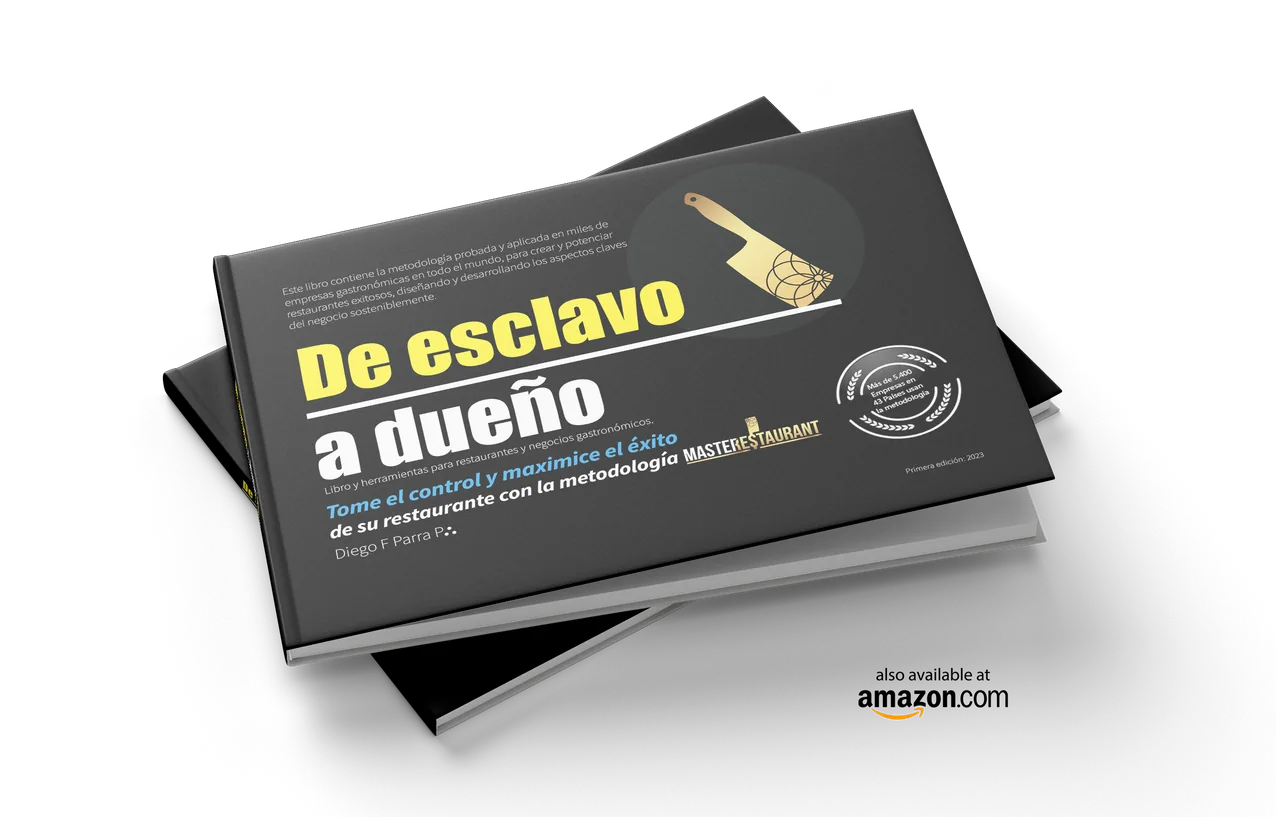
His published work backs it: Author of 3 ISBN-registered books, including «De esclavo a dueño», creator of the industry's leading podcast and of the largest bilingual community of owners, chefs and operations directors in the region (65M+ views per year as @masterestaurant), recognized among the top Latino restaurant operations experts globally. See Diego F Parra's professional profile.
Themed restaurant consulting with its own doctrine, not generic recipes
Themed restaurant consulting is not improvised. Every engagement is built on the Restaurant Model Canvas and real industry data — profitability, Prime Cost, cost structure, customer experience and expansion — applied to the specific business model of a themed restaurant. The goal is not a venue for the opening-night photo, but a food business that protects the concept, generates profit and can scale to new locations, licenses or franchises when the model is ready. That is why the work is organized on four fronts —diagnosis and business model; concept, menu and themed experience; structure, costs and operation; expansion, franchise and new locations— so the concept still holds up when it is no longer new.
Advisory that covers the full themed restaurant lifecycle
Where the project stands and which model holds
Diagnosis of the project and model design with the Restaurant Canvas: value proposition, consumption moment and the structure that decides whether there is a margin.
Tailor-made 1-on-1 support, for new projects and for operations already running:
Entrepreneurs and concept creators
Idea, brand and business model worked together, so the restaurant lives off what it sells and not off the noise of the opening.
Restaurant groups and chains
For portfolios that grow: a structured concept, investment protected by method and financial control from the start.
Hotels and tourism developments
So the hotel restaurant stops depending on the captive guest and starts bringing people in from outside.
Brands, IP and franchises
To replicate the concept without it degrading: standardization, processes and teams trained location by location.
Investors and family offices
To invest in hospitality with judgment: a profitable, scalable concept, with method and numbers on the table.
What's included
The possible content of your engagement
No two engagements are alike: they are assembled from these MASTERESTAURANT methodology modules:
Business model with numbers, not just with concept
Strategic diagnosis of the project, the brand and the stage
Concept, brand and story of the themed restaurant
Menu engineering and an experience that justifies the ticket
Prime Cost and cost structure decided at design stage
Operational improvements and standardization that hold the margin
The 10 key elements of the Restaurant Canvas
Processes, teams and leadership with the founder out of daily operations
Expansion strategy: locations, licenses and franchise
Partner and investor management to grow without diluting the brand
Executive bootcamps and training for the leadership team
1-on-1 advisory, ongoing consultations and on-site visits
Opening readiness that protects the concept's reputation
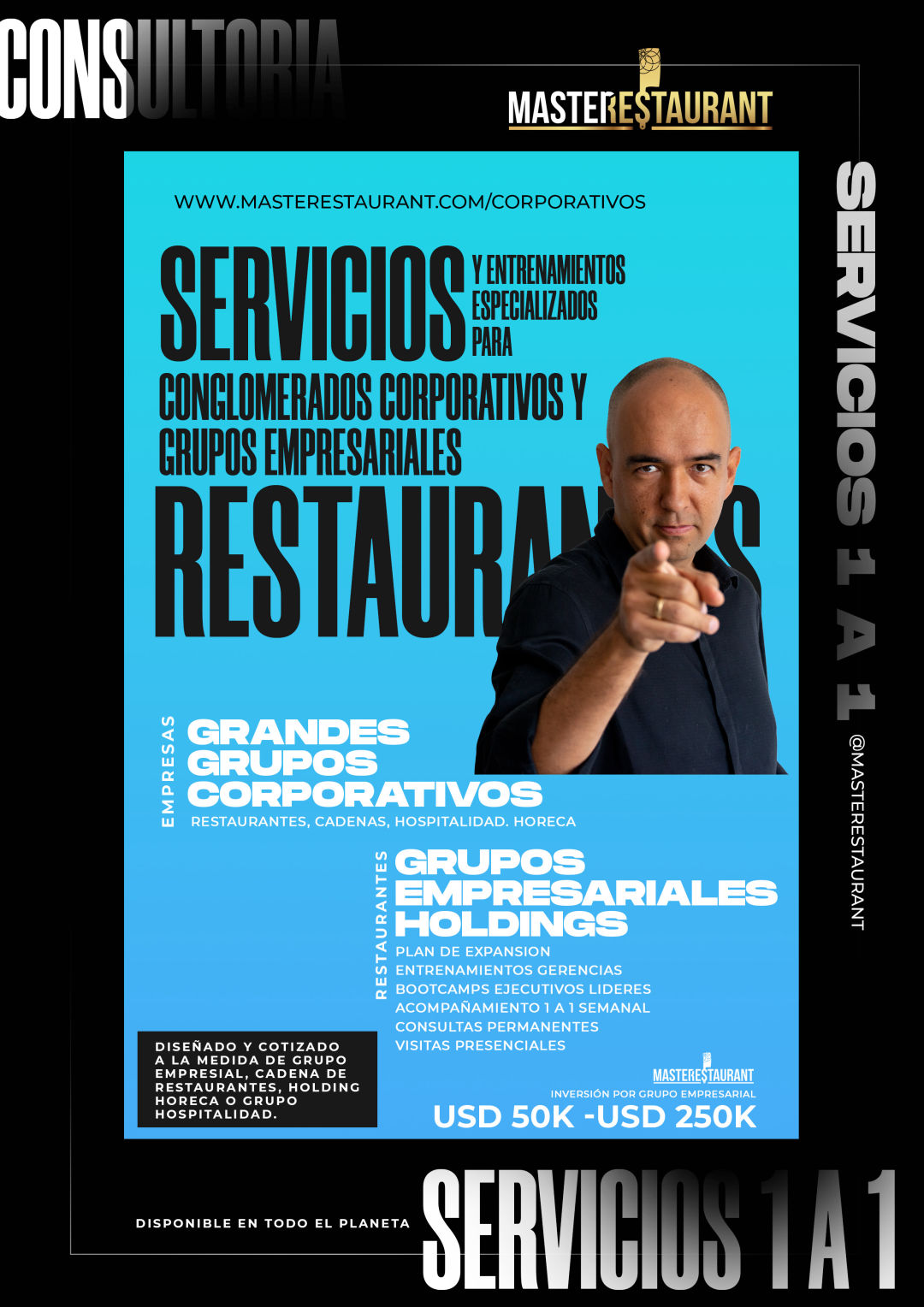
Investment: USD $35K – $250K · tailor-made, priced to each company · spots LIMITED worldwide to guarantee the best service.
Themed packages
Tailor-made themed restaurant consulting packages
Every themed restaurant engagement is 100% personalized and tailor-made to the project and the brand. After a strategic diagnosis, it works through the 10 key elements of the business model in the MASTERESTAURANT Restaurant Canvas — from value proposition and concept to profitability, standardization and expansion. Depending on the case, the package adds menu engineering, Prime Cost and cost structure, partner and investor management, executive bootcamps for the management team, ongoing consultations with visits to the venue and opening readiness. The quote starts from the concept, where the project stands and the numbers already on the table. Priced to each project's scope (USD $35K – $250K), with limited spots worldwide to ensure dedicated attention and discretion for each client.
Diego F Parra is an engineer and C-Suite consultant, creator of the MASTERESTAURANT® methodology —applied by 8,400+ restaurants across 43 countries— and author of 3 ISBN-registered books.
He is the consultant that brands and concepts, athletes, artists and investors choose to turn their brand into a profitable, standardized themed restaurant ready to expand. He has spent two decades creating, rescuing and expanding restaurants, franchises, dark kitchens and HORECA groups across four continents, and he works with his own tools: MTIE, Gastronomic Radar and KPI Dashboard. For a themed restaurant, that means the concept is designed as a system —tech sheets, costing, processes and KPIs— so it can be repeated in new locations, licenses or franchises without being diluted.
The book that changed how restaurants are managed: practical strategies and tools based on more than 20 years of experience, for traditional restaurants, dark kitchens, foodtech and HORECA businesses.
Triunfar o Morir en el Intento
Practical tools and key strategies to design and operate restaurants and food businesses efficiently.
Podcast: Masterestaurant — Mistakes for Restaurants
The public autopsy of the mistakes that bankrupt restaurants: thousands of owners and managers listen on Spotify to avoid repeating them. Condensed operating doctrine, free and direct.
The complete intervention catalog: consulting, training, advisory and specialized services, with scopes and formats. The document to decide with your team.
The full doctrine behind the methodology: how to structure a restaurant that runs without depending on the owner. Ideal pre-reading before your project's diagnosis.
Beyond themed restaurant consulting, Diego F Parra and his team offer keynotes, mentoring for owners, consulting for groups, training, programs, a membership and an interactive training kit. Everything starts from the same method and the same tools, so once the concept works, the dining-room team can train with that kit, partners can prepare the investment with the Pitch Deck service and the group can take the concept to new sites with the same criteria. The full ecosystem is available:
Get a quote for themed restaurant consulting for your project in Johannesburg
Your message goes straight to Diego's team: concept, project stage, city and what you need to achieve in Johannesburg.
“A themed restaurant succeeds when the business model sustains the experience, not when spectacular decoration masks fragile operations. I've watched millions disappear because the theme was captivating but the margins were fiction. The experiential concept must be profitable from day one.”
Diego F. Parra — International consultant, expert in creating, scaling and improving restaurants, HORECA and hospitality
MASTERESTAURANT® methodology applied by 8,400+ restaurants across 43 countries · Author of 3 ISBN-registered books, including «De esclavo a dueño» · 20+ years operating restaurants, franchises, dark kitchens and HORECA groups across 4 continents
Themed restaurants: territories, services and ecosystem resources
Useful links for concept founders, restaurant groups, hotels, brands and investors weighing themed restaurant consulting before they decide. They cover nearby territories where the service is published, sister services in the MASTERESTAURANT ecosystem, Diego F Parra's professional profile and the management tools the methodology works with.
How do I know if my themed restaurant concept will generate real repeat visits and not just be a passing trend?
Repeat visits come from designing the customer journey around clear consumption reasons and moments, not decoration. We validate your concept against specific local segments, define what attracts diners, show how your experience restaurant differentiates in the market, and model ticket size, frequency, and annual revenue based on realistic occupancy. We integrate experience (menu, environment, service) so each visit delivers consistent value. An immersive restaurant with solid business model, standardized operations, and clear value proposition becomes a destination, not a fad.
How scalable is an experiential and immersive model? Can I expand to new locations or develop a franchise system?
Yes, if the model is properly documented and proven. An experiential concept scales when you have: clear value proposition (what it is, why it exists, for whom), standard operations (processes, training, metrics), recognizable brand (customers know what to expect), and replicable financial model (controllable margins, predictable costs). We document your concept in a rigorous operations manual, train teams for new locations, validate that financial model holds, and design corporate governance structure for multi-unit growth. An experiential restaurant with this level of rigor generates sustainable brand value.
How is this different from a branding agency?
Here the concept is designed together with the numbers. After the strategic diagnosis the full business model is built —value proposition, menu, experience, costs and operation—and supported through implementation and expansion.
Who keeps the intellectual property?
The client, always. The whole process is signed under NDA and neither the concept nor the brand nor the developments leave their ownership. Limited spots worldwide guarantee focus on each project.
How is the process structured?
In four linked phases: diagnosis, business-model design, implementation and support during operation and expansion. Scope defines duration, and method defines that the result does not depend on inspiration.
What is the fee range?
Between USD $35K and USD $250K for the 1-on-1 work, priced to the scope of the project and the concept. Private programs for restaurant groups and chains are quoted separately.
And if the restaurant exists and makes no margin?
That is precisely one of the entry scenarios. Costs and menu are reviewed, the operation standardized, and then it is decided whether the concept is ready to scale to new locations or to franchise.
Community
Join our MASTERESTAURANT Community for FREE
Restaurant owners and teams from 43 countries sharing knowledge, tools and applied AI — straight to your WhatsApp.
 MASTERESTAURANT®